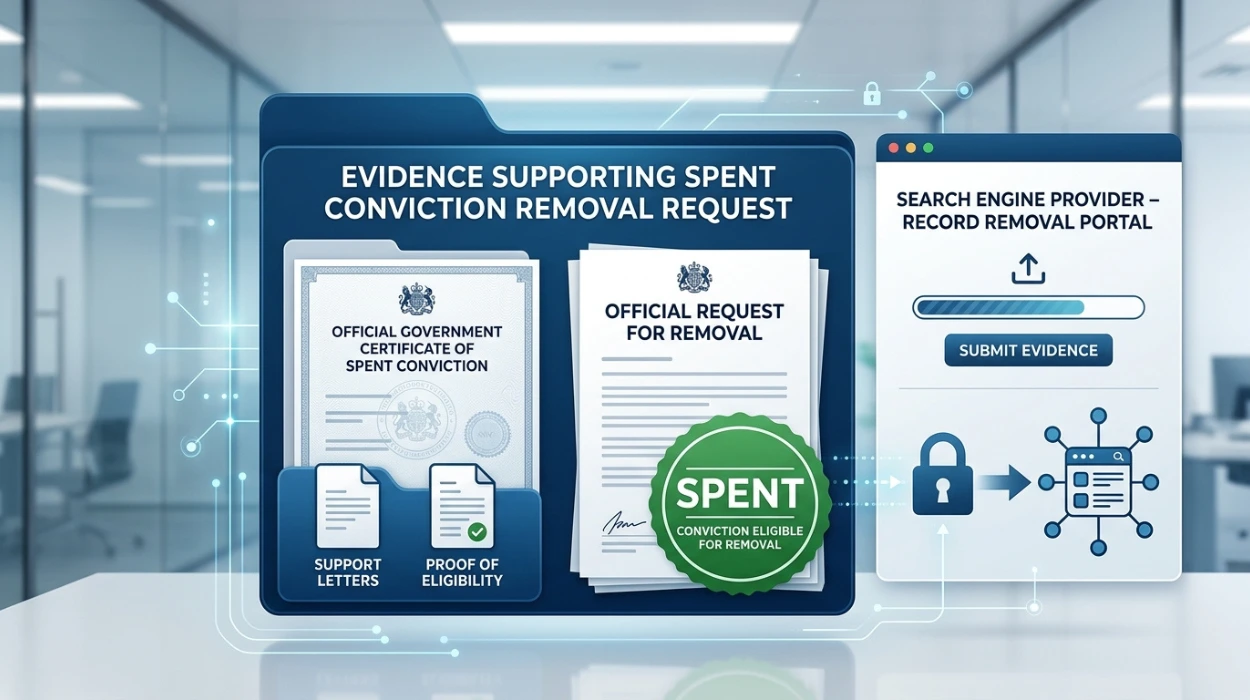
Evidence supporting a spent conviction removal request sent to Google focuses on legal status, relevance, public interest, and the continuing impact of indexed information on search visibility. Search engines evaluate documentation, contextual accuracy, and entity relevance when assessing whether conviction-related content remains justified within search results.
Reputation management strategies differ based on how information influences search perception, entity credibility, and reputation signals across digital ecosystems. Google spent conviction removal requests are evaluated through their impact on search ranking influence, content visibility, sentiment distribution, and long-term SERP composition.
What Types of Evidence Are Evaluated in a Spent Conviction Removal Request?
Legal documentation forms the primary evidence category evaluated in a spent conviction removal request. Evidence establishes whether the conviction has reached spent status under the Rehabilitation of Offenders Act and whether the information retains ongoing relevance within search ecosystems.
A spent conviction is a conviction that has completed its legally defined rehabilitation period. Search engines evaluate supporting records that demonstrate this status because legal classification influences the interpretation of public interest and relevance. Documentation typically serves as the foundation for assessing whether continued visibility aligns with current informational value.
Content-related evidence forms a second evaluation layer. Search systems analyse publication dates, contextual accuracy, and the relationship between historical information and present search intent. This evaluation process measures whether conviction-related content continues contributing meaningful information to users.
Search visibility is affected when evidence demonstrates a mismatch between historical information prominence and current relevance. The stronger the supporting documentation, the more clearly evaluators can analyse the relationship between indexed content and contemporary search expectations.
How Does Legal Status Compare With Content Relevance During Evaluation?
Legal status and content relevance operate as separate evaluation frameworks that intersect during reputation assessments. Legal classification defines the conviction’s rehabilitation position, while content relevance determines whether search visibility continues serving informational value.
A spent conviction establishes a formal legal status. This status changes disclosure expectations within specific contexts and influences how historical information is interpreted. Search systems do not automatically remove content based solely on rehabilitation status because indexing and ranking mechanisms function independently from legal classification.
Content relevance operates by evaluating whether information remains useful to users. Search engines analyse query intent, publication authority, and contextual significance when determining relevance. A page can remain highly relevant despite age if the information continues satisfying user expectations.
The comparison between legal status and relevance highlights a key reputation management principle. Legal rehabilitation affects informational context, whereas search visibility depends on retrieval and ranking frameworks. Effective evaluation therefore analyses both dimensions simultaneously rather than treating either factor as independently decisive.
How Does Search Engine Evaluation Differ From Legal Evaluation?
Search engine evaluation focuses on information retrieval, whereas legal evaluation focuses on rights, obligations, and statutory interpretation. These distinct systems often analyse the same information using different criteria.
Legal evaluation measures compliance with legislation and determines whether a conviction qualifies as spent. This process relies on statutory definitions and documented timelines. The outcome establishes a legal status that influences how information is understood within regulated environments.
Search engine evaluation operates through relevance assessment, indexing mechanisms, and ranking algorithms. Search systems measure informational value, source authority, and user benefit rather than legal rehabilitation outcomes. Content remains visible when it satisfies ranking criteria and aligns with search intent.
The distinction affects reputation signals because legal rehabilitation does not automatically alter search visibility. Search ecosystems prioritise retrieval accuracy, while legal systems prioritise rights and obligations. Understanding this difference explains why spent conviction information can remain discoverable despite a changed legal status.
Which Evidence Carries Greater Weight: Accuracy or Relevance?

Accuracy and relevance represent complementary evaluation factors rather than competing standards. Search ecosystems analyse both when assessing conviction-related content.
Accuracy refers to factual correctness. Information remains accurate when it reflects verifiable events and publication records. Search engines treat accuracy as a foundational trust signal because reliable information contributes to content quality assessments.
Relevance refers to informational value within current search contexts. Relevance changes over time because search intent, societal expectations, and legal circumstances evolve. Information that remains accurate does not automatically remain relevant.
The comparison demonstrates an important reputation principle. Accuracy validates content integrity, while relevance determines ongoing visibility value. Evaluation frameworks therefore analyse whether accurate information continues serving legitimate informational purposes within contemporary search environments.
How Do Reputation Signals Influence Evaluation Outcomes?
Reputation signals influence evaluation by helping search systems interpret entity credibility, authority, and informational significance. These signals contribute to broader assessments of visibility and perception.
Reputation signals are indicators that shape how entities are interpreted across search ecosystems. Indexed content, publication references, authority associations, and sentiment distribution all contribute to these signals. Conviction-related information becomes one element within a wider reputation framework.
Search engines analyse relationships between content sources and entities. Repeated references strengthen associations, increasing the likelihood that certain topics become prominent within search results. This mechanism affects search ranking influence because visibility often reflects established content relationships.
Evaluation outcomes are therefore connected to overall reputation composition. Information that strongly influences entity perception receives greater analytical attention because its visibility contributes directly to user understanding.
How Does Public Interest Compare With Privacy Considerations?
Public interest and privacy considerations represent two distinct evaluation frameworks used to analyse online information visibility. Both influence how conviction-related content is interpreted within digital environments.
Public interest refers to informational value that contributes to societal understanding, accountability, or awareness. Search systems and content publishers often evaluate whether information serves an ongoing public function. This analysis focuses on relevance and informational necessity.
Privacy considerations focus on personal data exposure and the continuing justification for accessibility. Privacy evaluation examines whether information remains proportionate in relation to its visibility and impact. This process becomes particularly significant when rehabilitation status alters the contextual interpretation of historical information.
The comparison demonstrates a balancing exercise rather than a conflict. Public interest supports accessibility, while privacy considerations support proportionality. Evaluation frameworks measure both dimensions when analysing reputation-related content.
What Is the Difference Between Content Removal and Content Suppression Strategies?
Content removal and content suppression are distinct reputation management approaches that influence SERP composition through different mechanisms. Both address search visibility but operate using separate methodologies.
Content removal operates by eliminating or deindexing information from search ecosystems. The objective is to reduce accessibility by altering indexing status or content availability. Removal strategies focus directly on information presence.
Content suppression vs content enhancement represents a separate strategic comparison. Content suppression operates by reducing the prominence of specific search results through the introduction of alternative authoritative content. The targeted information remains accessible but receives reduced visibility.
Removal provides direct visibility reduction when successful. Suppression creates indirect visibility changes by influencing SERP composition. The effectiveness of each approach depends on indexing conditions, authority signals, and search ranking influence.
Dive Deeper With Our Expert Guides:
Which Criminal Record Types Google Is Most Likely to Remove Upon Request
What Factors Determine Whether You Can Remove a Criminal Record From the Internet
How Do Short Term and Long Term Reputation Approaches Compare?
Short-term and long-term reputation approaches differ in their operational objectives, sustainability, and influence on search ecosystems. Both address visibility concerns but produce different outcomes.
Short-term approaches focus on immediate visibility adjustments. These methods often analyse specific content items and evaluate direct interventions affecting indexing or accessibility. Results become measurable through changes in search appearance and retrieval patterns.
Long-term approaches focus on entity credibility development. These strategies operate through content ecosystems, authority signals, and sentiment distribution improvements. The objective is sustained influence over reputation signals rather than isolated visibility changes.
The comparison highlights scalability differences. Short-term methods target specific information assets, whereas long-term methods influence broader entity perception. Sustainable reputation outcomes frequently depend on long-term ecosystem development rather than isolated interventions.
Which Evaluation Factors Most Strongly Influence Search Visibility?
Search visibility is influenced by a combination of authority, relevance, indexing status, and user-focused ranking signals. These factors determine how information competes within search ecosystems.
The most significant evaluation factors include:
- Analyse authority signals through publisher credibility, editorial standards, and source trustworthiness.
- Measure relevance indicators through query matching, topical significance, and contextual alignment.
- Evaluate indexing status through crawlability, accessibility, and search inclusion mechanisms.
- Assess user value signals through informational usefulness and content quality metrics.
Each factor contributes differently to search ranking influence. Visibility emerges from the interaction between these signals rather than from any single ranking element.
Search ecosystems continuously evaluate these components to determine content prominence. Reputation-related information therefore gains visibility through a combination of authority, relevance, and retrieval efficiency.
How Does Search Ranking Influence Affect Entity Credibility?
Search ranking influence affects entity credibility because users frequently interpret highly visible information as trustworthy and important. Visibility therefore contributes directly to perception formation.
Entity credibility refers to the perceived reliability and reputation of an individual or organisation within search environments. Search engines do not assign credibility independently; they organise information according to ranking frameworks. Users then interpret visible information and form conclusions.
High-ranking content often receives greater engagement because of increased exposure. This process strengthens reputation signals and reinforces entity associations. Conviction-related content that remains prominent therefore contributes to entity understanding regardless of publication age.
The relationship between ranking influence and credibility demonstrates how search ecosystems shape perception indirectly. Information visibility affects interpretation, while interpretation affects reputation outcomes.
Evidence supporting a spent conviction removal request extends beyond legal documentation alone. Evaluation frameworks analyse rehabilitation status, content relevance, authority signals, privacy considerations, public interest, and search visibility factors when assessing indexed information.
Different reputation management approaches operate through distinct mechanisms. Content removal focuses on accessibility reduction, while content suppression and content enhancement influence SERP composition. Short-term and long-term strategies produce different outcomes, and search ecosystems evaluate information through relevance, authority, and credibility frameworks. Understanding these differences provides a clearer perspective on how conviction-related information is assessed within modern search environments.
What evidence is needed for a spent conviction removal request sent to Google?
Evidence typically includes documents confirming that the conviction is spent under the Rehabilitation of Offenders Act, along with details showing why the information is no longer relevant. Supporting evidence may also include proof of identity and URLs containing the conviction-related content.
Does Google remove spent conviction information automatically?
No, Google does not automatically remove spent conviction information when a conviction becomes spent. Search engines evaluate removal requests based on relevance, privacy considerations, public interest, and applicable legal factors.
Can a spent conviction still appear in Google search results?
Yes, a spent conviction can remain visible in Google search results if related content is still indexed and considered relevant. Search visibility depends on ranking signals, content authority, and indexing status rather than rehabilitation status alone.
How does the Rehabilitation of Offenders Act affect Google removal requests?
The Rehabilitation of Offenders Act provides legal context by defining when a conviction becomes spent. This status can form part of the evidence reviewed when assessing whether conviction-related content remains relevant in search results.
What factors influence the success of a spent conviction removal request?
Key factors include the legal status of the conviction, the age of the information, the level of public interest, and the impact on online reputation. Search engines also evaluate content accuracy, relevance, and entity credibility when reviewing requests.