
Fake online reviews are removed through platform-specific reporting procedures, evidence-based verification, and reputation management strategies that improve the accuracy of online trust signals.
Reputation management strategies differ based on the review platform, policy enforcement mechanisms, and the way search engines interpret reputation signals. Online reputation control methods are evaluated through sentiment distribution, entity credibility, search ranking influence, and the long-term quality of digital trust rather than immediate review removal alone.
Which Methods Are Used to Remove Fake Online Reviews Across Different Platforms?
Removing fake online reviews involves platform moderation, legal assessment, and reputation management techniques that address both individual reviews and their broader impact on search visibility. Each review platform applies unique community guidelines, making the removal process dependent on policy compliance and supporting evidence instead of opinion. Search engines treat reviews as trust-related signals, while review platforms determine whether submitted content breaches their standards. Consequently, successful reputation management requires an understanding of both moderation systems and search ecosystems. Comparing these methods explains why identical complaints receive different outcomes across review platforms.
Platform-based review removal is the direct assessment of disputed reviews according to published community standards. This method operates by allowing businesses and individuals to report reviews containing fabricated experiences, impersonation, spam, or conflicts of interest. Automated detection systems and human moderators evaluate supporting evidence before determining whether a review violates platform policies. The effectiveness of this approach depends on objective proof rather than disagreement with negative feedback. It delivers accurate removal where clear policy breaches exist but remains limited to reviews that satisfy moderation criteria.
Legal removal focuses on reviews containing defamatory, fraudulent, or unlawful information. This approach operates by evaluating whether published content breaches legal standards instead of only violating platform rules. Formal legal procedures examine evidence, factual accuracy, and jurisdiction before determining whether content qualifies for removal. Compared with platform reporting, legal action addresses broader reputational harm but requires stronger documentation and more structured assessment. Search visibility changes only after unlawful content is removed or de-indexed from search results.
Reputation-based mitigation reduces the influence of fake reviews without depending entirely on deletion. This strategy operates by strengthening authentic customer feedback, improving authoritative content, and maintaining accurate business information across digital channels. Search engines evaluate aggregated reputation signals instead of isolated reviews, allowing balanced sentiment to improve overall entity credibility. Compared with direct removal methods, mitigation strengthens long-term digital trust rather than concentrating on individual reviews. The limitation is that misleading reviews remain publicly visible unless separate moderation or legal processes remove them.
How Do Platform Reporting Procedures Compare With Reputation Management Strategies?
Platform reporting and reputation management operate at different levels of online reputation control. Reporting focuses on identifying reviews that violate moderation policies, whereas reputation management strengthens the overall quality of trust signals across digital ecosystems. Search engines evaluate both review authenticity and entity credibility when determining branded search visibility and local search relevance. Comparing these approaches demonstrates the difference between immediate corrective action and sustainable reputation development. Their effectiveness is measured through search perception, trust signals, and SERP composition rather than individual review counts.
Platform reporting operates through structured moderation policies that determine whether submitted reviews satisfy authenticity requirements. Moderators evaluate account behaviour, transaction evidence, review patterns, and compliance with community guidelines before making decisions. This process provides a consistent method for removing policy-violating content while limiting intervention to documented breaches. Search engines recognise updated reputation information only after moderation decisions modify publicly available review profiles. The primary strength of this method is its precision, while its limitation is the inability to remove reviews that remain compliant despite creating misleading public perception.
Reputation management operates by improving the quality, authority, and consistency of digital reputation signals across multiple online assets. This strategy analyses review sentiment, business information accuracy, authoritative references, and content relevance to strengthen entity credibility. Search engines compare these interconnected signals when evaluating trustworthiness within branded search results. Unlike platform reporting, reputation management influences the broader reputation landscape instead of focusing on isolated reviews. Long-term consistency improves search perception by establishing stronger digital trust across multiple channels.
Which Reputation Management Strategy Produces Better Long-Term Results?
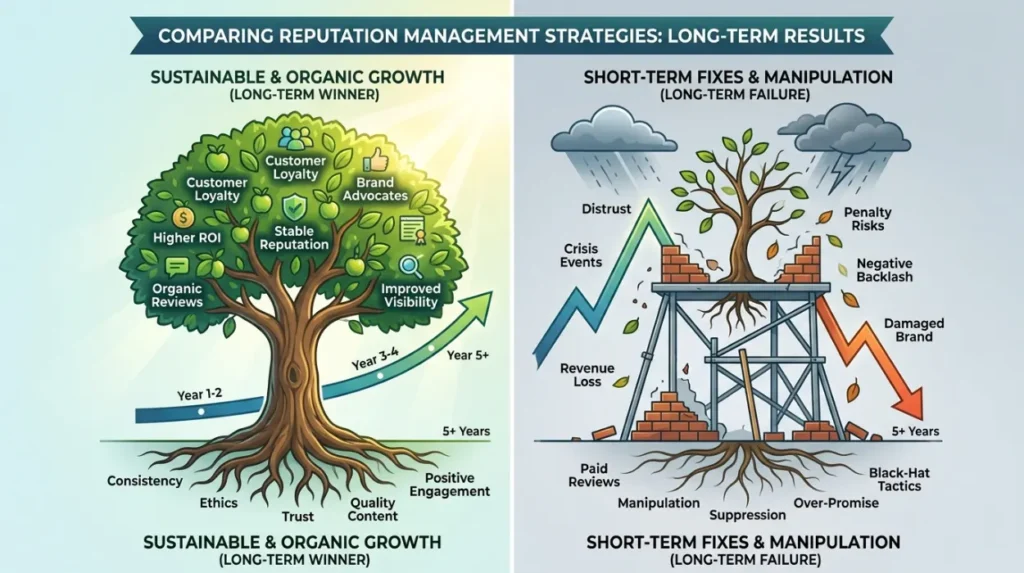
Long-term reputation performance depends on sustainable improvements in entity credibility instead of isolated moderation outcomes. Reputation management strategies differ according to their ability to maintain accurate trust signals across continuously evolving search ecosystems. Search engines reassess businesses and individuals using updated review sentiment, authoritative content, factual consistency, and reputation signals. Evaluating these strategies requires analysing durability, scalability, operational efficiency, and resilience against future reputation risks. Sustainable credibility produces more consistent search visibility than repeated reactive interventions.
Reactive reputation management addresses reputational issues after negative content becomes publicly visible. This strategy operates by reporting fake reviews, correcting inaccurate information, responding to reputation threats, and managing immediate visibility concerns. Reactive methods reduce short-term exposure by resolving individual incidents before wider reputational damage develops. Search engines recognise improvements only after updated reputation signals become available through moderation outcomes or corrected digital information. Although reactive management provides immediate issue resolution, it requires continuous intervention whenever new fake reviews appear.
Proactive reputation management establishes reliable trust signals before significant reputation issues emerge. This strategy operates through consistent review monitoring, accurate business information, authoritative content development, and the continuous collection of genuine customer feedback. Search engines evaluate these signals collectively when assessing entity credibility and search ranking influence. Compared with reactive approaches, proactive reputation management creates stronger resistance against isolated fake reviews because balanced sentiment reduces their overall impact. Continuous reputation maintenance therefore supports long-term digital trust and sustainable search visibility.
How Does Content Suppression Compare With Content Enhancement in Reputation Management?
Content suppression and content enhancement represent two distinct reputation management strategies that influence search engine results through different mechanisms. Content suppression reduces the visibility of unfavourable search results, whereas content enhancement increases the prominence of accurate, authoritative, and relevant content. Search engines evaluate topical authority, relevance, freshness, and user engagement when determining SERP composition. Consequently, these approaches affect search perception in different ways while contributing to the same objective of improving reputation signals. Comparing their effectiveness requires analysing sustainability, search ranking influence, scalability, and long-term entity credibility.
Content suppression operates by publishing stronger and more relevant digital assets that compete with lower-quality or misleading content for visibility within search results. Search engines compare authority, topical relevance, and user satisfaction before determining ranking positions, allowing authoritative content to replace less valuable pages over time. This strategy changes SERP composition without removing the original content unless separate moderation or legal processes succeed. Its primary advantage is improved search visibility for trusted information, while its limitation is that highly authoritative negative content remains visible when competing assets lack sufficient relevance or authority.
Content enhancement focuses on strengthening existing digital assets that contribute positive reputation signals. This strategy operates through factual consistency, semantic relevance, authoritative publishing, structured data implementation, and accurate business information across digital properties. Search engines interpret these improvements as indicators of entity credibility and trustworthiness. Compared with suppression, enhancement concentrates on increasing the quality and quantity of reliable information rather than reducing the visibility of negative assets. This approach supports sustainable reputation management because consistent authority improves long-term search perception.
Dive Deeper With Our Expert Guides:
What a Fake Reviews Removal Service Does Across Multiple Platforms at Once
How Do Search Engines Interpret Fake Reviews and Reputation Signals?
Search engines evaluate reputation using interconnected trust signals rather than isolated reviews. Reputation signals include review authenticity, sentiment distribution, entity consistency, authoritative references, and the accuracy of digital information. These factors contribute to search ranking influence because they help search systems determine credibility and relevance. Understanding this evaluation process explains why reputation management extends beyond individual review removal. Effective online reputation management strengthens the overall quality of trust signals available across digital ecosystems.
Review authenticity represents the assessment of whether published feedback reflects genuine customer experiences. Search ecosystems analyse behavioural patterns, account quality, review frequency, and verification processes to identify suspicious activity. Authentic reviews strengthen entity credibility because they contribute reliable information to aggregated reputation profiles. Fake reviews distort sentiment distribution and reduce confidence in publicly available information when detected. Consequently, authenticity contributes more significantly to long-term search perception than review volume alone.
Entity credibility represents the cumulative assessment of trustworthiness across connected online sources. Search engines combine review sentiment, factual consistency, authoritative mentions, structured business information, and topical relevance into a unified evaluation framework. Strong entity credibility reduces the relative influence of isolated reputation events because multiple trusted sources reinforce accurate information. This creates balanced search perception while improving digital trust across branded search results. Maintaining entity credibility therefore remains an ongoing reputation management process instead of a single corrective action.
Which Evaluation Framework Helps Assess Reputation Management Strategies?
A structured evaluation framework compares reputation management strategies using measurable performance indicators instead of subjective opinion. Effective analysis considers operational efficiency, long-term sustainability, scalability, and influence on search visibility. Comparing strategies through consistent criteria allows businesses and organisations to identify strengths, limitations, and potential risks before selecting an approach. Search ecosystems reward credibility, consistency, and reliable information, making structured evaluation essential for long-term digital trust. Measuring multiple reputation signals provides a more accurate assessment than relying solely on review counts or removal rates.
An effective evaluation framework includes:
- Measure review removal effectiveness by comparing verified moderation outcomes with submitted reports.
- Analyse sentiment distribution to determine the balance between authentic positive, neutral, and negative reviews.
- Evaluate search ranking influence by monitoring changes in branded SERP composition and visibility.
- Assess scalability by determining whether the strategy remains effective across multiple review platforms.
- Review sustainability by measuring the consistency of reputation signals over extended periods.
These evaluation criteria provide a comprehensive understanding of digital trust because search engines interpret reputation as an interconnected ecosystem rather than isolated review activity.
What Strategic Factors Differentiate Short-Term and Long-Term Reputation Management?
Short-term and long-term reputation management differ according to their objectives, operational methods, and influence on search ecosystems. Short-term strategies prioritise immediate correction through moderation requests, reporting procedures, and factual clarification. Long-term strategies strengthen entity credibility through sustained improvements in authoritative content, reputation signals, and authentic customer feedback. Search engines continuously reassess these signals, making long-term reputation management dependent on consistency rather than isolated interventions. Comparing both approaches highlights the importance of balancing immediate corrective actions with continuous credibility development.
Short-term methods deliver measurable improvements when fake reviews clearly violate platform guidelines and moderation decisions result in successful removal. Their effectiveness is evaluated through reduced misinformation and improved review accuracy within a limited timeframe. However, repeated dependence on reactive interventions increases operational demands because new reputation threats require continuous management. Search perception therefore remains vulnerable if broader trust signals remain unchanged.
Long-term reputation management operates by maintaining accurate business information, strengthening authoritative digital assets, improving sentiment distribution, and reinforcing entity credibility across search ecosystems. These mechanisms establish consistent trust signals that influence search visibility over time. Balanced reputation signals reduce the impact of isolated fake reviews because search engines evaluate aggregated evidence instead of individual incidents. Sustainable reputation management therefore combines corrective action with continuous credibility development to support stable digital trust.
Removing fake online reviews requires a combination of platform moderation, legal evaluation, and broader reputation management strategies that influence digital trust through different mechanisms. Platform reporting addresses policy violations, legal procedures resolve unlawful content, and reputation management strengthens entity credibility through consistent reputation signals. Content suppression and content enhancement improve SERP composition using different strategic approaches, while proactive and reactive methods differ in sustainability and operational efficiency. Search engines interpret reputation using interconnected signals that include authenticity, sentiment distribution, authoritative information, and entity credibility rather than isolated reviews.
Evaluating reputation management strategies requires analysing effectiveness, scalability, sustainability, and search ranking influence instead of focusing solely on review removal. A structured approach improves digital trust by strengthening reliable reputation signals while maintaining accurate information across search ecosystems.
Within a broader reputation management strategy, readers seeking further analysis of implementation approaches can explore Remove Fake Online Reviews Across Every Platform With One UK Service as the next stage in understanding platform-wide review management.
Can fake online reviews be removed from Google, Trustpilot, and other review platforms?
Fake online reviews can be removed when they violate a platform’s review policies, such as spam, impersonation, or fabricated experiences. Clear Your Name explains that each platform follows its own reporting and verification process, so removal criteria differ across websites.
How do review platforms decide whether a review is fake?
Review platforms evaluate authenticity by analysing account activity, policy compliance, supporting evidence, and user behaviour. These checks help identify fake online reviews while protecting genuine customer feedback from unnecessary removal.
Is reporting a fake review more effective than using reputation management strategies?
Reporting addresses individual reviews that breach platform policies, whereas reputation management improves broader reputation signals across search results. Clear Your Name explains that combining review removal with long-term reputation management provides a more comprehensive approach to digital reputation.
Do fake online reviews affect Google search rankings?
Fake reviews influence public trust and can alter sentiment distribution associated with a business or individual. Search engines evaluate multiple reputation signals, including review quality, entity credibility, and authoritative content, when assessing search visibility.
What is the difference between fake review removal and online reputation management?
Fake review removal focuses on eliminating reviews that violate platform guidelines, while online reputation management strengthens digital trust through accurate information, authoritative content, and balanced reputation signals. Both approaches address different aspects of online reputation and search perception.