

A fake reviews removal service evaluates review authenticity, platform policies, and search visibility across multiple websites to address inauthentic reputation signals through structured review management processes. The effectiveness of this approach depends on platform moderation systems, reputation signals, and how search ecosystems interpret review credibility.
Reputation management strategies differ based on how reputation signals are influenced across search ecosystems. Online reputation control methods are evaluated through search visibility, entity credibility, sentiment distribution, SERP composition, and digital trust. Different approaches operate through different mechanisms, making comparative evaluation essential when analysing fake review management across multiple platforms.
How Does a Fake Reviews Removal Service Compare with Manual Review Reporting?
A fake reviews removal service operates through structured assessment across multiple review ecosystems, whereas manual reporting focuses on individual review submissions.
Fake Reviews Removal Services are structured reputation management processes that identify potentially inauthentic reviews, compare them against platform policies, organise supporting evidence, and coordinate reporting procedures across multiple websites. This process standardises review assessment while maintaining consistency across different moderation systems.
Manual review reporting operates one platform at a time. Each report follows separate procedures, evidence requirements, and moderation timelines. While individual reports remain effective for isolated cases, the process becomes increasingly fragmented when identical reputation issues appear across multiple review platforms.
From a search ecosystem perspective, coordinated review management provides greater consistency because reputation signals are evaluated collectively rather than individually. Consistent moderation outcomes strengthen entity credibility by reducing conflicting review information across indexed platforms.
Which Reputation Management Approach Produces Better Search Visibility?
Removing inauthentic reviews influences search visibility more directly than publishing additional positive content because it changes the quality of existing reputation signals.
Review removal operates by reducing inaccurate sentiment within public review profiles. Once review platforms remove policy-violating content, reputation signals become more representative of genuine customer feedback. Search engines continue evaluating review authenticity alongside authority, relevance, and user trust.
Content enhancement operates differently. It increases the amount of positive information available online without changing the existence of disputed reviews. This approach influences content diversity rather than removing misleading reputation signals.
Search visibility therefore changes through different mechanisms. Removal improves information quality, while content enhancement improves information quantity. Each strategy contributes differently to SERP composition and entity perception.
How Do Multiple Review Platforms Evaluate Fake Reviews?
Review platforms evaluate fake reviews using platform-specific moderation policies supported by behavioural analysis and automated detection systems.
Although moderation criteria differ between platforms, most systems evaluate reviewer authenticity, behavioural consistency, review timing, account history, linguistic similarity, and publication patterns. Machine learning models compare these indicators with established behavioural baselines to identify potentially manipulated review activity.
Because every platform maintains different moderation standards, coordinated evaluation becomes increasingly important when identical reviews appear across multiple websites. Consistent reporting improves the likelihood that platform-specific moderation processes assess equivalent evidence using their own policy frameworks.
Search ecosystems also benefit from improved review consistency because accurate reputation signals strengthen entity credibility across multiple indexed sources.
How Does Review Removal Compare with Content Suppression?
Review removal changes publicly available review information, whereas content suppression changes ranking prominence through additional content creation.
Review removal is a moderation-based process that operates through policy enforcement. Once policy-violating reviews disappear, sentiment distribution changes naturally because remaining reviews more accurately represent authentic customer experiences.
Content suppression operates through search ranking competition. Additional authoritative content competes with existing pages to influence search visibility without changing the review itself. This improves SERP composition but leaves inaccurate reviews publicly accessible.
From a reputation management perspective, removal directly improves review authenticity, while suppression primarily improves search presentation. Each approach influences reputation signals using different operational mechanisms.
Which Factors Determine the Effectiveness of Fake Reviews Removal?
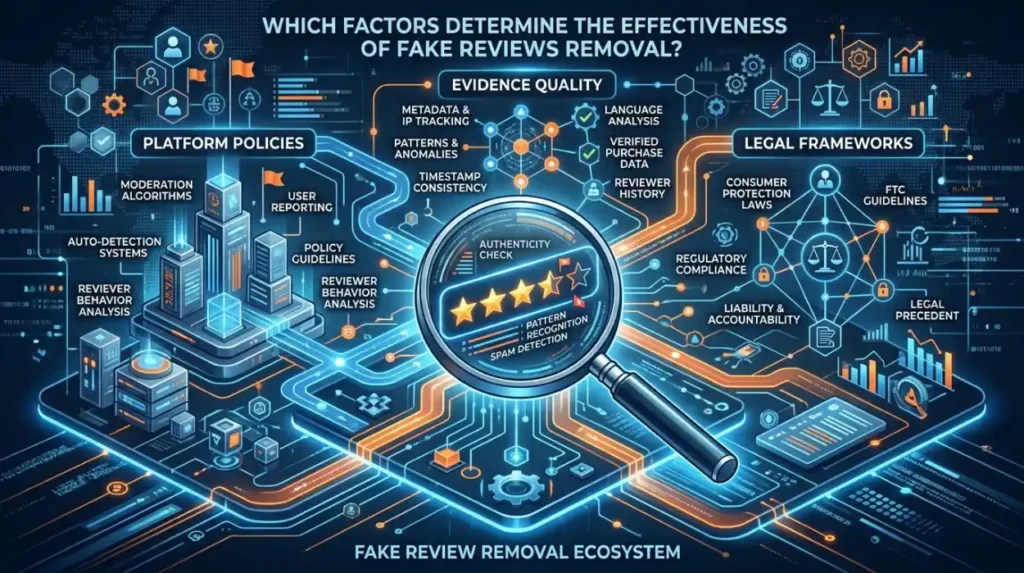
Effectiveness depends on review authenticity, evidence quality, moderation consistency, and platform-specific policy interpretation.
The evaluation process generally follows these stages:
- Identify suspicious reviews by analysing behavioural inconsistencies and publication history.
- Compare review content against published moderation policies to determine potential policy violations.
- Document supporting evidence that demonstrates inconsistencies or authenticity concerns.
- Submit structured reports using each platform’s moderation procedures.
- Monitor review outcomes and search visibility after moderation decisions.
Each stage contributes to improved reputation signals because moderation decisions influence the quality of publicly available review information.
How Do Reactive and Proactive Reputation Strategies Compare?
Reactive reputation management addresses fake reviews after publication, whereas proactive reputation management strengthens review credibility before reputation risks emerge.
Reactive methods include reporting reviews, policy-based moderation, review investigations, and structured removal processes. These strategies focus on correcting inaccurate reputation signals that already influence public perception.
Proactive methods emphasise review governance, customer feedback quality, transparent review collection, and ongoing reputation monitoring. These practices strengthen long-term entity credibility by supporting authentic sentiment distribution before moderation becomes necessary.
Both approaches influence digital trust differently. Reactive management improves existing reputation data, while proactive management strengthens future review quality and long-term search visibility.
Which Strategy Provides Greater Long-Term Reputation Stability?
Long-term reputation stability depends on maintaining authentic reputation signals rather than responding only after reputation issues appear.
Search engines continuously evaluate indexed review information, sentiment distribution, authority signals, and reviewer authenticity. Sustainable reputation management therefore combines accurate moderation outcomes with continuous monitoring of review ecosystems.
Understanding Use a UK Fake Reviews Removal Service to Restore Your True Star Rating provides additional context for evaluating how structured review management fits within broader reputation management strategies while supporting accurate search perception across multiple review platforms.
Which Approach Offers Greater Scalability Across Multiple Review Platforms?
A coordinated review management strategy offers greater scalability because it evaluates reputation signals across multiple platforms using a consistent framework.
Scalability refers to the ability to manage reputation issues efficiently as the number of review platforms increases. Fake Reviews Removal Services operate by applying structured evidence collection, policy comparisons, and review monitoring across multiple ecosystems instead of treating each platform as an isolated environment. This coordinated approach improves consistency because similar review issues are assessed through the same documentation process before platform-specific reporting begins.
Independent reporting remains suitable for isolated incidents but becomes less efficient when review manipulation appears across numerous websites. Separate moderation policies, reporting forms, and evidence requirements increase administrative complexity. A scalable process reduces duplication while maintaining consistent reputation management standards across the digital ecosystem.
How Does Search Engine Interpretation Influence Review Management?
Search engines interpret review information as one component of overall reputation rather than as an isolated ranking factor.
Review content contributes to reputation signals alongside content quality, authority, backlinks, structured data, and user engagement. Search algorithms evaluate review authenticity because trustworthy information strengthens entity credibility and improves search perception. Manipulated review profiles weaken confidence in publicly available information and reduce the reliability of reputation signals.
Review management therefore influences SERP composition indirectly. When moderation removes policy-violating reviews, the quality of publicly accessible information improves, allowing search engines to evaluate entities using more accurate reputation data. Improved review authenticity supports stronger long-term digital trust across search ecosystems.
Which Strategy Reduces Reputation Risk More Effectively?
A structured review removal strategy reduces reputation risk more effectively because it focuses on eliminating inaccurate reputation signals rather than simply competing with them.
Reputation risk develops when false reviews distort public perception and influence consumer decisions. Fake Reviews Removal Services operate by identifying review policy breaches, documenting supporting evidence, and submitting structured moderation requests. This process improves review accuracy while reducing the influence of manipulated sentiment on public-facing review profiles.
Content enhancement reduces visibility challenges by introducing additional authoritative information, but inaccurate reviews remain accessible if moderation does not remove them. Consequently, removal strategies address the source of reputation distortion, whereas content enhancement primarily changes information balance within search results.
How Is the Long Term Sustainability of Review Management Evaluated?
Long-term sustainability is evaluated through the consistency of reputation signals, review authenticity, and ongoing monitoring.
Sustainable reputation management refers to maintaining accurate digital information over time instead of relying on one-off corrective actions. Review ecosystems constantly evolve as new customer feedback, moderation decisions, and platform updates alter publicly available information. Continuous monitoring identifies newly published reviews, evaluates moderation outcomes, and measures changes in sentiment distribution across platforms.
A sustainable process also improves entity credibility because authentic review profiles remain aligned with platform policies and search engine quality assessments. Stable reputation signals provide stronger foundations for long-term search visibility than isolated corrective actions.
What Strategic Considerations Matter When Comparing Fake Reviews Removal Methods?
Strategic evaluation depends on effectiveness, scalability, risk exposure, and sustainability rather than speed alone.
Key evaluation considerations include:
- Assess policy compatibility by comparing moderation standards across review platforms.
- Measure evidence quality because documented authenticity concerns strengthen moderation assessments.
- Evaluate scalability by determining whether review management can operate consistently across multiple websites.
- Monitor reputation signals after moderation decisions to assess changes in search visibility and sentiment distribution.
- Review long-term outcomes by analysing whether authentic review profiles remain stable over time.
These factors provide a structured framework for comparing reputation management approaches without relying solely on immediate moderation outcomes.
Fake Reviews Removal Services operate through structured assessment, evidence collection, moderation procedures, and ongoing review monitoring across multiple platforms. Compared with manual reporting, content suppression, and isolated reputation management methods, coordinated review management provides a more consistent framework for evaluating review authenticity across interconnected review ecosystems.
Long-term reputation stability depends on authentic sentiment distribution, reliable reputation signals, scalable management processes, and continuous monitoring rather than isolated interventions. Understanding these differences enables a more informed evaluation of reputation management strategies and how they influence search visibility, entity credibility, and digital trust.
Within this comparative framework, Use a UK Fake Reviews Removal Service to Restore Your True Star Rating represents the next stage in understanding how structured review management can be implemented within broader reputation management processes.
What does a fake reviews removal service do across multiple platforms?
A fake reviews removal service identifies reviews that potentially breach platform policies, prepares supporting evidence, and submits review reports across multiple websites. Clear Your Name explains how Fake Reviews Removal Services improve review accuracy and reputation signals through structured moderation processes.
Can fake reviews be removed from more than one review platform at the same time?
Yes. Fake Reviews Removal Services evaluate review policy compliance across different platforms and coordinate separate reporting procedures where reviews breach individual platform guidelines. This approach supports consistent reputation management across multiple review ecosystems.
How do fake reviews affect search visibility?
Fake reviews influence search visibility by affecting reputation signals, entity credibility, and sentiment distribution. Search engines and review platforms analyse review authenticity alongside other trust indicators when evaluating online reputation.
What evidence is needed to report fake reviews?
Evidence typically includes review URLs, screenshots, account details, timestamps, and information demonstrating a breach of platform review policies. Clear Your Name outlines how Fake Reviews Removal Services organise supporting documentation for review assessments.
Is a fake reviews removal service more effective than reporting reviews manually?
Manual reporting focuses on individual reviews, while Fake Reviews Removal Services use a structured process to evaluate and report policy-violating reviews across multiple platforms. This coordinated approach improves consistency and supports more accurate reputation signals.