
Evidence is the primary factor that strengthens a request to remove fake reviews on Trustpilot because moderation decisions depend on verifiable information rather than opinion or disagreement. Reputation management strategies differ based on whether the objective is review removal, sentiment management, content correction, or long-term search visibility improvement. Online reputation control methods are evaluated through reputation signals, entity credibility, search ranking influence, and the sustainability of digital trust across search ecosystems.
Review platforms contribute significantly to online reputation because search engines index review content and incorporate reputation signals into broader entity evaluation. Fake reviews influence sentiment distribution, public perception, and digital credibility when they remain visible within search ecosystems. Understanding what constitutes strong evidence allows organisations and individuals to evaluate review removal strategies objectively while recognising the limitations of moderation systems.
What Types of Evidence Carry the Greatest Weight During Review Evaluation?
Documented and verifiable evidence carries the greatest weight because moderation systems rely on objective information to determine whether a review complies with platform policies. Evidence is information that confirms or disproves the authenticity of a published review through factual verification rather than personal interpretation. Reputation management evaluates evidence quality because stronger documentation improves the reliability of moderation decisions and supports accurate reputation signals.
Evidence commonly examined during review evaluation includes transaction records, customer communication, account verification details, booking confirmations, purchase documentation, and interaction history. These records establish whether a genuine customer relationship existed before the review was published. Moderation processes compare submitted evidence with the review content to identify inconsistencies that indicate policy violations.
Within search ecosystems, reliable moderation contributes to stronger entity credibility by improving the quality of publicly indexed review information. Search engines interpret trustworthy review environments as higher-quality information sources, strengthening overall search perception while reducing the influence of misleading content.
How Does Documentary Evidence Compare With Circumstantial Evidence?
Documentary evidence provides direct verification, whereas circumstantial evidence supports conclusions through indirect indicators. Both forms contribute to moderation assessments, but they differ in reliability, verification strength, and decision-making value.
Documentary evidence consists of records that directly demonstrate whether an interaction occurred. Examples include invoices, payment confirmations, contracts, service records, appointment logs, and verified communication history. These documents establish factual relationships between reviewers and businesses, allowing moderation teams to evaluate authenticity with greater certainty.
Circumstantial evidence operates differently by identifying behavioural patterns rather than direct proof. Account creation timing, repetitive language, duplicated review structures, unusual posting frequency, or coordinated submission patterns contribute supporting information during moderation. While these indicators strengthen an investigation, they generally require additional verification before confirming a policy violation.
From a reputation management perspective, documentary evidence provides stronger reputation signals because it directly validates factual claims. Circumstantial evidence improves contextual understanding but delivers greater value when combined with documented verification.
Why Does Review Authenticity Matter for Search Visibility?
Review authenticity matters because search engines evaluate review quality as part of broader reputation analysis. Authentic reviews improve information reliability, while fake reviews distort sentiment distribution and influence public perception through inaccurate reputation signals.
Search visibility depends on cumulative indicators rather than individual reviews. Algorithms analyse review consistency, source credibility, entity relationships, and user trust signals alongside website authority and content relevance. Authentic review environments therefore contribute positively to entity credibility because search systems interpret reliable review data as higher-quality information.
Fake reviews reduce confidence in publicly available information by introducing misleading signals into search ecosystems. When moderation systems successfully identify policy violations, the resulting improvement in review quality contributes to more accurate search perception and stronger digital trust. Reputation management therefore evaluates review authenticity as part of broader search visibility analysis.
Which Evidence Supports Policy Violation Claims More Effectively?
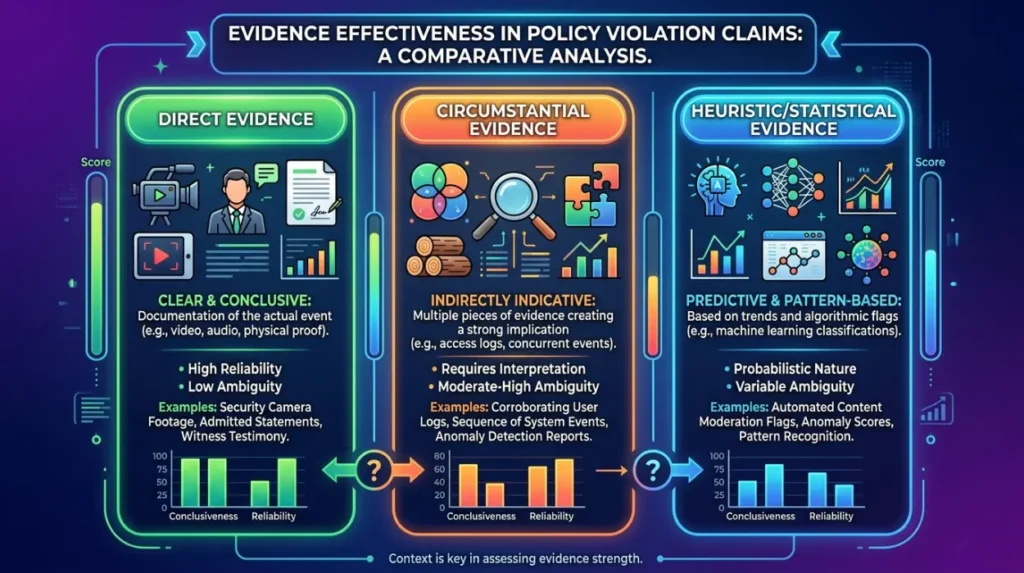
Policy violation claims become stronger when evidence demonstrates a direct conflict between review content and published moderation standards. Moderation systems compare reported reviews against authenticity requirements rather than evaluating customer satisfaction or subjective opinions.
The strongest supporting evidence typically includes:
- Provide transaction records that confirm whether a customer relationship existed before the review was published.
- Submit verified communication history showing inconsistencies between documented interactions and review claims.
- Present account verification information identifying false identities or unauthorised reviewer activity.
- Compare duplicated content demonstrating repeated review text across multiple accounts or profiles.
- Identify policy conflicts by linking specific review content to published moderation requirements.
Each evidence type contributes differently to moderation decisions. Combining multiple sources creates a stronger factual foundation because moderation systems evaluate consistency across all available information rather than relying on a single document.
How Does Review Reporting Compare With Long-Term Reputation Management?
Review reporting is a reactive reputation management approach, while long-term reputation management focuses on strengthening digital trust through sustained improvements in reputation signals. Both methods influence online credibility, but they operate through different mechanisms and achieve different outcomes.
Review reporting addresses individual pieces of content that potentially violate platform policies. Its effectiveness depends on evidence quality, moderation procedures, and verification outcomes. This approach provides targeted correction of inaccurate information but does not independently improve broader reputation signals.
Long-term reputation management operates through content quality, authority development, search visibility optimization, and consistent sentiment distribution. Rather than focusing exclusively on individual reviews, it strengthens the overall digital footprint by improving entity credibility across multiple indexed sources. Search engines evaluate these broader patterns when determining search ranking influence, making long-term strategies more sustainable for maintaining online credibility.
How Do Search Engines Interpret Reputation Signals Alongside Review Evidence?
Search engines interpret reputation signals by combining review information with authority indicators, topical relevance, structured data, and entity relationships. Review evidence influences moderation decisions, while search algorithms evaluate the resulting review environment as part of broader reputation assessment.
Reputation signals include authenticity, review consistency, content quality, authority references, sentiment distribution, and trust indicators. Search systems analyse these interconnected factors to develop contextual understanding rather than relying on isolated pieces of content. Accurate moderation therefore contributes to stronger entity credibility because verified review information improves overall information quality.
Evidence-based moderation also supports search perception by reducing misinformation within publicly indexed review platforms. As review environments become more reliable, search engines gain greater confidence in the reputation signals associated with those platforms, strengthening digital trust across search ecosystems.
How Does Reactive Review Removal Compare With Proactive Reputation Management?
Reactive review removal focuses on addressing existing review content that potentially violates platform policies, while proactive reputation management strengthens long-term reputation signals before reputation issues develop. Both approaches contribute to online credibility, but they differ in scope, sustainability, and search ranking influence.
Reactive methods operate by identifying individual reviews, collecting evidence, and requesting moderation based on policy compliance. Their primary objective is correcting inaccurate or misleading information that affects sentiment distribution. This approach produces targeted improvements where policy violations are confirmed but remains limited to specific review content.
Proactive reputation management operates by improving digital footprint quality, strengthening entity credibility, maintaining accurate business information, and encouraging authentic customer feedback. Search engines evaluate these cumulative signals across websites, review platforms, business directories, and other indexed sources. Consequently, proactive strategies create broader and more sustainable improvements in search perception than isolated review removal requests.
Dive Deeper With Our Expert Guides:
How to Remove Fake Online Reviews From Google Trustpilot and Other Platforms
What a Fake Reviews Removal Service Does Across Multiple Platforms at Once
What Limitations Affect Evidence Submitted for Fake Review Reports?
Evidence evaluation follows moderation standards that prioritise factual verification over personal disagreement. Strong evidence improves the quality of a request, but moderation decisions remain dependent on platform policies and verification procedures rather than the volume of submitted documents.
The principal limitations include:
- Demonstrate factual relevance because unrelated documents provide little support for authenticity assessment.
- Confirm reviewer identity where verification procedures require evidence linking the reviewer to the reported interaction.
- Avoid subjective interpretation because moderation focuses on documented facts rather than opinions.
- Maintain document accuracy so submitted information remains consistent with platform records.
- Recognise policy boundaries because not every negative review represents a moderation violation.
These limitations illustrate why evidence quality carries greater significance than evidence quantity. Reputation management evaluates documentation through accuracy, consistency, and direct relevance to moderation requirements.
How Does Evidence Influence Entity Credibility Within Search Ecosystems?
Evidence influences entity credibility indirectly by improving the quality of review moderation outcomes. Entity credibility refers to the level of trust search engines assign to an organisation or individual based on cumulative digital information. Reliable moderation strengthens this evaluation by reducing misleading reputation signals and preserving authentic review content.
Search engines analyse multiple information sources when interpreting credibility. Reviews, business information, structured data, authoritative references, and website quality contribute collectively to entity understanding. When moderation removes content that violates platform rules, the resulting review environment provides more reliable signals for search evaluation.
Evidence therefore supports credibility through improved information quality rather than direct ranking changes. Accurate moderation contributes to balanced sentiment distribution and enhances confidence in publicly indexed reputation data.
Which Reputation Management Strategy Provides Greater Long-Term Sustainability?
Long-term sustainability is achieved through reputation management strategies that strengthen overall information quality rather than focusing exclusively on isolated review disputes. Sustainable reputation management operates by maintaining accurate digital footprints, improving authority signals, and supporting authentic customer engagement across indexed platforms.
Short-term review reporting remains valuable because it addresses individual policy violations. However, search ecosystems continuously evaluate broader reputation patterns beyond individual reviews. Strong content quality, consistent business information, structured data accuracy, and authentic review generation provide lasting improvements in entity credibility.
Comparing these approaches demonstrates that reactive review reporting resolves specific moderation issues, whereas proactive reputation management strengthens digital trust across the entire search ecosystem. Both contribute to reputation management, but their effectiveness depends on the objective being evaluated.
How Should Organisations Evaluate Evidence Before Reporting a Fake Review?
Evidence evaluation begins by determining whether the review conflicts with published moderation standards. Objective documentation provides the strongest basis for review reporting because moderation systems rely on verifiable facts rather than assumptions or personal disagreement.
An effective evaluation framework includes:
- Verify customer records to confirm whether a documented interaction occurred.
- Compare review claims against available transaction or communication history.
- Identify policy conflicts by matching review content with moderation guidelines.
- Collect supporting documentation that demonstrates factual inconsistencies.
- Review evidence consistency before submitting a moderation request.
This structured approach improves evaluation quality because every stage focuses on factual verification. Reputation management benefits from consistent documentation since stronger evidence contributes to more reliable moderation outcomes and clearer reputation signals.
Evidence is the foundation of effective fake review reporting because moderation systems depend on verifiable information rather than subjective opinion. Documentary records, verified communication, transaction history, and policy-based comparisons provide stronger support than circumstantial indicators alone. Understanding these distinctions improves the evaluation of review authenticity and contributes to more accurate moderation outcomes.
Reputation management extends beyond individual review disputes by considering how review quality, sentiment distribution, authority signals, and entity credibility interact across search ecosystems. Reactive review reporting addresses specific moderation concerns, while proactive reputation management strengthens long-term digital trust through consistent information quality. Evaluating both approaches provides a balanced framework for understanding how evidence supports review moderation and influences online reputation over time.
Within this analysis, readers seeking further insight into policy-based review resolution can explore Remove Fake Trustpilot Reviews in the UK With Our Policy-Based Approach for additional context on structured moderation and reputation management strategies.
What evidence strengthens a request to remove fake reviews on Trustpilot?
Strong evidence includes transaction records, invoices, booking confirmations, customer communication, and account verification details that demonstrate whether a genuine customer interaction occurred. Clear, factual documentation helps moderators assess whether a review breaches Trustpilot’s policies.
Can Trustpilot remove a fake review without supporting evidence?
Trustpilot evaluates fake review reports based on the evidence provided and its moderation guidelines. Without relevant supporting information, it is more difficult to verify that a review violates the platform’s authenticity or content policies.
What types of documents are accepted when reporting fake Trustpilot reviews?
Useful documents include receipts, invoices, order confirmations, appointment records, email correspondence, and other verifiable business records. These documents help establish whether the reviewer had a legitimate customer relationship.
How do fake reviews affect online reputation and search visibility?
Fake reviews can influence reputation signals, sentiment distribution, and public perception because review platforms are indexed by search engines. Misleading reviews can affect entity credibility until they are reviewed and, where appropriate, removed.
How does Clear Your Name help with fake review evidence?
Clear Your Name explains the importance of evidence-based review reporting and how moderation systems evaluate supporting documentation. It also provides guidance on reputation management principles and the role of authentic reviews in maintaining online credibility.