
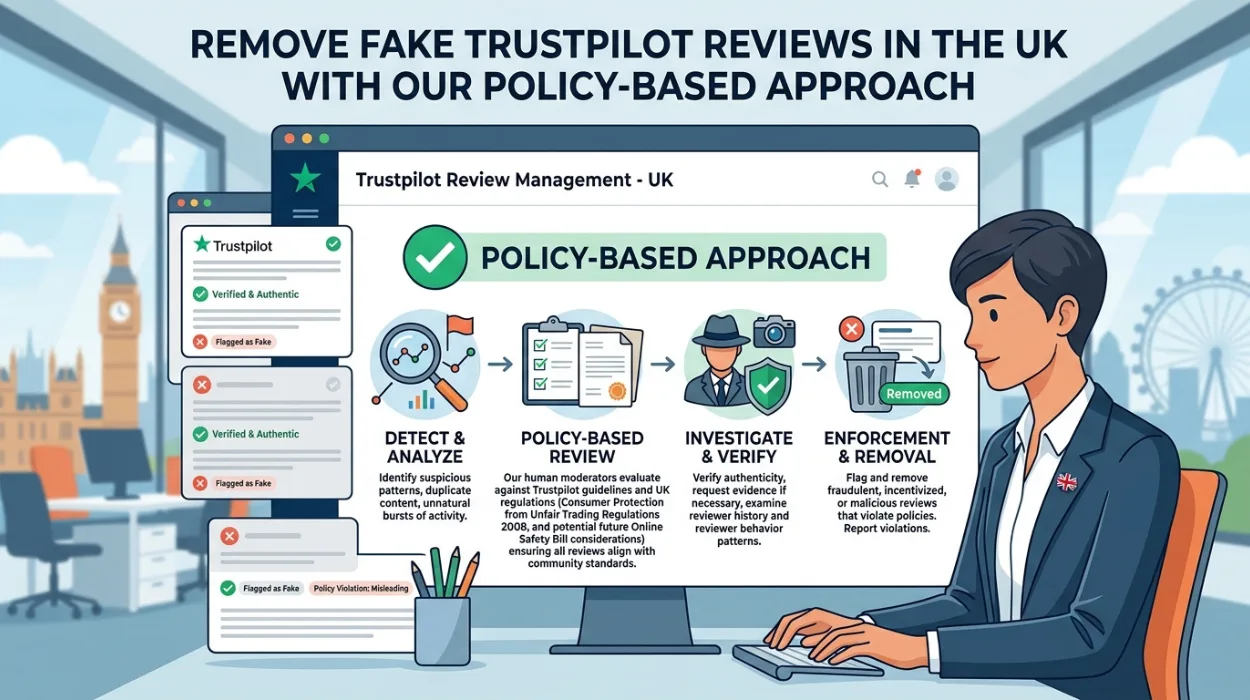
Remove Fake Trustpilot Reviews UK strategies improve search visibility by ensuring reputation signals reflect authentic customer experiences through a structured, policy-based process. Search perception directly influences public trust, making accurate review moderation an essential part of effective reputation management.
Reputation management services deliver measurable outcomes when they combine evidence-based review analysis, platform policy compliance, and search visibility control. Within search ecosystems, fake reviews influence entity credibility, sentiment distribution, and public perception. A structured removal process reduces these risks by aligning review content with platform standards and strengthening long-term digital trust.
Why Is a Policy Based Approach More Effective Than Informal Review Disputes?
A policy-based approach delivers greater consistency because every review is evaluated against published moderation rules instead of subjective disagreement. Fake review assessments rely on documented evidence, authenticity verification, and policy compliance rather than personal opinion. This structured process improves the quality of review submissions while reducing unnecessary rejection caused by incomplete documentation.
Informal disputes often focus on dissatisfaction with negative feedback rather than demonstrating an actual policy violation. Moderation systems assess factual evidence, account authenticity, and documented customer interactions before making removal decisions. A policy-led strategy therefore strengthens reputation signals by presenting clear, verifiable information that supports moderation requirements.
For businesses seeking reliable review management, Fake Reviews Removal Services provide a structured framework for identifying policy violations, preparing supporting documentation, and monitoring moderation outcomes. This process improves search perception influence because review quality contributes to broader evaluations of entity credibility across search ecosystems.
Which Results Demonstrate Successful Fake Review Removal?
Successful fake review removal produces measurable improvements in reputation accuracy, search visibility, and public trust. When reviews that breach moderation policies are removed, users gain access to a more accurate representation of customer sentiment. This improves digital credibility because search engines interpret authentic review environments as stronger reputation signals.
The most significant outcomes include:
- Improve sentiment distribution by removing policy-violating review content.
- Strengthen entity credibility through authentic and verifiable customer feedback.
- Reduce reputation risk by limiting misleading information within publicly indexed review platforms.
- Support SERP control by improving the overall quality of reputation signals.
- Enhance digital trust through consistent moderation and review accuracy.
These improvements contribute to long-term online reputation because search engines evaluate cumulative review quality rather than isolated reviews. Consistent moderation strengthens trust signals that influence both users and search algorithms.
How Does the Review Removal Process Deliver Reliable Outcomes?
Reliable review removal begins with a detailed assessment of the reported review against platform moderation policies. Every review is examined to determine whether it breaches authenticity standards through fabricated experiences, impersonation, manipulated activity, or other policy violations. This structured evaluation ensures that removal requests are supported by relevant evidence before submission.
The process continues by collecting documentary evidence, verifying customer interaction records, and comparing review content with platform requirements. Accurate documentation reduces ambiguity during moderation because every claim is supported by factual information. Once the review request has been submitted, ongoing monitoring confirms moderation outcomes and evaluates whether search perception has improved following the decision.
Clear Your Name follows this evidence-led methodology to ensure that review removal requests are supported by accurate documentation and aligned with moderation requirements. This structured approach improves consistency while reducing the risk of unsuccessful submissions caused by incomplete preparation.
Why Do Reputation Signals Matter When Removing Fake Reviews?
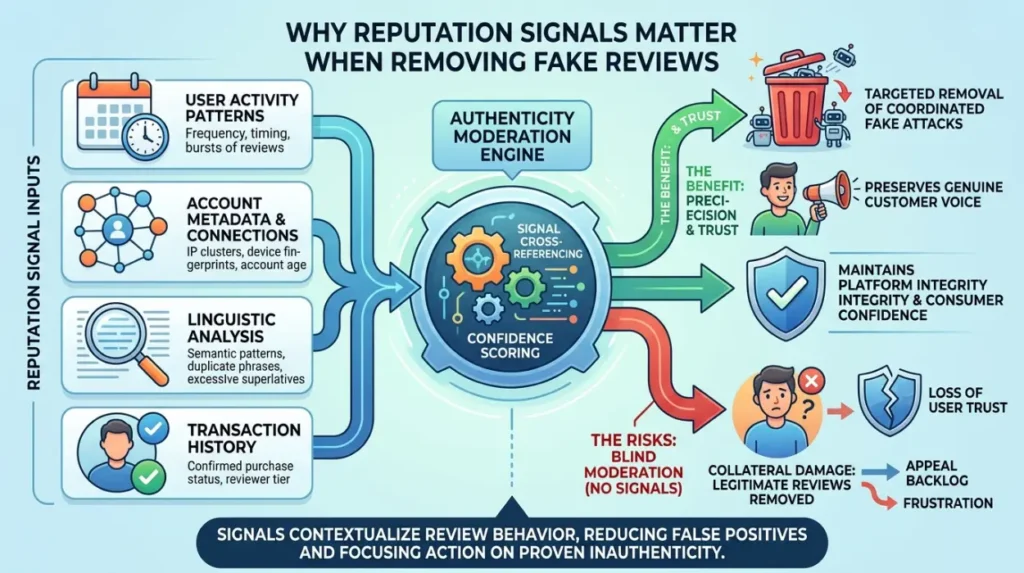
Reputation signals determine how search engines interpret the credibility of an organisation or individual across digital platforms. Fake reviews distort these signals by introducing misleading information into publicly indexed review environments. As search engines analyse review quality alongside websites, structured information, and authoritative references, inaccurate reviews influence entity credibility beyond the review platform itself.
Removing reviews that violate moderation policies strengthens the accuracy of reputation signals because search ecosystems rely on authentic information when evaluating trust. Improved review quality contributes to balanced sentiment distribution and more reliable public perception. This relationship between moderation and search evaluation explains why reputation management focuses on both review accuracy and broader search visibility.
Businesses evaluating long-term reputation improvement often combine review moderation with professional reputation management service solutions that address digital footprint quality, review integrity, and search perception influence simultaneously. This integrated approach produces more sustainable outcomes than isolated moderation requests because reputation signals remain consistent across multiple indexed sources.
Which Factors Influence the Success of Fake Review Removal Requests?
The success of a fake review removal request depends on evidence quality, policy relevance, documentation accuracy, and moderation compliance. Review platforms evaluate factual information rather than assumptions, making documentary evidence essential for demonstrating policy violations. Transaction records, communication history, account verification details, and documented inconsistencies strengthen the moderation process by supporting authenticity assessments.
Search ecosystems also benefit from accurate moderation because trustworthy review environments improve information quality. Reviews that comply with platform policies contribute stronger reputation signals than manipulated or fabricated content. By addressing policy violations through documented evidence, organisations improve both moderation outcomes and long-term search perception.
Decision-makers frequently compare immediate review removal against broader reputation management objectives. A structured policy-based process delivers greater long-term value because it combines evidence preparation, moderation accuracy, and ongoing reputation monitoring instead of relying on isolated review disputes.
Why Does Search Visibility Depend on More Than Removing Individual Reviews?
Removing individual fake reviews improves one aspect of reputation management, but search visibility depends on the cumulative strength of reputation signals across the digital ecosystem. Search engines evaluate websites, review platforms, business listings, media references, structured information, and content quality together when interpreting entity credibility.
Effective reputation management therefore combines review moderation with technical optimisation, digital footprint management, and continuous reputation monitoring. This broader strategy improves search perception because users evaluate organisations through the overall composition of search results rather than a single review platform. Maintaining consistency across indexed information stabilises reputation signals and strengthens long-term digital trust.
Readers seeking additional analytical insight can explore Trustpilot Fake Review Reports to understand how moderation decisions are evaluated, while Remove Fake Reviews on Trustpilot explains the importance of evidence when assessing policy-based review removal requests.
How Does Clear Your Name Deliver a Reliable Fake Review Removal Process?
Clear Your Name delivers a structured review removal process by combining policy analysis, evidence verification, moderation preparation, and post-submission monitoring. Every case begins with a detailed assessment of whether the reported review breaches published platform guidelines. This evaluation identifies the most relevant policy provisions before supporting documentation is organised. The process reduces unnecessary risk because each submission is aligned with moderation requirements rather than opinion. As a result, reputation signals become more accurate and search perception influence improves through evidence-based review management.
The workflow also includes monitoring after submission to evaluate moderation outcomes and identify any remaining reputation risks. Search visibility changes as review quality improves, making ongoing analysis an essential part of long-term reputation management. This systematic approach strengthens entity credibility because accurate review environments contribute to higher-quality reputation signals across search ecosystems.
Dive Deeper With Our Expert Guides:
Remove Fake Online Reviews Across Every Platform With One UK Service
Use a UK Fake Reviews Removal Service to Restore Your True Star Rating
Which Long-Term Benefits Justify Professional Reputation Management?
Professional reputation management delivers long-term value because it improves digital trust instead of focusing only on individual review disputes. Search engines continuously evaluate reputation signals, sentiment distribution, content quality, and entity credibility when determining how organisations appear within search results. A structured reputation strategy strengthens each of these elements through consistent monitoring and technical accuracy.
The principal long-term benefits include:
- Strengthen search visibility by improving authentic reputation signals across indexed platforms.
- Improve entity credibility through accurate and policy-compliant review environments.
- Reduce reputation risk by identifying and addressing policy violations efficiently.
- Stabilise public perception through balanced sentiment distribution and reliable moderation.
- Support sustainable SERP control by maintaining consistent digital trust over time.
These outcomes improve search ecosystems because accurate review information contributes to stronger authority and more reliable entity evaluation. Long-term reputation management therefore creates measurable improvements beyond isolated review removals.
What Should Organisations Evaluate Before Choosing a Fake Review Removal Provider?
Selecting a fake review removal provider requires evaluating technical expertise, moderation knowledge, evidence preparation, and process transparency. Effective providers explain how platform policies operate and how supporting documentation influences moderation decisions. A structured methodology demonstrates an understanding of reputation management systems instead of presenting review removal as an automatic outcome.
Decision-makers also benefit from assessing whether review removal forms part of a broader reputation management strategy. Providers that integrate review analysis, reputation monitoring, digital footprint evaluation, and search visibility management deliver stronger long-term outcomes than providers focused only on submitting reports. This broader approach strengthens entity credibility because reputation signals remain consistent across multiple search environments.
Clear Your Name applies these principles by combining policy-based review analysis with structured reputation management. This methodology provides greater process clarity while supporting sustainable improvements in online credibility and search perception.
Why Is Ongoing Reputation Monitoring Essential After Fake Review Removal?
Ongoing reputation monitoring ensures that improvements achieved through review moderation continue supporting search visibility over time. Search engines repeatedly evaluate review quality, authority signals, and indexed content as part of continuous ranking assessments. Without monitoring, new policy violations or reputation inconsistencies can reduce the effectiveness of previous moderation efforts.
Monitoring also measures whether sentiment distribution, review quality, and search perception improve following successful moderation outcomes. This information supports future reputation management decisions by identifying emerging risks before they influence broader digital credibility. Continuous evaluation therefore strengthens SERP control while maintaining consistent reputation signals across search ecosystems.
Removing fake Trustpilot reviews through a policy-based approach improves reputation accuracy by ensuring moderation decisions are supported by evidence, platform compliance, and structured documentation. Review quality influences search visibility because search engines evaluate authentic reputation signals when interpreting entity credibility and public trust. A reliable reputation management process therefore extends beyond reporting individual reviews and focuses on strengthening long-term digital trust.
By combining evidence verification, policy analysis, moderation preparation, and ongoing reputation monitoring, Clear Your Name delivers a structured process that supports sustainable improvements in search perception. This approach reduces reputation risk, improves search visibility, and reinforces entity credibility through accurate review environments rather than isolated moderation requests. Organisations seeking dependable reputation management benefit from a transparent methodology that prioritises process clarity, measurable outcomes, and long-term search stability.
Within this evaluation, readers can gain additional context by exploring Trustpilot Fake Review Reports to understand moderation principles and Remove Fake Reviews on Trustpilot to examine how evidence supports effective review removal. Integrating these resources with a professional reputation management service provides a comprehensive framework for managing online reputation with greater confidence.
How can fake Trustpilot reviews be removed in the UK?
Fake Trustpilot reviews can be reported when there is evidence that they breach the platform’s moderation or authenticity policies. A policy-based approach supported by relevant documentation improves the quality of the review assessment process.
What evidence is required to remove fake Trustpilot reviews?
Evidence such as invoices, order confirmations, booking records, customer communications, and account verification details helps demonstrate whether a review violates Trustpilot’s policies. Accurate documentation supports evidence-based moderation decisions.
Why is a policy-based approach better for fake review removal?
A policy-based approach focuses on documented policy violations instead of subjective disagreement with a review. This method aligns review reports with moderation requirements and improves the accuracy of review evaluations.
How do Fake Reviews Removal Services support online reputation?
Fake Reviews Removal Services help identify reviews that potentially breach platform policies and organise supporting evidence for moderation requests. This process contributes to stronger reputation signals, improved search visibility, and greater entity credibility.
How does Clear Your Name approach fake Trustpilot review removal?
Clear Your Name uses a structured process that includes policy analysis, evidence review, documentation preparation, and moderation monitoring. This evidence-led methodology supports accurate reputation management and sustainable improvements in online credibility.