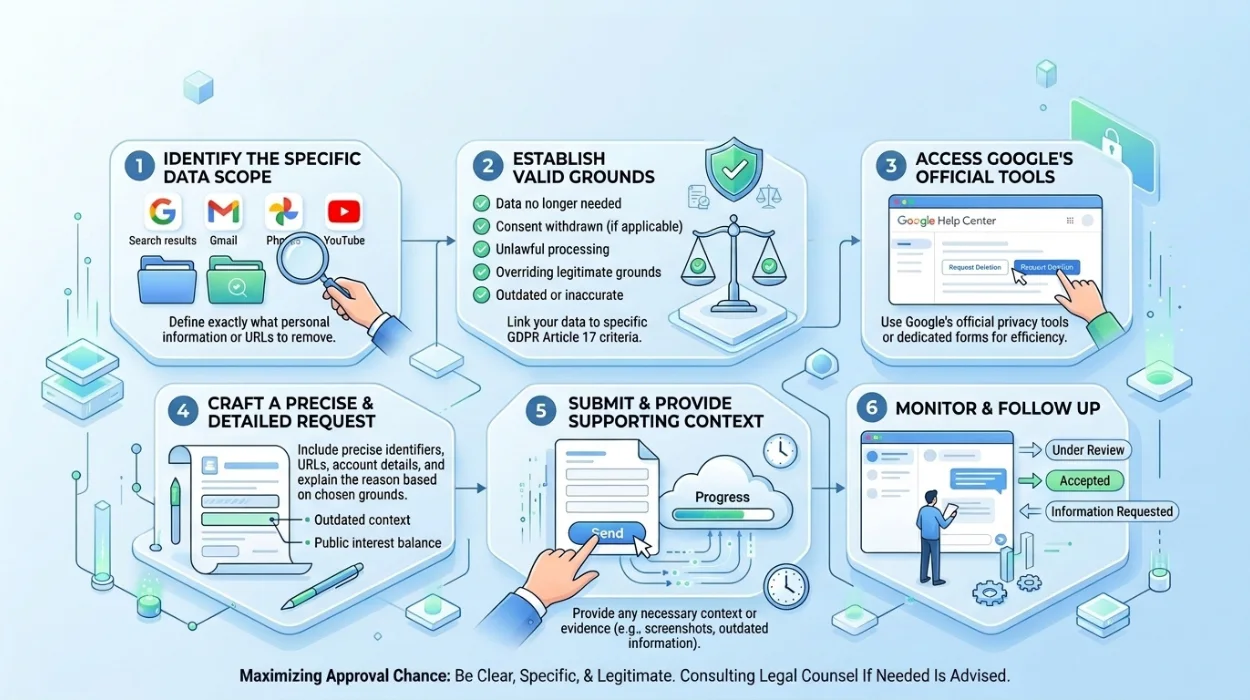
A GDPR Right to Erasure request is more likely to succeed when it clearly demonstrates that the legal requirements for erasure are satisfied and provides accurate supporting information. The outcome depends on compliance with data protection law, evidence quality and the balance between privacy rights and lawful publication rather than the existence of unwanted online content alone.
Reputation management strategies differ based on the legal basis supporting content removal, the type of personal information involved and the relationship between data protection law and search ecosystems. Online reputation control methods are evaluated through their effect on reputation signals, entity credibility, search ranking influence and the long-term composition of search engine results pages (SERPs).
The GDPR Right to Erasure provides a structured legal framework governing the removal of qualifying personal data. However, successful requests depend upon satisfying statutory conditions rather than personal preference. Evaluating different submission approaches explains how legal compliance, search visibility and digital reputation interact throughout the decision-making process.
Which submission approach produces the strongest legal foundation?
A legally structured submission produces the strongest foundation because it demonstrates compliance with the statutory grounds required for erasure.
The GDPR defines specific legal conditions that determine whether personal information qualifies for deletion. Effective requests identify the applicable legal basis, explain why continued processing lacks justification and provide supporting evidence relevant to that legal ground. This structured approach enables data controllers to assess requests efficiently against the legislative framework. Requests based solely on dissatisfaction with online information provide less legal clarity because they fail to establish the statutory requirements governing erasure.
From a search ecosystem perspective, legally supported requests contribute to more accurate management of personal information while preserving trust in publicly available data. The legal framework therefore strengthens both privacy protection and information reliability.
How does evidence quality compare with general explanations?
Evidence quality provides greater effectiveness because legal decisions rely upon verifiable information rather than broad personal statements.
Supporting documentation establishes whether personal data satisfies the statutory grounds required for deletion. Relevant evidence identifies the published information, demonstrates its relationship to the applicable legal ground and explains why continued processing conflicts with data protection requirements. General explanations without supporting documentation reduce the efficiency of legal evaluation because decision-makers require objective information when assessing compliance. Structured evidence therefore strengthens procedural clarity throughout the review process.
Search visibility is affected only after qualifying personal information is removed from its source. High-quality evidence supports this outcome by improving the accuracy of legal assessment before any changes occur within search indexing systems.
Accurate documentation improves legal evaluation and procedural consistency.
- Identify the personal data by providing precise URLs, screenshots or references showing where the information appears.
- Demonstrate the legal ground by explaining how the applicable GDPR condition supports erasure.
- Provide supporting records through documentation confirming that the information satisfies the statutory requirements.
- Explain continued impact by showing why the ongoing processing of personal information no longer complies with the legal basis relied upon by the data controller.
Each element strengthens legal assessment by providing objective information rather than subjective opinion.
Which strategy is more effective: requesting source removal or focusing on search visibility?
Requesting source removal provides a stronger legal mechanism because GDPR regulates the processing of personal data by data controllers rather than directly controlling search engine rankings.
Search engines organise publicly available information through indexing systems, whereas the GDPR governs how organisations collect, retain and process personal information. Removing qualifying data from its original source influences search visibility indirectly because search engines update indexed content after recrawling affected pages. Focusing exclusively on search results does not address the legal processing of personal information, making source-based requests more closely aligned with data protection law. This distinction improves procedural consistency while maintaining compliance with statutory requirements.
Search ranking influence changes progressively after lawful source updates occur. Consequently, source removal represents a more sustainable reputation management approach than attempting to alter search visibility independently.
How does GDPR erasure compare with other reputation management methods?

GDPR erasure operates through statutory privacy rights, whereas broader reputation management methods focus on influencing search perception through different mechanisms.
Content suppression versus content enhancement represents one comparison frequently examined within reputation management. Content suppression reduces the visibility of specific information through strategic optimisation, while content enhancement strengthens positive, authoritative information that contributes to entity credibility. GDPR erasure differs because it evaluates whether qualifying personal information must be removed under legal obligations rather than changing ranking signals directly. Each method therefore operates within a distinct legal or technical framework.
Comparing these approaches demonstrates that GDPR erasure provides a legally defined pathway with clearly established eligibility criteria. Other reputation management methods rely upon search optimisation, content development or broader digital communication strategies rather than statutory privacy rights.
How do search engines interpret changes after lawful data removal?
Search engines interpret lawful data removal by reassessing the information available during subsequent crawling and indexing processes.
When qualifying personal information is deleted from its original source, search engines revisit the updated content and gradually reflect those changes within their searchable indexes. This process alters reputation signals because publicly available information becomes more closely aligned with the current state of the original source. Entity credibility therefore develops through the ongoing evaluation of authoritative information rather than historical indexing alone. Search visibility evolves as updated content replaces outdated references across search engine results pages.
Which approach provides the most sustainable long-term outcome?
A legally compliant and evidence-based approach provides the most sustainable long-term outcome because it aligns privacy rights with search ecosystem behaviour.
Sustainability depends on resolving the source of personal data processing rather than focusing only on search result visibility. Once qualifying information is lawfully removed from the original source, search engines gradually update their indexes during normal crawling cycles. This process creates more stable reputation signals because the indexed information reflects the current availability of content. Approaches that rely only on temporary visibility changes do not alter the underlying data processing position. Long-term reputation protection therefore depends on lawful source management combined with accurate search indexing.
Which evaluation framework improves request quality?
A structured evaluation framework strengthens legal accuracy and procedural consistency.
- Verify legal eligibility by confirming that one or more statutory grounds under the GDPR apply.
- Review processing purpose by evaluating whether the original reason for processing personal data remains valid.
- Measure evidence quality through accurate documentation supporting every legal argument presented.
- Assess indexing impact by understanding how source removal influences search visibility over time.
This framework improves decision-making because every stage supports legal compliance before any search-related changes occur.
Dive Deeper With Our Expert Guides:
How the Right to Be Forgotten Works in Practice and What Google Actually Removes
How to Evaluate a Personal Information Removal Service Before Starting a Case
How do reactive requests compare with planned submission strategies?
Planned submission strategies provide greater procedural consistency because they prioritise legal preparation before formal requests are submitted.
Reactive requests frequently focus on removing unwanted online content without establishing the legal grounds required by data protection legislation. Planned strategies evaluate statutory eligibility, collect supporting documentation and organise evidence before contacting the relevant data controller. This preparation enables decision-makers to assess requests efficiently while reducing uncertainty during legal review. Structured submissions also improve transparency because every argument relates directly to recognised legal requirements.
From a search ecosystem perspective, planned approaches support more reliable reputation signals because lawful source updates produce sustainable changes in indexed information. This comparison demonstrates that preparation improves both legal clarity and long-term search perception.
Which factors influence the success of a GDPR Right to Erasure request?
The success of a GDPR Right to Erasure request depends on legal eligibility, evidence quality and compliance with data protection principles.
Decision-makers assess whether personal information qualifies for deletion by examining the applicable lawful basis for processing, the relevance of the supporting evidence and any legal exemptions preventing erasure. Public interest, freedom of expression and statutory obligations remain important considerations throughout the assessment process. Requests that clearly explain why continued processing no longer complies with the GDPR provide stronger legal foundations than requests based solely on personal preference. This evaluation protects the balance between privacy rights and legitimate public access to information.
Search engines remain separate from this legal assessment because they organise information already available online. Search ranking influence changes after source information is lawfully updated rather than during the legal evaluation itself.
How does a structured submission improve digital reputation?
A structured submission improves digital reputation by supporting lawful management of personal information and enhancing the accuracy of publicly available reputation signals.
Search ecosystems evaluate indexed information continuously, making the quality of source content central to long-term entity credibility. Removing qualifying personal information reduces outdated or unnecessary data within the digital footprint once search engines refresh their indexes. Accurate public information strengthens trust signals because users encounter information that reflects current lawful publication. Reputation management therefore benefits from legally compliant data governance rather than isolated search optimisation measures.
Understanding these relationships demonstrates why GDPR erasure requests contribute to sustainable online reputation when supported by clear legal reasoning and accurate documentation. The process protects privacy rights while preserving the reliability of search engine results.
Submitting a GDPR Right to Erasure request successfully depends on demonstrating legal eligibility, presenting accurate supporting evidence and understanding how data protection law interacts with search ecosystems. Comparing evidence-based submissions with reactive approaches shows that structured preparation improves procedural clarity, legal consistency and long-term effectiveness. Source removal also provides a stronger foundation than focusing solely on search result visibility because the GDPR regulates data processing rather than search rankings.
The relationship between lawful data removal, content indexing and reputation signals explains why sustainable reputation management depends on accurate information and legal compliance. Evaluating these mechanisms provides a clearer understanding of how GDPR erasure requests influence digital reputation, entity credibility and long-term search visibility.
How do I submit a GDPR Right to Erasure request to Google?
A GDPR Right to Erasure request should clearly identify the personal information involved, explain the applicable legal grounds and include supporting evidence. Google evaluates each request individually against UK GDPR, EU GDPR and its own legal obligations before making a decision.
What information should I include in a GDPR Right to Erasure request?
Include the relevant URLs, details of the personal information, proof of identity where required and an explanation of why the data qualifies for erasure. Accurate supporting evidence helps the request be assessed more efficiently.
Does Google remove all personal information after a GDPR request?
No. Google considers whether the request meets the legal requirements of the GDPR while balancing factors such as public interest, freedom of expression and other legal obligations. Not every request qualifies for removal.
What are Personal Information Removal Services?
Personal Information Removal Services assess whether online content qualifies for removal under privacy laws, platform policies or other legal procedures. Clear Your Name helps evaluate these options, while the final decision remains with Google or the relevant data controller.
How long does a GDPR Right to Erasure request take to process?
Processing times vary depending on the complexity of the request, the evidence provided and the organisation reviewing it. Some requests require additional verification or legal assessment before a final decision is issued.