

Removing your home address from the internet through a structured reputation management process delivers stronger control over search visibility, reduces unnecessary exposure, and improves long-term digital privacy. Reputation signals directly influence search perception, making accurate information management an essential part of protecting personal identity within search ecosystems.
Search visibility control defines how personal information appears across search engine results pages, while reputation signals determine how search engines evaluate entity credibility and information reliability. Personal Information Removal Services operate by identifying publicly indexed personal data, evaluating its publication source, and applying the appropriate removal strategy to reduce unnecessary exposure. This process strengthens search perception influence by limiting unwanted personal information and improving the overall accuracy of a digital footprint. Within UK privacy frameworks, structured removal provides measurable improvements in content visibility, reputation control, and long-term information governance.
Which Personal Information Removal Approach Delivers the Most Reliable Results?
A structured source-removal strategy delivers the most reliable results because it targets the original publication rather than simply changing search rankings. Removing personal information from its source reduces future indexing opportunities and strengthens long-term reputation management.
Personal Information Removal Services begin with identifying every indexed location where a residential address appears. Each source is evaluated according to its legal basis for publication, authority, and contribution to search visibility. Commercial databases, people-search websites, online directories, and publicly accessible listings require different removal processes because search ecosystems interpret each source differently. Understanding why your home address appears online provides important context before evaluating the most effective removal strategy.
Unlike visibility-only strategies, source removal changes the information available for search engine indexing. As publishers update or remove personal data, search engines gradually replace outdated indexed versions during routine crawling cycles. This process delivers measurable improvements in SERP control because fewer authoritative sources continue reinforcing identical reputation signals.
For individuals seeking long-term information governance, structured removal provides stronger sustainability than temporary visibility management. It reduces duplicated personal information while improving entity credibility across search ecosystems.
Why Does Removing Personal Information Improve Search Perception?
Removing unnecessary personal information improves search perception because search engines evaluate entity credibility using the quality, consistency, and relevance of indexed content. Accurate information creates stronger reputation signals than excessive or outdated personal data.
Residential addresses often become connected to property records, commercial databases, archived listings, and directory profiles. These connections influence search perception by expanding an individual’s digital footprint beyond its intended purpose. Search algorithms analyse these relationships when determining entity understanding across search results.
Reducing unnecessary address exposure limits conflicting entity associations. As outdated records disappear, search ecosystems rely on fewer but more accurate references, creating clearer identity relationships. Improved information consistency strengthens entity credibility while reducing unwanted search visibility connected to obsolete or unnecessary personal details.
This process represents an important aspect of modern reputation management because search perception increasingly depends on information accuracy rather than information volume.
Which Process Does Clear Your Name Use to Remove Home Address Information?
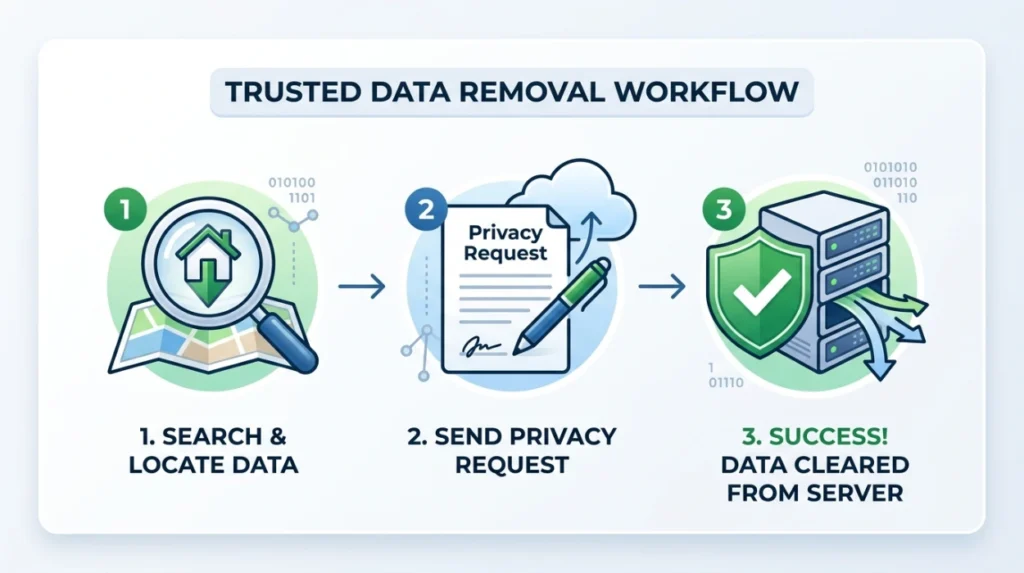
Clear Your Name follows a structured reputation management process that focuses on identifying personal information, evaluating publication authority, and applying the appropriate removal pathway for each source. This systematic approach improves control over search visibility while reducing unnecessary risk.
The removal process generally includes:
- Identify every indexed webpage containing residential address information through comprehensive search analysis.
- Evaluate the legal basis supporting publication to determine the most effective removal mechanism.
- Submit appropriate privacy or removal requests to qualifying organisations processing personal information.
- Monitor indexing updates to measure changes in search visibility and reputation signals.
- Verify that removed information no longer contributes to ongoing search perception influence.
Each stage contributes directly to long-term SERP control because removing information from authoritative sources reduces future indexing opportunities. Continuous monitoring also identifies newly published information before it develops into persistent reputation signals.
This structured methodology improves process transparency while ensuring reputation management decisions remain evidence-based rather than reactive.
How Do Personal Information Removal Services Strengthen Entity Credibility?
Personal Information Removal Services strengthen entity credibility by improving the consistency and accuracy of information associated with an individual’s digital identity. Search engines evaluate entities through relationships between indexed sources rather than isolated webpages.
Conflicting residential addresses, duplicated records, outdated directory listings, and historical commercial databases introduce unnecessary complexity into search ecosystems. Search algorithms analyse these inconsistencies when evaluating information reliability and entity relationships.
Removing unnecessary references simplifies search interpretation. Authoritative sources become easier for algorithms to evaluate because fewer conflicting signals remain available. This improves entity credibility while reducing ambiguity across search engine results pages.
Better information consistency also contributes to stronger digital trust because publicly available data reflects current, accurate, and relevant information rather than outdated publications.
Why Is Professional Reputation Management More Effective Than Individual Removal Attempts?
Professional reputation management delivers greater consistency because it combines search ecosystem analysis, privacy evaluation, publication assessment, and ongoing monitoring into a coordinated process. Individual removal attempts often focus on isolated websites rather than the broader network of indexed information.
Personal information rarely exists on only one platform. Commercial databases share information with affiliated publishers, archived webpages preserve historical versions, and syndicated datasets continue distributing identical records across multiple domains. Addressing only one source leaves remaining reputation signals unchanged. Understanding how to remove your home address from the internet using UK privacy rights provides the legal framework needed to evaluate the most appropriate removal approach before implementation.
Professional analysis evaluates relationships between publishers rather than treating each website independently. This approach identifies primary publication sources, secondary data distributors, and indexing patterns that influence long-term search visibility.
Clear Your Name applies this structured evaluation process to improve information governance while reducing unnecessary exposure across search ecosystems. By focusing on the origin of published information instead of isolated search results, the process delivers more sustainable improvements in search perception and entity credibility.
Which Benefits Demonstrate the Long-Term Value of Personal Information Removal Services?
Personal Information Removal Services deliver long-term value by reducing unnecessary personal data exposure, improving search perception, and strengthening control over digital identity. Sustainable reputation management focuses on controlling information at its source rather than repeatedly responding to new search results.
The long-term benefits include:
- Reduce unnecessary personal data exposure by removing information from eligible websites before further indexing occurs.
- Strengthen entity credibility through accurate and consistent reputation signals across search ecosystems.
- Improve SERP control by decreasing the number of authoritative sources publishing identical residential information.
- Stabilise search perception by limiting conflicting or outdated address records.
- Support long-term digital privacy through continuous monitoring and information governance.
Each benefit contributes to measurable improvements because search engines continuously evaluate information quality, authority, and consistency when determining search visibility.
Dive Deeper With Our Expert Guides:
Remove Your Personal Data From Websites Using Our UK Privacy Service
Submit a GDPR Right to Erasure Request With Professional UK Legal Support
How Quickly Does Home Address Removal Influence Search Results?
Home address removal influences search results through the search engine indexing cycle rather than instant deletion. Search ecosystems continuously revisit webpages, compare updated content, and replace previous indexed versions according to crawl frequency and content authority.
Removing information from the original source immediately stops that page from providing ongoing reputation signals. Search engines subsequently recognise those changes during recrawling, allowing outdated indexed content to disappear over time. The overall speed depends on website authority, crawl schedules, and the number of remaining websites publishing identical information.
Information distributed across multiple commercial databases requires coordinated removal because each source contributes independently to search visibility. A structured process therefore delivers more consistent improvements than isolated requests directed at individual websites.
This systematic approach strengthens long-term SERP control because it reduces the number of authoritative references available for future indexing.
Why Is Risk Reduction an Essential Part of Reputation Management?
Risk reduction forms a central objective of reputation management because unnecessary personal information increases exposure across search ecosystems. Search engines continuously organise publicly accessible data, making accurate information governance essential for maintaining control over digital identity.
Residential address information contributes to entity relationships that extend beyond property records alone. Directory listings, archived webpages, commercial databases, and public profiles combine to expand an individual’s digital footprint. Search algorithms evaluate these interconnected reputation signals when presenting search results.
Reducing unnecessary publications decreases information duplication while improving search perception influence. Fewer indexed references create stronger information consistency, allowing search ecosystems to evaluate entity credibility more accurately.
Professional Personal Information Removal Services therefore reduce long-term exposure by addressing the sources responsible for generating ongoing reputation signals instead of concentrating solely on visible search results.
Which Reputation Management Solution Provides the Best Balance Between Privacy and Search Visibility?
A structured removal strategy provides the strongest balance because it protects personal privacy while maintaining accurate search visibility. Reputation management succeeds when publicly available information reflects legitimate, relevant, and current entity relationships rather than unnecessary personal exposure.
Search engines reward information quality through authority, consistency, and contextual relevance. Eliminating unnecessary residential address publications improves these evaluation factors by reducing conflicting data points. Better information governance creates stronger entity credibility without interfering with legitimate public records that remain legally accessible.
During this evaluation process, individuals researching personal information removal services often benefit from understanding why home addresses appear online before selecting an appropriate removal strategy. Analysing UK privacy rights for home address removal also provides valuable context regarding the legal mechanisms available for reducing unnecessary exposure.
This combination of education, legal understanding, and structured implementation supports sustainable reputation management because every decision is based on information quality rather than temporary visibility changes.
Why Choose Clear Your Name for Personal Information Removal?
Clear Your Name delivers a structured and transparent approach to Personal Information Removal Services by combining search ecosystem analysis, publication assessment, legal evaluation, and ongoing monitoring into one coordinated process. Each stage focuses on improving search perception while reducing unnecessary personal information exposure.
The process begins by identifying all indexed references connected to a residential address before evaluating the legal basis for publication. Removal requests are then directed toward qualifying publishers, while continuous monitoring measures indexing updates and changes in reputation signals. This methodology improves process clarity because every action contributes directly to stronger SERP control and better entity credibility.
Rather than relying on temporary visibility adjustments, Clear Your Name prioritises source-level information governance that produces sustainable search improvements. This evidence-based approach reduces long-term exposure while strengthening digital trust through accurate and consistent online information.
Removing a home address from the internet requires more than submitting isolated removal requests. Effective Personal Information Removal Services combine source identification, legal assessment, structured removal, and continuous monitoring to improve search visibility, strengthen entity credibility, and reduce unnecessary reputation signals across search ecosystems.
A coordinated reputation management process delivers sustainable outcomes because it addresses the origin of published information rather than focusing solely on search rankings. Through transparent methodology, measurable progress, and long-term information governance, Clear Your Name provides a reliable framework for individuals seeking stronger control over their digital footprint while maintaining accurate and trustworthy search perception.
How can I remove my home address from the internet in the UK?
You can remove your home address by identifying the websites that publish it and submitting removal or privacy requests where eligible under UK data protection laws. Personal Information Removal Services also help manage information across multiple data sources and search results.
What websites are most likely to publish my home address?
Home addresses commonly appear on data broker websites, people-search directories, property databases, business listings, and some public records. These websites collect information from lawful public and commercial data sources that search engines can index.
How long does it take for my home address to disappear from Google after removal?
Once the source website removes your home address, search engines update their indexes during future crawling cycles. The timeframe depends on how frequently the page is crawled and whether the same information exists on other websites.
Are Personal Information Removal Services effective for protecting online privacy?
Personal Information Removal Services improve online privacy by reducing unnecessary personal information across eligible websites and limiting search visibility. They focus on removing information at the source, which supports stronger long-term reputation management.
How does Clear Your Name approach home address removal?
Clear Your Name follows a structured process that identifies where personal information appears, evaluates removal eligibility, and monitors search indexing after requests are completed. This approach supports improved search visibility, stronger entity credibility, and better control over your digital footprint.