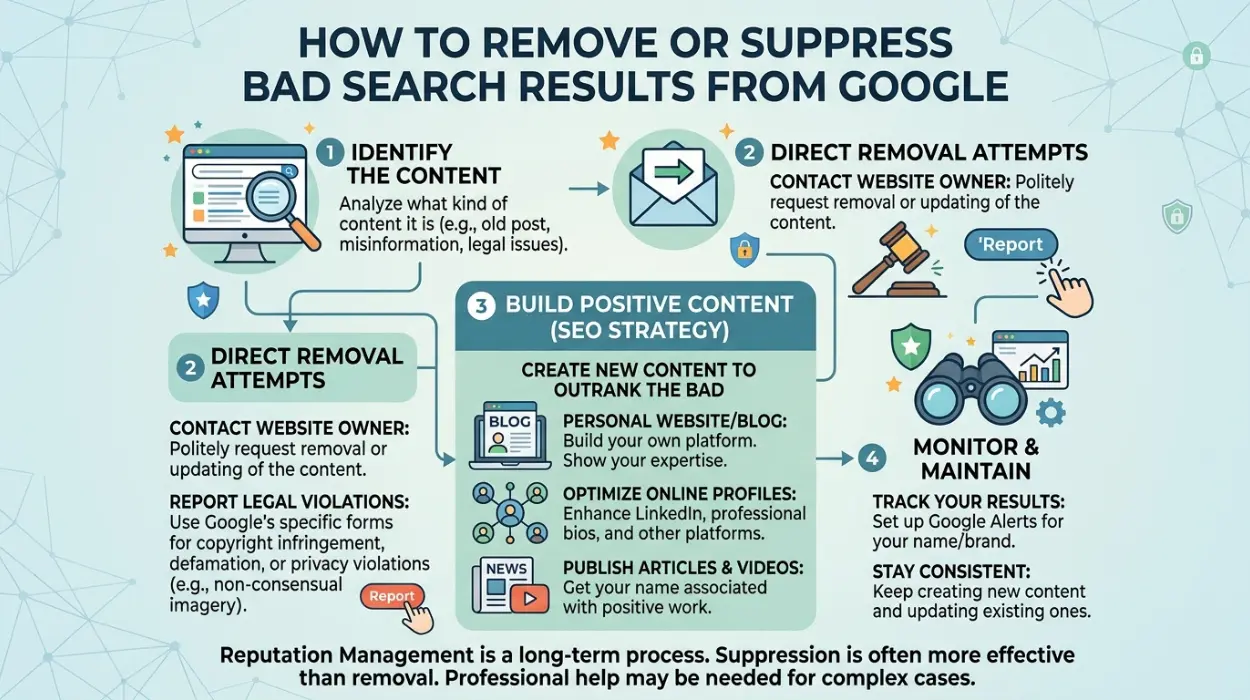
Removing bad search results from Google depends on the type of content, its legal status, indexing behaviour, and the mechanisms available within search ecosystems. Reputation management strategies differ based on the source of the content, search ranking influence, entity credibility, and the long-term sustainability of different reputation control methods.
Online reputation control methods are evaluated through their ability to influence search visibility, strengthen reputation signals, and improve entity perception without disrupting search quality standards. Google continuously analyses indexed information, authority relationships, and user intent when determining how search results appear within search engine results pages (SERPs). Understanding the strengths and limitations of different approaches provides a clearer framework for evaluating reputation management strategies.
What Methods Can Remove Bad Search Results from Google?
Removing bad search results from Google involves different approaches depending on whether the objective is eliminating indexed content, reducing its visibility, or improving the overall balance of reputation signals within search ecosystems.
Content removal is one approach that operates by eliminating information from its original source or requesting de-indexing where applicable. This method directly affects search visibility because search engines rely on accessible webpages to generate indexed results. When content no longer exists or becomes inaccessible for indexing, search systems gradually update their searchable databases during subsequent crawling cycles.
Content suppression represents a different mechanism. Rather than removing existing information, it improves the visibility of authoritative and relevant content that better represents an entity. Search engines evaluate topical authority, semantic relevance, and content quality when determining which documents deserve stronger ranking positions. Suppression therefore changes SERP composition instead of deleting information.
Both approaches influence reputation signals differently. Content removal changes the availability of indexed information, whereas content suppression changes the relative prominence of information already available within search ecosystems. The effectiveness of each method depends upon content authority, indexing behaviour, and search ranking influence.
How Does Content Removal Compare with Content Suppression?
Content removal and content suppression represent two distinct reputation management strategies that operate through different search mechanisms.
Content removal is the process of eliminating searchable information from its source or making it unavailable for indexing. When successful, search engines eventually remove the corresponding search result after re-crawling and updating their indexes. This approach directly affects the searchable presence of specific webpages but depends entirely on the availability of recognised removal mechanisms.
Content suppression operates by strengthening competing reputation signals rather than altering the original publication. Search algorithms compare authority, freshness, semantic relevance, and user value when arranging results. As stronger content develops greater search ranking influence, lower-ranking pages receive reduced visibility within branded search queries.
The comparison highlights different strategic characteristics. Removal changes indexed availability, whereas suppression changes ranking distribution. Removal often delivers immediate structural changes when applicable, while suppression focuses on long-term search visibility through sustained authority development.
Which approach provides longer-term search visibility benefits?
Long-term search visibility generally depends on the consistency of authoritative reputation signals rather than isolated ranking changes. Content suppression strengthens entity credibility across multiple trusted sources, whereas content removal addresses the presence of specific indexed documents. Both mechanisms influence SERP composition through different evaluation processes.
How Do Search Engines Evaluate Bad Search Results?
Search engines evaluate bad search results according to relevance, authority, factual consistency, content quality, and user intent rather than subjective opinions regarding whether information is favourable or unfavourable.
Google analyses webpages through automated systems that interpret semantic relationships, publication authority, structured information, and overall content quality. Reputation signals emerge from these interconnected evaluations instead of isolated keywords. Search ranking influence therefore reflects the strength of indexed information within broader search ecosystems.
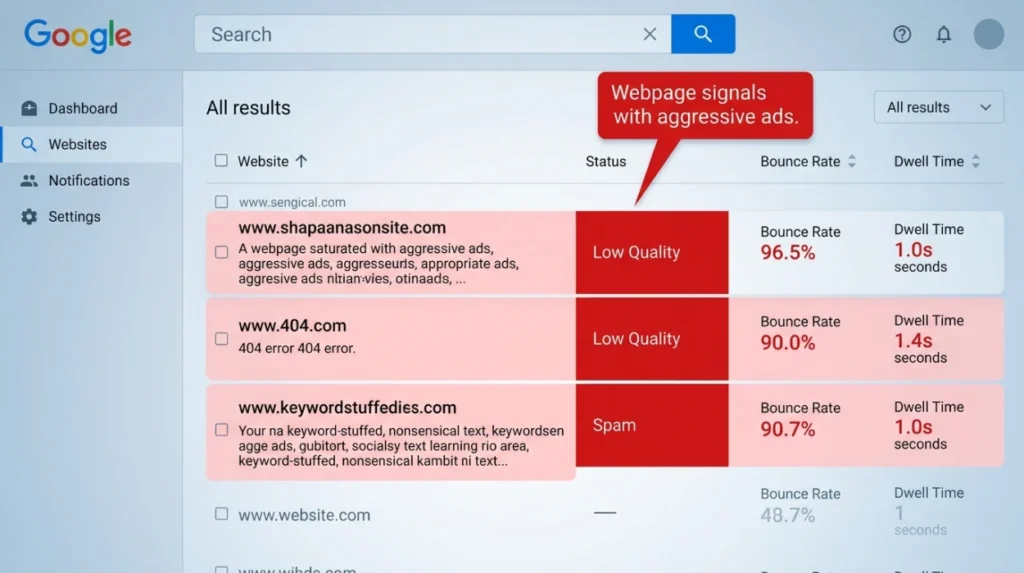
Authority plays a central role in search evaluation. Information published by recognised media organisations, government websites, legal resources, or established institutions carries stronger credibility signals because these sources demonstrate editorial standards and factual reliability. Lower-authority webpages receive proportionally less influence when competing against trusted publications.
Search engines also evaluate content freshness alongside historical relevance. Newly published authoritative information provides updated context that complements existing indexed documents, while historically important publications continue contributing long-term entity associations. SERP composition therefore reflects both current relevance and established authority.
What Is the Difference Between Organic and Reactive Reputation Management?
Organic reputation management is the continuous development of authoritative digital assets that strengthen entity credibility before reputation issues emerge. Reactive reputation management focuses on analysing and responding to information that has already affected search visibility or public perception.
Organic approaches operate through long-term content development, authoritative publishing, structured data improvements, and consistent entity associations. Search engines interpret these signals gradually, strengthening topical authority and semantic understanding over time. This process contributes to stable reputation signals across branded search queries.
Reactive approaches evaluate existing indexed content to determine which reputation management methods are applicable. Analysis often includes assessing publication authority, indexing status, legal considerations, and search ranking influence before selecting an appropriate response. The objective is to understand how existing information affects SERP composition rather than immediately altering search results.
Comparing these approaches demonstrates different strategic purposes. Organic methods strengthen long-term entity credibility through continuous information development, whereas reactive methods analyse existing search environments to address current reputation challenges. Both contribute to overall online reputation but operate at different stages of digital reputation management.
Why Does Entity Credibility Influence Search Rankings?
Entity credibility is the degree of confidence search engines assign to a recognised person, organisation, or brand based on consistent, authoritative, and verifiable information across search ecosystems.
Search algorithms establish entity credibility by comparing structured information, authoritative citations, publication quality, and semantic consistency. Every indexed reference contributes additional context that strengthens or weakens overall entity understanding. Consistent factual relationships improve search certainty and reduce ambiguity surrounding recognised entities.
Entity credibility also influences search ranking evaluation because trusted entities frequently receive stronger contextual relevance across related topics. Search engines compare historical authority, recognised expertise, and interconnected reputation signals before determining ranking prominence. These evaluations improve the accuracy of search results by favouring well-supported information over isolated or inconsistent references.
High entity credibility also strengthens knowledge graph associations and semantic recognition throughout search ecosystems. As search engines improve confidence in entity relationships, they organise information more effectively across branded searches, related topics, and enhanced SERP features. This interconnected evaluation explains why credibility remains a central component of long-term online reputation management.
How Do Short-Term and Long-Term Reputation Strategies Compare?
Short-term and long-term reputation strategies differ in their objectives, sustainability, and influence on search visibility. Short-term approaches focus on addressing immediate search perception issues, while long-term strategies establish durable reputation signals that strengthen entity credibility over time. Search engines evaluate both approaches according to the quality, consistency, and authority of indexed information rather than the speed of implementation.
Short-term methods often concentrate on analysing existing search results, identifying high-visibility content, and evaluating available removal or suppression mechanisms. These activities provide an understanding of how current SERP composition affects digital reputation. Their effectiveness depends on the authority of existing content and the technical feasibility of influencing indexed results.
Long-term strategies operate through continuous improvement of authoritative content, entity consistency, structured information, and trusted digital assets. Search ecosystems reward sustained quality because algorithms compare long-term authority with temporary ranking fluctuations. This creates more stable reputation signals that remain resilient as search indexes evolve.
Comparing both approaches demonstrates that immediate visibility changes do not always produce lasting improvements in entity perception. Long-term reputation development provides stronger search ranking influence because it aligns with the way search engines continuously evaluate authority, credibility, and semantic relevance.
Dive Deeper With Our Expert Guides:
Reputation Protection Services for CEOs and Executives
Best Ways to Remove Unwanted Content from Internet
How Does Content Enhancement Compare with Content Suppression?
Content enhancement and content suppression are complementary reputation management methods that influence search ecosystems through different mechanisms. Content enhancement focuses on improving the quality, relevance, and authority of digital assets, while content suppression aims to reduce the prominence of less favourable information by increasing the visibility of stronger content.
Content enhancement operates by expanding authoritative information that accurately represents an entity. Official biographies, expert articles, interviews, and trusted publications strengthen semantic relationships and improve entity credibility. Search engines interpret these signals as evidence of expertise, consistency, and topical relevance.
Content suppression works through ranking competition rather than direct modification of existing pages. Higher-authority content earns stronger search ranking influence, causing less authoritative pages to occupy lower positions within SERPs. This approach changes the overall distribution of reputation signals without removing previously indexed information.
Comparative analysis demonstrates that content enhancement strengthens the foundation of digital credibility, whereas content suppression influences the visibility balance across search results. Together they affect SERP composition through different but interconnected evaluation processes.
How do search engines interpret enhanced content?
Enhanced content refers to authoritative information that provides greater topical relevance, factual accuracy, and semantic depth. Search algorithms evaluate these characteristics alongside entity relationships, publication quality, and user intent to determine how prominently the content appears within search results.
What Factors Determine the Effectiveness of Reputation Management Methods?
The effectiveness of reputation management methods is determined by the interaction between search algorithms, authority signals, indexing behaviour, and entity credibility. Search engines analyse the overall quality of available information rather than relying on a single ranking factor when evaluating reputation-related content.
Authority remains one of the strongest evaluation signals because credible publications provide reliable context for entity recognition. Search systems compare editorial quality, citation relationships, semantic relevance, and publication trust before assigning ranking influence. These assessments help determine which information contributes most significantly to online reputation.
Scalability also affects strategic evaluation. Methods that strengthen multiple authoritative assets across trusted platforms create broader reputation signals than isolated actions targeting individual webpages. Search ecosystems interpret interconnected authority more effectively because consistent information improves semantic understanding.
Risk exposure varies between different approaches. Strategies based on factual accuracy, authoritative publishing, and transparent information align closely with search quality principles, while approaches that rely on artificial manipulation conflict with long-term algorithmic evaluation. Sustainable reputation management therefore depends upon methods that strengthen genuine entity credibility.
Why Is Sustainability Important in Search Reputation Management?
Sustainability refers to the ability of a reputation management strategy to maintain consistent search visibility and entity credibility despite ongoing algorithm updates and continuous content indexing. Search ecosystems constantly reassess digital information, making long-term stability more valuable than temporary ranking improvements.
Sustainable methods strengthen reputation signals by maintaining accurate, authoritative, and regularly updated information across trusted digital sources. Search engines recognise these consistent patterns and reinforce entity understanding through repeated semantic evaluation. Stable information therefore contributes to reliable search visibility over extended periods.
Unsustainable approaches frequently depend on temporary ranking fluctuations or isolated technical changes that provide limited long-term value. As search indexes expand and algorithms refine quality assessments, inconsistent reputation signals lose relative influence. Search ranking stability therefore depends upon continuous authority rather than isolated interventions.
Evaluating sustainability highlights the importance of aligning reputation management with the way search ecosystems naturally organise and interpret digital information. Long-term credibility remains more resilient because it reflects enduring semantic relationships rather than short-lived ranking changes.
Throughout the evaluation of removal methods, suppression strategies, entity credibility, and search visibility, the principles associated with Online Reputation & Content Removal provide a broader understanding of how different reputation management approaches influence indexed information and overall SERP composition.
Removing bad search results from Google involves evaluating multiple reputation management approaches rather than relying on a single method. Content removal, content suppression, content enhancement, organic reputation development, and reactive analysis each operate through different mechanisms that influence search visibility, entity credibility, and reputation signals. Search engines continuously assess authority, semantic relevance, indexing behaviour, and content quality when determining SERP composition. Understanding the differences between these approaches provides a structured framework for evaluating effectiveness, sustainability, scalability, and long-term influence within modern search ecosystems.
How can bad search results be removed from Google?
Bad search results can be removed from Google if the content qualifies under Google’s removal policies or is removed from the original website. When removal is not possible, online reputation and content removal strategies often focus on improving search visibility for more authoritative content.
Does Google remove negative search results automatically?
Google does not automatically remove negative search results simply because they are unfavourable. Search engines evaluate content based on relevance, authority, indexing status, and compliance with removal policies rather than public opinion.
What is the difference between content removal and content suppression?
Content removal eliminates a webpage from its original source or Google’s index when applicable. Content suppression improves the visibility of authoritative content so lower-ranking pages become less prominent within search engine results pages (SERPs).
How long does it take for Google to update removed search results?
The time depends on how quickly Google re-crawls and re-indexes the affected webpages. Once content is removed or significantly changed, search results are updated after Google’s indexing systems process the new information.
Why is online reputation and content removal important for search visibility?
Online Reputation & Content Removal helps evaluate methods for reducing the visibility of harmful or outdated content while strengthening accurate reputation signals. It supports better entity credibility, balanced SERP composition, and improved digital reputation across search ecosystems.