
Reputation management is the process of understanding how information influences public perception across search ecosystems and digital platforms. Online reputation refers to the collection of indexed content, authority signals, reviews, and entity associations that shape how individuals are evaluated in search results.
Senior executives and chief executive officers occupy highly visible positions within search ecosystems because their names are closely associated with corporate entities, leadership decisions, media coverage, regulatory announcements, and professional achievements. Search engines continuously evaluate publicly available information and organise it into search engine results pages (SERPs), creating a digital representation of an executive’s credibility. Reputation protection therefore represents the study of how search systems interpret information, authority, and trust rather than a single action applied to online content. Understanding these mechanisms explains why executive reputations remain closely connected to search visibility, entity perception, and long-term digital credibility.
What Are Reputation Protection Services for CEOs and Executives?
Reputation protection services for CEOs and executives refer to the structured discipline of preserving positive entity perception by understanding how search ecosystems interpret, organise, and evaluate publicly available information.
Executive reputation differs from consumer reputation because search engines associate senior leaders with corporate entities, public communications, financial performance, regulatory activity, and industry recognition. Every indexed document contributes additional reputation signals that help search algorithms evaluate authority and credibility. Search visibility therefore reflects the cumulative relationship between digital content rather than isolated webpages.
Reputation protection focuses on analysing how search ecosystems process information across multiple sources. Articles, interviews, press releases, corporate biographies, professional profiles, conference appearances, review platforms, and knowledge panels collectively define an executive’s searchable identity. Search engines compare these sources to establish entity consistency and determine whether information appears trustworthy.
The concept also extends beyond search rankings. Reputation includes how users interpret information once it appears within SERPs. Headlines, publication authority, structured data, image indexing, and content freshness all contribute to perception before a webpage receives a click. Search evaluation therefore combines technical indexing with behavioural interpretation.
Why Do CEOs and Executives Have Distinct Digital Reputations?
Chief executives develop distinct online reputations because search engines classify them as individual entities connected to organisations, industries, and authoritative information sources.
Entity perception defines how search systems understand a person independently from the organisation they represent. A CEO’s digital identity contains relationships with companies, board memberships, interviews, awards, publications, and news coverage. These interconnected signals enable search engines to build comprehensive entity profiles that extend beyond simple keyword matching.
Corporate announcements frequently influence executive search visibility because algorithms recognise semantic relationships between organisational developments and executive leadership. Financial reports, mergers, acquisitions, regulatory investigations, executive appointments, and strategic initiatives generate new indexed content that strengthens or changes entity associations. Search ecosystems therefore evaluate leaders alongside their organisations rather than in isolation.
Search engines also compare information consistency across trusted domains. Official biographies, professional networking profiles, government records, respected publications, and verified corporate websites reinforce entity accuracy when factual details remain aligned. Consistent information improves search understanding and reduces ambiguity surrounding executive identities.
How Does Entity Association Influence Executive Visibility?
Entity association refers to the semantic relationships connecting an executive with organisations, products, industries, events, and recognised institutions. Search algorithms evaluate these relationships to improve entity recognition and contextual relevance. Strong entity associations help search engines distinguish individuals with similar names while organising accurate knowledge across search results.
How Is Executive Reputation Formed Within Search Ecosystems?
Executive reputation is formed through the continuous indexing, categorisation, and evaluation of information published across authoritative digital sources.
Search engines begin by discovering publicly accessible content through crawling processes. Crawlers identify webpages, documents, multimedia assets, structured data, and metadata before storing them within searchable indexes. Indexed information becomes eligible for evaluation whenever users search for an executive’s name or related topics.
Algorithms then analyse semantic relevance between documents. Rather than evaluating isolated webpages, search systems interpret contextual relationships across publications, organisations, citations, and recognised entities. Repeated references from authoritative sources strengthen topical associations, helping algorithms define expertise, credibility, and relevance.
Content freshness also influences search evaluation. Newly indexed information provides updated context regarding leadership positions, public statements, awards, regulatory developments, or company announcements. Search engines compare fresh information with historical content to maintain accurate entity understanding while preserving authoritative historical records.
User interaction contributes additional interpretation signals after content appears within SERPs. Click behaviour, engagement patterns, and query refinement indicate whether indexed content satisfies informational intent. These behavioural signals complement content quality rather than replacing authority evaluation, allowing search systems to refine result presentation over time.
How Do Search Engines Evaluate Trust and Credibility?
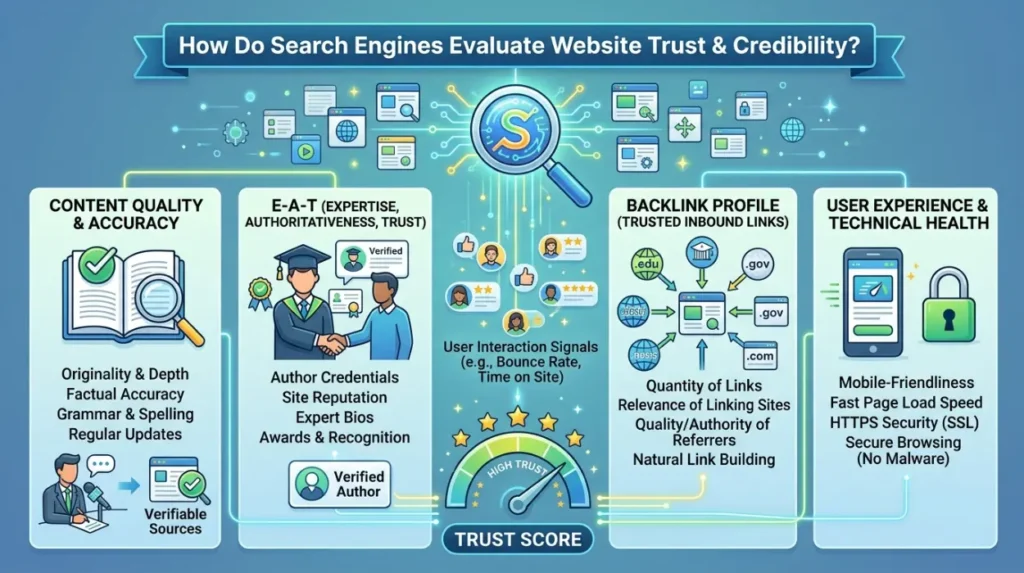
Search engines evaluate trust and credibility by analysing authority signals, information consistency, source quality, and entity relationships across indexed content.
Authority begins with source evaluation. Publications recognised for editorial standards, factual accuracy, and subject expertise contribute stronger reputation signals than low-quality or duplicated sources. Search algorithms examine publication history, citation relationships, editorial transparency, and topical expertise when interpreting credibility.
Information consistency strengthens entity confidence throughout search ecosystems. Matching employment history, executive biographies, educational credentials, leadership roles, and corporate affiliations across trusted sources reinforce entity accuracy. Contradictory information weakens semantic certainty and increases ambiguity during SERP evaluation.
Reputation signals also emerge from structured information. Schema markup, verified organisational profiles, knowledge graph connections, and clearly defined authorship enable search systems to interpret factual relationships more efficiently. Structured data therefore enhances entity understanding by reducing uncertainty surrounding identity and context.
Trust evaluation extends beyond technical optimisation because algorithms analyse relationships between content quality and authoritative references. Citations from recognised organisations, industry publications, academic resources, and established media outlets collectively demonstrate credibility through corroborated information rather than isolated claims.
What Role Does Content Indexing Play in Reputation Protection?
Content indexing refers to the process through which search engines discover, process, classify, and store digital information for retrieval within search results.
Indexing forms the foundation of online reputation because information cannot influence search visibility until it becomes part of searchable databases. Crawlers first identify accessible content before algorithms determine relevance, topical relationships, language, publication quality, and technical accessibility. Successful indexing enables search engines to compare documents across broader knowledge networks.
Different forms of content contribute unique reputation signals after indexing. News articles establish topical authority through editorial reporting, professional biographies define identity attributes, interviews reinforce expertise, multimedia assets strengthen entity recognition, and official organisational pages validate factual information. Together these indexed assets create a comprehensive representation of executive credibility.
Search ecosystems continuously reassess indexed information rather than treating indexing as a one-time event. Updated publications, revised structured data, newly discovered citations, and refreshed webpages modify entity understanding over time. This ongoing evaluation explains why digital reputation evolves as search engines process additional information across interconnected sources.
How Do Search Engine Results Pages Shape Executive Reputation?
Search engine results pages (SERPs) shape executive reputation by determining which information receives the greatest visibility for branded searches. Every result displayed on the first page contributes to the overall interpretation of an executive’s professional identity. Search engines prioritise information according to relevance, authority, freshness, and entity relationships rather than publication date alone. SERP evaluation therefore represents both technical ranking processes and semantic understanding of available information.
Organic search results frequently include news articles, official biographies, corporate websites, interviews, multimedia content, and knowledge panels. Each content type provides distinct reputation signals that collectively influence entity perception. Search algorithms compare the authority and topical relevance of these sources before arranging them within search results. The order of indexed information therefore affects the visibility of specific narratives without altering their factual content.
Search features also influence perception before users select a result. Featured snippets, image packs, video results, news carousels, and knowledge panels provide immediate contextual information directly within SERPs. These elements increase the importance of structured information because search systems rely on verified data to generate enhanced search features. Executive reputation therefore extends beyond webpage rankings to include every visible search component.
Dive Deeper With Our Expert Guides:
Best Ways to Remove Unwanted Content from Internet
How to Remove Your Name from Google Search Results
How Do Review Signals Influence Trust and Credibility?
Review signals represent measurable indicators of public evaluation that search ecosystems analyse alongside broader authority and relevance signals. Although CEOs rarely receive consumer-style reviews in the same way as products or local businesses, search engines still interpret feedback, editorial commentary, industry recognition, and professional evaluations as reputation signals. These references contribute contextual information that strengthens or weakens entity perception.
Sentiment interpretation examines the overall context surrounding indexed content rather than isolated positive or negative words. Search algorithms analyse semantic relationships, publication quality, author credibility, and topical relevance to understand how information contributes to public perception. This process enables search systems to evaluate credibility through patterns instead of individual statements.
Authority also influences the significance of review-related signals. Commentary published by recognised media organisations, respected industry journals, or established institutions contributes stronger contextual value than anonymous or low-authority sources. Search ecosystems therefore evaluate both the content itself and the credibility of the source that publishes it.
What is sentiment interpretation within search ecosystems?
Sentiment interpretation refers to the analytical process through which search systems evaluate the overall context, tone, and semantic relationships contained within indexed content. Rather than assigning simple positive or negative labels, algorithms examine how language, authority, and contextual associations influence entity perception across search results.
Why Do Authority Signals Strengthen Executive Reputation?
Authority signals define the credibility of information according to the expertise, reliability, and trustworthiness of its source. Search engines analyse these signals to determine whether indexed content represents dependable information suitable for prominent search visibility. Executive reputation therefore becomes closely associated with authoritative publishing environments.
Authority emerges through consistent publication standards, editorial oversight, factual accuracy, recognised expertise, and established domain credibility. Search systems compare these characteristics across multiple sources before assigning contextual importance to individual documents. High-authority publications strengthen semantic confidence because their information aligns with recognised standards of accuracy.
Entity relationships further reinforce authority. Consistent references from respected organisations, professional associations, academic institutions, regulatory bodies, and established publications create interconnected credibility signals that improve search understanding. These relationships help search algorithms evaluate an executive’s digital footprint through corroborated information rather than isolated references.
How Does a Digital Footprint Affect Long-Term Reputation?
A digital footprint refers to the complete collection of searchable information associated with an individual across online platforms, publications, multimedia assets, databases, and indexed documents. Every publicly accessible record contributes additional context that search systems evaluate when interpreting entity perception. Digital footprints therefore evolve continuously as new information enters searchable indexes.
Search engines connect information across multiple domains using semantic relationships rather than exact keyword matching. Professional biographies, interviews, conference presentations, articles, corporate announcements, and publicly available documents collectively define an executive’s searchable identity. These interconnected references enable algorithms to establish long-term entity consistency.
Digital footprints also demonstrate historical continuity. Older authoritative publications remain valuable because they provide contextual background that complements newly indexed information. Search ecosystems therefore balance historical authority with current relevance to maintain accurate entity understanding across evolving search environments.
Why Does Entity Perception Matter in Reputation Management?
Entity perception refers to the way search engines identify, classify, and connect a person with related organisations, industries, achievements, publications, and recognised topics. It forms the foundation of modern search evaluation because algorithms increasingly interpret entities instead of relying exclusively on keyword matching. Executive reputation therefore depends upon accurate semantic understanding across interconnected information sources.
Strong entity perception improves search clarity by reducing ambiguity between individuals with similar names or overlapping professional histories. Search systems compare factual relationships, structured information, citations, and authoritative references to determine whether indexed content belongs to the same recognised entity. This process strengthens consistency throughout search results.
Entity perception also influences knowledge graph development, enhanced search features, and contextual ranking decisions. When search engines establish clear semantic relationships between an executive and recognised organisations, they improve the accuracy of search visibility across branded queries. Reputation management therefore remains closely connected to entity recognition rather than isolated content performance.
Throughout this discussion, the principles surrounding Online Reputation & Content Removal connect directly with broader understanding of entity perception, search visibility, and digital credibility by explaining how indexed information influences long-term reputation within search ecosystems.
Reputation protection for CEOs and executives represents the systematic understanding of how search ecosystems discover, classify, interpret, and rank publicly available information. Executive reputation develops through the interaction of content indexing, authority signals, entity perception, review interpretation, digital footprints, and SERP evaluation rather than through isolated webpages or individual publications. Search engines continuously refine these relationships to improve the accuracy and relevance of searchable information. Understanding these mechanisms provides a clearer view of how digital credibility is established, maintained, and interpreted across modern search environments.
What are reputation protection services for CEOs and executives?
Reputation protection services for CEOs and executives focus on managing how publicly available information appears across search engines and digital platforms. They often involve monitoring search visibility, improving entity perception, and addressing content that affects online reputation.
Why is online reputation important for CEOs and executives?
A CEO’s online reputation influences stakeholder confidence, media perception, investor trust, and business credibility. Search engines display indexed content that shapes first impressions, making reputation management an important part of executive visibility.
How do search engines evaluate an executive’s online reputation?
Search engines evaluate executive reputation using signals such as content indexing, source authority, entity relationships, review sentiment, and overall search relevance. These reputation signals help determine how information is organised and presented within search engine results pages (SERPs).
Can negative search results affect a CEO’s professional reputation?
Yes, negative search results can influence how investors, clients, employees, and business partners perceive an executive before direct interaction. The visibility, authority, and context of indexed content all contribute to overall online reputation and entity perception.
What is the difference between reputation protection and online reputation & content removal?
Reputation protection focuses on maintaining positive search visibility, strengthening credibility, and improving digital reputation over time. Online Reputation & Content Removal specifically addresses the removal or reduction of harmful or unwanted online content where appropriate and legally possible.