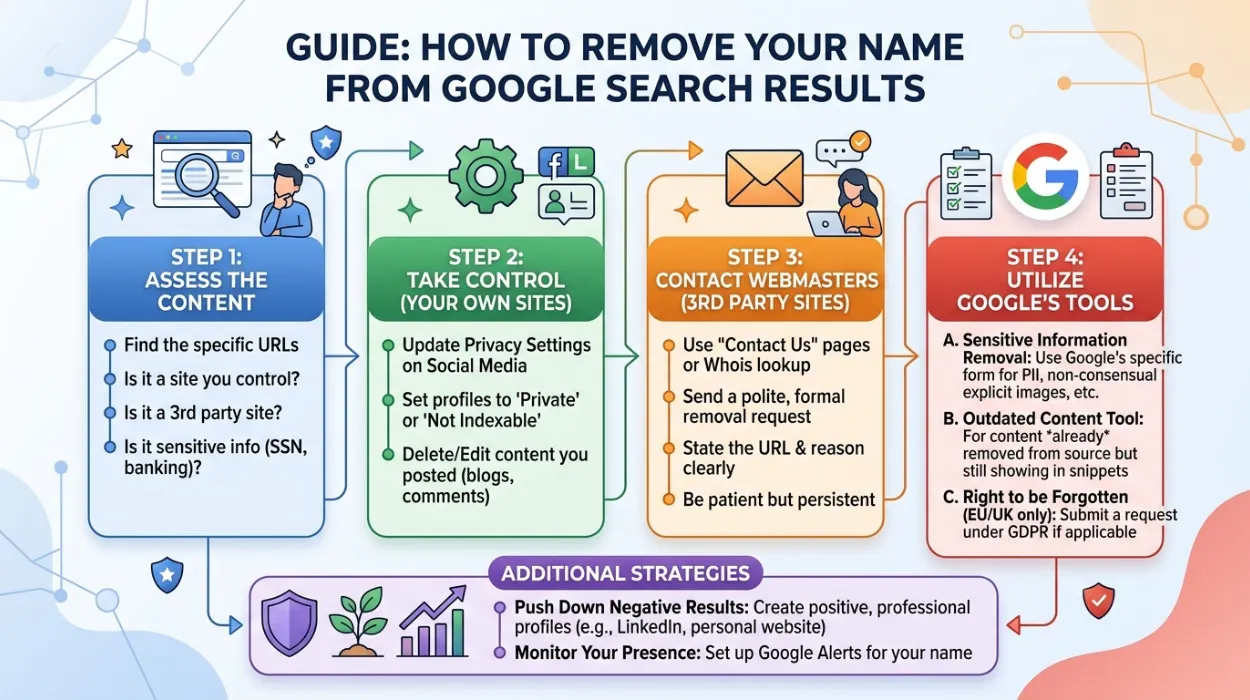
Removing your name from Google Search results refers to reducing or eliminating the visibility of indexed information associated with an identifiable person where removal mechanisms apply.
Reputation management is the structured analysis of digital information that influences search visibility, while online reputation refers to the collection of indexed content, reputation signals, and entity associations that search engines use to evaluate credibility.
Search engines organise information rather than create it. Google indexes publicly accessible webpages, evaluates their relevance and authority, and determines where they appear within Search Engine Results Pages (SERPs). Information connected to an individual’s name forms a searchable digital identity that evolves as new content is indexed and existing content is re-evaluated.
Name visibility in Google Search depends on relationships between indexed documents, authority signals, content freshness, and semantic entity recognition. Search algorithms continuously compare these signals to determine which information receives greater prominence. Understanding these mechanisms explains why some results remain visible for extended periods while others disappear following updates or removal requests.
What Does It Mean to Remove Your Name from Google Search Results?
Removing your name from Google Search results refers to limiting the appearance of indexed information associated with an individual through recognised search engine, legal, or publisher-controlled processes. The objective is not to erase an identity from the internet but to reduce the search visibility of specific indexed content where legitimate removal conditions exist.
Google does not host most online content. Instead, it indexes publicly available webpages and displays them when algorithms determine they satisfy user intent. As a result, removing a search result often involves changes at the original publishing source, content removal requests, or search engine de-indexing where policies permit.
Search ecosystems distinguish between removing content from a website and removing a URL from search results. A webpage deleted by the publisher eventually disappears from Google’s index after content indexing systems recognise the change. Alternatively, certain legal or policy-based requests allow search engines to remove specific search listings while the original webpage remains online.
The process relies on content indexing rather than manual search adjustments. Search visibility changes after search engines recrawl affected pages, reassess indexing status, and update SERP evaluation according to current information.
How Does Google Associate Your Name with Online Content?
Google associates names with online content through entity recognition, semantic relationships, structured data, and content indexing systems. Algorithms identify recurring references across multiple authoritative sources to build a coherent understanding of an individual’s digital identity.
Entity recognition analyses names alongside occupations, organisations, locations, publications, and contextual references. These semantic relationships allow search engines to distinguish between individuals who share identical names and strengthen entity perception when consistent information appears across trusted websites.
Structured information also contributes to name association. Author biographies, organisation profiles, professional directories, and schema markup provide additional signals that improve search engine understanding of identity relationships. These structured signals enhance the accuracy of SERP evaluation.
Repeated references across authoritative domains reinforce identity recognition. Employer websites, regulatory registers, academic publications, media coverage, and professional associations collectively strengthen Google’s confidence that indexed information belongs to the same identifiable entity.
Why Does Your Name Continue Appearing in Google Search Results?
Your name continues appearing in Google Search results because indexed information remains available within search ecosystems until algorithms detect significant changes affecting indexing or ranking eligibility. Search visibility depends upon the existence, authority, and relevance of publicly accessible content.
Content remains searchable while webpages continue existing on accessible domains. Search engine crawlers periodically revisit indexed pages to evaluate updates, technical accessibility, and content quality. If information remains unchanged and accessible, indexing generally continues.
Historical authority also contributes to persistent visibility. Older documents originating from established publishers frequently retain ranking strength because search algorithms continue recognising their credibility and relevance. Time alone does not remove indexed content from search results.
Search engines also preserve information consistency across digital ecosystems. Multiple authoritative references connected to the same individual reinforce entity perception, increasing the likelihood that related search results remain visible during future ranking evaluations.
What Role Does Content Indexing Play in Name Visibility?
Content indexing defines how searchable information becomes available within Google’s databases and influences the visibility of individual names in search results. Only indexed pages participate directly in ranking systems.
Google’s crawlers discover publicly accessible webpages before indexing systems analyse textual content, metadata, structured information, semantic relationships, and technical quality. After evaluation, eligible pages become searchable whenever relevant user queries occur.
Each indexed page introduces additional reputation signals associated with an individual’s name. Professional biographies, directory listings, interviews, academic research, business profiles, and news publications collectively strengthen entity recognition by expanding digital relationships.
Indexing also determines persistence. Pages remaining accessible continue contributing to digital identity until search engines recognise deletion, technical restrictions, or approved removal actions. Consequently, indexed content frequently remains visible despite reduced public attention.
How Do Search Engine Results Pages Influence Name Visibility?

Search Engine Results Pages determine which indexed information receives immediate attention when users search for an individual’s name. SERPs organise search results according to algorithmic relevance, authority, and user intent rather than chronological publication.
Higher-ranked documents receive greater visibility because users generally interact with the first results presented. Consequently, search visibility directly influences entity perception before detailed content evaluation occurs.
SERPs display multiple content formats simultaneously, including webpages, news articles, images, videos, knowledge panels, directory profiles, and review platforms. Each result contributes contextual information that expands public understanding of an individual’s digital footprint.
Search engine algorithms continuously reassess ranking positions using authority signals, content relevance, freshness, and user engagement patterns. This ongoing evaluation explains why name visibility changes gradually as search ecosystems process newly indexed information.
How Do Authority Signals Affect Search Visibility?
Authority signals define the level of confidence search engines assign to indexed information when determining ranking positions. These signals influence how prominently information associated with an individual’s name appears within Search Engine Results Pages (SERPs).
Authority develops through recognised publishers, government records, educational institutions, professional organisations, established media outlets, and trusted industry websites. Search algorithms evaluate these sources because they demonstrate editorial oversight and factual consistency. Strong authority signals increase confidence in entity perception and influence ranking stability.
Search engines compare authority across competing documents rather than evaluating pages in isolation. A page published on a highly trusted domain generally contributes stronger reputation signals than content hosted on an unknown website. This comparative evaluation helps search systems organise search results according to reliability and relevance.
Authority also interacts with semantic relationships. Consistent references across credible sources reinforce identity recognition, enabling search engines to develop a clearer understanding of the individual represented by indexed content.
How Do Trust Signals Influence Online Reputation?
Trust signals represent indicators that help search engines evaluate the reliability, consistency, and credibility of digital information connected to an identifiable individual. These signals support accurate entity interpretation throughout search ecosystems.
Trust develops through consistent professional details, verified organisational affiliations, transparent authorship, secure websites, and factual accuracy across multiple indexed sources. Search algorithms analyse these characteristics to determine whether information deserves greater search visibility.
Consistency remains a fundamental trust indicator. Matching names, professional roles, qualifications, and affiliations across authoritative websites reduce ambiguity during entity recognition. Inconsistent information introduces uncertainty that affects SERP evaluation.
Trust signals also influence long-term reputation stability. As search engines continuously reassess indexed information, reliable sources maintain stronger credibility within search ecosystems, supporting more consistent visibility across relevant searches.
Dive Deeper With Our Expert Guides:
Online Reputation Cleanup Services for Professionals
Remove Defamatory Content from Search Engines Legally
Why Does a Digital Footprint Continue Expanding?
A digital footprint refers to the complete collection of searchable information associated with an identifiable individual across online environments. It expands whenever additional content becomes publicly accessible and eligible for content indexing.
Professional biographies, business directories, media publications, interviews, conference presentations, social media profiles, regulatory records, and public databases collectively contribute to digital footprint development. Search engines connect these sources through semantic entity relationships that improve identity recognition.
Every newly indexed document introduces additional reputation signals into search ecosystems. Search algorithms compare fresh information with historical content to maintain accurate entity perception while refining search visibility. This continuous process explains why digital identities evolve over time.
Digital footprints also persist because archived information frequently remains accessible through authoritative websites. Search engines continue evaluating these sources until technical changes, removal requests, or publisher updates alter indexing eligibility.
How Do Content Ranking Dynamics Affect Name Visibility?
Content ranking dynamics define the mechanisms search engines use to determine which indexed pages appear most prominently for searches involving an individual’s name. These mechanisms continuously evaluate competing information before assigning ranking positions.
Search algorithms analyse relevance, authority, trust signals, content quality, semantic relationships, technical accessibility, and freshness simultaneously. No single ranking factor determines visibility. Instead, search systems compare multiple reputation signals to identify the most reliable information.
Ranking positions also change as search ecosystems evolve. Newly indexed content, updated webpages, improved authority signals, and algorithm refinements influence ongoing SERP evaluation. Consequently, search visibility reflects continuous algorithmic assessment rather than permanent placement.
Entity perception remains closely connected to ranking dynamics because highly visible information contributes more significantly to public interpretation. Search engines therefore balance authority, accuracy, and contextual relevance when presenting search results associated with personal names.
What Factors Determine Whether Information Can Be Removed?
Information removal depends upon publisher policies, legal frameworks, search engine guidelines, privacy regulations, and technical indexing status. Search engines evaluate removal eligibility according to established policies rather than individual preference.
Some information becomes eligible for removal following publisher deletion, successful legal action, privacy protections, or violations of platform policies. After the original content changes, search engines reassess indexing status during subsequent crawling and content indexing cycles.
Google also distinguishes between removing content from the internet and removing references from search results. Content hosted on external websites generally requires action by the publisher before indexing systems recognise permanent changes. Search result removal therefore follows clearly defined technical and policy-based processes.
Search ecosystems prioritise factual accuracy, public interest, legal obligations, and user access to reliable information when evaluating removal requests. These principles maintain consistency across SERP evaluation while supporting balanced access to publicly available information.
Removing a name from Google Search results involves understanding how search ecosystems collect, index, evaluate, and present digital information. Search visibility depends upon content indexing, authority signals, trust indicators, semantic relationships, and continuous algorithmic assessment rather than isolated webpages.
Entity perception develops through the interaction of multiple indexed sources, including professional profiles, publications, directories, media coverage, and other publicly accessible content. Search engines evaluate these relationships collectively to determine credibility and relevance within Search Engine Results Pages.
Understanding the mechanisms behind search visibility provides a clearer explanation of why personal information appears in Google Search and how indexing systems influence online reputation. Rather than representing a fixed digital identity, search results continuously evolve as algorithms reassess authority, relevance, and the relationships between indexed information.
Can you remove your name from Google Search results?
Yes, your name can be removed from certain Google Search results if the content meets Google’s removal policies or if the original publisher removes the webpage. In other cases, reducing search visibility involves managing indexed content and reputation signals rather than deleting information.
Why does my name appear in Google Search results?
Your name appears because Google indexes publicly available webpages that mention or identify you. Professional profiles, news articles, business directories, social media pages, and other online content contribute to your digital footprint and search visibility.
Does removing a webpage remove it from Google Search immediately?
No. After a webpage is removed or updated, Google must recrawl and re-index the page before the search result disappears. The timing depends on Google’s content indexing and crawling schedule.
What types of content can be removed from Google Search?
Google may remove certain search results involving sensitive personal information, legal requirements, or content that violates its policies. Clear Your Name offers Online Reputation & Content Removal services to assess appropriate removal routes and improve the visibility of accurate online information.
How long does it take for Google Search results to update after content is removed?
Google Search results update after search engine crawlers detect changes and content indexing systems process the updated webpage. The timeframe varies depending on crawl frequency, website authority, and the nature of the content changes.