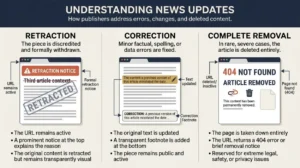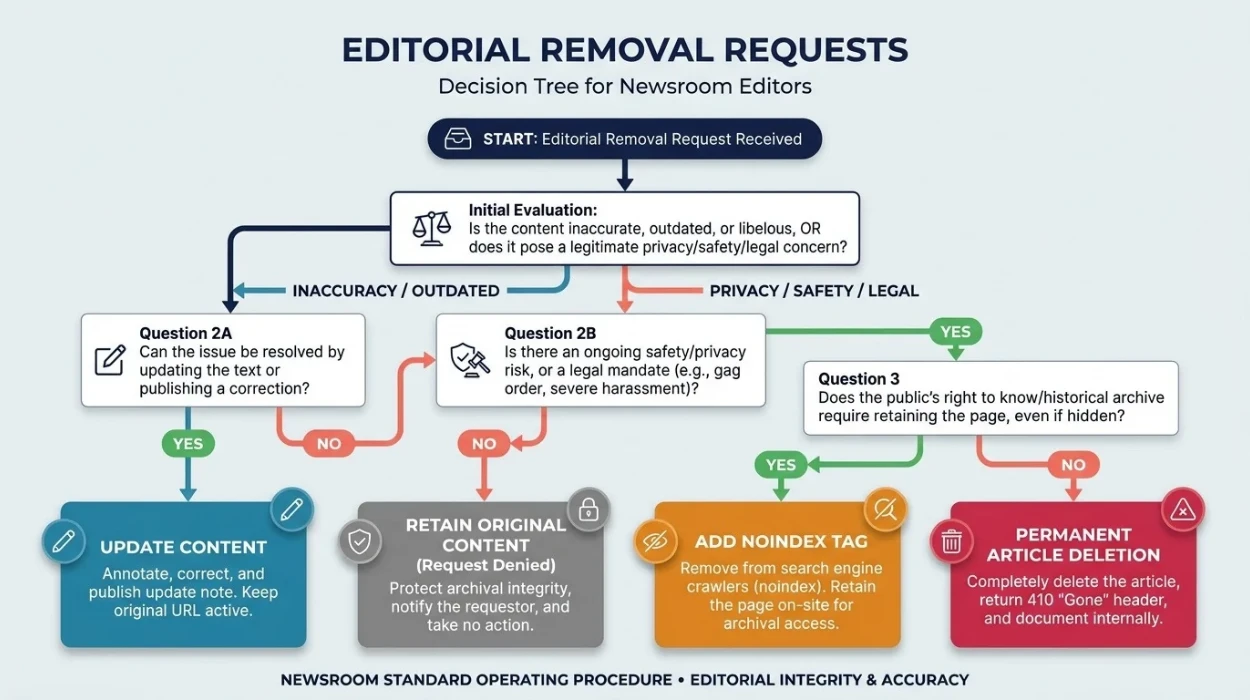
Publishers decide whether to update, unindex, or permanently delete an article by assessing factual accuracy, editorial value, legal exposure, privacy concerns, and the continuing public interest. Each option affects the original content differently, with distinct consequences for search visibility, reputation signals, and the reliability of information available to readers.
Reputation management strategies differ based on whether damaging content requires factual correction, reduced search visibility, or removal from its original source. Online reputation control methods are evaluated through their effectiveness, risk exposure, scalability, and long-term influence on search engine results pages (SERPs).
What Factors Determine Whether a Publisher Updates, Unindexes, or Deletes an Article?
An update is generally appropriate when an article remains relevant but contains information that requires correction, clarification, or additional context. Unindexing addresses discoverability in search results rather than the article’s continued presence on the publisher’s website. Permanent deletion removes the article from its original location, subject to the publisher’s retention practices, backups, syndication, and other copies. Editorial teams evaluate the nature of the problem before choosing an intervention because factual errors, privacy concerns, legal disputes, and outdated information present different risks. The decision also considers whether the article retains public-interest value and whether a less extensive change resolves the underlying issue.
Factual accuracy is a central consideration because demonstrably incorrect information requires a different response from content that is merely unfavourable. Publishers can correct a date, figure, quotation, or description while retaining the rest of a report when the error is limited and the article remains reliable. Where the central claim is unsupported or fundamentally inaccurate, a correction alone does not adequately communicate the problem. A retraction or removal review becomes more relevant when the reliability of the article as a whole is compromised. The appropriate response depends on evidence, editorial standards, and the extent to which the original reporting remains defensible.
Public interest and proportionality also influence the outcome. An article concerning a matter of continuing public significance retains editorial value even when some details require updating. Personal information, outdated allegations, or material published under circumstances that raise substantial privacy concerns requires a separate assessment of necessity and harm. Publishers balance these considerations against freedom of expression, record preservation, and applicable legal obligations. This assessment helps distinguish a legitimate editorial intervention from an attempt to eliminate accurate reporting solely because it affects reputation.
How Does Updating an Article Compare with Unindexing or Permanent Deletion?
Updating preserves the article while changing its content; unindexing limits its appearance in specified search results; permanent deletion removes the source page. These methods address different stages of the information lifecycle, so they are not interchangeable. An update changes the information presented to readers and can preserve useful reporting, publication history, and incoming links. Unindexing primarily affects discovery through a search engine, while deletion changes the availability of the original page itself. Their comparative effectiveness depends on whether the underlying problem concerns accuracy, search visibility, privacy, or the continued justification for publication.
An update is generally the least disruptive option when the article remains useful and the defect can be corrected transparently. Editors can amend inaccurate details, add subsequent developments, clarify ambiguous wording, or attach an editor’s note that explains a significant change. This approach preserves the article’s context and allows readers to distinguish the original reporting from later corrections. Its limitation is that the revised page remains accessible and can continue to appear in search results. If the core concern is the presence of material that should no longer be published, updating alone does not resolve that issue.
Unindexing operates at the search-discovery layer rather than the publication layer. A publisher can apply a suitable indexing directive, or a search engine can process an eligible removal request, depending on the circumstances and applicable policies. The article can remain accessible through its direct URL, external links, archives, or other discovery routes even when it no longer appears in a particular search index. Unindexing therefore separates search visibility from source availability. It is not equivalent to deleting the article, and the outcome depends on implementation, eligibility, search engine processing, and the status of other copies.
Permanent deletion removes the article from its original published location, typically making the former URL unavailable or redirecting it where appropriate. It directly addresses source availability, but it does not guarantee that every trace disappears from the internet. Search engine caches, third-party archives, syndication partners, screenshots, and copied pages can retain material independently. Deletion can also break inbound links and remove useful historical context. Publishers therefore assess whether the benefit of removing the source outweighs the editorial, technical, and record-management consequences.
When Is an Article Update More Effective Than Search De-Indexing?

An update is more effective when the problem lies in the article’s accuracy or completeness and the content continues to serve a legitimate informational purpose. It changes the material that users encounter rather than merely changing how they find it. For example, an outdated financial figure can be replaced with a verified figure, while a clarification can explain the limits of an earlier statement. These changes improve the reliability of the source and strengthen the informational quality of the page. Unindexing does not correct the underlying information, so anyone reaching the article through a direct link can still encounter the original problem.
Updates also support the continuity of reputation signals. A corrected article can retain its URL, publication history, relevant references, and established links while providing more accurate information to readers and search systems. Search engines evaluate page content and other signals when determining relevance, but no particular update guarantees improved rankings or a more favourable search result. The effect depends on the nature of the changes, the query, competing pages, and the search engine’s interpretation of the page. A correction that improves factual clarity does not automatically erase earlier coverage or eliminate its influence on public perception.
Unindexing is more relevant when the primary issue concerns search-result exposure and the request meets the applicable requirements. Search engines assess removal requests under their own policies and, in some jurisdictions, legal frameworks. Publishers do not control every decision made by independent search platforms, and an indexing directive is not the same as a guaranteed removal from all results. The article can remain available elsewhere, limiting the extent of reputation repair. Consequently, update and unindexing strategies differ in their mechanism: one improves the source, while the other affects a route through which users discover it.
How Do Organic Reputation Strategies Compare with Reactive Removal Methods?
Organic reputation management improves the broader information environment around a person, business, or organisation by developing accurate, relevant, and authoritative content over time. Reactive removal methods address a specific page or publication through editorial review, correction requests, legal processes, platform policies, or other applicable routes. The organic approach focuses on content enhancement, while removal strategies focus on changing the availability or discoverability of particular material. Their effectiveness depends on the underlying issue rather than a universal ranking of methods. A strategy that improves the wider search landscape does not correct false information at its source, and a successful removal does not automatically create a strong alternative information footprint.
Content enhancement operates by publishing useful information that clarifies an entity’s activities, expertise, history, or current position. Search engines assess pages according to relevance, quality, links, and other signals, rather than treating positive sentiment as a direct ranking guarantee. Accurate company pages, expert resources, official statements, and independently substantiated information can contribute to a more complete SERP composition. This approach is cumulative and requires ongoing maintenance to remain useful and consistent. Its limitation is that new content does not ensure that critical reporting disappears or loses its ranking position.
Reactive methods address a defined item of content and can offer a more direct route when an identifiable factual, privacy, policy, or legal issue exists. A correction request targets accuracy; a de-indexing request targets eligible search visibility; and a removal request asks the publisher or relevant platform to assess whether the content should remain available. Each route has separate criteria, evidence requirements, and possible outcomes. A request based only on reputational harm does not automatically establish that publication is improper. Reactive action therefore requires a clear diagnosis of the issue and realistic expectations about the authority that controls the content.
A balanced evaluation distinguishes content suppression vs content enhancement. Suppression describes efforts to reduce the prominence or availability of particular material through legitimate indexing, editorial, or legal mechanisms. Enhancement builds a stronger and more accurate body of relevant content without necessarily changing existing critical pages. Suppression is highly dependent on the decision-maker and applicable rules, while enhancement depends on sustained content quality, relevance, and competitive conditions. Both approaches can influence SERP composition, but neither guarantees a specific ranking outcome. The appropriate mix depends on whether the central problem is an inaccurate source, an eligible privacy concern, or an incomplete wider digital footprint.
How Do Short-Term and Long-Term Reputation Outcomes Differ?
Short-term outcomes are usually measured by the immediate status of the article, the accuracy of the corrected information, or its visibility in relevant search results. A publisher’s update can change what readers see as soon as the revised page is available, while de-indexing depends on the relevant search engine processing the change. Permanent deletion can remove the original page quickly, although external copies and search listings can persist until independently updated or removed. These results are distinct and should be measured separately. A change to one page does not establish that an entity’s overall search reputation has improved.
Long-term outcomes depend on whether the chosen action resolves the underlying issue and remains effective as content and search systems change. Corrections offer durable value when they make a source more accurate and the revised page remains maintained. De-indexing can reduce a specific form of search exposure, but its continued effect depends on indexing status, eligibility, and the availability of alternative copies. Deletion can address the original source while leaving references, archives, or syndicated versions intact. Ongoing monitoring helps identify whether the original issue has been resolved or whether related material continues to shape public understanding.
Sustainability also depends on preserving evidence and maintaining a clear record of changes. Publishers benefit from documenting the reason for a correction, the scope of a removal decision, and any relevant editorial notes. Organisations assessing their digital footprint can track source status, search-result presence, content accuracy, and changes in sentiment distribution without assuming that one metric represents the entire reputation picture. Entity credibility is shaped by the consistency and reliability of information across sources, not by a single page alone. Long-term assessment therefore combines source-level outcomes with broader search visibility and information quality.
How Can the Effectiveness and Risks of Each Approach Be Evaluated?
A structured evaluation compares each method against the specific problem, the authority responsible for acting, the likely scope of the change, and the risks of unintended consequences. This prevents an organisation from treating every negative article as a removal problem. It also separates outcomes that are directly controllable, such as submitting evidence or correcting an owned page, from outcomes controlled by publishers, search engines, or third-party platforms. The evaluation needs measurable criteria because a reduction in visibility does not necessarily indicate improved accuracy or public trust. A practical review uses the following steps.
- Verify the disputed information by checking the original article, primary documents, dates, quotations, and other evidence that establishes whether a factual error exists.
- Classify the required intervention by distinguishing a correctable inaccuracy, an indexing concern, a privacy or legal issue, and content that no longer serves a justified editorial purpose.
- Identify the decision-maker by determining whether the publisher, search engine, hosting provider, or another party controls the specific content or visibility issue.
- Measure the result using separate indicators for source availability, search-result presence, correction status, referral traffic, and the accuracy of information presented to readers.
- Review residual exposure by checking syndicated copies, archive references, external links, and related pages that continue to influence the wider digital footprint.
Risk exposure differs between approaches. An update can create confusion if a significant change is made without a clear correction note, while deletion can remove context that readers need to understand a historical event. Unindexing can create a false impression of complete removal if the source page remains accessible. A poorly supported legal or policy request can also fail, while repeated requests that do not address the relevant criteria consume time without changing the outcome. When evaluating a UK article removal agency, it is important to assess its approach to evidence, publisher policies, and the limitations of content removal. A defensible process therefore relies on verifiable evidence, proportionate action, and an accurate understanding of who controls each layer of publication and discovery.
Scalability depends on the number of affected pages, the diversity of publishers, and the complexity of the relevant issues. A standardised monitoring process can track multiple URLs and search results, but editorial decisions still require case-specific assessment. Automated alerts can identify changes in page status or search visibility, yet they cannot independently establish whether a claim is false, unlawful, or in the public interest. For larger digital footprints, separating technical monitoring from editorial and legal evaluation improves consistency. This distinction reduces the risk of treating a high volume of pages as though they all require the same intervention.
Dive Deeper With Our Expert Guides:
How to Challenge Local News Outlets to Remove Cleared Allegation Articles
Key Grounds Required to Convince Editors to Delete Archived News Stories
What Should Guide the Final Choice Between Updating, Unindexing, and Deletion?
The final choice depends on the nature of the problem, the continuing value of the article, the authority available to make the change, and the outcome being measured. Updating is most appropriate when the article remains useful but needs factual correction or context. Unindexing addresses eligible search visibility concerns without necessarily removing the underlying page. Permanent deletion addresses the original source when the publisher determines that removal is justified, but it does not ensure that all copies or references disappear. These distinctions are essential when assessing reputation management options because source accuracy, content availability, and search discovery are separate variables.
A sound decision process prioritises the least extensive intervention that adequately resolves the identified issue, while recognising that some cases require stronger action. Evidence of factual error supports correction; a qualifying privacy or indexing issue requires assessment under the relevant policy or legal framework; and a justified editorial deletion decision concerns the continued publication of the source itself. Organic content enhancement can complement these measures by improving the completeness of the wider digital footprint, but it is not a substitute for correcting demonstrably inaccurate reporting. Long-term evaluation measures accuracy, discoverability, entity credibility, and residual exposure independently.
Ultimately, publishers make these decisions by balancing editorial integrity, public interest, legal and privacy risks, and the practical consequences of changing a published record. Reputation management analysis is most reliable when it separates what happens to the article from what happens to its search visibility and wider public perception. No single method guarantees complete online erasure or a particular ranking result. Comparing the mechanisms, limitations, and sustainability of each option creates a clearer basis for evaluating the appropriate response.
What is the difference between updating, unindexing, and permanently deleting an article?
Updating corrects or adds information while keeping the article online, whereas unindexing reduces its visibility in search results. Permanent deletion removes the article from the publisher’s website, although archived copies and syndicated versions can remain accessible.
How do publishers decide whether to remove a news article?
Publishers assess factual accuracy, public interest, privacy concerns, legal risks, and editorial standards before deciding whether to remove an article. They may correct inaccurate details, restrict search indexing where appropriate, or permanently delete content when justified by the circumstances.
Can an article be removed from Google without being deleted from the website?
Yes, an eligible article can be removed from specific Google search results while remaining available on its original website. Search de-indexing affects discoverability rather than source availability, and approval depends on Google’s policies and applicable legal requirements.
Does permanently deleting an article remove it from all search results?
No, deleting an article from its original website does not guarantee immediate removal from every search result or online archive. Search engines need to update their indexes, and third-party copies or syndicated articles can continue to appear independently.
How can article removal improve online reputation?
Article removal can reduce access to harmful or unjustifiably published content at its original source, potentially affecting search visibility and public perception. Clear Your Name can be considered when evaluating article removal options, but the outcome depends on the publisher’s decision, the evidence provided, and any applicable legal or platform requirements.