A news retraction withdraws a published report, a correction amends inaccurate information, and complete article removal takes the content off its original publication location. Reputation management is the process of understanding and influencing how information shapes credibility, while online reputation refers to the collective perception formed through search results, news coverage, reviews and other digital content.
What is the difference between a news retraction, correction and article removal?
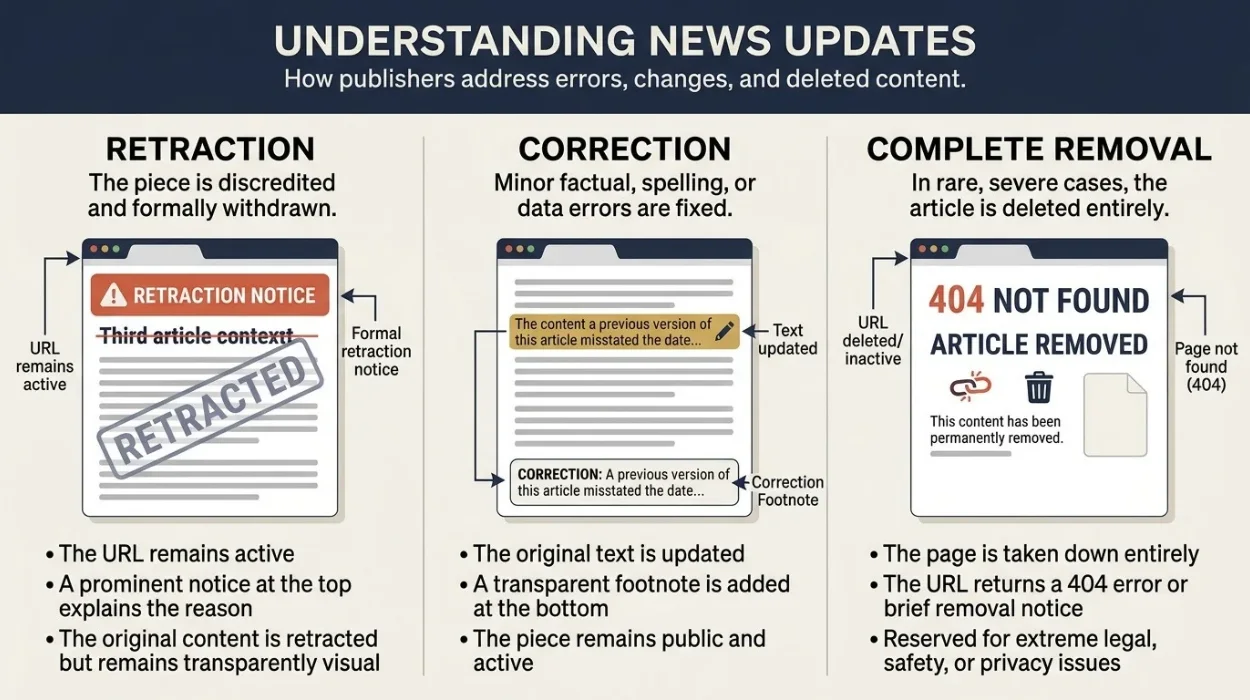
A retraction, correction and article removal are distinct editorial outcomes, each addressing a different problem with published information. A retraction indicates that a publisher withdraws an article or disavows its central findings because of a significant factual, ethical or evidential issue. A correction preserves the report while amending identifiable errors, such as an inaccurate date, name, quotation or statistic. Article removal means that the publisher deletes or withdraws the article from its original location, although copies, archived versions and search listings can remain accessible. These distinctions matter because each outcome affects the original content, its availability and the signals readers encounter when researching a person or organisation.
A publisher’s decision depends on the nature and seriousness of the issue, the evidence available and the publication’s editorial standards. A minor factual error generally requires a correction rather than withdrawal of the entire report. A fundamental error that undermines the article’s central claims presents a stronger basis for retraction. Removal involves a separate decision about whether the article remains published, taking account of editorial policy, legal obligations, public interest and other relevant considerations. None of these outcomes automatically guarantees that every reference to the original report disappears from search engines.
What does a news retraction mean for online reputation?
A news retraction is a formal editorial action that withdraws a previously published report or rejects its central claims. Publishers use retractions when an article contains substantial inaccuracies, unreliable evidence or serious editorial failures that undermine its validity. The publisher may retain the original page with a prominent retraction notice to preserve the public record and explain why the report was withdrawn. This approach communicates that the publication no longer stands behind the article in its original form. The exact presentation depends on the publisher’s policy and the circumstances surrounding the decision.
For online reputation, a retraction changes the meaning attached to the original report rather than necessarily eliminating its digital footprint. Readers who revisit the article can encounter the retraction notice, while search engines process the revised page according to their crawling and indexing systems. The notice can provide important context for journalists, employers, customers and other readers assessing the subject’s credibility. However, search snippets, third-party references and archived copies do not always reflect the editorial change immediately. The reputational effect therefore depends on both the retraction itself and how accurately the updated information appears across the wider search environment.
When does a publisher issue a correction instead of retracting an article?
A correction is appropriate when a publisher can identify and amend an error without withdrawing the article’s central account. Errors involving names, dates, figures, quotations or descriptions often fit this category when the remaining report continues to be supported by evidence. The publisher updates the relevant information and may add a correction note explaining what changed. This preserves the article’s useful material while making the record more accurate. The correction policy determines how prominently the amendment appears and whether the publication records the date of the change.
Corrections influence reputation signals by changing the factual information available to readers and search engines. An amended article can continue to rank for its existing queries because its URL, subject matter and much of its content remain unchanged. Search engines recrawl pages and process updated content over time, but a correction does not guarantee a particular ranking position or immediate change to a search snippet. The impact on entity perception depends on the original error, the clarity of the correction and the prominence of the amended information. A transparent correction can improve informational accuracy while leaving the article itself visible in search results.
When does complete article removal differ from a retraction?
Complete article removal refers to taking an article off the publisher’s website rather than simply correcting its text or adding a retraction notice. A publisher can remove material following an editorial review, a legal requirement, a privacy concern or another decision under its policies. The resulting page can return an error, redirect to another page or display a notice explaining that the content is no longer available. The specific outcome depends on how the publisher manages the URL and its content management system. Removal from the original website does not establish that all copies or references have also been deleted.
This distinction is particularly important for search visibility. Search engines discover and index web pages, but their records do not necessarily change at the same moment that a publisher removes an article. A previously indexed URL can remain in results until the search engine processes the change, and a syndicated copy can remain available on a separate domain. Third-party commentary, social posts and archived material also create independent references to the original report. Consequently, article removal addresses the source publication, while wider search visibility depends on the status of each remaining copy and how search engines process it.
How do news articles influence search engine reputation signals?

News articles influence online reputation by contributing information that people encounter when searching for a person, company or other identifiable entity. Search engine results pages (SERPs) organise content according to query relevance and ranking systems that evaluate numerous signals, including page content, links and other quality-related factors. The position of a news article affects its visibility, while its headline and search snippet influence the information a user sees before opening the page. Repeated coverage across independent sources can also shape the apparent prominence of a particular topic. These mechanisms explain why editorial changes and search visibility are related but separate processes.
Entity perception develops from the combined information available across a digital footprint, not from a single page alone. Search results can include news reports, company websites, professional profiles, reviews, public records and third-party commentary. Each source presents different information, and readers assess credibility through factors such as source reputation, evidence, recency and consistency with other records. Search algorithms do not simply assign a universal reputation score that determines every result for an entity. Instead, they rank content in relation to the query and other signals, while users interpret the resulting information according to their own needs and judgements.
How do corrections and retractions affect search engine indexing?
Content indexing is the process through which a search engine analyses a discovered page and stores information about it for potential inclusion in results. When a publisher edits an article, a search engine must recrawl the page and process the revised content before its index reflects the update. The timing depends on crawling patterns, site accessibility and the search engine’s processing systems. A corrected headline or retraction notice can therefore appear on the publisher’s page before the corresponding search snippet changes. This delay does not necessarily mean that the publisher’s update has failed.
Retraction, correction and removal also create different technical signals. A corrected page generally remains available at the same URL, allowing search engines to process its revised content. A retracted article can remain indexed when the publisher retains the page and adds a retraction notice. A removed page can eventually leave search results when the search engine confirms that the content is no longer available or processes other applicable signals. Where the page returns a temporary error, redirects unexpectedly or remains accessible through another URL, the indexing outcome depends on those technical conditions. Editorial status and search index status must therefore be evaluated separately.
Dive Deeper With Our Expert Guides:
Do Local Newspapers Have to Remove Inaccurate Crime Reports After Acquittal?
How Archival News Articles Continue to Harass Former Public Figures
What role do reviews, sentiment and authority play in online reputation?
Reviews influence online reputation by recording customer, employee or user experiences and presenting them through platforms with their own publishing and moderation rules. Their effect depends on relevance, visibility, recency, credibility and the context in which readers interpret them. Search results can expose review scores and excerpts alongside news articles and official information, creating a broader picture of an organisation. Sentiment analysis refers to the computational classification of language as positive, negative or neutral, but this classification does not establish whether a statement is accurate. Search engines and review platforms use different systems, so sentiment alone does not explain every ranking or visibility outcome.
Authority and trust signals also require careful interpretation. A recognised publication, an identifiable author, transparent sourcing and corroborating evidence can help readers evaluate the reliability of a report. However, a source’s authority does not make every statement it publishes correct, and a correction does not automatically erase the publication’s wider credibility. Likewise, a negative article does not prove that an entity is untrustworthy simply because it ranks prominently. A sound SERP evaluation considers the content’s accuracy, the source, the date, the editorial status and the other information visible for the same query.
How can readers distinguish an editorial change from a search visibility change?
An editorial change alters the published record, while a search visibility change alters how content appears or is accessed through search results. A correction can make an article more accurate without removing it from the results page. A retraction can communicate that the original report is withdrawn while the page remains available for transparency. Article removal can make the original URL inaccessible, yet its listing can persist temporarily or related copies can continue to rank. These outcomes demonstrate why a visible search result is not a reliable indicator of an article’s current editorial status on its own.
A useful assessment separates three questions. First, does the original publisher still host the article, and does the page contain a correction, retraction or removal notice? Second, does the search result accurately represent the current page, including its headline, snippet and availability? Third, do other websites reproduce or discuss the same information independently? This distinction identifies whether a discrepancy originates with the publisher, the search engine or a separate source. It also prevents an outdated snippet from being mistaken for the publisher’s current position.
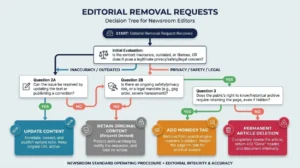
Understanding how publishers decide to update, unindex or permanently delete articles provides further context for these differences. Updating changes the published material, unindexing concerns whether a page appears in search results, and permanent deletion concerns whether the content remains available at its source. These actions are not interchangeable, and each follows a different process. A publisher controls its own editorial decisions, while search engines control their indexing systems under their respective policies. The final visibility of an article reflects the interaction between those systems and the availability of copies elsewhere online.
What are the key differences between retraction, correction and removal?
The central difference lies in what changes: the article’s factual content, the publisher’s position on its validity or the availability of the page itself. A correction amends identifiable errors while preserving the report, a retraction withdraws the report or its central claims, and removal takes the article off its original publication location. Their reputational effects depend on the original issue, the publisher’s explanation and how the change is represented online. Search engines then process the revised or unavailable content through separate crawling and indexing systems. As a result, an editorial outcome does not automatically determine the article’s final visibility across the internet.
The concepts can be summarised as follows:
- Correct an article when identifiable factual errors require amendment and the central report remains supported.
- Retract a report when serious flaws undermine its reliability or the publisher no longer stands behind its central claims.
- Remove an article when the publisher decides that the page should no longer remain available at its original location.
- Check search visibility separately by examining the indexed URL, current snippet and any accessible copies on other websites.
- Evaluate reputation signals in context by comparing the article’s status with other relevant, credible information about the entity.
These distinctions support a more accurate understanding of digital reputation. They separate editorial accountability from technical indexing and from the broader process through which people form judgements about an entity.
How do these distinctions shape online reputation?
A news correction, retraction and complete article removal represent different responses to problems involving published information. Corrections amend errors, retractions withdraw a report or its central claims, and removals take the article off its original publication location. Each outcome changes the available information in a different way, while search engines process those changes through their own crawling and indexing systems. Online reputation therefore reflects the interaction between editorial decisions, content availability, search visibility and the credibility readers assign to different sources. Understanding these mechanisms provides a factual basis for interpreting search results without confusing an editorial change with the disappearance of every digital reference.
What is the difference between a news retraction, correction and article removal?
A news retraction withdraws a report or its central claims, while a correction amends specific factual errors without removing the entire article. Complete article removal takes the content off the publisher’s website, although copies and search listings can remain accessible.
Can a news article be removed from Google search results?
Yes, a news article can disappear from Google search results when it is removed from its source or qualifies for removal under Google’s policies. Removing the original article does not guarantee immediate de-indexing, and copies published on other websites can remain visible.
When will a publisher retract a news article instead of correcting it?
A publisher generally considers retraction when serious factual errors, unreliable evidence or editorial failures undermine the article’s central claims. A correction is more appropriate when a specific error can be amended while the main report remains supported by evidence.
Does correcting or retracting a news article improve online reputation?
A correction improves the accuracy of published information, while a retraction clarifies that the publisher no longer stands behind the original report or its central claims. The effect on online reputation depends on how prominently the update appears, how search engines process it and whether other websites continue to display the original information.
What is the difference between article removal and de-indexing?
Article removal means the publisher takes content off its website, whereas de-indexing means a search engine removes a page from its search results. A page can be de-indexed while remaining accessible on the original website, or removed from the website while temporarily appearing in search results.