Indeed and Glassdoor apply different review policies because each platform operates its own rules for workplace reviews, content moderation, eligibility, and publication.
Reputation management is the process of analysing how reviews and other digital information influence an organisation’s online credibility, search visibility, and entity perception.
How do Indeed and Glassdoor define workplace reviews?
Indeed and Glassdoor treat workplace reviews as user-generated information about employment experiences, but their review systems operate through platform-specific rules. A workplace review is a form of reputation content because it associates an organisation with statements about employment, management, culture, compensation, or working conditions. The platform’s review policy determines which submissions qualify for publication and which content enters its information ecosystem. This creates a distinction between the existence of a review and the platform’s decision to publish or retain it. For reputation analysis, the relevant question is therefore how each platform evaluates the content before it becomes publicly visible.
Review policies also establish boundaries around acceptable content, personal information, offensive material, and unsupported allegations. These boundaries influence the composition of reviews available to users researching an organisation. Once published, review content can become part of the entity’s digital footprint and contribute to broader reputation signals. Search engines can also discover publicly accessible review pages and evaluate their relevance to organisation-related queries. Platform policy therefore affects reputation at the source level, while search systems influence how that information becomes visible beyond the platform.
How do Indeed and Glassdoor review moderation systems differ?
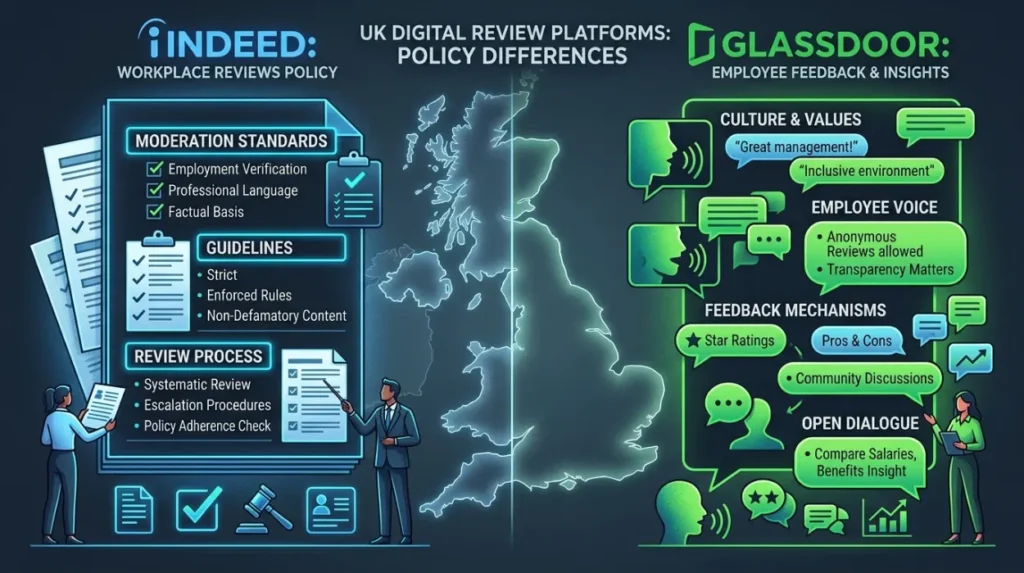
The primary difference lies in the specific moderation criteria and processes each platform uses to assess submitted workplace reviews. Moderation is the process through which a platform evaluates user-generated content against its publication requirements before or after publication. A platform’s rules determine whether content remains available, requires modification, or becomes subject to removal. The criteria are not interchangeable because each platform maintains its own content governance framework. Comparing review policies therefore requires examining the actual requirements applied to each publication environment.
Moderation also affects the quantity and type of reputation information available about an entity. Content that passes moderation becomes part of the platform’s visible information environment, while rejected or removed material does not contribute in the same way. This difference influences sentiment distribution because moderation determines which positive, neutral, and negative statements remain publicly accessible. Search engines then encounter the resulting content as part of the broader digital ecosystem. Platform moderation therefore represents an upstream reputation signal that precedes search ranking and SERP evaluation.
What types of review content do Indeed and Glassdoor restrict?
Both platforms restrict categories of content that violate their respective policies, but the exact rules and enforcement mechanisms need to be assessed independently. Restricted content generally concerns material that falls outside the purpose of a workplace review, breaches privacy expectations, contains prohibited material, or violates platform-specific standards. The classification of a statement matters because a negative review is not automatically prohibited simply because it damages an organisation’s reputation. Legitimate criticism and policy-violating content represent different information categories. Reputation analysis therefore requires examining the substance and context of the review rather than relying only on its sentiment.
The distinction becomes particularly important when a review contains allegations presented as factual claims. A factual allegation is materially different from an employee expressing dissatisfaction with management or workplace conditions. Platform moderation systems evaluate content according to their own rules, while legal concepts such as defamation involve separate standards. This separation prevents search visibility from being confused with factual verification. A review appearing in a SERP does not establish that its claims have been independently validated.
Dive Deeper With Our Expert Guides:
Why Former Employees Post Anonymous Defamatory Reviews on Indeed
Why Competitors Sometimes Post Fake Reviews on Your Indeed Profile
How does review eligibility affect online reputation?
Review eligibility affects online reputation because it determines which employment experiences become part of an organisation’s publicly accessible information environment. Eligibility rules establish whether a submission fits the platform’s definition of appropriate workplace content. A review that satisfies those requirements enters the platform’s reputation ecosystem and becomes available for readers to interpret. If the content is publicly accessible, it can also become part of the organisation’s wider digital footprint. Eligibility therefore represents an important stage between user-generated information and searchable reputation signals.
The effect extends beyond the platform itself because indexed review content can appear in searches associated with the organisation. Search engines evaluate pages according to relevance, authority, content signals, and other ranking factors. A review with strong query relevance can therefore contribute to entity perception when users encounter it during organisation-related searches. The platform determines whether the content exists within its environment, while search systems determine how prominently users encounter it. This creates two distinct stages of reputation formation.
Why do review policies matter for search visibility?
Review policies matter for search visibility because moderation determines which content remains accessible and therefore available for indexing and retrieval. Content indexing is the process through which search engines add accessible information to their searchable systems. A publicly available review can become part of the information evaluated for queries involving an organisation’s name or employment reputation. If a review is not published or is removed, that particular source no longer contributes in the same way to the accessible information environment. Platform policy therefore influences the information available for search evaluation.
Search visibility is not determined by platform policy alone. Search engines assess relevance, authority, user intent, content quality, and other ranking signals when deciding which pages appear for particular queries. A negative review can exist without ranking prominently, while another review can receive greater visibility because it closely matches a user’s search intent. This distinction explains why reputation analysis evaluates both content availability and search performance. The same review policy outcome can therefore produce different search consequences depending on indexing and ranking dynamics.
How do review signals influence entity perception?
Review signals influence entity perception by providing users and search systems with textual information about an organisation’s workplace reputation. A review signal is an identifiable piece of information that contributes to how an entity is interpreted within a digital environment. Sentiment, subject matter, language, recency, relevance, and contextual associations all contribute to the informational value of review content. Search engines do not simply calculate a universal reputation score from these signals. Instead, they organise information according to query relevance and broader ranking mechanisms.
Entity perception develops from the combined information associated with an organisation across its digital footprint. Workplace reviews form one component of this environment alongside corporate websites, professional profiles, publications, directories, and other sources. A concentration of negative review language can influence the information users encounter when researching an organisation. However, the presence of negative sentiment does not independently establish that the underlying claims are accurate. Reputation analysis therefore distinguishes sentiment signals from factual credibility.
How does sentiment interpretation differ from factual review assessment?
Sentiment interpretation measures the positive, neutral, or negative orientation expressed within content, while factual assessment examines whether specific claims have evidential support. These processes answer different questions and therefore require separate analysis. A review can contain strongly negative sentiment without containing defamatory factual allegations. Conversely, a neutral-sounding statement can contain a serious factual assertion with substantial reputational implications. Search systems primarily process the information contained in the document rather than making a definitive legal determination about its truth.
This distinction is important when comparing workplace review policies because moderation decisions can depend on content categories rather than sentiment alone. A platform can permit negative criticism while restricting other forms of content that violate its rules. Search engines then process whatever content remains accessible according to their own retrieval and ranking systems. Consequently, sentiment distribution does not provide a complete representation of reputation. Entity credibility requires analysis of source context, factual claims, authority signals, and information consistency.
How do authority and trust signals affect workplace review visibility?
Authority and trust signals influence how information is evaluated within search ecosystems, although a review’s platform presence does not automatically establish its factual authority. Authority refers to the perceived reliability or relevance of a source within a particular information context. Trust signals refer to indicators that help users and systems evaluate whether information is credible and appropriate for the query. Review platforms can provide contextual relevance because their content is specifically associated with employment experiences. Search engines nevertheless evaluate individual pages through broader ranking systems.
The relationship between authority and visibility explains why platform content can appear prominently for organisation-related searches without representing an objective reputation assessment. A review page can be highly relevant to an employment-related query because it directly concerns the organisation. Search ranking influence then determines whether users encounter that page prominently. This creates an important distinction between relevance and truth. A highly relevant document can achieve search visibility without the search engine independently validating every statement within it.
How should users compare Indeed and Glassdoor review policies?

Users should compare the platforms by examining their definitions of eligible reviews, prohibited content, moderation criteria, reporting mechanisms, and treatment of disputed material. Comparing policy language provides a clearer understanding of how each platform governs workplace-generated content. It also prevents assumptions that a decision on one platform automatically applies to the other. Each publication environment has its own content governance structure. Policy comparison therefore needs to remain platform-specific.
A structured comparison can focus on four elements:
- Examine eligibility rules to determine which employment-related submissions qualify for publication under each platform’s review framework.
- Analyse restricted content to identify categories involving privacy, prohibited material, irrelevant content, or unsupported allegations.
- Evaluate moderation mechanisms to understand how each platform handles content that is reported or challenged.
- Assess search exposure by examining whether published review pages become indexed and visible for organisation-related queries.
This framework connects platform policy with reputation-system analysis. It also separates publication rules from search ranking dynamics, which operate through different mechanisms.
How does content removal differ from review-policy enforcement?
Content removal through platform policy is a moderation outcome, while reputation management is a broader process that analyses how information affects an entity across digital systems. Policy enforcement focuses on whether specific content violates the platform’s requirements. Reputation management considers the wider relationship between the content, entity perception, search visibility, and digital footprint. A platform can therefore remove a review without changing every other reputation signal associated with the organisation. Similarly, a review can remain published while having limited search visibility.
This distinction is important because removing one document does not automatically restructure the wider SERP environment. Search engines independently crawl, index, and rank accessible information. Other pages containing similar information can continue to contribute to entity perception. Effective reputation analysis therefore examines the source-level policy environment alongside search-level visibility. The two systems interact, but neither completely controls the other.
What should organisations understand before comparing review policies?
Organisations need to distinguish platform governance from search-engine evaluation before interpreting differences between workplace review systems. A review policy determines how user-generated content is handled on a particular platform. Search algorithms determine how accessible and relevant content is evaluated within search results. Legal standards provide another separate framework for evaluating potentially defamatory claims. These systems operate independently but interact through the information available to users.
The most important distinction is between content eligibility, content moderation, and search visibility. Content eligibility determines whether a review fits the platform’s requirements. Content moderation determines whether it remains publicly accessible. Search visibility determines how prominently users encounter the resulting information through search queries. Understanding these stages provides a more accurate framework for analysing reputation signals and digital credibility.
What is the relationship between review policy and digital footprint?
Review policy contributes to an organisation’s digital footprint by determining which workplace experiences remain publicly represented on a platform. A digital footprint is the accumulated collection of online information associated with an entity. Reviews represent one category within this footprint, alongside websites, publications, social profiles, directories, and other digital sources. Each source contributes a different type of reputation signal. The resulting entity perception develops from the combined information available across the ecosystem.
The digital footprint also changes as content is published, removed, updated, indexed, or de-indexed. This means reputation is not a static property stored in one location. Search engines continuously process accessible information and adjust the results presented for changing queries and ranking conditions. Review policy therefore represents one part of a larger reputation system. Analysing that system requires attention to both source-level governance and search-level information retrieval.
What should users know before comparing Indeed and Glassdoor removal options?
Users need to understand that removal options depend on the specific content, platform rules, available evidence, and applicable procedures. A review’s negative sentiment does not by itself establish that it qualifies for removal. The relevant question is whether the content falls within a category addressed by the platform’s rules or another applicable mechanism. Evidence also matters when a review contains disputed factual assertions. This creates a distinction between dissatisfaction, policy violations, and potentially defamatory content.
The comparison also requires attention to what happens after content is removed. Source-level removal changes the availability of the original document, while search-engine indexing determines whether associated search results continue to display information from other sources. This means removal and search visibility are connected but separate processes. Understanding what to know before comparing Indeed and Glassdoor removal options helps clarify why the same reputation strategy does not produce identical outcomes across different platforms.
What are the key differences between Indeed and Glassdoor review policies?
The key differences involve platform-specific eligibility rules, moderation standards, restricted content categories, reporting processes, and publication environments. Neither platform’s policy framework automatically determines how the other handles equivalent workplace content. Each system controls its own review environment, while search engines independently evaluate publicly accessible pages. This creates a layered reputation system in which platform governance and search ranking interact without becoming the same process.
From a reputation-management perspective, the important issue is understanding how information moves through the ecosystem. A workplace review begins as user-generated content, passes through platform governance, becomes publicly accessible if retained, and can then enter search-engine indexing and ranking systems. Users encounter the resulting information through SERPs and interpret it alongside other reputation signals. Comparing the two platforms therefore requires analysis of the complete information pathway rather than focusing on a single policy clause.
Indeed and Glassdoor review policies differ because each platform maintains its own rules for review eligibility, prohibited content, moderation, and publication. These differences affect which workplace reputation signals enter each platform’s information ecosystem. Search engines then operate independently by crawling, indexing, and ranking publicly accessible content. Reputation perception consequently develops through the interaction between platform governance, search visibility, content relevance, sentiment, and trust signals.
Understanding these mechanisms provides a more accurate framework for evaluating workplace review content. A review’s publication status does not establish the truth of its claims, while search visibility does not constitute factual verification. The most reliable analysis separates platform policy, content assessment, search ranking dynamics, and entity perception. This systems-based view explains why differences between review platforms matter for the wider digital footprint and online credibility of an organisation.
How do Indeed and Glassdoor review policies differ in the UK?
Indeed and Glassdoor use separate rules for review eligibility, prohibited content, moderation, and reporting. A review that is handled in one way on one platform is not automatically subject to the same process on the other.
Can Indeed and Glassdoor remove defamatory reviews?
Potentially, depending on the content and the platform’s applicable review policies. Defamatory factual allegations need to be distinguished from legitimate criticism or personal opinion when assessing review removal options.
What types of reviews can be removed from Indeed or Glassdoor?
Reviews containing prohibited content, privacy violations, irrelevant material, or other policy breaches can fall within platform removal processes. Negative sentiment alone does not automatically make a workplace review eligible for removal.
Does removing a review from Indeed or Glassdoor remove it from Google?
Removing the original review can reduce its availability as a source, but search engines independently control crawling, indexing, and ranking. Other pages containing similar information can continue to appear in search results.
Which is easier to remove a review from, Indeed or Glassdoor?
There is no universal answer because removal depends on the specific review, evidence, and platform policy that applies. Comparing eligibility rules, prohibited content, moderation procedures, and reporting mechanisms provides a more accurate assessment.