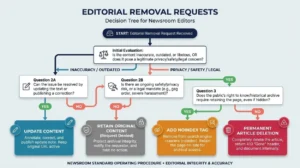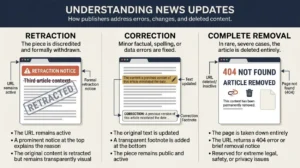
Indeed and Glassdoor removal options differ according to platform rules, content eligibility, evidence requirements, and the mechanisms available for addressing disputed reviews.
Reputation management strategies differ based on whether the objective is source-level removal, search visibility control, or broader improvement of the information environment surrounding an organisation.
What should be compared when evaluating Indeed and Glassdoor removal options?
The most important comparison involves content rules, evidence requirements, reporting mechanisms, processing procedures, and search implications. Each platform operates its own content governance system, meaning an approach that applies to one review environment does not automatically apply to another. Removal is a source-level strategy because it targets the original publication rather than the wider search ecosystem. Reputation management therefore evaluates both whether content qualifies for intervention and how its removal affects the entity’s digital footprint. This distinction creates a more accurate basis for comparing potential outcomes.
Content assessment provides the starting point for comparison because negative sentiment alone does not establish that a review violates platform requirements. A review containing ordinary criticism represents a different category from one containing prohibited material, privacy violations, or unsupported factual allegations. Evidence must therefore correspond with the specific issue identified in the content. Stronger evidence creates a clearer basis for evaluating the appropriate mechanism. Search visibility then provides a separate measurement of how significantly the review affects online perception.
How does review removal compare with content suppression?
Review removal targets the original publication, while content suppression focuses on reducing the prominence of unwanted information within search results. Removal operates at the source level by seeking to make the disputed content unavailable under an applicable platform or formal process. Suppression operates within the search ecosystem by increasing the relative visibility of other relevant and authoritative content. The first approach therefore addresses the existence of a reputation signal, while the second addresses its visibility. Their effectiveness depends on the specific reputation problem being evaluated.
Removal has a more direct relationship with the disputed review when an applicable mechanism exists, but it does not automatically remove duplicate or independently published information. Suppression provides broader coverage because it considers the composition of search results around the entity. Its limitation is that search ranking influence depends on relevance, authority, indexing, competition, and user intent. Neither mechanism represents a universal solution for every negative review. Comparative analysis therefore measures the source-level and search-level consequences separately.
Is reactive review removal more effective than organic reputation management?
Reactive review removal provides targeted intervention against an existing reputation signal, while organic reputation management develops a stronger information environment over time. A reactive strategy operates by identifying a specific disputed review and evaluating whether an applicable removal or reporting mechanism exists. An organic strategy operates by creating and maintaining authoritative information that contributes to entity credibility and search visibility. Reactive action is therefore narrower and more immediate in scope. Organic development is broader and more dependent on sustained content performance.
The main limitation of reactive management is its dependence on the outcome of the specific review dispute. If content remains accessible, the organisation still requires an approach for managing its search visibility and surrounding reputation signals. Organic management does not depend on the removal of one document, but it requires consistent development of relevant and authoritative information. This creates different risk profiles. Reactive management concentrates risk around one disputed source, while organic management distributes effort across the wider digital footprint.
How does evidence affect the effectiveness of review removal?
Evidence determines how clearly a disputed review can be evaluated against the relevant removal criteria. Useful evidence identifies the exact content being challenged and demonstrates the factual or policy issue associated with that content. Screenshots, URLs, publication details, dated records, communications, and documentation addressing specific allegations can provide an evidential foundation. The strength of the evidence depends on its direct connection to the claim rather than its volume alone. A precise evidence set therefore provides greater analytical value than a large collection of unrelated material.
Evidence also reduces attribution risk when a review is anonymous. Establishing that a person had a relationship with an organisation does not independently prove authorship of an anonymous publication. Attribution requires a stronger connection between the individual, account, publication, and relevant circumstances. This distinction is important because incorrect attribution creates additional reputational and legal risk. A sound removal strategy therefore separates evidence about the content from evidence about the reviewer.
How do Indeed and Glassdoor differ in removal effectiveness?
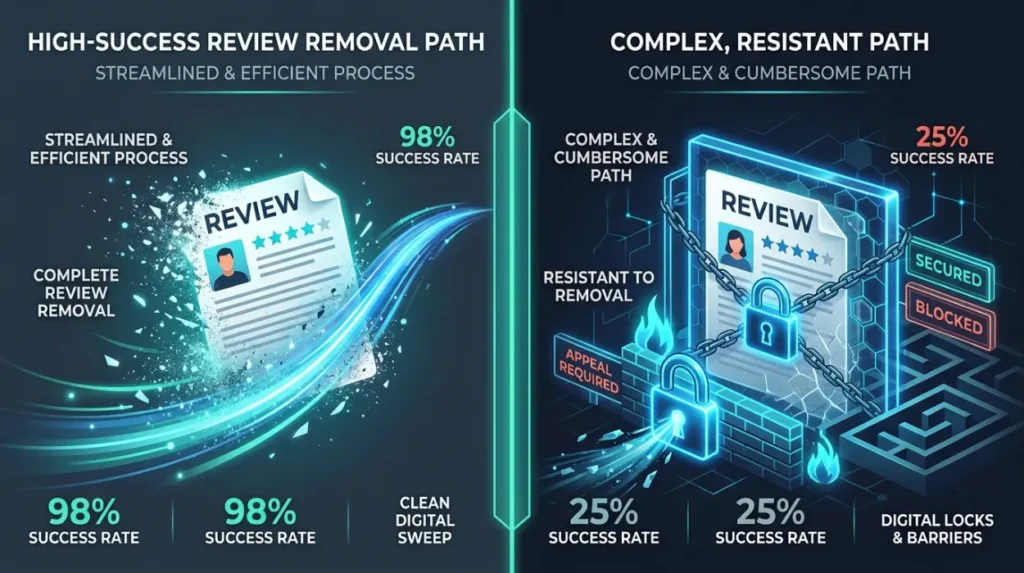
Removal effectiveness differs because each platform determines its own content standards, moderation processes, and mechanisms for responding to disputed reviews. The same factual issue can therefore require separate assessment within each publication environment. Platform-specific rules determine whether a particular review falls within an actionable category. The availability of evidence then influences how clearly that issue can be demonstrated. This makes removal effectiveness dependent on both policy alignment and evidential quality.
Search visibility introduces another layer to the comparison. Even when a review is removed from its original platform, search engines independently process their indexed information. Other pages containing related references can continue to appear for organisation-related queries. Conversely, a review that remains published can have limited search influence if it receives little visibility. Evaluating removal effectiveness therefore requires measuring both source status and SERP composition rather than treating publication status as the only outcome.
How does search visibility influence the value of review removal?
Search visibility determines how frequently users encounter a reputation signal when researching an organisation. A review with high relevance to branded or employment-related queries has greater search-perception significance than a document that receives limited exposure. Search engines evaluate accessible content through information retrieval and ranking mechanisms rather than independently verifying every factual claim. Removing a highly visible source can therefore alter the information environment available to users. The practical value of removal is closely connected to the visibility and relevance of the content being addressed.
Search visibility also determines whether content suppression represents a useful complementary approach. If the original source remains accessible, authoritative and relevant information can influence SERP composition by competing for visibility. This does not delete the original reputation signal but changes the distribution of information encountered by users. Content enhancement therefore operates differently from source-level removal. A complete reputation assessment measures both the status of the disputed review and the surrounding search environment.
Dive Deeper With Our Expert Guides:
What Evidence Unmasks an Anonymous Defamatory Indeed Reviewer in the UK
How to Prove a Competitor Posted a Fake Indeed Review
Is content suppression more sustainable than review removal?
Content suppression and review removal have different sustainability characteristics because they address different layers of the reputation ecosystem. Removal is sustainable at source level when the original content is successfully addressed and does not reappear through another accessible source. Suppression is sustainable when the surrounding information environment consistently contains strong, relevant, and authoritative content. The former depends primarily on the status of a particular publication. The latter depends on continued search relevance and content strength.
Long-term sustainability therefore requires consideration of the wider digital footprint. Removing one review does not automatically change other reputation signals associated with an entity. Similarly, suppressing one result does not guarantee that future negative content will not appear. A sustainable strategy monitors both source-level content and broader SERP composition. This creates a distinction between solving an individual content problem and improving the resilience of the overall reputation environment.
How should short-term and long-term reputation impact be measured?
Short-term impact is measured through changes in content availability, review visibility, ranking position, and immediate SERP composition. These indicators establish whether the targeted reputation signal remains accessible and prominent. Long-term impact is measured through the stability of search results, distribution of reputation signals, consistency of authoritative information, and overall entity perception. These measurements address different time horizons. A short-term improvement does not automatically establish sustainable reputation control.
The distinction is particularly important when evaluating removal against content enhancement. Removal can produce a direct change to the source environment when an applicable process succeeds. Content enhancement generally requires continued development and search performance before its effect becomes visible. Long-term measurement therefore needs to track whether accurate information maintains relevant search positions. This approach evaluates reputation as an evolving information system rather than a fixed ranking outcome.
What are the main risks of comparing removal strategies without evidence?
The principal risk is selecting an intervention without establishing whether the disputed content actually qualifies for that intervention. Treating every negative review as defamatory creates an inaccurate classification and weakens the basis for a removal request. Incorrect reviewer attribution creates an additional risk because assumptions about authorship can affect uninvolved individuals. Search-focused strategies also carry risk when rankings are treated as evidence of factual accuracy. Each stage requires a separate evidential and analytical assessment.
Another risk involves relying on a single reputation mechanism. A source-level removal strategy does not address unrelated negative information elsewhere in the digital footprint. A suppression strategy does not remove the original publication and therefore remains dependent on search ranking conditions. An organic content strategy does not directly resolve an eligible policy violation at source level. Comparing the limitations of each approach reduces the risk of treating one mechanism as a complete reputation solution.
How can organisations evaluate scalability across both platforms?
Scalability is evaluated by determining whether the chosen process can be applied consistently across multiple reviews, platforms, queries, and reputation signals. A platform-specific removal process requires separate content assessments because each publication environment has its own governance framework. Evidence collection also needs to remain organised so that each disputed review has a distinct factual basis. Search monitoring requires consistent query tracking to measure changes across the relevant SERP environment. Scalability therefore depends on process standardisation without assuming that every review receives identical treatment.
A scalable framework can be structured around four analytical stages:
- Classify each review by identifying its content type, factual allegations, sentiment, and potential policy issue.
- Document each disputed publication using its URL, screenshots, publication details, relevant evidence, and search visibility.
- Compare removal, suppression, and content enhancement according to effectiveness, limitations, risk exposure, and resource requirements.
- Monitor source status and SERP composition over time to determine whether the selected approach produces stable reputation improvements.
This framework provides consistency while preserving platform-specific analysis. It also allows organisations to distinguish between individual review problems and broader reputation patterns.
Which approach provides stronger control over SERP composition?
A combined approach provides broader SERP control because removal and content enhancement influence different components of the search environment. Removal addresses the availability of a specific reputation signal, while content enhancement strengthens alternative information that can influence search-result composition. Neither mechanism independently controls every result because search engines determine ranking through their own systems. SERP control therefore refers to influencing the information environment rather than guaranteeing a fixed ranking position. This distinction is essential for accurate reputation measurement.
The relative value of each approach depends on the visibility and nature of the negative content. A highly visible review with a clear policy issue presents a stronger case for source-level assessment. A broader search environment containing multiple negative references requires analysis beyond one publication. In that situation, content enhancement and digital-footprint development become more relevant. Strategic comparison therefore starts with the structure of the search results rather than the platform name alone.
How does entity credibility influence the choice of reputation strategy?
Entity credibility influences strategy selection because reputation signals affect how users interpret an organisation within search ecosystems. Entity credibility is the perceived reliability and authority associated with an organisation based on the information available about it. A single disputed review represents one signal within that wider environment. If authoritative information is already strong, source-level review management can address a more isolated reputation issue. If the digital footprint is weak or fragmented, broader content development becomes more important.
Trust signals also influence how users interpret search results. Consistent information, authoritative sources, relevant content, and clear entity associations provide contextual signals around an organisation. Negative review content can compete with these signals for attention depending on search ranking and query intent. This makes reputation strategy a question of information balance as well as removal. The stronger the wider credibility environment, the less dependent entity perception becomes on one isolated publication.
What should be considered before choosing a review removal strategy?
The decision should consider the nature of the content, evidential strength, platform rules, search visibility, risk exposure, cost, timescale, and long-term sustainability. Content classification establishes whether the review represents legitimate criticism, a policy issue, or a potentially defamatory factual allegation. Evidence then determines how clearly the identified issue can be demonstrated. Search analysis establishes the practical significance of the content by measuring its visibility for relevant queries. These factors create the foundation for comparing available interventions.
Cost also needs to be assessed against the duration and significance of the reputation problem. A highly visible negative result connected to an important organisational query has greater strategic relevance than an inaccessible or rarely viewed page. Speed is similarly dependent on the mechanism selected and the processing requirements involved. Long-term sustainability requires monitoring after the initial intervention. The most appropriate approach therefore emerges from a complete risk and visibility assessment rather than from the platform alone.
How should Indeed and Glassdoor removal options be evaluated together?
Indeed and Glassdoor removal options should be evaluated as separate source-level processes within one broader reputation framework. Each platform requires independent assessment of content eligibility, evidence, moderation rules, and available response mechanisms. Search visibility then provides a common measurement layer because both types of content can influence the digital footprint surrounding an organisation. This creates a distinction between platform-specific action and ecosystem-wide reputation monitoring. A unified strategy can coordinate the analysis without treating the two platforms as identical.
A combined assessment also improves scalability and consistency. The organisation can apply the same analytical framework to both platforms while retaining separate policy evaluations. Content removal can then be compared with suppression and enhancement according to the same criteria: effectiveness, risk, cost, speed, scalability, and sustainability. This produces a more reliable basis for strategic decision-making. The result is a reputation strategy designed around the information ecosystem rather than a single publication source.
What is the most sustainable approach to managing reviews across both platforms?
The most sustainable approach combines source-level evaluation with long-term search perception monitoring and accurate content development. Removal addresses eligible negative publications directly, while content enhancement supports the wider information environment. Monitoring measures whether reputation signals continue to influence relevant search results after the initial intervention. This combination reduces dependence on a single mechanism. It also provides a framework for managing future changes in the digital footprint.
The long-term objective is not simply to eliminate negative sentiment from search results. Reputation systems contain legitimate criticism, positive experiences, factual information, and disputed claims, all of which contribute to entity perception. Sustainable reputation management therefore focuses on accurate representation, appropriate content governance, and balanced search visibility. This creates a more defensible strategy than attempting to control every individual statement. The quality and resilience of the wider information ecosystem remain central to long-term reputation control.
Comparing Indeed and Glassdoor removal options requires analysis at both the platform and search-system levels. Removal directly addresses individual publications, while suppression and content enhancement influence the wider SERP environment. Reactive strategies provide targeted intervention, whereas organic strategies support longer-term development of entity credibility and digital footprint strength. Evidence, platform rules, search visibility, cost, risk, scalability, and sustainability all influence the appropriate strategic choice.
The key distinction is between solving a source-level content problem and improving the broader reputation environment. A review can be removed without eliminating every associated reputation signal, while stronger search visibility for authoritative information does not remove the original publication. Evaluating both mechanisms together provides a more complete understanding of reputation control. For organisations comparing platforms, managing Indeed and Glassdoor reviews together represents the broader strategic concept of coordinating separate review environments within one reputation framework.
What should you know before comparing Indeed and Glassdoor review removal options?
Compare each platform’s review policies, prohibited content rules, evidence requirements, reporting procedures, and available removal mechanisms. The same review issue does not automatically receive the same treatment on both platforms.
Can the same review removal strategy be used for Indeed and Glassdoor?
A common reputation management framework can be used, but each platform requires separate policy and content assessment. Removal decisions depend on the specific review, supporting evidence, and platform requirements.
Is review removal better than suppressing negative content?
Review removal targets the original publication, while negative content suppression focuses on reducing its prominence in search results. The appropriate approach depends on content eligibility, search visibility, evidence, and the wider digital footprint.
How does removing Indeed or Glassdoor reviews affect Google search results?
Removing the original review can reduce the availability of that reputation signal, but search engines independently control crawling, indexing, and ranking. Other pages containing similar information can continue to appear in search results.
What evidence is needed to compare Indeed and Glassdoor removal options?
Relevant evidence includes the review URL, screenshots, publication details, and documentation addressing specific factual or policy issues. Strong evidence directly connects the disputed content with the reason for challenging its publication.