
Checking whether personal data was exposed in a breach involves verifying official notifications, reviewing reputable breach-checking resources and assessing which information was affected.
Reputation management strategies differ based on whether the objective is information verification, exposure reduction, search visibility control or long-term digital footprint management.
Which Method Is Most Reliable for Checking Personal Data Exposure?
Official breach notifications provide the strongest starting point because they identify the organisation associated with the incident and describe the affected data categories. A breach notification establishes the source of the exposure rather than relying on an unverified online claim. Reputable breach-checking services provide another verification layer by matching identifiers against known breach records. These methods differ in scope, because an official notification relates to a specific incident while a breach database can cover multiple incidents. Combining source verification with independent checking creates a clearer picture of whether personal data was exposed.
The type of identifier used also affects the reliability of the assessment. Email addresses provide a practical identifier for checking known breach records, while names alone provide weaker attribution because multiple people can share the same name. A confirmed match does not automatically indicate that every piece of personal information associated with the individual was exposed. The breach record needs to be evaluated for the specific categories of information involved. This distinction prevents an exposure check from being interpreted as evidence of broader compromise without supporting information.
How Does Breach Verification Compare With Searching Your Name Online?
Breach verification determines whether an identifier appears within known breach records, while search monitoring determines whether information is publicly visible through search engines. These approaches answer different questions and therefore provide different forms of evidence. A breach record can exist without the information appearing in Google search results, particularly when the underlying data remains within a restricted environment. Conversely, information can appear in search results without originating from a confirmed breach. Effective assessment therefore separates breach verification from public search analysis.
Search monitoring has greater relevance to online reputation because it measures what users can discover about an identifiable person or entity. Search visibility depends on content indexing, relevance, source authority and ranking dynamics. A page containing exposed personal information becomes a reputation concern when it enters the public search environment and becomes associated with the affected identity. SERP evaluation therefore complements breach verification rather than replacing it. The two methods together distinguish private exposure from publicly discoverable information.
Is Data Exposure Different From Publicly Searchable Information?
Data exposure and public search visibility represent different stages of the information lifecycle. Data exposure occurs when information becomes accessible outside its intended security environment, while public visibility occurs when that information becomes accessible through public websites, platforms or search engines. A breach can therefore expose data without creating an immediate search-reputation issue. The situation changes when exposed information is published on an indexed page or redistributed through public channels. This distinction is central to evaluating the actual digital footprint created by a breach.
Search engines process publicly accessible content through crawling and indexing systems. Once a page enters a search index, ranking systems determine its position for relevant queries. The resulting SERP can influence entity perception because users evaluate the information they encounter when searching for a person or organisation. Public availability therefore has a stronger relationship with search reputation than an exposure that remains outside publicly indexed environments. Risk assessment needs to measure both the underlying exposure and its search visibility.
How Should You Compare Data Removal With Search Suppression?

Data removal addresses the source containing exposed information, while search suppression focuses on reducing the visibility of unwanted content within search results. Removal operates at the publication level by addressing the page, post or database where information appears. Search suppression operates at the SERP level by changing the balance of visible results through stronger relevant content and other search perception techniques. The two approaches therefore have different mechanisms and limitations. Neither approach provides a universal substitute for the other.
Removal provides stronger source-level control when the relevant publisher or platform offers an applicable mechanism. Its measurable outcome is a reduction in the availability of the targeted material. Search suppression provides broader relevance when unwanted information remains accessible but continues to occupy prominent search positions. Its limitation is that the underlying source remains available outside the search results. The appropriate approach therefore depends on whether the primary objective is eliminating the source or reducing its search visibility.
Which Is More Effective: Reactive Removal or Organic Reputation Management?
Reactive removal addresses an identified exposure after it enters the digital environment, while organic reputation management develops a stronger information ecosystem over time. Removal focuses on a defined source and provides a direct intervention against specific content. Organic management operates through content creation, authoritative profiles and consistent information that contribute to entity credibility. These approaches therefore address different stages of reputation control. Their effectiveness depends on whether the principal problem is source availability or broader search perception.
Organic content development has greater relevance to long-term SERP composition because new authoritative pages compete with existing results for visibility. Content enhancement can strengthen relevant reputation signals and provide search engines with additional information about an entity. Reactive removal provides a more immediate source-level response but does not automatically create replacement content. A sustainable strategy therefore evaluates whether the search environment requires only source intervention or additional content development. This distinction also determines the level of ongoing monitoring required.
How Do Search Engines Interpret Breach-Related Reputation Signals?
Search engines interpret breach-related reputation signals through relevance, content characteristics, source relationships and other ranking factors rather than treating the existence of a breach reference as a verified reputation judgement. Search algorithms organise available information according to the query and the characteristics of accessible pages. A breach-related page can therefore receive visibility without the search engine confirming every statement contained within it. Search ranking influence and factual verification remain separate concepts. This distinction is essential when analysing how exposed information affects an entity’s search presence.
Authority and trust signals provide additional context within the search ecosystem. Authoritative sources can have stronger ranking influence than obscure or weakly connected pages, while relevant content can receive visibility because it matches an entity-related query. Users then interpret the visible results through context, source credibility and sentiment. Reputation analysis therefore considers both the technical visibility of information and its potential influence on perception. This creates a more complete assessment of entity credibility.
Dive Deeper With Our Expert Guides:
How Dark Web Monitoring Detects Leaked Personal Information Early
What Steps Reduce Identity Theft Risk After a Personal Data Leak
Does Content Creation Provide Better Long-Term Control Than Content Removal?
Content creation provides broader long-term control over SERP composition, while content removal provides more direct control over individual information sources. Creating relevant content adds new pages to the digital footprint and establishes additional reputation signals around an entity. These pages can compete for relevant search positions and strengthen the overall information architecture. Removal does not provide this additional information layer because it focuses on eliminating or restricting existing content. The approaches therefore serve complementary rather than identical purposes.
Content enhancement is also more dependent on sustained search performance. New pages require indexing, relevance and ranking authority before they influence the composition of search results. Content removal provides a clearer immediate measurement because the targeted source either remains accessible or becomes unavailable. Organic approaches therefore offer greater scalability across a broader query environment but require continued monitoring. Reactive approaches provide tighter control over defined sources but become more resource-intensive when information is distributed across numerous locations.
How Does Sentiment Affect the Evaluation of Breach-Related Content?
Sentiment affects reputation analysis by determining whether surrounding content presents an entity in a positive, negative or neutral context. Sentiment distribution refers to the balance of evaluative language associated with an entity across visible digital sources. Breach-related personal information itself is not necessarily positive or negative sentiment because it represents an information category rather than an evaluation. However, exposed data can appear alongside commentary, allegations, reviews or other contextual material. This surrounding content can influence how users interpret the affected entity.
Review signals operate through a related but distinct mechanism. Reviews provide explicit evaluations based on experiences, while breach records generally describe information exposure or security incidents. Search engines process both types of content according to their relevance and ranking systems, but users interpret them differently. Separating personal identifiers from evaluative content therefore improves the accuracy of reputation analysis. This prevents a breach record from being incorrectly treated as equivalent to a negative review or sentiment signal.
How Can You Measure the Effectiveness of a Breach Response?
Effectiveness is measured by comparing information exposure, source availability, search visibility and reputation signals before and after an intervention. A breach-verification process establishes whether an identifier appears in known records and determines what categories of information were involved. A search assessment then identifies publicly accessible sources and measures their positions for relevant queries. Removal analysis determines whether targeted sources remain available, while SERP monitoring evaluates changes in search composition. These measurements create separate indicators rather than relying on one overall reputation metric.
A structured evaluation framework can compare the main outcomes:
- Verify breach exposure by matching relevant identifiers against confirmed breach records and documenting the affected data categories.
- Map public sources by locating indexed pages, social-media references and websites containing exposed or related personal information.
- Measure search visibility by recording the position and frequency of relevant URLs across defined identity-related queries.
- Evaluate reputation signals by analysing source authority, contextual relevance and sentiment distribution surrounding the exposed information.
- Monitor sustainability by tracking whether removed sources reappear or alternative pages gain visibility over time.
This framework separates immediate exposure assessment from longer-term reputation analysis. It also provides measurable criteria for comparing removal, suppression and content enhancement.
Which Strategy Provides the Best Balance of Scalability and Risk Reduction?
A combined strategy provides the strongest balance when exposure exists across multiple information layers. Breach verification establishes whether an incident affected a particular identifier, while source mapping determines whether that information entered public digital channels. Removal then addresses identifiable sources, while search perception analysis evaluates remaining SERP visibility. Organic content enhancement provides an additional layer when long-term search composition requires improvement. Each component addresses a different risk variable.
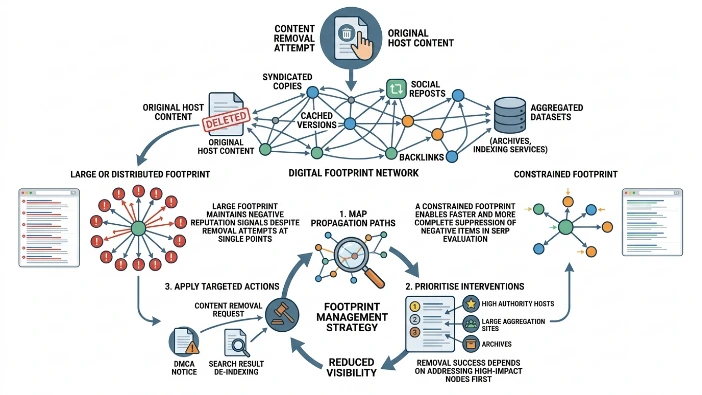
Scalability depends on the number of sources, the number of relevant search queries and the persistence of the exposed information. A single source can be assessed through targeted intervention, while a distributed digital footprint requires broader monitoring. Removal becomes less scalable as duplicate publications increase, whereas organic content strategies can influence multiple related queries through a coherent content structure. Search suppression occupies an intermediate position because it focuses on search visibility rather than every underlying source. Evaluating scalability therefore requires analysing both the volume of information and its search distribution.
How Does Personal Information Removal Fit Into Reputation Management?
Personal Information Removal Services operate at the source-control layer of reputation management by identifying exposed information and assessing available removal mechanisms. This approach differs from search optimisation because its primary objective is addressing the underlying publication rather than increasing the visibility of alternative content. Source identification establishes which URLs, profiles or pages contain the information. Evidence assessment then supports a structured evaluation of the applicable removal process. The resulting outcome can be measured through source accessibility and subsequent search visibility.
Removal also interacts with the wider digital footprint because eliminating one source does not automatically address duplicate publications. Search engines maintain independent indexes, while websites and platforms maintain separate content systems. A source-level intervention therefore requires subsequent evaluation of whether related information remains discoverable. This creates a relationship between content removal and search perception control. Understanding that relationship provides a more accurate basis for evaluating the effectiveness and sustainability of a reputation-management strategy.
What Should You Consider When Choosing a Data-Breach Response Strategy?
The decision should be based on the type of exposure, public visibility, source distribution, search ranking influence and long-term reputation requirements. Breach verification is appropriate for establishing whether an identifier appears within known records, while search monitoring evaluates whether information has entered the public search environment. Removal is more directly aligned with source availability, while suppression addresses SERP visibility. Organic content development addresses longer-term entity credibility and search composition. These methods therefore represent different stages of the same information-control framework.
Risk exposure also changes as information moves from private records into public search results. An indexed page containing personal information creates a different search-reputation profile from a confirmed breach that has not entered public search. Get Help Securing Your Data After a Breach Exposure Today relates to the next stage of this process, where information-security considerations and reputation management become connected. Evaluating these stages separately prevents the response from relying on a single intervention. It also creates clearer criteria for assessing effectiveness, scalability and sustainability.
Checking whether personal data was included in a breach requires a distinction between confirmed exposure, public availability and search visibility. Breach verification establishes whether an identifier appears in known records, while search monitoring determines whether related information has entered the indexed digital environment. Removal addresses source availability, search suppression addresses SERP composition, and organic content enhancement strengthens the broader information environment. Each method therefore provides a different form of reputation control.
The most effective evaluation considers effectiveness, scalability, risk exposure and sustainability together. Reputation signals, entity credibility, authority and sentiment provide additional context for understanding how exposed information influences perception. Long-term monitoring then measures whether changes remain stable as search engines recrawl content and new information enters the digital footprint. This layered approach provides a clearer framework for evaluating personal-data exposure within modern search ecosystems.
How can I check if my personal data was in a breach?
Check official breach notifications and use reputable breach-checking resources to determine whether your email address or other identifiers were included. Review the specific data categories involved to understand the extent of the exposure.
What should I do if my personal information was exposed in a breach?
Identify the exposed information, secure affected accounts and assess whether the data has appeared publicly online. Search monitoring can then determine whether exposed information has entered indexed pages or other public sources.
Can I find out what information was exposed in a data breach?
Breach notifications often identify the categories of affected information, such as email addresses, names or account details. Reviewing the incident details provides a clearer assessment of the digital footprint created by the exposure.
Can breached personal information appear in search results?
Yes, personal information can become searchable when exposed data is published on publicly accessible and indexed websites. Search visibility depends on factors such as content indexing, relevance, source authority and ranking signals.
Can personal information from a data breach be removed from the internet?
Removal depends on where the information appears and the policies of the relevant website or platform. Personal Information Removal Services focus on identifying exposed content and evaluating available removal or reporting mechanisms.