Reducing identity theft risk after a personal data leak requires immediate exposure assessment, account protection, data removal, and continuous monitoring of public information.
Reputation management strategies differ based on whether the priority is removing exposed information, strengthening legitimate reputation signals, or monitoring changes across search ecosystems.
Online reputation control methods are evaluated through search visibility, content indexing, entity credibility, and the accessibility of personal information. A data leak creates a privacy problem when information becomes accessible beyond its intended audience. The same information can also become a reputation issue when search engines index it and associate it with an identifiable person. Effective evaluation therefore compares reactive removal with proactive digital footprint management. The distinction determines which approach provides immediate risk reduction and which creates longer-term resilience.
Which Steps Provide the Strongest Immediate Protection After a Data Leak?
Immediate protection comes from identifying exposed information and securing the accounts or systems connected to the leaked data. A personal data leak is an event in which information becomes accessible to an unauthorised audience through a security incident, accidental disclosure, or other exposure mechanism. The first analytical step involves determining what information was exposed rather than treating every leak as identical. Names, addresses, telephone numbers, email addresses, usernames, financial information, and authentication credentials carry different risk characteristics. This classification establishes which response mechanisms have the highest priority.
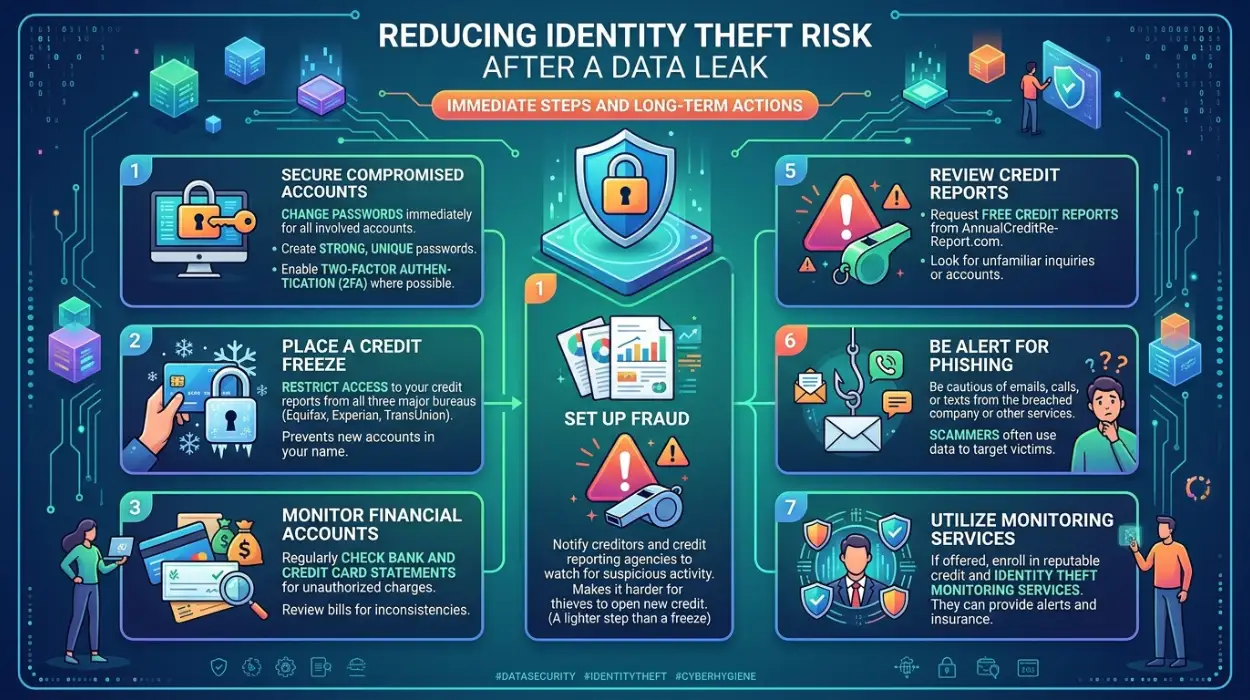
Account protection operates separately from online reputation management but forms an essential part of identity risk reduction. Password changes, multi-factor authentication, account recovery checks, and financial monitoring address direct security risks. Public information removal addresses a different layer by reducing the amount of identity data available for discovery. Combining both approaches creates broader coverage. Relying exclusively on either account security or information removal leaves part of the exposure environment unaddressed.
The distinction between private and publicly exposed information also matters. A compromised password requires a security response, while a residential address published on an accessible directory requires a privacy response. Search visibility becomes relevant when publicly exposed information is indexed and appears for identity-related queries. This creates a bridge between cybersecurity, privacy management, and reputation systems. A structured response therefore separates the underlying risks before selecting an intervention.
How Does Personal Information Removal Compare With Account Security?
Personal information removal and account security address different mechanisms of identity theft risk. Account security protects access to digital systems, while personal information removal reduces the publicly available data that supports identification and targeting. Removing an exposed telephone number does not secure an account associated with that number. Similarly, changing an account password does not remove a residential address from an indexed directory. The two approaches therefore complement rather than replace each other.
Personal information removal operates by reducing the accessibility of unnecessary identity data across websites, directories, profiles, and other public sources. The effectiveness of this approach depends on whether the source accepts removal requests, whether the information qualifies for removal, and whether duplicate copies exist elsewhere. Account security operates through authentication controls that restrict unauthorised access. Its effectiveness depends on credential strength, authentication methods, recovery settings, and ongoing account monitoring. The mechanisms are fundamentally different.
From a reputation management perspective, removal changes the information environment available to users and search engines. Account security generally does not change what appears in search results. This distinction becomes important when evaluating search visibility and entity perception after a leak. A complete response therefore assesses both security exposure and public information exposure. The resulting framework provides a more accurate measure of overall identity risk.
Which Data Types Require the Highest Removal Priority?
Data requiring the highest removal priority includes information that directly identifies an individual or creates strong links between separate identity attributes. The sensitivity of information depends on its function, accessibility, accuracy, persistence, and relationship with other data. A residential address can become more consequential when published alongside a full name and telephone number. A personal email address becomes more useful for targeting when associated with professional information or social profiles. Priority therefore depends on the combined information structure rather than a single data field.
A practical evaluation framework can prioritise exposed information according to its identity and targeting value:
- Identify direct identifiers such as full names, residential addresses, personal telephone numbers, and private email addresses.
- Classify authentication-related information such as usernames, account identifiers, security questions, or exposed credentials.
- Map associated information including employers, professional profiles, social accounts, public directories, and location references.
- Evaluate search visibility by checking whether exposed information appears for name-based or identity-related queries.
- Track duplication by identifying websites, directories, archives, or profiles that reproduce the same personal details.
This process creates a hierarchy for evaluating exposure rather than treating every result equally. High-visibility information with multiple identity connections generally represents a different risk profile from isolated, difficult-to-discover data. Search ranking influence also affects practical exposure because prominently displayed information is easier for users to find. This makes SERP evaluation an important component of privacy analysis. The objective remains risk classification rather than indiscriminate removal.
Is Removing Leaked Information More Effective Than Monitoring It?
Removal provides direct intervention against accessible personal information, while monitoring provides visibility into whether exposure continues or reappears. Content removal operates by reducing the availability of a specific information source. Monitoring operates by identifying changes in search visibility, content indexing, and the appearance of new references. Neither mechanism replaces the other. Removal addresses an existing exposure, while monitoring measures the continuing state of the digital footprint.
The effectiveness of removal depends on the source and the nature of the information. A website that accepts a valid privacy request provides a direct intervention route, while an independently published reference can require a different process. Duplicate content also limits the effectiveness of treating one webpage as the complete problem. Monitoring identifies these secondary sources and provides evidence of continuing exposure. This makes monitoring essential for evaluating the sustainability of removal.
The comparison also reveals an important difference between short-term and long-term outcomes. Successful removal can produce a direct reduction in public accessibility. Continuous monitoring creates resilience by detecting future exposure before it becomes deeply established. A combined strategy therefore produces stronger coverage than either approach alone. The information environment becomes measurable rather than dependent on assumptions about whether a removal action has fully resolved the problem.
How Does Search Visibility Influence Identity Theft Risk?

Search visibility influences identity theft risk by determining how easily exposed personal information can be discovered through ordinary searches. Search visibility refers to the prominence and accessibility of content within search results for relevant queries. A personal address located on an obscure webpage has a different exposure profile from the same address appearing prominently for a person’s full name. Search engines therefore act as discovery systems that influence the practical accessibility of public data. This makes SERP evaluation relevant to privacy risk.
Content indexing is the process through which search engines discover and store webpage information for potential retrieval. Once a page becomes indexed, users can potentially locate it without knowing the original website address. Ranking systems then determine where that page appears for relevant searches. Higher visibility increases discoverability, although search ranking does not establish whether the underlying information is accurate or appropriate. This distinction separates search ranking influence from factual validation.
Search visibility also affects entity perception. When personal information repeatedly appears alongside a person’s name, users can associate that information more strongly with the individual. Search systems can similarly establish relationships between recurring references. This creates an information structure around the entity. Managing the visibility of unnecessary information therefore addresses both privacy exposure and the broader digital footprint.
Which Reputation Management Method Creates Better Long-Term Risk Reduction?
Long-term risk reduction comes from combining reactive information removal with proactive digital footprint management. Reactive management responds to known exposure by identifying and addressing specific sources. Proactive management monitors the wider information environment and strengthens accurate, relevant reputation signals. The first approach addresses existing problems, while the second creates resilience against recurring exposure. Their different mechanisms make direct comparison more useful than treating reputation management as a single activity.
Content suppression focuses on reducing the availability or visibility of qualifying harmful or unnecessary information. Content enhancement focuses on strengthening legitimate, accurate, and authoritative information around an entity. In privacy situations, suppression has greater relevance when personal information is unnecessarily exposed. Enhancement has greater relevance when users require accurate context about the individual. The two approaches therefore solve different information problems.
Search ecosystems evaluate content through relevance, authority, quality, context, and other ranking signals. Strengthening accurate information does not guarantee removal of unwanted results, but it can improve the overall information environment surrounding an entity. Similarly, removing one source does not guarantee that duplicate or independently published information disappears. The sustainable approach evaluates both mechanisms together. This produces stronger visibility control without relying on unsupported assumptions about search ranking behaviour.
How Can Search Monitoring Measure Whether Exposure Is Declining?
Search monitoring measures exposure by tracking changes in indexed pages, search-result composition, information prominence, and new references associated with an identity. Monitoring establishes a baseline before intervention and compares later search results against that baseline. This creates evidence of whether public visibility is declining, remaining stable, or expanding. The same process identifies new pages that enter the search ecosystem. Measurement therefore transforms privacy management from a one-time action into an ongoing evaluation process.
A structured monitoring framework can measure:
- Record baseline search results by documenting prominent pages, exposed data types, and relevant identity queries.
- Compare SERP composition by measuring changes in the visibility of exposed information after intervention.
- Detect new references by tracking newly indexed pages, directories, profiles, and duplicate content.
- Evaluate entity associations by reviewing how personal information appears alongside names, locations, organisations, or professional identifiers.
- Measure persistence by checking whether removed information continues through cached, replicated, or independently published sources.
These measurements distinguish actual visibility changes from assumptions. A removal request represents an action, not proof of complete exposure reduction. Search monitoring provides the evidence required to determine whether the information remains discoverable. This distinction is important for evaluating effectiveness and sustainability. It also supports better prioritisation when new sources emerge.
Does Organic Digital Footprint Management Reduce Future Exposure?
Organic digital footprint management reduces future exposure by maintaining accurate information and identifying unnecessary public data before it becomes highly visible. Digital footprint management is the structured analysis of information associated with an individual across online platforms. It includes reviewing public profiles, directories, search results, professional references, social accounts, and other accessible sources. The objective is not to eliminate an individual’s entire online presence. It is to understand and manage the information environment surrounding the identity.
Organic management operates over a longer period than reactive removal. Regular monitoring identifies new references, changes in search visibility, duplicate content, and inconsistent entity information. Accurate professional and public information can also strengthen legitimate reputation signals. These signals provide context when users search for the individual. The result is a more coherent information environment that reduces reliance on individual removal actions.
Sustainability depends on consistency. An information removal process that addresses only current exposure does not prevent future publication. Monitoring and periodic digital footprint audits create an ongoing detection mechanism. This makes the approach more scalable because the same evaluation framework can be applied to new sources. Long-term reputation resilience therefore comes from maintaining the information environment rather than responding only after exposure becomes severe.
Dive Deeper With Our Expert Guides:
How to Remove Historic Address Records From the Internet
What Options Exist to Restrict Public Land Registry Property Data
What Are the Limitations of Personal Information Removal Strategies?
Personal information removal strategies have limitations because website operators, search engines, and third-party platforms control their own content and systems. A legitimate removal request does not guarantee acceptance. Some information also remains subject to legal, public-interest, regulatory, or platform-specific considerations. Search engines independently determine indexing and ranking outcomes. These constraints make process accuracy and realistic expectations essential.
Duplicate publication creates another limitation. Information can appear across directories, archived pages, social profiles, data aggregators, and unrelated websites. Removing the original source therefore does not necessarily remove every copy. Search monitoring identifies these additional references and determines whether they require separate intervention. The broader the distribution, the more complex the removal process becomes.
Search ranking also creates a distinction between removal and visibility reduction. A webpage can remain online while becoming less prominent in search results, whereas complete removal eliminates access at the source. These outcomes are not interchangeable. Reputation analysis must therefore distinguish source accessibility from search visibility. This distinction provides a more accurate basis for evaluating results.
How Should Organisations Evaluate the Sustainability of a Privacy Strategy?
Organisations can evaluate sustainability through removal success, exposure recurrence, search visibility, monitoring coverage, and the strength of legitimate reputation signals. A sustainable privacy strategy does not rely exclusively on individual removal events. It creates a repeatable process for discovering new exposure and assessing its significance. This enables consistent prioritisation as the digital footprint changes. Sustainability therefore depends on process continuity rather than one successful intervention.
A comparative evaluation can examine each approach across four dimensions:
| Approach | Primary mechanism | Short-term effect | Long-term value |
|---|---|---|---|
| Reactive removal | Addresses specific exposed sources | Direct reduction in accessibility | Limited without monitoring |
| Search monitoring | Tracks indexed and visible information | Improves exposure awareness | Strong detection capability |
| Digital footprint management | Reviews broader identity exposure | Establishes baseline control | Creates ongoing resilience |
| Content enhancement | Strengthens accurate reputation signals | Provides additional context | Supports entity credibility |
This comparison demonstrates why no single mechanism fully addresses identity exposure. Removal is direct but source-dependent. Monitoring is measurable but does not itself remove information. Digital footprint management provides broader coverage, while content enhancement supports the reputation dimension. Combining mechanisms creates a more complete strategy.
What Steps Provide the Most Sustainable Identity Theft Risk Reduction?
The most sustainable approach combines immediate security controls, targeted information removal, search monitoring, and long-term digital footprint management. These mechanisms operate at different points in the exposure lifecycle. Security controls protect accounts, removal reduces unnecessary public data, monitoring detects changes, and digital footprint management strengthens ongoing awareness. Their combined effect creates layered risk reduction. This is more comprehensive than treating a data leak as a single incident.
The strategic sequence can be evaluated through five connected stages:
- Secure affected accounts by changing credentials, strengthening authentication, and reviewing recovery settings.
- Audit exposed information by identifying data types, sources, duplication, accessibility, and search visibility.
- Remove unnecessary public information through appropriate website, platform, privacy, or legal mechanisms.
- Monitor search results and public sources for continuing exposure, duplicate content, and new references.
- Maintain accurate digital information by reviewing the wider footprint and preserving credible entity signals.
This sequence separates immediate response from long-term management. It also establishes measurable checkpoints for determining whether exposure is declining. The approach remains adaptable because new information sources can enter the digital footprint at any time. Continuous evaluation therefore forms the foundation of sustainable privacy and reputation management.
Which Approach Best Reduces Identity Theft Risk After a Data Leak?
Reducing identity theft risk after a personal data leak requires more than removing one exposed webpage. Reactive removal provides direct intervention against specific sources, while monitoring identifies continuing exposure and duplicate information. Organic digital footprint management creates longer-term resilience by maintaining awareness of how personal information appears across search ecosystems. Account security addresses a separate technical layer and remains essential alongside public information management.
The strongest strategy evaluates privacy exposure through both accessibility and search visibility. Content indexing determines whether information becomes searchable, while ranking dynamics influence how prominently it appears. Reputation signals and entity credibility determine the broader context surrounding an individual’s online identity. These mechanisms explain why personal information removal, search monitoring, and digital footprint management work as complementary rather than interchangeable approaches.
Ultimately, sustainable risk reduction depends on disciplined execution, evidence-based prioritisation, and continuous monitoring. Reduce your identity theft risk with personal data removal is therefore best answered through a layered process that secures accounts, identifies exposed information, addresses unnecessary public data, measures SERP changes, and maintains the wider digital footprint. This framework provides a practical basis for evaluating effectiveness, scalability, risk exposure, and long-term sustainability without relying on unsupported guarantees.
What should you do after a personal data leak?
Identify which personal information was exposed, secure affected accounts, and monitor for suspicious activity. Check search results and public websites for exposed data that requires privacy-focused removal.
How can personal information removal reduce identity theft risk?
Personal information removal reduces the amount of publicly accessible data that can be used to identify or target an individual. Removing unnecessary addresses, phone numbers, email addresses, and other exposed details also reduces digital footprint exposure.
Should you remove personal information from Google after a data leak?
Review search results for exposed personal information and identify the original webpages displaying the data. Addressing the source and monitoring search visibility helps determine whether the information remains publicly accessible.
How do you monitor personal information after a data breach?
Monitor search engines, public directories, social profiles, and other websites for exposed or duplicated personal information. Regular digital footprint checks help identify new references and continuing exposure after the initial response.
What is the best way to reduce identity theft risk after a data leak?
The strongest approach combines account security, targeted personal information removal, search monitoring, and ongoing digital footprint management. This layered process addresses both direct account risks and publicly accessible information.