Historic address records are removed by identifying the websites holding the information, using their applicable privacy or removal procedures, and addressing duplicate or indexed copies separately. The effectiveness of each approach depends on whether the objective is source removal, search visibility reduction or broader digital footprint management.
Reputation management strategies differ based on the source, persistence and search visibility of personal information. Online reputation control methods are evaluated through their ability to reduce unwanted exposure, improve information accuracy and limit the reputation signals associated with outdated records. Historic addresses therefore require an approach that distinguishes between data removal, search-result suppression and long-term digital footprint optimisation.
Which method is most effective for removing historic address records?
Source-level removal is generally the most direct method because it addresses the website or database holding the historic address. Source removal operates by requesting that the publisher, directory or data provider delete, amend or restrict the relevant personal information. This approach changes the underlying record rather than simply reducing its visibility in search results. Its effectiveness depends on the source’s removal procedure, the information involved and the authority of the request.
Search-result suppression operates differently because it focuses on discoverability rather than the underlying record. A search engine can continue displaying a result when the source page remains accessible, even if the information has become outdated. Removing the source therefore provides stronger control over the origin of the information, while search suppression addresses a separate visibility layer. Comparing the two requires measuring both source accessibility and SERP visibility.
How does a personal information removal strategy compare with search suppression?
Personal information removal focuses on the underlying publication, whereas search suppression focuses on how prominently that publication appears for relevant queries. Removal therefore operates at the source level, while suppression operates within the search ecosystem. A removed page no longer provides the same accessible information source, while a suppressed result can remain available elsewhere. This distinction makes source removal more closely connected to data control and suppression more closely connected to search perception.
Search visibility also depends on indexing and ranking signals. If an old address remains present on a people-search website, a search engine can continue discovering and indexing that page. Reducing its ranking does not necessarily eliminate the record from the source. An effective evaluation therefore examines whether the objective concerns eliminating personal information, reducing search exposure or addressing both.
Why does removing one historic address listing not remove every copy?
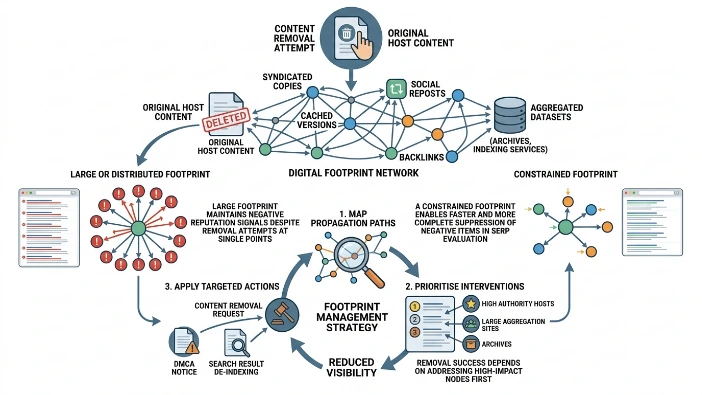
Removing one listing does not remove every copy because personal information is frequently replicated across independent databases and websites. Data aggregation operates by collecting information from multiple sources and creating records that can later appear on additional platforms. Each database maintains its own copy and follows its own update procedures. A correction made at one source therefore does not automatically synchronise every other database containing the same address.
Duplication also affects search visibility because separate pages can provide multiple indexed references to the same historical information. Search engines evaluate these pages individually while also analysing relationships between similar content. This creates a distributed digital footprint rather than a single address record. Effective removal analysis therefore maps the information network before measuring the result.
Is reactive address removal more effective than organic reputation management?
Reactive address removal provides stronger immediate control over an identified privacy issue, while organic reputation management provides broader long-term control over the information environment. Reactive removal operates by identifying existing unwanted records and addressing them directly through source-level procedures. Organic reputation management operates by developing accurate, relevant information that strengthens the wider digital footprint. The two approaches therefore address different stages of the reputation lifecycle.
Reactive methods directly target an unwanted reputation signal but have limited scope when duplicate records remain elsewhere. Organic methods influence SERP composition through the presence and relevance of alternative information but do not necessarily remove the original personal record. This creates an important distinction between removal and content enhancement. Strategic evaluation therefore considers whether the immediate objective is information deletion or longer-term search perception management.
How does source authority affect historic address visibility?

Source authority affects visibility because search engines evaluate the characteristics and relevance of webpages when determining their position in search results. Authority is a signal associated with the perceived strength and relevance of a source within a particular information context. A well-established directory can therefore receive different search visibility from a low-authority page containing similar information. Authority does not independently verify every personal-data field on a webpage.
Historic address information can remain highly visible when it appears on pages that continue to satisfy relevant name-based queries. Search engines analyse the relationship between query terms, page content and other ranking signals when composing SERPs. This means the same outdated address can have different visibility across different sources. Reputation analysis therefore considers both the accuracy of the information and the characteristics of the source publishing it.
How should historic address removal be evaluated for effectiveness?
Effectiveness is measured through changes in source accessibility, duplication, indexing and search visibility rather than through one removal confirmation. A reliable evaluation begins by identifying the total number of relevant sources and recording their current status. Each source can then be assessed according to whether the information remains visible, has been amended or has been removed. This establishes a measurable baseline for subsequent comparison.
A structured evaluation can include:
- Identify every known source containing the historic address and record its URL, database type and visibility.
- Classify each record according to whether it represents an original source, duplicate listing or indexed search reference.
- Measure search visibility by analysing the position and persistence of relevant pages for name-based queries.
- Compare results after source-level changes to determine whether accessibility and SERP composition have changed.
- Monitor residual records to identify new copies or previously undiscovered sources.
This framework separates operational activity from actual outcomes. A removal request represents an action, while reduced accessibility and search exposure represent measurable results. The distinction is important when comparing personal information removal methods.
What is the difference between short-term and long-term address removal?
Short-term address removal focuses on reducing immediate exposure, while long-term management focuses on preventing recurring visibility across the digital footprint. Short-term action generally involves identifying prominent listings and addressing the most visible sources first. This can reduce immediate exposure where the relevant source accepts the removal request. Long-term management examines whether the same information continues appearing through other databases or search results.
Search ecosystems are continuously updated as webpages are published, modified, removed and re-indexed. A historic address therefore requires ongoing evaluation when information exists across a distributed network. Long-term sustainability depends on the ability to identify residual sources and monitor changes in SERP composition. A one-time removal process has a narrower scope than continuous digital footprint analysis.
Dive Deeper With Our Expert Guides:
What Options Exist to Restrict Public Land Registry Property Data
How to Remove a Director’s Home Address From Companies House
How does content enhancement compare with historic address removal?
Content enhancement strengthens accurate and relevant information surrounding an entity, while historic address removal eliminates or restricts unwanted personal information at its source. Content enhancement operates through the creation or optimisation of authoritative information that contributes to the entity’s search environment. Removal operates through direct intervention with the source holding the personal record. These mechanisms influence reputation systems through different pathways.
The distinction between content suppression vs content enhancement is particularly important when evaluating search perception. Suppression focuses on reducing the prominence of unwanted results, while enhancement focuses on strengthening alternative information. Neither mechanism automatically changes the underlying historic address record. Source removal therefore remains distinct from strategies designed to influence SERP composition.
Which approach provides better long-term control over a digital footprint?
A combined source-removal and monitoring approach provides broader control because it addresses both the origin of personal information and its continuing visibility. Source removal targets the record itself, while monitoring identifies duplicates and remaining indexed references. Organic content development then supports a more accurate information environment around the entity. Each layer contributes a different form of digital footprint management.
Long-term control depends on scalability as well as immediate effectiveness. A strategy that works for one directory becomes less efficient when the same record appears across dozens of independent databases. Standardised source mapping and categorisation improve scalability by allowing similar records to be evaluated systematically. Sustainable management therefore depends on repeatable processes rather than isolated removal actions.
How does historic address removal affect search visibility?
Historic address removal can reduce search visibility when the removed source was responsible for a prominent indexed result. Once the underlying page changes or disappears, search engines process the altered source during subsequent crawling and indexing. The resulting SERP composition depends on the remaining indexed pages and their relative ranking signals. Removal therefore influences search visibility indirectly through changes to the available information environment.
Search visibility should not be treated as identical to source removal. A page can remain indexed temporarily after its source changes, while another website containing the same address can continue ranking. This creates a difference between removing information and removing its search footprint. Evaluating both conditions provides a more accurate measure of reputation impact.
How does historic address information influence trust signals and perception?
Historic address information contributes to the information associated with an individual’s digital identity, although it does not automatically represent a negative reputation signal. Trust signals are evaluated within a broader context that includes source reliability, information consistency and relevance. When outdated records appear alongside current information, users encounter multiple versions of an individual’s identity information. This can affect how clearly the digital footprint represents current circumstances.
Entity perception refers to the way information associated with an identifiable person or entity is interpreted across search and information environments. Search engines do not apply a single public reputation score to determine this perception. Instead, different sources contribute different signals to the information landscape. Historic address records therefore form one component of a wider identity ecosystem.
Is removing historic address information scalable across multiple data sources?
Scalability depends on how efficiently different sources can be identified, categorised and addressed through their respective procedures. Each people-search website or data provider can maintain different account structures, privacy processes and record formats. A manual approach that treats every listing as completely unique becomes less efficient as the number of sources increases. Structured source classification creates a more consistent method for handling repeated information.
Scalability also requires monitoring after initial removal activity. New records can appear when datasets are refreshed or when existing information is reproduced by another source. A scalable process therefore combines source discovery with status tracking and search monitoring. This creates a repeatable framework for managing a distributed personal-information footprint.
What risks exist when relying only on search-result suppression?
Relying exclusively on search-result suppression creates source-level limitations because the underlying historic address can remain published elsewhere. Suppression addresses visibility within particular search environments but does not necessarily change the original database record. Users accessing the source directly can therefore continue encountering the information. Duplicate websites can also preserve the same historical record outside the suppressed result.
This approach also creates sustainability considerations because search-result composition changes over time. New pages can enter the index, existing pages can gain authority and ranking positions can change. A suppressed result therefore does not represent permanent deletion of the underlying information. Source-level removal and search visibility management have to be evaluated as separate mechanisms.
How should the cost of historic address removal be evaluated?
Cost is best evaluated against the complexity of the information network rather than the number of individual URLs alone. A single prominent source requires a different level of analysis from a distributed set of people-search profiles, directories and duplicate records. The scope includes source discovery, evidence management, removal procedures, duplicate analysis and post-removal monitoring. Each component contributes to the total operational requirement.
Long-term value also depends on whether the approach reduces recurring exposure. A low-cost one-time action has limited strategic value when identical information continues appearing across other sources. Conversely, a structured process that maps and monitors the wider digital footprint provides a stronger basis for measuring sustained results. Cost evaluation therefore needs to include both immediate activity and continuing information exposure.
What should be compared when choosing a historic address removal approach?
The most relevant comparison criteria are source coverage, removal mechanism, search visibility impact, scalability, risk exposure and sustainability. Source coverage measures how comprehensively the process identifies relevant databases and websites. Removal mechanism evaluates whether the approach addresses the underlying record or only its visibility in search. Search impact measures changes in SERP composition and the prominence of historic address pages.
A decision framework can also assess:
- Compare source control by determining whether the underlying personal record is removed, amended or simply de-indexed.
- Evaluate search influence by measuring changes in rankings for relevant name and address queries.
- Assess scalability by examining how the approach handles duplicate records across independent databases.
- Measure sustainability by tracking whether historic information reappears after initial removal.
- Analyse risk exposure by identifying sources that continue publishing or reproducing the information.
These criteria provide a consistent basis for comparing personal information removal strategies. They also distinguish immediate visibility improvements from lasting changes to the digital footprint.
How do removal strategies support long-term online reputation control?
Removal strategies support long-term reputation control by reducing the number of accessible personal-information sources associated with an individual. Fewer accessible historic records create a more accurate digital footprint when current information is available through relevant authoritative sources. Monitoring then evaluates whether unwanted records return or appear through additional databases. This creates an ongoing information-management cycle rather than a single intervention.
Online reputation control methods are evaluated through both information accuracy and search perception. Source removal addresses information accuracy at the publication level, while search visibility analysis examines how the remaining information appears to users. Remove Old Address History From the Internet With Our UK Team represents a focused approach to addressing historic address information at the source while considering its wider search visibility. Organic content development can then support a more coherent SERP composition. The combination provides a broader framework for managing personal information within search ecosystems.
Historic address removal involves more than deleting one webpage because personal information is distributed across independent databases, directories and search indexes. Source-level removal provides direct control over the underlying record, while search suppression addresses its visibility within search results. Organic content enhancement provides a separate mechanism for strengthening accurate information within the broader digital footprint.
The strongest evaluation framework considers effectiveness, scalability, risk exposure and sustainability together. Immediate source removal addresses direct exposure, search visibility analysis measures SERP impact, and ongoing monitoring identifies duplicate or recurring records. These approaches operate at different levels and therefore require separate measurement.
Historic address management is ultimately a digital-footprint optimisation problem involving source control, indexing, ranking and information accuracy. Comparing these mechanisms provides a clearer basis for determining which approach fits the scale and persistence of the records involved.
How can I remove historic address records from the internet?
Start by identifying the websites and data providers publishing the historic address, then use their applicable privacy or removal procedures. Personal information removal can address the source record, while search-result management focuses on its online visibility.
Can old address records be removed from people-search websites?
Old address records can often be submitted for removal or correction through the relevant people-search website’s privacy process. The outcome depends on the provider, the type of information and the applicable UK privacy requirements.
Does removing an old address from one website remove it everywhere?
No, removing one listing does not automatically remove duplicate records held by other websites or databases. Each independent source generally requires separate identification and assessment.
How does removing an old address affect Google search results?
Removing the underlying source can reduce the information available for search engines to index, but search results can remain visible until updated pages are recrawled and re-indexed. Other websites containing the same historic address can also continue ranking.
What is the difference between address removal and search-result suppression?
Address removal targets the underlying personal information at its source, while search-result suppression targets the visibility of a webpage in search results. Removal changes the source record, whereas suppression focuses primarily on search visibility and SERP composition.