

Indeed review removal is primarily a platform-policy process in which businesses report reviews that breach published content standards rather than simply requesting the deletion of unfavourable opinions. The most effective reputation response depends on whether the review is inaccurate, abusive, irrelevant, confidential, or otherwise policy-violating.
Reputation management strategies differ based on the source, nature, visibility, and persistence of the reputation signal. Online reputation control methods are evaluated through information accuracy, SERP composition, trust signals, and the relationship between review content and entity credibility.
Which Indeed review removal approach is more effective than content creation?
Review removal is more direct when harmful content violates platform rules, while content creation addresses the wider search environment surrounding the business. Removal operates at the publication level by challenging content against the platform’s moderation criteria, whereas content creation operates through the introduction of relevant, authoritative information across indexed properties. The distinction matters because removing a review changes the source itself, while publishing additional content does not necessarily alter the existence of the original review. A removal strategy therefore has greater relevance when the underlying content is demonstrably inappropriate or policy-violating. Content enhancement has greater relevance when the objective is to strengthen the overall information environment rather than challenge one specific publication.
Content creation also influences SERP composition through relevance, authority, freshness, and entity associations. Search engines evaluate individual pages within a broader information ecosystem rather than treating a single review as an isolated reputation score. Publishing useful business information, professional profiles, authoritative company pages, and relevant third-party references can create additional reputation signals around the entity. However, newly created content does not automatically suppress negative material because search ranking influence depends on query relevance and competing page authority. This makes content enhancement a complementary approach rather than a direct substitute for legitimate review removal.
How does reactive review management compare with organic reputation building?
Reactive review management responds to an existing reputation signal, while organic reputation building establishes a broader and more consistent information structure over time. A reactive approach begins with monitoring, classification, evidence assessment, and platform reporting. Its mechanism is therefore tied to a specific event, such as the publication of a review that contains prohibited or misleading material. Organic reputation building operates continuously by developing credible information that accurately represents the organisation across relevant digital properties. The two approaches address different stages of the reputation lifecycle.
Reactive management offers greater precision because each action is linked to a defined piece of content. It also provides a clearer evaluation framework because the business can assess whether the review breaches a specific policy and whether the platform accepts the report. Its limitation is scope, since removing one review does not establish broader search resilience. Organic reputation building has greater scalability because one authoritative content asset can support multiple branded queries and entity associations. Its limitation is that its effect on individual negative URLs is indirect and dependent on search engine interpretation.
Does removing an Indeed review have a stronger impact than suppressing negative search results?
Removing a policy-violating review has a more direct impact on the original information source, whereas search suppression focuses on changing the relative visibility of competing content. Removal operates before or at the publication level by seeking the elimination of content from the platform. Suppression operates within the search ecosystem by increasing the relevance and authority of alternative pages for specific queries. These mechanisms therefore produce different outcomes even when they address the same reputation problem. A deleted review no longer contributes its original content to the platform, while suppressed content can remain accessible through direct searches or less prominent results.
Search suppression also requires an assessment of SERP composition rather than simply the existence of negative content. A page can remain indexed while receiving less visibility because other pages become more relevant to the query. This distinction is important when evaluating search ranking influence because visibility and publication status are separate variables. Removal has a defined endpoint when the platform accepts the request, while suppression requires continuous assessment of rankings and competing content. The appropriate evaluation therefore depends on whether the primary problem concerns the source itself or the way that source appears in search results.
How do search engines interpret Indeed reviews as reputation signals?
Search engines interpret online reviews as part of a broader collection of information signals rather than as a simple reputation score assigned to a business. Reputation signals can include review content, business information, third-party references, structured data, authoritativeness, relevance, and relationships between entities. Search systems analyse these signals in relation to particular queries, meaning the same review can have different visibility for different searches. A negative review therefore does not automatically determine the entire SERP for a branded query. Its influence depends on relevance, indexing, authority, freshness, and the surrounding information environment.
Entity credibility is strengthened when multiple independent and relevant sources consistently identify the same organisation and describe it accurately. Search engines can connect information across websites through entity relationships, business identifiers, names, locations, and contextual references. This creates a broader semantic environment in which a single review represents only one information point. Reputation management therefore requires analysis of the complete SERP rather than relying exclusively on the rating or wording of an Indeed review. Measuring reputation signals across the search ecosystem provides a more reliable basis for comparing removal, response, and content enhancement strategies.
Is content suppression or content enhancement more sustainable for small businesses?
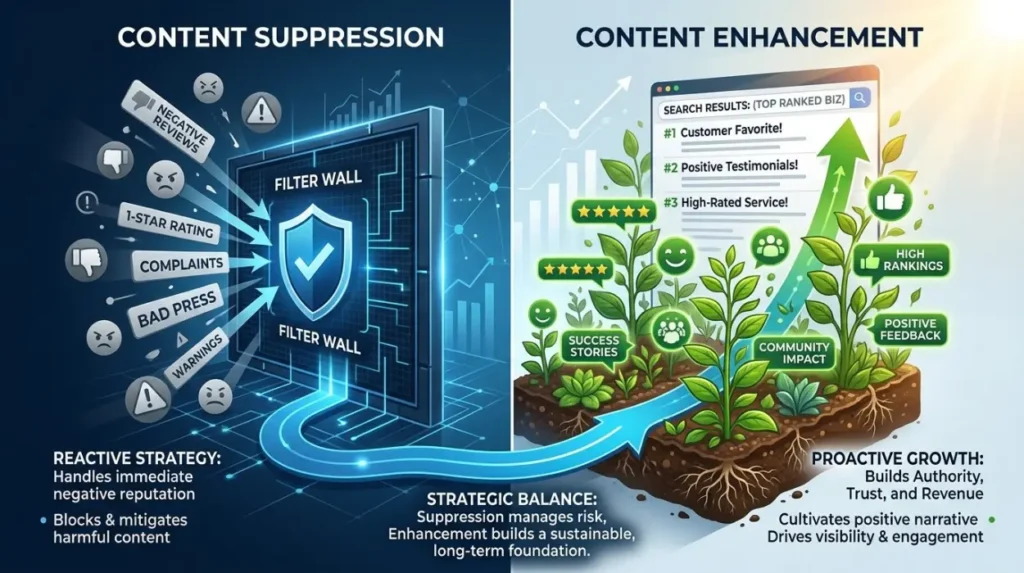
Content enhancement is generally more sustainable as a long-term reputation framework because it builds an information structure rather than depending on individual removal decisions. Content suppression focuses on reducing the visibility of undesirable results through stronger competing content, while enhancement focuses on improving the quality, relevance, and authority of information associated with the business. Enhancement operates by creating useful assets that satisfy branded and commercially relevant search intents. These assets can include company information, professional profiles, industry resources, authoritative references, and other legitimate forms of digital presence. The sustainability of this approach depends on maintaining accuracy, relevance, and editorial quality rather than producing content solely to influence rankings.
Suppression has a more measurable short-term objective because performance can be assessed through changes in search-result positions. However, its sustainability depends on whether the supporting content continues to demonstrate relevance and authority against competing pages. Search results are dynamic, so a page that moves downward in rankings can regain visibility when competing content changes or becomes less relevant. Content enhancement therefore requires ongoing quality management rather than a single publishing event. The comparison demonstrates that long-term reputation control is better evaluated through stability of the overall SERP composition rather than temporary movement of one URL.
How should businesses evaluate the effectiveness of Indeed review removal services?
Effectiveness is measured through identifiable changes in content status, search visibility, sentiment distribution, and risk exposure rather than through the submission of a removal request alone. A removal process can be evaluated by checking whether the reported content meets the platform’s stated criteria, whether evidence supports the complaint, and whether the platform changes the content status. Search visibility can then be assessed separately to determine whether the review continues to appear for relevant branded queries. These measurements distinguish operational activity from an actual reputation outcome. Without this separation, a high number of reports does not necessarily demonstrate effective reputation management.
A structured evaluation framework can measure the following factors:
- Classify the review according to accuracy, relevance, abuse, confidentiality, impersonation, or other applicable policy categories.
- Document supporting evidence that demonstrates the specific issue rather than relying on general disagreement with the review.
- Measure the review’s visibility across branded searches and relevant employment-related queries.
- Compare removal outcomes against content enhancement and organic reputation activity.
- Monitor SERP composition over time to identify changes in negative-result visibility and entity credibility.
This framework also improves scalability because each review can be assessed using consistent criteria. Small businesses benefit from separating legitimate criticism from content that violates platform standards, since attempting to remove genuine opinions introduces a different risk profile from reporting prohibited material. The evaluation process therefore needs to balance effectiveness with platform compliance, evidence quality, resource requirements, and long-term sustainability.
What are the main limitations and risks of Indeed review removal?
The principal limitation is that a negative review is not necessarily removable simply because it damages a business’s reputation. Platform moderation normally distinguishes between permissible criticism and content that violates specific rules. A business that treats every unfavourable review as removable can misallocate resources and weaken its reputation strategy by ignoring legitimate customer or employee feedback. The distinction between negative sentiment and policy-violating content is therefore central to risk evaluation. Removal strategies have the strongest basis when the reported content can be connected to a clearly defined platform rule.
Risk exposure also increases when reputation management relies on manipulative or artificial tactics. Fabricated reviews, coordinated reporting, misleading content, or attempts to disguise the source of reputation material can undermine trust signals and create additional credibility problems. A compliant strategy instead evaluates the source, evidence, platform rules, search visibility, and wider entity context. This approach supports a clearer distinction between content suppression and legitimate information management. It also provides a more sustainable basis for analysing reputation outcomes without treating search visibility as the only measure of success.
Dive Deeper With Our Expert Guides:
How to Ethically Encourage Employees to Leave Indeed Reviews
What Employer Branding Steps Reduce Negative Indeed Reviews Long Term
How should small businesses compare short-term and long-term reputation strategies?
Short-term strategies prioritise immediate control of a defined reputation problem, while long-term strategies focus on strengthening the wider digital information environment. Indeed review reporting belongs primarily to the reactive category because it responds to an existing publication and depends on platform moderation. Search perception management through authoritative content belongs to the longer-term category because it seeks to influence SERP composition through relevance and entity credibility. Neither approach provides a universal solution because their mechanisms operate at different levels of the search ecosystem. A balanced assessment therefore considers the nature of the problem before selecting an intervention.
Short-term removal has greater relevance when a review presents a clear policy issue and the evidence supports a legitimate complaint. Long-term content enhancement has greater relevance when negative information forms part of a broader search perception problem involving multiple pages or weak branded results. The two approaches can also operate sequentially, with policy-based review assessment addressing the source while organic content development strengthens the surrounding information environment. This distinction prevents businesses from treating search suppression as equivalent to deletion. It also creates a clearer basis for measuring reputation performance through both content status and SERP visibility.
What should businesses consider when choosing between reputation management methods?
The most appropriate method depends on content legitimacy, platform policy, search visibility, business objectives, available evidence, and the required time horizon. Removal strategies focus on the original publication and therefore require a defensible policy basis. Reactive responses focus on communication and contextual clarification, making them relevant when the content remains published but requires an organisational response. Content enhancement focuses on the wider search environment and aims to establish stronger information signals around the business. These approaches differ in mechanism, scalability, risk exposure, and sustainability.
For small UK businesses, the key distinction is between correcting an inappropriate source and improving the broader perception environment. A review that breaches platform rules requires a different assessment from a legitimate negative opinion, even when both appear prominently in search results. Similarly, a single negative URL requires a different strategy from a SERP containing multiple negative or low-authority pages. Reputation management therefore works best as an evidence-led evaluation process rather than a single tactic. The final assessment should consider whether the chosen method addresses the source, the visibility problem, or the underlying weakness in the business’s digital information ecosystem.
Indeed review removal and organic reputation management address different mechanisms within the digital reputation ecosystem. Removal targets the original publication when a review breaches platform requirements, while content enhancement strengthens the wider set of information associated with the business. Reactive management provides targeted intervention, whereas organic strategies provide broader and potentially more sustainable search visibility support. Content suppression focuses on SERP position, while content enhancement focuses on developing stronger reputation signals and entity credibility. Evaluating these methods through effectiveness, scalability, risk exposure, and sustainability provides a more accurate framework for managing harmful Indeed reviews and broader search perception.
Can a small UK business remove a negative review from Indeed?
A business cannot usually remove a genuine review simply because it is negative. Indeed review removal generally depends on whether the content violates Indeed’s review guidelines, such as containing abusive, discriminatory, defamatory, or otherwise prohibited material.
How can a business report an inappropriate Indeed review?
A business can report a review to Indeed when it believes the content breaches the platform’s policies. The report should identify the specific issue and provide relevant evidence to support the request for review removal.
What types of Indeed reviews may be eligible for removal?
Reviews containing prohibited content, personal information, threats, discriminatory material, or other policy violations may be eligible for removal. A negative opinion or criticism alone is generally not sufficient grounds for deleting an Indeed review.
How long does Indeed review removal take?
The timeframe for Indeed review removal can vary depending on the nature of the complaint and the platform’s review process. Businesses should allow time for Indeed to assess the reported content and determine whether it violates its guidelines.
Should a small business use professional Indeed review removal services?
Professional review removal services can help businesses assess potentially problematic content, organise evidence and manage a platform complaint. The appropriate approach depends on whether the review actually breaches Indeed’s policies rather than simply being unfavourable.