Long-term reduction in negative Indeed reviews depends on aligning employer branding with actual employee experience, management practices and workplace expectations. Reputation management strategies differ based on whether an organisation addresses the causes of negative sentiment or reacts only after reputation signals appear publicly.
Online reputation control methods are evaluated through sentiment distribution, review visibility, employee experience and the consistency of information presented across digital channels. Employer branding therefore extends beyond recruitment messaging because workplace reality directly influences the review content employees publish and the reputation signals prospective candidates encounter.
Which employer branding approach reduces negative Indeed reviews most effectively?
A workplace-led employer branding approach provides the strongest foundation for reducing recurring negative Indeed reviews because it connects external messaging with internal employee experience. Employer branding is the structured presentation of an organisation as an employer, including its culture, values, management approach, development opportunities and workplace conditions. When these elements accurately reflect employee experience, expectations become more consistent. When external promises differ from internal reality, the gap creates credibility risk.
A communication-led approach focuses primarily on recruitment content, career pages and employer messaging. This approach strengthens information consistency but does not directly resolve workplace problems. An experience-led approach evaluates management, progression, workload, recognition and communication before translating those realities into employer messaging. The second approach therefore addresses the source of reputation signals rather than only their presentation.
How does employee experience compare with reputation-focused review management?
Employee experience provides a preventative mechanism, while review management provides a reactive mechanism. Employee experience refers to the cumulative perception employees form through workplace interactions, policies, management and organisational processes. Review management focuses on the public information generated from those experiences. The two approaches operate at different points within the reputation lifecycle.
Improving employee experience addresses the conditions that generate sentiment before it becomes external content. Review management evaluates the content after publication and determines its relevance, accuracy, visibility and policy status. A review-focused strategy therefore has a narrower operational scope than an experience-focused strategy. Long-term reputation stability depends on understanding both mechanisms without treating review removal as a substitute for organisational improvement.
Which employer branding factors have the greatest influence on review sentiment?
Management quality, communication, workload, career progression and organisational consistency represent key factors influencing employee sentiment. These factors become reputation signals when employees repeatedly describe them in public reviews. Sentiment distribution reflects how positive, neutral and negative themes are represented across review content. Recurring criticism around one workplace factor creates a stronger thematic signal than an isolated complaint.
Employer branding must therefore represent these factors accurately. Statements about supportive management, development or flexible working create expectations that employees compare against actual experience. A mismatch between the expected and experienced workplace creates a perception gap. That gap can become visible through review language, ratings and recurring themes.
How does employer messaging affect Indeed review credibility?
Employer messaging affects review credibility by providing prospective employees with a reference point against which employee feedback is evaluated. Recruitment pages and employer profiles communicate claims about culture, values and workplace conditions. Reviews provide an independent source of employee-generated information. Users compare these information sources when evaluating employer credibility.
Consistent messaging creates greater informational coherence. If public employer claims closely correspond with employee experiences, review content exists within a more consistent information environment. If claims repeatedly contradict employee commentary, the contradiction itself becomes a reputation signal. Employer branding therefore operates as an information layer rather than a mechanism for controlling independent opinions.
Is proactive employer branding more sustainable than reactive review management?
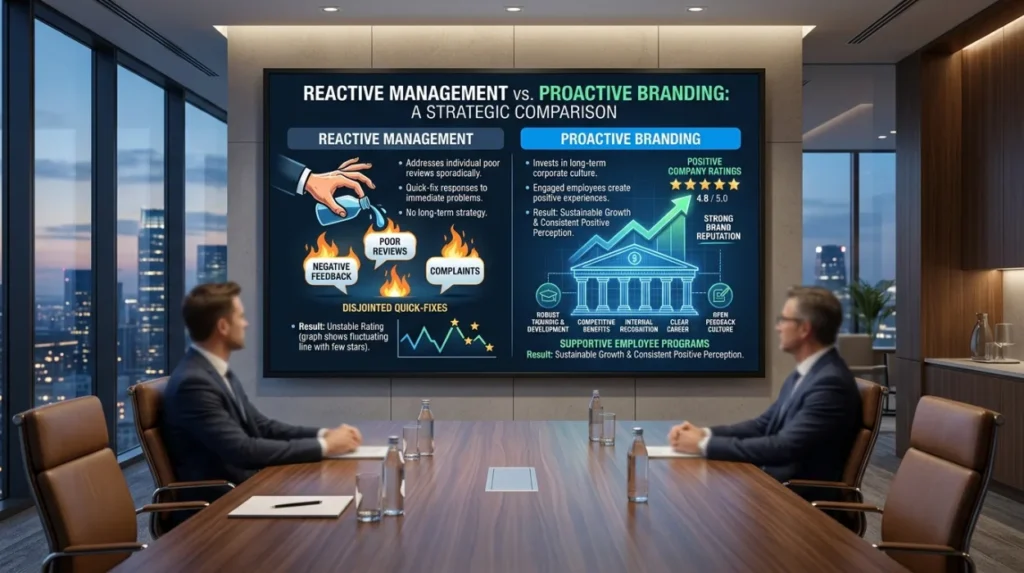
Proactive employer branding is more sustainable when it addresses workplace conditions before negative sentiment becomes recurring public content. A proactive approach analyses employee experience, identifies reputation risks and aligns external communication with organisational reality. A reactive approach responds after negative content has already entered the public information environment. These approaches differ primarily in timing and risk exposure.
Reactive review management remains relevant because existing content can affect search visibility and employer perception. However, removing or suppressing individual content does not automatically change the employee experience that generated similar criticism. Proactive employer branding addresses the upstream cause, while reactive management addresses downstream reputation signals. The most complete evaluation therefore separates prevention from response.
How does management communication influence long-term review patterns?
Management communication influences long-term review patterns by shaping how employees understand decisions, expectations and organisational changes. Communication is a reputation mechanism because repeated interactions influence employee perception before any review is published. Clear information reduces ambiguity around workplace decisions and responsibilities. Inconsistent communication creates a different perception pattern that can become visible in employee feedback.
Communication quality also affects the interpretation of organisational policies. A well-defined policy has limited reputation value if employees receive inconsistent explanations from different managers. Consistent communication creates stronger internal trust signals and reduces informational discrepancies. These factors influence the themes employees later associate with the organisation.
Which is more effective: improving workplace conditions or strengthening employer content?
Improving workplace conditions addresses the underlying source of employee sentiment, while strengthening employer content improves the information environment surrounding the organisation. Workplace improvements influence the experiences that generate future reviews. Employer content provides accurate contextual information for candidates and search systems. Each approach therefore operates at a different layer of reputation management.
Content enhancement without workplace improvement creates a presentation gap. Workplace improvement without accurate external communication leaves search users with incomplete information about organisational changes. A balanced approach connects operational improvements with transparent employer communication. This creates stronger alignment between internal experience and external reputation signals.
How does career development affect long-term employer reputation?
Career development affects employer reputation because employees evaluate organisations partly through opportunities for progression, learning and professional growth. Clear progression frameworks establish defined expectations around skills, responsibilities and advancement. When these structures operate consistently, employees receive stronger signals about organisational investment in their development. When career messaging lacks corresponding internal opportunities, negative sentiment can emerge around credibility and progression.
Career development also influences employer branding before employment begins. Recruitment content frequently communicates development opportunities as part of the employer proposition. Candidates then compare those claims with their subsequent experience. Alignment between employer messaging and internal progression therefore supports stronger entity credibility.
How does workload management influence negative review risk?
Workload management influences negative review risk because workload forms part of the everyday employee experience. Workload refers to the quantity, complexity and time demands associated with assigned responsibilities. Persistent imbalance between workload and available capacity can become a recurring source of employee dissatisfaction. When the same theme appears repeatedly in reviews, it becomes a recognisable reputation signal.
The reputation effect extends beyond individual comments. Recurring workload criticism creates thematic consistency across review content and influences sentiment distribution. Organisations analysing reviews therefore need to distinguish isolated dissatisfaction from repeated operational patterns. Addressing the underlying workload structure provides a preventative mechanism that content management alone does not provide.
Dive Deeper With Our Expert Guides:
How to Write a Professional Response to a Negative Indeed Review
How to Compare Indeed Review Removal Service Pricing in the UK
How should employers measure the effectiveness of employer branding changes?
Employers can measure effectiveness by comparing internal employee sentiment with external review trends over defined periods. Internal indicators include employee feedback, management assessments, progression satisfaction and workplace communication measures. External indicators include review ratings, sentiment distribution, recurring themes and review-page visibility. Combining these datasets provides a broader reputation measurement framework.
Measurement also requires separating activity from outcome. Publishing new employer content represents an activity, while changes in employee sentiment and review themes represent outcomes. Similarly, responding to a review represents an action, while reduced recurring criticism represents a longer-term reputation indicator. This distinction creates greater analytical accuracy when evaluating employer branding strategies.
How do search engines interpret employer review signals?
Search engines interpret employer review signals through the content and relevance of indexed webpages rather than through a simple reputation score. Review pages can become part of the search ecosystem surrounding an organisation when they are indexed and considered relevant to employer-related queries. Ranking systems evaluate pages using multiple signals that determine their position within search results. This makes search visibility distinct from the underlying sentiment expressed in reviews.
SERP composition therefore influences how prospective employees encounter reputation information. A review page appearing prominently has greater visibility than a page receiving limited search exposure. Employer branding content, professional information and review pages can all contribute to the information environment surrounding an entity. Search perception is consequently shaped by the interaction between content relevance, source authority and user intent.
Does content enhancement reduce the impact of negative Indeed reviews?
Content enhancement can strengthen the wider information environment surrounding an employer by providing accurate, relevant and authoritative organisational information. It does not erase independent reviews or alter the factual content of employee feedback. Instead, it creates additional context through career information, organisational pages and professional resources. This changes the composition of information available to users without replacing independent reputation signals.
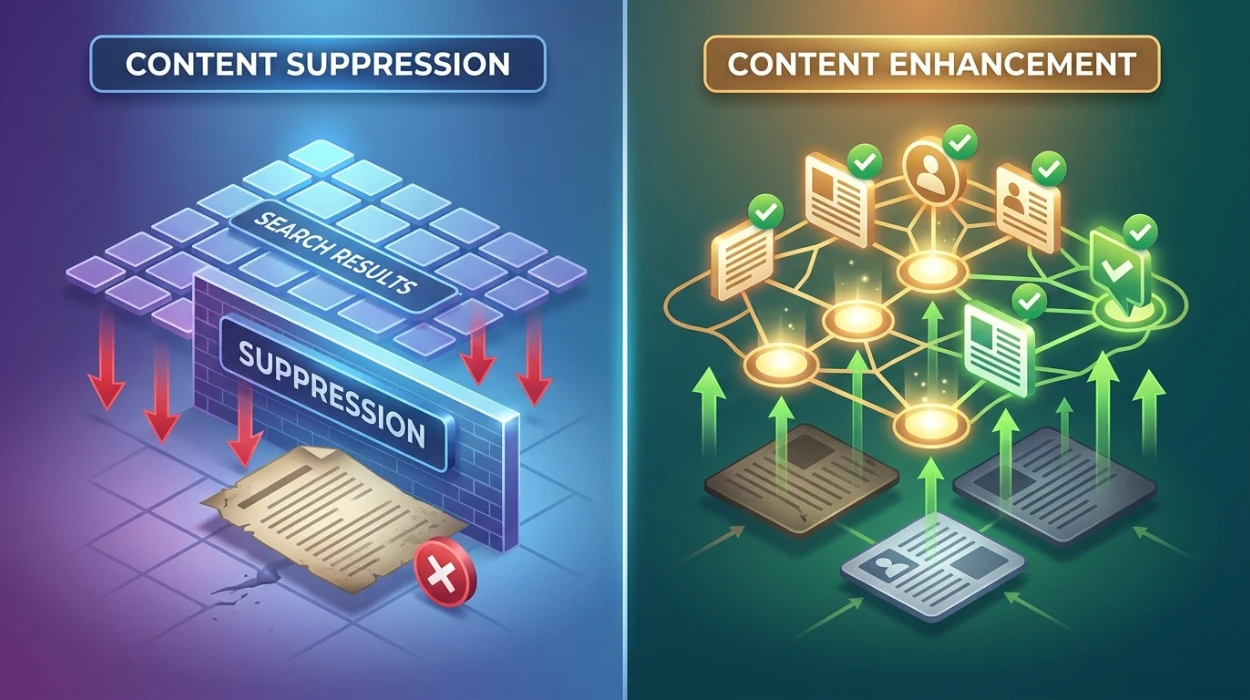
The distinction between content enhancement and content suppression is important. Content suppression focuses on reducing the prominence of unwanted information, while content enhancement strengthens relevant information that supports a clearer entity profile. Both approaches influence search visibility through different mechanisms. Neither replaces the need to address recurring workplace issues that generate negative sentiment.
How does employer branding compare with Indeed review removal strategies?
Employer branding and review removal represent fundamentally different reputation management approaches. Employer branding focuses on prevention by improving organisational communication, employee experience and information consistency. Review removal focuses on specific published content and depends on whether that content violates the applicable platform rules or other relevant standards. The first approach is systemic, while the second is content-specific.
Removal therefore has a narrower scope but remains relevant when an individual review raises a legitimate policy or accuracy issue. Employer branding has broader scope because it influences the conditions that generate future sentiment. A sustainable strategy evaluates the reason for the content before selecting a response. Treating every negative review as a removal problem ignores the distinction between legitimate criticism and content that qualifies for removal.
Which strategy offers the strongest long-term risk reduction?
A combined prevention framework offers stronger long-term risk reduction because it addresses workplace causes, communication gaps and external reputation signals together. Prevention begins with employee experience and organisational consistency. Monitoring then identifies recurring themes within published reviews. Search analysis evaluates how those reputation signals appear within relevant SERPs.
A practical evaluation framework includes:
- Analyse employee feedback to identify recurring themes involving management, workload, progression and communication.
- Align employer branding with actual workplace conditions so recruitment claims correspond with employee experience.
- Measure review sentiment to identify changes in ratings, recurring topics and sentiment distribution.
- Monitor search visibility to evaluate how review pages and employer content appear for relevant queries.
- Evaluate individual reviews against applicable platform standards before considering content-specific action.
This framework separates prevention, measurement and response. It also reduces the risk of relying on one mechanism to address a complex reputation system. The result is a clearer distinction between organisational improvement, reputation monitoring and content-level intervention.
How can employers build a sustainable negative review prevention strategy?
A sustainable prevention strategy connects employee experience, employer branding, review analysis and search perception into one continuous framework. Employer branding establishes the external representation of the organisation, while employee experience determines whether that representation remains credible. Review analysis identifies how employees describe the resulting experience publicly. Search monitoring evaluates how those reputation signals reach prospective employees.
The process operates as a continuous feedback system rather than a one-time campaign. Internal feedback identifies potential reputation risks, organisational changes address relevant causes, and external review analysis measures resulting sentiment. Search visibility analysis then evaluates how the information environment changes over time. This creates a measurable relationship between organisational practice and digital reputation.
For organisations evaluating the next stage of prevention, negative Indeed review prevention strategies provide a useful decision framework for comparing proactive employer branding, employee-experience improvements and reactive review management. The key consideration is whether the selected approach addresses the source of recurring reputation signals or only their public visibility.
Long-term reduction in negative Indeed reviews depends on the relationship between employer branding, employee experience and reputation signals. Proactive approaches address workplace conditions before negative sentiment becomes recurring public content, while reactive approaches manage reputation information after publication. Content enhancement improves contextual information, while removal and suppression address specific visibility or policy-related issues.
The strongest strategic framework evaluates effectiveness through employee sentiment, review themes, search visibility and organisational consistency. Employer branding becomes a reputation-management mechanism when its claims accurately represent workplace reality. Review management becomes a complementary mechanism when it evaluates existing content without replacing the need for organisational improvement.
The central distinction is therefore between prevention and response. Prevention addresses the causes of recurring negative sentiment, while response addresses the digital content generated by those experiences. Evaluating both mechanisms through effectiveness, scalability, risk exposure and sustainability provides a more complete understanding of long-term employer reputation management.
What employer branding steps reduce negative Indeed reviews long term?
Align employer branding with the actual employee experience, particularly around management, workload, communication and career development. Consistent expectations and workplace practices reduce the recurring issues that often influence negative review sentiment.
How does employer branding affect Indeed reviews?
Employer branding influences reviews when recruitment messaging establishes expectations about workplace culture, management and progression. Matching these claims with actual employee experiences strengthens employer credibility and reduces perception gaps.
Can improving employee experience reduce negative Indeed reviews?
Improving employee experience addresses workplace factors that frequently influence review sentiment, including communication, workload, recognition and management. Analysing employee feedback helps identify recurring issues before they become persistent reputation signals.
Is employer branding better than Indeed review removal for long-term reputation management?
Employer branding is a preventative approach that addresses the workplace conditions influencing future reviews, while review removal focuses on specific published content that qualifies for removal. Long-term reputation management evaluates both approaches according to their purpose, effectiveness and limitations.
How can employers measure the success of a negative Indeed review prevention strategy?
Employers can measure changes in employee sentiment, recurring review themes, ratings and sentiment distribution over time. Search visibility monitoring also evaluates how review pages and employer content influence the organisation’s digital reputation.