
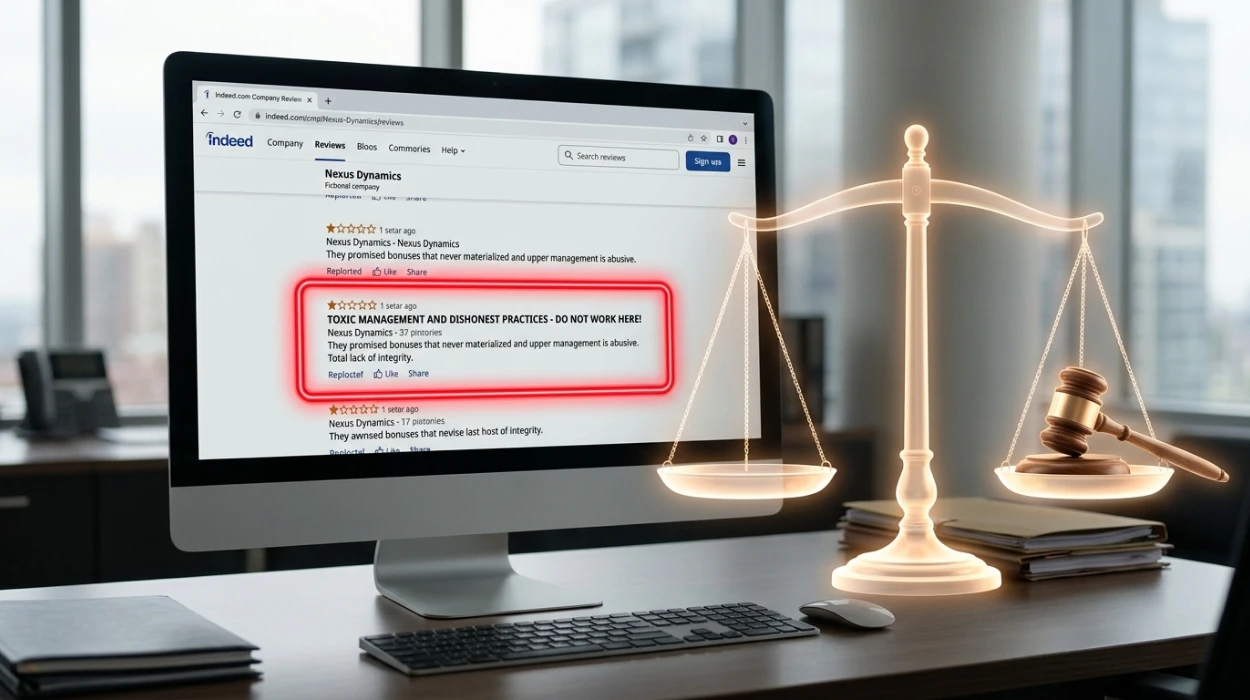
Legal action over an Indeed review makes sense when the content creates a legally recognisable harm, such as a defamatory false statement, rather than simply expressing an unfavourable opinion. Reputation management is the process of understanding, monitoring and managing how information about a person or organisation is interpreted across digital environments.
What is online reputation in the context of an Indeed review?
Online reputation refers to how publicly available information shapes perceptions of an individual or organisation within search ecosystems. An Indeed review forms part of a wider digital footprint because its content can influence how prospective employees, customers, recruiters and other audiences interpret an organisation.
Reputation management is therefore broader than removing one negative page. It involves analysing reputation signals across review platforms, search engine results pages (SERPs), social profiles, business directories and other indexed sources. Each source contributes information that search systems and users interpret as part of an entity’s broader online presence.
An Indeed review contains several reputation signals, including sentiment, factual claims, employment-related statements and references to workplace conditions. Search engines process publicly accessible review pages as content within the wider web ecosystem, while users interpret the wording according to context, credibility and relevance.
A negative review does not automatically represent unlawful content. UK law distinguishes between statements of opinion and statements presented as facts, while defamation law also considers whether publication has caused or is likely to cause serious harm to reputation. This distinction is central when evaluating whether a dispute remains a platform moderation issue or develops into a legal matter.
When does an Indeed review become a legal issue?
An Indeed review becomes a legal issue when its content satisfies the requirements of a recognised legal claim. A critical opinion about management, working conditions or an employment experience is not automatically defamatory simply because an organisation considers it unfair.
Defamation is particularly relevant when a published statement presents a factual allegation that damages reputation. Under the Defamation Act 2013, a claimant pursuing a defamation action in England and Wales needs to establish serious harm to reputation, while companies with a trading reputation face the additional serious financial loss requirement.
The distinction between fact and opinion is therefore important. A statement such as an individual’s assessment of workplace culture represents opinion when it is recognisably presented as an opinion, whereas an objectively verifiable allegation of misconduct represents a factual assertion requiring different analysis.
Legal assessment also examines the meaning conveyed by the publication rather than isolated words alone. Context, wording, publication, identification of the subject and resulting reputational consequences form part of the broader evaluation.
How does UK defamation law apply to an Indeed review?
UK defamation law applies to online publications when the relevant legal requirements are satisfied, regardless of whether the statement appears on a conventional website or a review platform. The digital format of an Indeed review does not create a separate standard for determining whether a defamatory publication exists.
A defamation analysis evaluates whether the statement refers to the claimant, whether it has been published to a third party, whether it carries a defamatory meaning and whether the applicable statutory requirements are met. For claims brought in England and Wales, serious harm is a central statutory requirement under the Defamation Act 2013.
Defences also form part of the legal framework. Truth, honest opinion and publication on a matter of public interest represent important statutory defences in appropriate circumstances, so disagreement with a review does not by itself establish liability.
The legal question therefore concerns the nature and meaning of the statement rather than its negative sentiment alone. A review that contains criticism without an actionable defamatory meaning occupies a different legal position from a review containing demonstrably false allegations presented as fact.
Why is the difference between fact and opinion important?
The distinction between fact and opinion determines how a review is evaluated under defamation principles. Opinion generally communicates an assessment or judgement, while a factual allegation communicates information capable of being established as true or false.
A review stating that a workplace felt poorly managed expresses an evaluative judgement. A review alleging that a named organisation committed a specific unlawful act presents a more concrete factual proposition that can receive different legal scrutiny.
Context determines how a reasonable reader interprets the publication. The overall wording, surrounding statements and presentation of the review influence whether readers understand the material as opinion, factual allegation or a combination of both.
This distinction also affects reputation analysis. Search perception does not independently determine legal liability, but repeated factual allegations across indexed pages can create stronger reputation signals for users who encounter the material through search.
How can a harmful Indeed review affect search reputation?
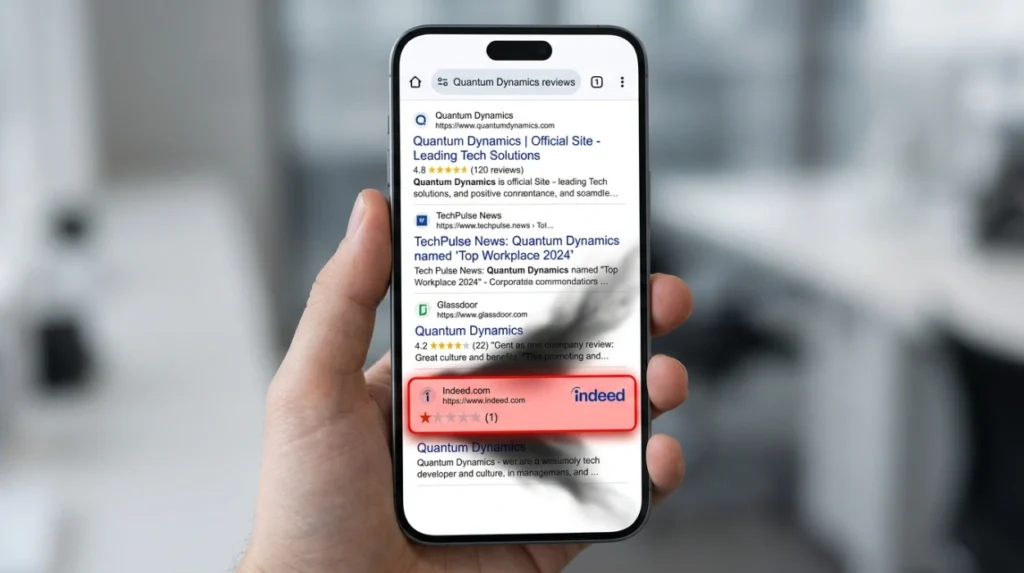
A harmful Indeed review can affect search reputation when the review page becomes visible for searches connected with an organisation, executive or professional entity. Search visibility determines whether users encounter the review when researching the relevant name or entity.
Content indexing is the process through which search engines discover, process and store web content for potential retrieval. Once indexed, a review page becomes part of the searchable information environment surrounding the entity associated with the publication.
Ranking systems evaluate relevance, content characteristics and other signals when determining which pages appear for a query. A negative review therefore does not automatically rank prominently, but its visibility becomes reputationally significant when users repeatedly encounter it during relevant searches.
Entity perception refers to how information associated with an entity contributes to its representation within search ecosystems. Review content can become one component of that representation alongside official websites, professional profiles, news coverage, directories and other reputation assets.
When is legal escalation different from requesting review removal?
Legal escalation is different from requesting review removal because the two processes operate under different decision frameworks. A platform removal request asks the hosting service to assess whether content breaches its rules, whereas legal action relies on applicable legal rights and procedural requirements.
A review platform evaluates content according to its own policies, moderation criteria and available evidence. A legal claim evaluates the publication against relevant legislation, case law and procedural standards.
The distinction becomes important when a review contains material that appears unlawful but does not clearly violate a platform’s content rules. Conversely, a review can breach a platform policy without satisfying the legal threshold for a successful court claim.
Reputation management therefore separates platform enforcement from legal enforcement. This separation prevents search visibility concerns from being treated as evidence of legal liability and keeps the analysis focused on the correct decision framework.
What evidence is relevant before taking legal action?
Relevant evidence establishes what was published, when it was published, who it concerns and what harm resulted. Preserving the original review is important because online content can change, disappear or become inaccessible during a dispute.
Useful evidence includes the complete review, publication date, profile information visible on the platform, screenshots, search results and records demonstrating the identity of the organisation or individual referenced. Evidence also needs to preserve sufficient context to show how a reasonable reader encounters and interprets the publication.
Demonstrating reputational impact forms another part of the assessment. Business correspondence, recruitment records, customer communications or other contemporaneous evidence can establish consequences connected with the publication where those consequences are relevant to the legal claim.
Evidence relating to the truth or falsity of factual allegations also carries importance. Employment records, policies, correspondence, documented events and other reliable records provide a factual basis for evaluating disputed statements.
What legal options exist for a harmful online review?
Legal options depend on the nature of the publication and the rights affected. Defamation represents one route where a published statement causes the required level of reputational harm, while other legal frameworks address different forms of unlawful conduct.
Malicious falsehood addresses certain false statements involving economic interests where its specific requirements are satisfied. Data protection law addresses the processing and disclosure of personal data, although its application depends on the circumstances and the legal basis for processing.
Harassment law provides another framework where conduct forms part of a prohibited course of conduct rather than constituting an isolated criticism. The correct legal route therefore depends on the characteristics of the publication and the evidence supporting the underlying claim.
Legal action also involves procedural considerations, costs and evidential requirements. A solicitor specialising in the relevant area of UK law provides the appropriate assessment of whether the facts support formal proceedings.
Dive Deeper With Our Expert Guides:
What Happens When Indeed Refuses to Remove a Review
What Indeed’s Built-In Flagging Tool Can and Cannot Do
How do search engines interpret legal disputes involving reviews?
Search engines do not function as courts and do not determine whether an Indeed review is legally defamatory. Their systems evaluate web content for search purposes, while legal authorities determine liability through applicable legal procedures.
SERP evaluation concerns the ranking and presentation of indexed information for a particular query. Search engines therefore process the review as web content rather than treating an allegation as legally established merely because it appears online.
A legal dispute can nevertheless affect the information environment surrounding an entity. Changes to a review page, de-indexing decisions, subsequent publications or new authoritative content alter the set of information available for search retrieval.
This distinction explains why legal resolution and search visibility represent separate processes. A successful legal outcome does not automatically produce an immediate change in every search result, because content indexing and ranking operate through separate technical systems.
When is taking legal action over an Indeed review proportionate?
Legal action is proportionate when the publication presents a credible legal issue supported by evidence and the potential harm justifies formal escalation. A simple disagreement with negative feedback does not itself establish the factual or legal basis required for litigation.
The assessment begins with the review’s exact wording and meaning. It then considers identification, publication, factual accuracy, available defences, reputational harm, financial consequences where relevant and the available procedural route.
The proportionate response also depends on whether the issue can be addressed through a platform complaint, direct correspondence, correction, legal notice or formal proceedings. Each route addresses a different level of dispute and carries different evidential and procedural requirements.
This framework keeps reputation management aligned with legal reality. Search visibility, negative sentiment and business inconvenience provide context, but they do not independently establish that legal action is justified.
How should an organisation evaluate an Indeed review before escalation?
An organisation can evaluate an Indeed review by separating reputation impact, platform policy and legal liability into distinct categories. This approach creates a structured assessment rather than treating every negative publication as an actionable legal dispute.
- Preserve the publication: Record the complete review, publication date, author information and surrounding context before content changes.
- Classify the statements: Separate factual allegations from opinion, commentary and subjective workplace assessments.
- Verify the facts: Compare factual claims against reliable records, correspondence and documented events.
- Assess legal relevance: Examine whether the publication engages defamation, data protection, harassment or another applicable legal framework.
- Measure reputational impact: Analyse search visibility, indexed pages, entity references and evidence of actual reputational or financial consequences.
This process creates a clearer distinction between a negative reputation signal and a potentially actionable publication. It also provides a stronger evidential foundation for deciding whether platform escalation or legal advice is appropriate.
What is the relationship between legal action and reputation management?
Legal action addresses legal rights and remedies, while reputation management analyses the broader information ecosystem surrounding an entity. The two disciplines intersect when unlawful or disputed content becomes part of an organisation’s digital footprint.
Reputation management evaluates how content is created, indexed, ranked and interpreted across search systems. Legal analysis evaluates whether the underlying publication satisfies the requirements of a particular legal claim.
This distinction matters because removing one review does not erase every reputation signal associated with an organisation. Search engines continue to evaluate other indexed pages, while users interpret the wider collection of information available through relevant queries.
The relationship between law and search reputation is therefore complementary rather than identical. Legal processes address the status of disputed content, while search systems determine how available information is retrieved and presented to users.
For organisations examining formal escalation, How UK Legal Escalation Works for a Harmful Indeed Review provides a more focused framework for understanding the legal and procedural stages involved.
What are the key principles for understanding legal action over an Indeed review?
Legal action over an Indeed review is fundamentally an evidence and threshold question rather than a response to negative sentiment alone. A review becomes legally significant when its content engages a recognised cause of action and the applicable legal requirements are supported by evidence.
Online reputation refers to the collective perception created by publicly available information across digital ecosystems. An Indeed review contributes to that environment through its wording, factual claims, sentiment and potential search visibility.
Search engines, however, do not determine legal liability. SERP evaluation, content indexing and entity perception operate separately from the legal assessment of defamation, data protection, harassment or other claims.
The most useful distinction is therefore between criticism, policy violations and legally actionable publications. Understanding these categories enables organisations to analyse reputation signals accurately while keeping platform enforcement, search visibility and legal remedies within their proper boundaries.
Can you take legal action over an Indeed review?
Legal action over an Indeed review may be considered when the content appears defamatory, contains false factual claims, or causes demonstrable harm. The appropriate legal route depends on the evidence, jurisdiction, wording of the review, and circumstances surrounding publication.
What makes an Indeed review potentially defamatory?
An Indeed review may raise defamation concerns when it presents false statements of fact as truthful and those statements harm a person or business’s reputation. Opinions, fair comment, and genuine experiences are generally treated differently from demonstrably false factual allegations.
Should you contact Indeed before taking legal action over a review?
Yes, it is often sensible to review Indeed’s reporting and moderation process before pursuing court action. If a review breaches platform rules, documenting the issue and submitting an appropriate Indeed review removal appeal may provide an alternative to legal proceedings.
What evidence is needed to challenge a false Indeed review?
Useful evidence can include screenshots of the review, publication dates, records that contradict specific factual claims, relevant communications, and evidence of reputational or financial impact. Keep the original material preserved because reviews or account details may change or be removed later.
Can Clear Your Name help with an Indeed review dispute?
Clear Your Name can help assess the online reputation implications of an Indeed review and explain possible review removal or reputation management options. Whether legal action is appropriate is a matter for a qualified legal professional who can assess the specific facts and applicable law.