
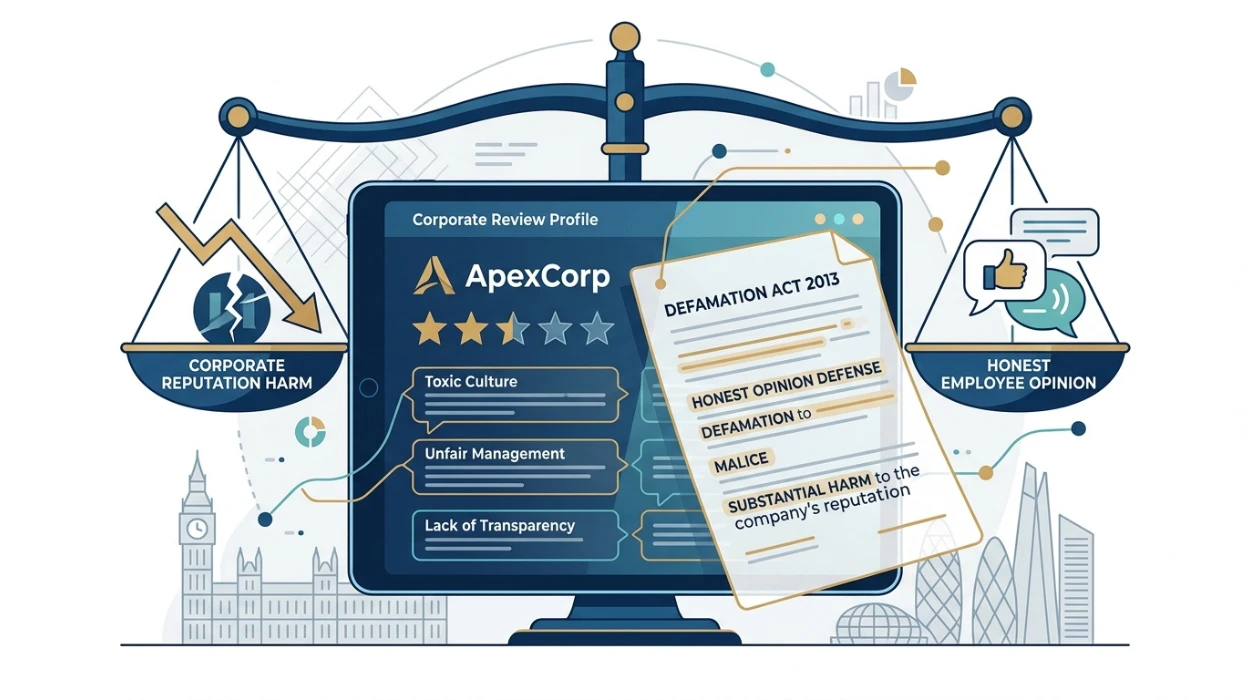
UK defamation law does not make every negative Indeed review defamatory; the statement must meet the applicable legal test, including the serious-harm requirement in England and Wales.
A harmful review is evaluated through its wording, factual meaning, publication, reputation impact, and available defences rather than its negative tone alone.
What Is Defamation Under UK Law?
Defamation is a legal concept concerning published statements that cause, or are likely to cause, serious harm to a person’s reputation. In England and Wales, Section 1 of the Defamation Act 2013 establishes serious harm as a threshold for a statement to be defamatory. For a business trading for profit, serious harm requires serious financial loss or a likelihood of serious financial loss. This means a negative review does not automatically establish defamation simply because the subject dislikes or disputes its content. The legal assessment focuses on the substance and effect of the statement.
Online reputation refers to the collection of information that users can encounter about a person, employer, organisation, or other identifiable entity across digital platforms. An Indeed review forms part of this digital footprint because employment-related searches can expose comments to prospective candidates, employers, or other users. Search visibility can therefore amplify the practical significance of a review beyond its original audience. Reputation signals are created through the accumulation of publicly available information rather than through one universal reputation score. The interpretation of a review consequently depends on both its wording and its surrounding information.
Defamation law and reputation management are related but distinct concepts. Defamation determines whether a published statement satisfies legal requirements for a claim, while reputation management evaluates the wider visibility and perception created by online information. A review can therefore create reputational concern without necessarily being defamatory. This distinction prevents negative sentiment from being treated as proof of unlawful publication. It also establishes a more precise framework for evaluating harmful Indeed reviews.
How Does the Serious Harm Test Apply to an Indeed Review?
The serious harm test requires more than showing that a review contains criticism or is damaging in an everyday sense. Section 1 of the Defamation Act 2013 states that a statement is not defamatory unless its publication has caused or is likely to cause serious harm to the claimant’s reputation. For a profit-making body, the statute applies an additional serious-financial-loss requirement. The assessment therefore focuses on the level and nature of reputational harm rather than simply the existence of negative feedback. Evidence of impact becomes relevant when assessing whether the statutory threshold is satisfied.
An Indeed review can contain different types of statements within the same publication. A reviewer can express an opinion, describe an event as fact, or combine factual assertions with evaluative commentary. The legal characterisation of each statement matters because different defences apply to different forms of publication. The ordinary meaning conveyed to readers also forms part of the assessment. Consequently, analysing the exact wording is more informative than categorising an entire review as either positive or negative.
Search visibility adds another dimension to reputation analysis. If a review appears prominently when users search an employer or identifiable individual, the content becomes part of the visible information environment surrounding that entity. Search ranking does not itself establish defamation, but visibility affects the practical audience exposed to the statement. SERP evaluation therefore complements legal analysis by showing where the content appears and how easily it can be discovered. Legal validity and search visibility remain separate questions.
When Is an Indeed Review Potentially Defamatory?
An Indeed review becomes legally significant when its specific statements satisfy the applicable elements of a defamation claim rather than simply expressing dissatisfaction. The distinction between factual assertions and opinions is particularly important. A statement presented as fact can be assessed differently from a clearly expressed opinion based on disclosed or indicated facts. The surrounding context also affects how an ordinary reader understands the publication. Therefore, the precise language of the review requires analysis before a legal conclusion is reached.
The Defamation Act 2013 provides a statutory defence of truth. Section 2 states that it is a defence to a defamation action for the defendant to show that the imputation conveyed by the statement is substantially true. This means a statement does not become defamatory merely because it is damaging if the relevant legal defence applies. The focus remains on the actual imputation conveyed by the publication.
A separate statutory defence covers honest opinion. The explanatory notes to the 2013 Act describe three core conditions: the statement must be an opinion, the basis of the opinion must be indicated, and an honest person could have held the opinion based on the relevant facts or assertions. The notes specifically recognise that the application of the defence can vary according to context, including comments made on social networks. This distinction is important for online reviews because subjective employment experiences can contain evaluative language.
How Does Honest Opinion Affect Harmful Indeed Reviews?
Honest opinion is a statutory defence that can be relevant when an Indeed review expresses a genuine opinion rather than presenting an unsupported factual allegation. Section 3 of the Defamation Act 2013 establishes the defence and requires the statutory conditions to be satisfied. The explanatory notes emphasise that the statement must be recognisable as an opinion and indicate its basis. This means simply adding phrases such as “I think” does not automatically determine the legal classification. The substance and context of the publication remain important.
Reviews frequently combine subjective assessment with factual material. For example, an opinion about management quality can be accompanied by statements about specific events, dates, decisions, or conduct. Those factual components can affect the analysis of the overall publication. A reviewer expressing dissatisfaction does not automatically make the review unlawful. The legal assessment instead considers what an ordinary reader would understand the review to communicate.
From a reputation perspective, opinion-based content can still influence entity perception even where it does not meet the requirements for defamation. Search users can interpret repeated negative sentiment as a reputation signal. Search engines can also index publicly available review content and display it in relevant results. Consequently, reputation analysis examines visibility and sentiment separately from the legal question of whether a statement is defamatory.
Does a Negative Indeed Review Have to Be False to Matter?
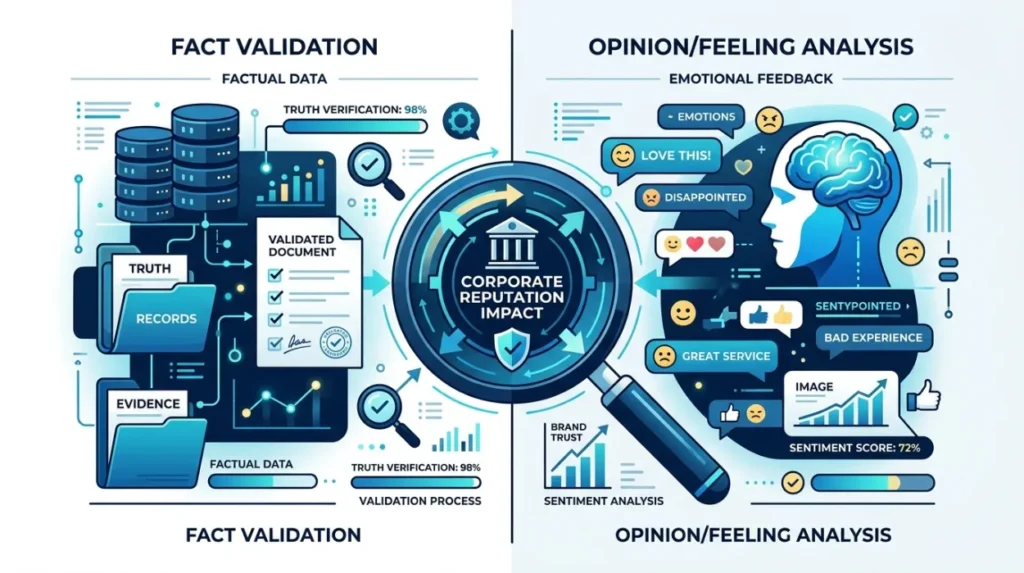
Falsity is not the only issue that determines whether a review creates legal or reputational consequences. A defamation assessment considers the meaning conveyed by the statement, applicable legal thresholds, and available defences. Truth is specifically recognised as a defence under Section 2 of the Defamation Act 2013. Therefore, a damaging statement that is substantially true is treated differently from an unsubstantiated factual allegation.
The distinction between factual accuracy and reputational impact is essential for online reputation analysis. A truthful review can influence perception without creating a viable defamation claim. Conversely, a potentially false factual allegation requires closer assessment of meaning, evidence, publication, and harm. Treating all negative reviews as legally actionable creates an inaccurate understanding of UK defamation law. A structured assessment instead separates legal exposure from general reputational concern.
Content indexing further affects the practical significance of a review. When a review or related page becomes discoverable through search, its information can reach users who were not part of the original interaction. Search visibility therefore influences the scale of potential exposure. This does not alter the legal test for defamation, but it can affect the practical reputation environment in which the statement is encountered.
How Do Search Engines Interpret Harmful Review Content?
Search engines evaluate content through automated systems that consider relevance, quality, authority, links, freshness, user intent, and other signals. They do not operate as courts and do not determine whether an Indeed review is legally defamatory. Search ranking therefore represents an information-discovery process rather than a legal finding. A highly visible review can influence what users encounter without establishing that the underlying statement is unlawful. This distinction is fundamental to understanding search reputation.
Reputation signals arise from the information associated with an entity across indexed sources. An Indeed review can contribute to entity perception when it appears alongside employer pages, business profiles, news coverage, directories, or other online information. The resulting search environment is formed from multiple sources rather than a single review platform. SERP evaluation helps determine the relative visibility of each source. This allows reputation analysis to distinguish between the existence of negative content and its actual search prominence.
Content indexing also creates a difference between publication and discoverability. A review can remain available on a platform without ranking prominently in search results, while another piece of content can gain significant visibility through search. Search perception therefore depends on both content availability and ranking dynamics. Analysing these systems provides a broader understanding of how online credibility is formed.
Dive Deeper With Our Expert Guides:
How Indeed’s Review Policies Differ From Glassdoor’s in the UK
Why Former Employees Post Anonymous Defamatory Reviews on Indeed
What Evidence Helps Establish the Impact of an Indeed Review?
Evidence helps establish the factual and reputational context surrounding a review. Useful records include the exact review URL, publication date, screenshots, the reviewer’s wording, relevant surrounding context, and evidence of where the content appears in search results. Preserving the original material is important because online content can change after publication. A clear evidence record also separates the original statement from later interpretations of it. This improves the accuracy of subsequent legal or reputation analysis.
The impact of a review requires careful distinction between direct and indirect evidence. Direct evidence relates to the publication itself, while indirect evidence can relate to changes in reputation, business activity, or other measurable consequences. For a legal claim, the relevance and admissibility of evidence depend on the circumstances and applicable law. Reputation management uses a broader measurement framework that includes search visibility and content exposure. These functions should not be confused.
A structured evidence process can therefore:
- Record the original review URL and publication date to preserve the source.
- Capture screenshots showing the complete relevant content and surrounding context.
- Document search visibility to establish where the review appears for relevant queries.
- Compare indexed results over time to identify changes in content exposure.
- Preserve supporting records that clarify the factual background of disputed statements.
This approach creates an evidence trail rather than relying on memory or subjective assessment. It also helps distinguish between a legal allegation and a broader reputation-management concern. Evidence does not automatically prove defamation, but it creates a stronger factual basis for professional assessment. Where legal proceedings are contemplated, specialist legal advice remains appropriate.
What Is the Difference Between Defamation and Review Removal?
Defamation is a legal concept, while review removal is a platform or content-management outcome. A review can be negative without being defamatory, and a platform can have its own rules governing content that do not mirror defamation law. Consequently, a request to remove content requires analysis of the platform’s applicable rules as well as any relevant legal grounds. The two processes operate through different decision-making systems. Treating them as identical can lead to incorrect expectations.
Review removal also does not necessarily depend on proving a defamation claim. Platforms can maintain separate standards concerning prohibited content, privacy, authenticity, harassment, or other forms of misuse. Conversely, a review that appears unfair or damaging does not automatically qualify for removal. The relevant criteria depend on the platform’s policies and the circumstances of publication. This makes policy analysis distinct from legal analysis.
For reputation management, the practical question is often broader: how does the review affect the visible information environment surrounding the entity? Search visibility, content indexing, sentiment distribution, and entity credibility provide useful analytical dimensions. These measures do not replace legal assessment. They explain how the content functions within the wider digital ecosystem.
How Can an Indeed Defamation Case Be Analysed Without Confusing Legal and SEO Issues?
A reliable analysis separates legal validity, platform policy, and search visibility into distinct layers. The legal layer examines whether the publication satisfies the relevant elements of defamation and whether a statutory defence applies. The platform layer evaluates whether the content breaches the relevant rules for publication and removal. The search layer examines indexing, ranking, visibility, and entity perception. Keeping these systems separate prevents one type of evidence from being treated as proof of another.
This layered model also improves decision-making. A review can have high search visibility but no viable defamation claim. Another review can present a stronger legal concern but have limited search exposure. A third publication can fail a legal test while still creating a significant reputation-management issue. Each situation therefore requires its own assessment rather than a universal removal assumption.
The MOFU topic building a defamation case around an Indeed review extends this analysis by examining how evidence, factual meaning, and reputational impact fit into a more structured assessment. The focus remains on understanding the relationship between legal principles and the evidence required to evaluate an online review.
What Does UK Defamation Law Mean for Harmful Indeed Reviews?
UK defamation law does not treat negative employment reviews as automatically unlawful. In England and Wales, the serious-harm requirement, truth defence, honest-opinion defence, and other legal principles determine whether a publication falls within the scope of a defamation claim. The exact meaning of the review and its factual context remain central to the assessment. Search visibility provides an additional reputation-management dimension but does not establish legal liability.
The key distinction is between legal harm, platform eligibility, and search visibility. Legal harm concerns the requirements for a defamation claim, platform eligibility concerns applicable content rules, and search visibility concerns how information is discovered and interpreted within search ecosystems. These systems interact but operate independently. Understanding their boundaries creates a more accurate framework for analysing harmful Indeed reviews. It also prevents ordinary criticism, honest opinion, and potentially defamatory factual allegations from being treated as identical forms of content.
A final practical point concerns timing. In England and Wales, the limitation period for defamation actions is generally one year from the date the cause of action accrued, subject to the statutory framework and possible judicial discretion in exceptional circumstances. This makes prompt professional legal assessment important where litigation is being considered.Conclusion
Harmful Indeed reviews require analysis based on legal meaning, reputational impact, publication context, evidence, and search visibility. In England and Wales, the Defamation Act 2013 establishes serious harm as a fundamental threshold and provides statutory defences including truth and honest opinion. A negative review therefore requires more than disagreement or reputational discomfort before it becomes a potential defamation matter. Search visibility and content indexing provide a separate layer for understanding how the information reaches users.
The most accurate approach separates legal assessment from platform processes and search perception analysis. This framework explains why an Indeed review can create significant online reputation exposure without necessarily establishing a successful defamation claim. It also demonstrates why evidence, precise wording, contextual analysis, and visibility data matter when evaluating disputed review content. For specific legal circumstances, a qualified UK solicitor can assess the facts and applicable jurisdiction.
Can an Indeed review be defamatory under UK law?
An Indeed review can raise defamation issues when it contains a false statement of fact that causes, or is likely to cause, serious harm to a person’s or organisation’s reputation. The legal assessment depends on the wording, context, publication and available evidence.
What makes an Indeed review potentially defamatory in the UK?
A review becomes potentially defamatory when it presents damaging factual allegations as fact rather than clearly expressed opinion. UK defamation law also considers whether the statement meets the applicable serious-harm threshold and whether a valid defence applies.
Can an employer challenge a false Indeed review?
An employer can challenge a review that contains demonstrably false and reputation-damaging factual claims. The appropriate response depends on the evidence, the wording of the review and the legal or platform-based grounds available.
Is an opinion in an Indeed review considered defamation?
Genuine opinion is treated differently from a false factual allegation under UK defamation law. A statement framed as opinion still requires sufficient indication of the facts on which that opinion is based to qualify for the relevant defence.
What evidence is useful when assessing a harmful Indeed review?
Useful evidence includes the original review, publication date, screenshots, employment records and documents that contradict factual allegations. Keeping the complete context helps distinguish factual claims from opinion and supports an evidence-based assessment.