
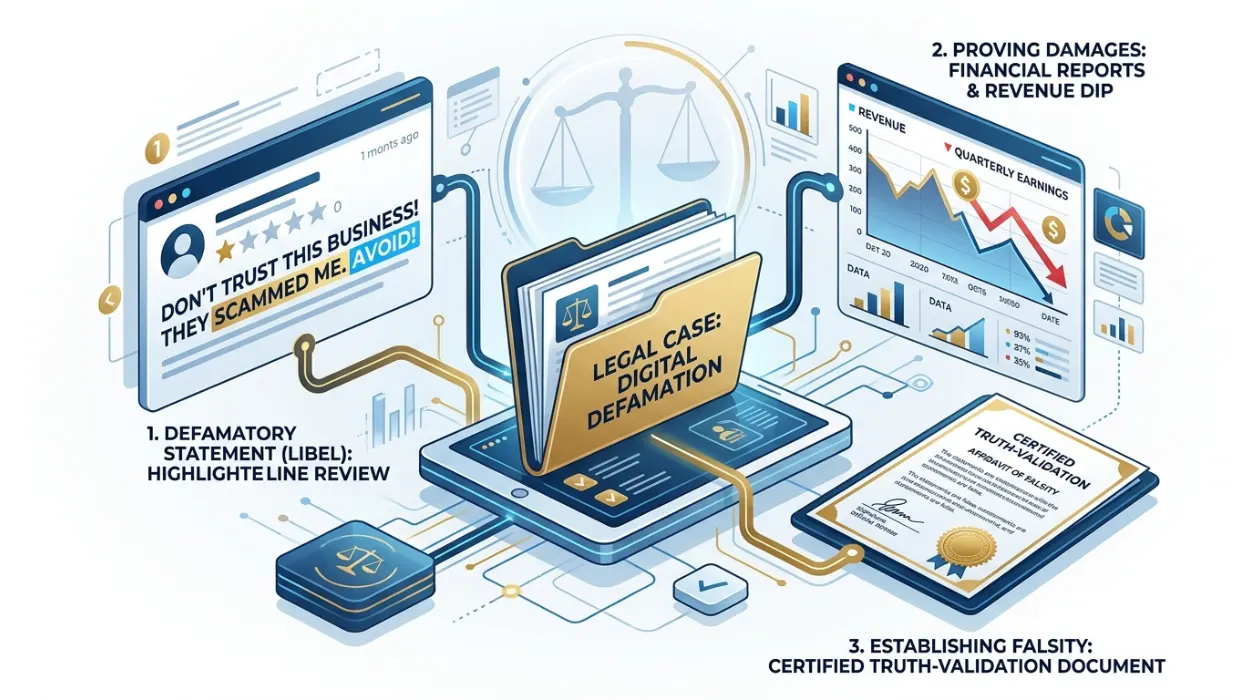
A defamation case around an Indeed review depends on proving that a published statement is defamatory, identifies the claimant, and satisfies the applicable UK legal requirements. Evidence must establish the exact wording, publication, factual meaning and reputational impact of the review.
Reputation Management StrategiesReputation management strategies differ based on whether the objective is legal redress, platform-level action, or reduction of search visibility. Online reputation control methods are evaluated through evidence quality, legal relevance, platform rules, search visibility and the sustainability of the resulting outcome.
What makes an Indeed review relevant to a defamation assessment?
A review becomes relevant to defamation analysis when it contains a potentially damaging statement presented as fact. Defamation is a legal concept concerning publication of material that causes, or is likely to cause, serious harm to reputation, subject to applicable statutory requirements and defences. The distinction between fact and opinion is central because a reviewer expressing an evaluative view is treated differently from someone asserting an objectively verifiable allegation. The exact wording therefore carries greater evidential value than a general description of the review as “negative”. A structured assessment examines what the words mean to an ordinary reader and whether that meaning carries a defamatory implication.
An Indeed review also creates a publication record because the content is presented to an audience through a public-facing employment platform. The publication element is therefore distinct from the question of whether the statement is legally actionable. Evidence needs to establish what was published, where it appeared and when it was accessible. Screenshots alone provide useful visual evidence, but preserving the URL, date, author information and surrounding context creates a stronger record. This distinction helps separate a reputation-management concern from a legal defamation assessment.
Which evidence is strongest when assessing a potentially defamatory Indeed review?
The strongest evidence establishes the original statement, its factual meaning, its publication and the consequences associated with it. A complete evidence record begins with an unaltered copy of the review and continues with supporting documentation that tests the accuracy of each material allegation. Employment records, internal correspondence, policies, performance documentation and contemporaneous communications can help establish whether factual assertions are accurate or false. Evidence also needs to preserve the context surrounding the statement rather than isolating individual sentences. This approach produces a clearer evidential chain for legal evaluation.
A useful assessment separates evidence into four categories:
- Preserve the original review with its URL, publication date and visible context to establish what was actually published.
- Identify factual allegations by separating objectively testable claims from subjective criticism or opinion.
- Compare each allegation with contemporaneous records that confirm, contradict or qualify the statement.
- Document reputational consequences with evidence demonstrating how the publication affected the claimant’s professional or commercial standing.
The value of evidence depends on relevance rather than volume. Ten documents that directly address an allegation provide stronger analytical support than a large collection of unrelated material. A timeline also helps establish whether records existed before the review was published, which reduces ambiguity around later-created evidence. The resulting structure allows each disputed statement to be assessed independently rather than treating the entire review as one undifferentiated complaint.
How does the distinction between fact and opinion affect an Indeed defamation case?
The distinction between fact and opinion is one of the most important evaluation points in a defamation assessment. A factual allegation presents information as something capable of being established as true or false, while an opinion communicates an evaluative judgement. UK defamation law recognises a defence of honest opinion subject to its statutory conditions, including that the statement indicates the basis of the opinion. The wording, context and implied factual foundation therefore require close analysis. Calling a statement an “opinion” does not automatically determine its legal classification.
Consider statements according to their linguistic and contextual characteristics rather than their emotional tone. An allegation describing a specific event, financial transaction, workplace action or professional misconduct has a factual dimension that can be tested against evidence. A statement expressing dissatisfaction with management style or workplace culture has a stronger evaluative character, although its surrounding wording still matters. This comparison helps determine which parts of a review require factual verification. It also prevents reputation management activity from incorrectly treating all negative sentiment as defamatory material.
Does proving that an Indeed review is false establish a defamation claim?
Falsity is important, but falsity alone does not establish every element of a UK defamation claim. The assessment also considers meaning, identification, publication, serious harm and applicable defences. Section 1 of the Defamation Act 2013 establishes a serious-harm threshold, with additional rules applying to bodies trading for profit. The legal analysis therefore extends beyond proving that a statement is inaccurate. Each required element needs to be considered against the available evidence.
The distinction matters because reputation management and legal assessment operate through different mechanisms. A platform complaint can focus on whether content breaches platform rules, whereas a defamation assessment examines statutory legal requirements and available defences. Search-engine activity focuses on indexing and ranking rather than determining whether a statement is defamatory. These systems interact, but they do not provide interchangeable remedies. Evaluating them separately creates a more accurate picture of risk, effectiveness and potential outcomes.
How does the serious-harm requirement influence the strength of a case?
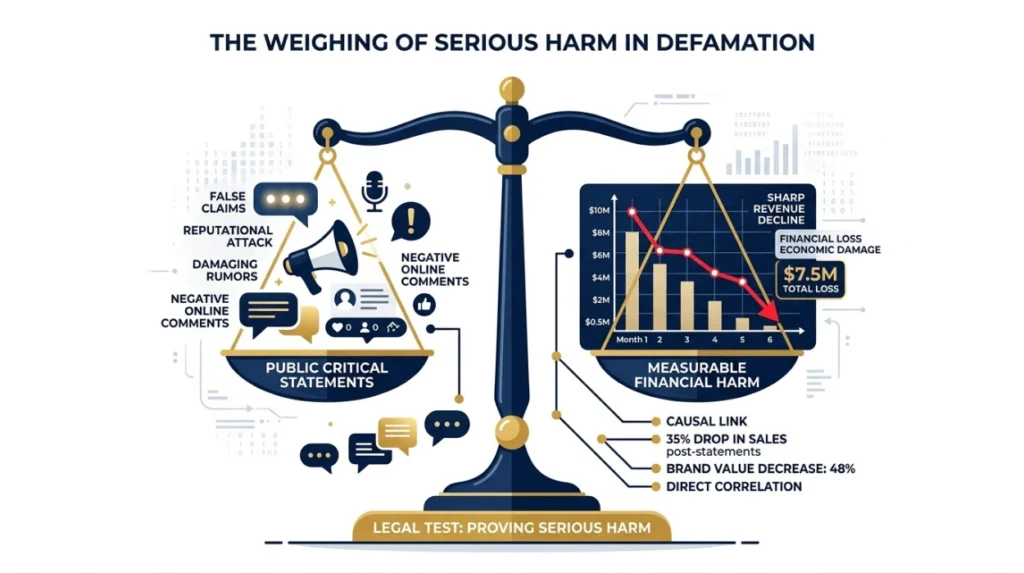
The serious-harm requirement makes reputational impact an important component of the assessment. For individuals, section 1 of the Defamation Act 2013 requires serious harm to reputation, while the Supreme Court has interpreted this requirement as involving actual or likely serious reputational harm. Evidence therefore needs to connect the publication with the level of reputational damage alleged. The analysis does not depend solely on whether the claimant personally considers the review damaging. It examines the meaning conveyed and the evidence supporting serious harm.
Evidence of professional consequences can therefore become relevant where it demonstrates how the publication affected reputation. Examples include documented loss of opportunities, communications referring to the allegation, or evidence showing that relevant audiences encountered the material. Search visibility can also form part of the broader reputational context because prominent results influence how information is encountered. However, search position alone does not establish legal liability. The legal and search dimensions require separate evaluation.
Is legal action more effective than requesting removal from Indeed?
Legal action and platform removal are different approaches with different mechanisms, timescales and risk profiles. A platform request operates through the site’s content rules, while legal action operates through applicable law and formal dispute procedures. Removal can address the immediate visibility of content on a particular platform, whereas a legal route focuses on the underlying publication and associated liability. The appropriate route therefore depends on the nature of the statement, evidence available and objective being pursued. Comparing these approaches prevents a platform process from being treated as equivalent to a legal remedy.
Platform-level action generally focuses on whether content violates the platform’s policies. A defamation route requires analysis of legal elements and potential defences. Content suppression through platform action can reduce direct exposure without necessarily addressing copies, screenshots or references elsewhere online. Conversely, legal proceedings involve greater procedural complexity and require a stronger evidential foundation. The two approaches can therefore be evaluated separately according to effectiveness, risk exposure and sustainability.
Dive Deeper With Our Expert Guides:
What to Know Before Comparing Indeed and Glassdoor Removal Options
What Evidence Unmasks an Anonymous Defamatory Indeed Reviewer in the UK
How does content removal compare with search-result suppression?
Content removal addresses the source itself, while search-result suppression focuses on how information appears within search ecosystems. Removing a review from its original platform can reduce the availability of the source, but search engines can retain indexed references temporarily or display other pages containing related information. Search-result suppression operates differently by influencing the visibility of pages for particular queries rather than deleting the underlying publication. These mechanisms have different effects on SERP composition and reputation signals. A complete reputation assessment therefore distinguishes source removal from search visibility management.
Search engines evaluate pages through ranking systems that consider relevance, authority, content signals and query relationships. They do not function as courts and do not independently establish whether a statement is defamatory. A page ranking highly for a person’s name can nevertheless influence public perception because users encounter it prominently during entity-related searches. Content suppression therefore concerns visibility rather than legal truth. Content removal concerns the availability of the original material and depends on the authority of the party controlling that source.
How does an organic approach compare with a reactive reputation response?
An organic approach builds a broader information environment through legitimate content, authoritative profiles and consistent digital identity signals. A reactive approach responds directly to an identified harmful publication through reporting, correction, legal assessment or removal requests. Organic activity is generally oriented towards long-term SERP composition, while reactive activity addresses a defined reputation problem. Each method therefore operates at a different point in the information lifecycle. The strongest evaluation considers whether the objective is source removal, reduced visibility or improved entity credibility.
Organic content enhancement does not automatically remove a disputed Indeed review from search results. It instead creates additional relevant information that search engines can evaluate for the entity. Reactive action directly addresses the problematic source but does not guarantee that other references will disappear. The distinction between content suppression and content enhancement is therefore essential. A strategy based exclusively on one mechanism creates a narrower response to a multi-layered search ecosystem.
How can the effectiveness of an Indeed reputation strategy be measured?
Effectiveness is measured through observable changes in content visibility, source status and reputation signals rather than through subjective impressions. Baseline searches establish which URLs, reviews and references appear for relevant name or organisation queries. Subsequent monitoring compares those results against the original baseline to identify changes in SERP composition. Platform status, indexed URLs and ranking positions provide measurable indicators for ongoing evaluation. The measurement framework needs to distinguish temporary ranking changes from sustained changes in visibility.
A structured monitoring process can evaluate:
- Record baseline search results before intervention to establish the original SERP composition.
- Track source URLs after action to determine whether content remains publicly accessible or indexed.
- Compare ranking positions across consistent queries to identify changes in search visibility.
- Review new results periodically to identify additional references entering the search ecosystem.
This measurement process also supports sustainability analysis. A result that changes briefly before returning to its previous position provides different evidence from a stable long-term change. Monitoring also identifies whether new copies, discussions or indexed pages have emerged. The resulting data creates a clearer basis for evaluating whether a reputation strategy has produced meaningful search perception influence.
What risks need to be considered before pursuing an Indeed review dispute?
Risk evaluation requires consideration of legal strength, evidence quality, platform rules, cost and the potential consequences of escalation. A weak factual foundation increases the risk of pursuing an inappropriate legal or removal route. An aggressive response can also create additional attention around content that previously had limited visibility. Reputation management therefore needs to consider both the original publication and the potential effects of the response. The objective is to reduce exposure without creating unnecessary secondary reputation signals.
Cost also needs to be evaluated against the duration and scale of the reputational problem. A single low-visibility review presents a different risk profile from a prominent result that repeatedly appears for an individual’s name or organisation. Speed is equally important because platform action and formal legal procedures operate on different timescales. Sustainability requires monitoring after an initial outcome rather than treating the first removal or ranking change as the end of the process. This creates a more complete assessment of long-term reputation risk.
How should the evidence be organised before choosing a reputation strategy?
Evidence is most useful when organised around individual statements, sources and measurable consequences. Begin by preserving the complete review, then identify each factual allegation and connect it to documents that confirm or contradict the claim. Record publication details and search visibility separately so that legal evidence is not confused with SEO evidence. Finally, classify the available response routes according to their mechanism, cost, speed and expected durability. This framework creates a decision structure rather than a generalised complaint about negative content.
A practical evaluation separates the decision into three layers. The first layer determines whether the content presents a legal issue based on meaning, evidence, serious harm and applicable defences. The second evaluates platform-based options according to the relevant content rules and available reporting mechanisms. The third examines search visibility and whether additional content affects the entity’s SERP composition. Separating these layers improves analytical accuracy because each system operates according to different rules. It also clarifies which outcome each strategy is actually capable of delivering.
What is the most sustainable approach to an Indeed review reputation problem?
The most sustainable approach combines accurate evidence assessment, proportionate source-level action and continuous reputation monitoring. A single removal request does not address every possible copy, indexed reference or future publication. Likewise, creating new content without addressing a problematic source does not necessarily resolve the underlying issue. Sustainability therefore depends on matching each action to the mechanism responsible for the exposure. This creates a controlled process that can adapt when search results or source availability changes.
For cases where formal legal assessment indicates that a defamation route is appropriate, professional legal advice provides the correct framework for evaluating the claim and available remedies. Where the primary issue is platform visibility, a platform-specific process addresses a different objective. Search perception management then measures how the overall information environment changes after intervention. These approaches are complementary in analysis but remain distinct in purpose. Understanding that distinction reduces strategic confusion and supports evidence-led decision-making.
Building a defamation case around an Indeed review requires more than demonstrating that a review is negative or inaccurate. The assessment depends on the statement’s meaning, publication, identification, serious harm, available evidence and applicable legal defences. Platform removal, legal action, content enhancement and search-result management operate through different mechanisms and therefore produce different outcomes. Effective reputation analysis measures source visibility, SERP composition, reputation signals and the sustainability of changes over time. A structured evidence framework provides the clearest basis for comparing these options without confusing legal remedies with search-engine outcomes.
Where a formal legal route is being considered, the relevant evidence and legal requirements need to be assessed before action is taken. For readers evaluating the next stage of the process, information about defamation claims over an Indeed review provides a natural transition from evidence analysis to the legal considerations surrounding a potential claim.
Can an Indeed review be defamatory under UK law?
An Indeed review can raise a defamation issue when it contains a false factual allegation that causes, or is likely to cause, serious harm to reputation. The assessment also considers the meaning of the statement, publication and any applicable legal defences.
What evidence is needed to build a defamation case around an Indeed review?
Useful evidence includes the original review, URL, publication date, screenshots and records that contradict specific factual allegations. Evidence of serious reputational harm can also support the overall assessment.
Is a false Indeed review enough to make a defamation claim?
Falsity alone does not establish every element of a UK defamation claim. The assessment also considers serious harm, the meaning of the publication, identification and any available defences.
Can an employer request removal of a defamatory Indeed review?
An employer can use the platform’s reporting or review processes where the content breaches applicable rules. A defamation assessment is separate and focuses on the legal requirements governing harmful published statements.
How do you distinguish fact from opinion in an Indeed review?
A factual allegation presents information that can be assessed as true or false, while an opinion expresses an evaluative judgement. The wording, context and factual basis of the statement determine how it is assessed under UK defamation principles.