
Correcting inaccurate personal information in a Google Knowledge Panel requires more than changing a single search result; it requires structured control over the sources and signals that influence the displayed entity information. Personal Information Removal Services provide a defined process for identifying inaccurate details, addressing relevant sources and strengthening accurate information across the search ecosystem.
Why does Google Knowledge Panel information require professional management?
Professional management delivers stronger control because a Knowledge Panel reflects information gathered from multiple sources rather than functioning as a conventional webpage that can simply be edited. Google uses information associated with an entity across its systems and external sources, meaning an inaccurate address, occupation, profile detail or other personal information can remain visible when supporting information continues to reinforce it. This creates a reputation risk because Knowledge Panel information often appears prominently when someone searches a person’s name. Search users can interpret prominent information as an authoritative representation of the individual, even when the underlying information is inaccurate or outdated. A structured reputation management process therefore focuses on the information ecosystem behind the displayed result, not just the visible panel.
Search visibility control is particularly important when personal information appears alongside branded searches, professional searches or identity-based queries. A Knowledge Panel occupies valuable SERP real estate and can influence the first impression formed by clients, employers, journalists, business partners and members of the public. When incorrect information receives prominent placement, it can weaken entity credibility and create inconsistencies between verified identity information and third-party sources. Professional intervention establishes a clear distinction between factual correction, source-level removal and broader negative content suppression. This makes the process measurable because changes can be assessed against the original search landscape.
Understanding how personal information appears in Google Knowledge Panels also helps determine which intervention is appropriate. Information that originates from an external website requires a different response from information that is generated or displayed through Google’s own systems. A reliable process maps the relationship between source content, entity information and search visibility before action is taken. This prevents resources being spent on actions that do not address the actual origin of the information. The result is a more controlled route towards improving search accuracy and stabilising public perception.
Can inaccurate personal details in a Knowledge Panel be corrected effectively?
Yes, correction delivers a targeted solution when the information itself is inaccurate, outdated or incorrectly associated with the person. The process begins by identifying the exact information displayed and determining whether the problem originates from an authoritative source, an outdated profile or an incorrect entity association. Evidence then supports the requested correction so that the change is based on factual accuracy rather than subjective reputation preferences. This distinction is important because legitimate reputation management focuses on correcting inaccurate information and improving the reliability of the information environment. The objective is a Knowledge Panel that represents the correct entity with information supported by credible sources.
A professional service also evaluates consistency across the wider search ecosystem. If one source presents an incorrect occupation while other authoritative profiles contain different information, the discrepancy can weaken entity credibility and create ambiguity for search systems. Addressing relevant inconsistencies strengthens the information signals surrounding the entity. This approach supports SERP control because accurate information becomes more consistently represented across relevant search surfaces. It also improves the quality of the evidence available to search systems when they process entity information.
Correction does not mean attempting to manipulate search results through unsupported claims. A reliable process uses factual documentation, credible sources and appropriate platform procedures. This reduces the risk associated with submitting incomplete or unsupported requests and creates a defensible basis for the requested change. The outcome is not simply a cosmetic adjustment but a stronger alignment between the person’s real-world identity and the information represented online. That alignment directly supports trust when users encounter the Knowledge Panel during name-based searches.
When are Personal Information Removal Services the right solution?
Personal Information Removal Services deliver the strongest strategic value when personal details are unnecessarily exposed across websites, profiles or search surfaces and the underlying source can be addressed through legitimate removal procedures. The first step is identifying where the information originates and whether the relevant website, platform or search service provides an appropriate mechanism for removal. This separates source-level privacy work from Knowledge Panel correction and ensures each issue receives the correct treatment. Removing information at its source reduces the amount of material available for continued indexing or association. The approach therefore addresses the underlying availability of personal information rather than relying exclusively on changes to search presentation.
The service also creates a structured framework for prioritising information according to exposure and reputation risk. An address displayed across multiple pages presents a different risk profile from an outdated professional biography on a low-visibility website. Priority can be determined through search position, query relevance, source authority and the sensitivity of the information involved. This allows resources to focus on information with the greatest potential impact on personal privacy and search perception. It also creates a measurable baseline from which improvements in visibility can be evaluated.
A controlled removal process contributes to broader reputation stability because fewer inaccurate or unnecessary details remain available to influence search systems. It complements correction work when the Knowledge Panel contains information derived from external sources. Where direct removal is not appropriate, the strategy can instead focus on correction, suppression or enhancement of accurate information. This decision framework prevents every reputation issue from being treated as a takedown problem. It also ensures that the chosen intervention corresponds with the stage of the search ecosystem responsible for the problem.
How does a UK reputation management team improve search visibility and trust?
A UK-focused reputation management team improves search visibility by connecting source analysis, entity credibility and SERP monitoring into one controlled process. Clear Your Name approaches Knowledge Panel issues by treating the displayed information as part of a broader search ecosystem rather than as an isolated Google feature. The process begins with identifying the information requiring correction or removal, followed by source evaluation and prioritisation. Appropriate requests and optimisation actions are then aligned with the nature of each issue. This provides process clarity while keeping every action connected to a defined reputation objective.
Search perception influence depends heavily on what users encounter within the first page of results. When inaccurate personal details appear prominently, they can compete with accurate professional information and influence how a person is evaluated before further research takes place. Strengthening credible information improves the balance of reputation signals surrounding the entity. This does not require unsupported claims or artificial manipulation; it relies on accurate, relevant and authoritative information being represented consistently. Over time, stronger information alignment supports a more reliable search environment.
Monitoring is equally important because reputation management is not complete when an initial request is submitted. Search results can change as pages are updated, reindexed or replaced, while third-party sources can introduce new information. Ongoing SERP assessment identifies whether the targeted information remains visible and whether the broader search landscape has improved. Baseline and post-intervention comparisons provide evidence of visibility changes rather than relying on subjective impressions. This measurement strengthens decision-making and supports sustainable reputation management.
What process delivers the most reliable Knowledge Panel outcome?
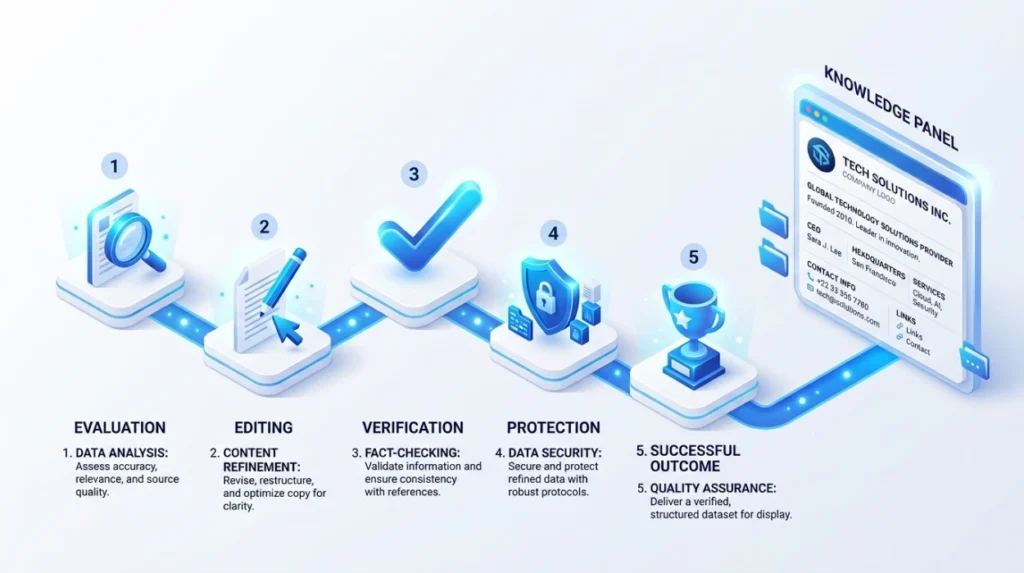
A defined process delivers greater reliability because each stage addresses a specific mechanism within the search ecosystem. The work can be organised around the following actions:
- Audit the Knowledge Panel and surrounding SERPs to identify inaccurate personal information, ranking positions, source relationships and reputation signals.
- Trace displayed details to relevant websites and authoritative sources to determine whether correction, removal or another intervention addresses the underlying issue.
- Validate factual information using credible evidence so correction requests establish a clear and defensible basis for change.
- Submit appropriate requests through relevant platform or source procedures while maintaining accurate documentation of each intervention.
- Strengthen authoritative information that accurately represents the entity and improves the consistency of search signals.
- Monitor rankings, Knowledge Panel changes and content visibility against the original baseline to measure the effect of each action.
This process reduces operational risk because every intervention has a defined purpose and measurable reference point. It also prevents the common mistake of focusing solely on the Knowledge Panel while ignoring the external sources that contribute to the wider entity profile. Source-level analysis, correction and search monitoring work together to create a more complete reputation strategy. The process therefore supports both immediate issue resolution and longer-term search stability.
For users evaluating whether intervention is appropriate, understanding how to correct or remove personal details from a Google Knowledge Panel provides useful decision context. It clarifies the difference between correcting inaccurate information and removing personal information from a source. That distinction matters because each action follows a different mechanism and produces a different type of outcome. A professional assessment uses these distinctions to select the appropriate route rather than applying a single tactic to every problem.
Is professional reputation management worth the cost for personal information issues?
Professional intervention delivers long-term value when the cost of unmanaged personal information exceeds the cost of structured remediation. An inaccurate Knowledge Panel can affect professional credibility, privacy expectations and the first impression created by branded or name-based searches. If the same information appears across multiple sources, addressing each occurrence without a coordinated strategy creates duplicated effort and inconsistent outcomes. A professional process consolidates source analysis, correction, removal and monitoring into a single reputation framework. This improves resource allocation and reduces the risk of repeatedly addressing symptoms rather than underlying information signals.
The value also comes from risk reduction rather than simply achieving one visible search change. Removing unnecessary personal information reduces exposure, correcting inaccurate details improves factual accuracy and strengthening authoritative information improves entity credibility. These outcomes contribute to a more stable search environment where accurate information has stronger representation. Measurement against baseline SERP conditions also provides evidence of progress, allowing decisions to be based on visibility data rather than assumptions. This makes reputation management a structured business and privacy decision rather than an open-ended search exercise.
Cost evaluation therefore needs to consider both immediate intervention and ongoing sustainability. A one-time correction without monitoring leaves the search ecosystem vulnerable to future changes in source information. Conversely, a structured process establishes monitoring points and identifies new risks as they emerge. Clear Your Name supports this outcome-focused approach by connecting personal information remediation with broader search perception influence. The emphasis remains on measurable visibility, factual accuracy, trust signals and controlled reputation outcomes.
Dive Deeper With Our Expert Guides:
Restrict Public Access to Your Marriage Records With Our Help
Audit and Protect Your Professional Profiles With Our Privacy Service
How can a UK team reduce the risk of recurring Knowledge Panel problems?
Risk reduction depends on maintaining consistency between authoritative information and the wider digital footprint. When professional profiles, websites and trusted sources contain accurate and consistent information, they provide stronger signals for entity identification and credibility. Regular monitoring then identifies discrepancies before they become established across prominent search results. This proactive approach reduces dependence on reactive removal after inaccurate information has gained significant visibility. It also creates an ongoing framework for protecting search perception.
Sustainability requires the same discipline applied during the initial correction. Search ecosystems change continuously, and information can be republished, updated or associated with an entity through new sources. Monitoring relevant name searches and Knowledge Panel information provides an early warning mechanism for emerging inaccuracies. Where an issue appears, the response can be matched to its mechanism through correction, removal, negative content suppression or enhancement. This maintains a controlled information environment without relying on a single intervention.
The decision process can then compare removal, correction, suppression and enhancement according to their mechanisms. Removal addresses source availability, correction addresses displayed factual information, suppression addresses search prominence and enhancement strengthens accurate competing information. Fix Your Google Knowledge Panel Personal Information With Our UK Team provides a focused approach for addressing inaccurate or outdated details within the search ecosystem. Each approach carries different limitations and operates at a different stage of the search ecosystem. Measuring results against baseline SERP conditions provides evidence of actual search visibility changes. This creates a structured basis for deciding whether the selected strategy is effective and sustainable.
Why choose Clear Your Name for personal information reputation management?
Clear Your Name provides a structured reputation management approach centred on evidence, process clarity and measurable search outcomes. The service focuses on identifying the source of inaccurate or unwanted information before selecting the appropriate intervention. This prevents inappropriate tactics from being applied to issues that require a different mechanism. Each action remains connected to a defined objective, whether that objective involves improving factual accuracy, reducing personal information exposure or strengthening search perception.
The strongest outcome comes from combining privacy-focused remediation with broader SERP control. A corrected Knowledge Panel has greater value when surrounding search results also present accurate and credible information. Strengthening reputation signals helps create consistency between the person’s actual identity and their digital representation. Monitoring then verifies whether visibility changes persist and whether new risks emerge. This creates a repeatable process that supports trust restoration and long-term search stability.
For UK individuals facing inaccurate, outdated or unnecessarily exposed personal details, a professional service provides a clear route from diagnosis to measurable remediation. The emphasis remains on legitimate source management, factual correction, privacy protection and search visibility control. By connecting these mechanisms, the process reduces reputation risk while strengthening entity credibility. The result is a more accurate and controlled digital information environment in which users encounter reliable information when searching for the individual.
What is the final decision for correcting or removing Knowledge Panel personal information?
The strongest decision is to use a structured professional process when inaccurate or unnecessary personal information affects prominent search visibility. Correction, removal, negative content suppression and enhancement address different mechanisms, so selecting the correct intervention is essential for reliable results. Evidence-based source analysis establishes where the problem originates, while SERP monitoring measures whether visibility and reputation signals improve. This approach reduces wasted effort and creates a defensible framework for reputation management.
The objective is not simply to change one Google Knowledge Panel field. It is to establish greater control over the information ecosystem surrounding the entity, improve factual accuracy and strengthen the signals that influence public perception. Professional management delivers this through defined processes, measurable baselines and continuous assessment. For individuals seeking a reliable UK-based route to address personal information concerns, this creates a clearer path towards improved search visibility, stronger entity credibility and reduced reputation risk.
How can I fix personal information in a Google Knowledge Panel?
You can request a correction when a Knowledge Panel displays inaccurate, outdated or incorrectly associated personal details. The process involves identifying the information, providing supporting evidence and addressing relevant source information.
Can personal information be removed from a Google Knowledge Panel?
Personal information can be addressed through the appropriate correction or removal process, depending on where the information originates and why it appears. Source-level removal can also reduce the information available for continued indexing or association.
How do Personal Information Removal Services help with Google Knowledge Panels?
Personal Information Removal Services identify exposed personal details, trace their sources and apply appropriate removal or correction procedures. This helps reduce unnecessary information exposure while improving search accuracy and privacy.
How long does it take to correct a Google Knowledge Panel?
The timeframe depends on the nature of the inaccurate information, its source and the review process involved. Providing clear evidence and addressing relevant source information creates a more structured correction process.
Can a reputation management service improve Google Knowledge Panel accuracy?
Yes, a reputation management service can coordinate source analysis, factual correction, personal information removal and SERP monitoring. These activities strengthen accurate reputation signals and improve the consistency of information associated with the relevant entity.