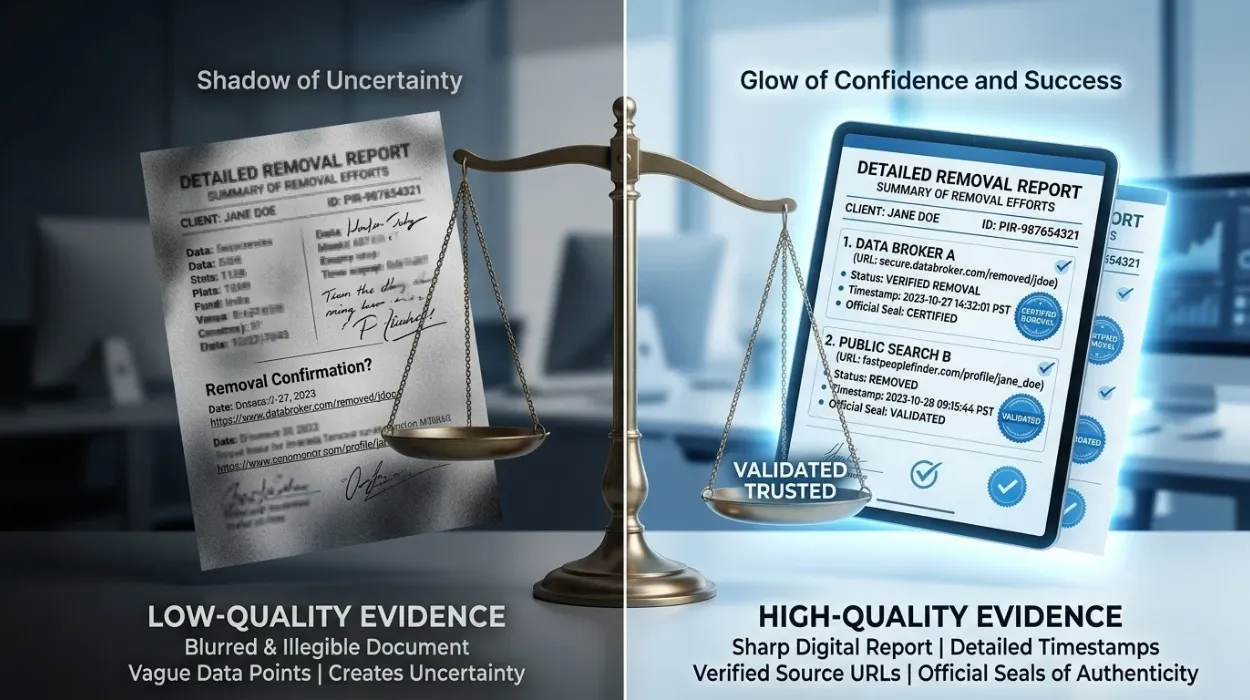
Indeed’s review flagging process relies on evidence that demonstrates a review breaches applicable review guidelines rather than simply expressing disagreement with its content. Reputation management is the structured analysis of information that shapes how an organisation, employer or entity is perceived across digital environments.
Online reputation refers to the collection of publicly accessible information, opinions, reviews and other reputation signals associated with an entity within search ecosystems. On employment platforms, reviews form part of this digital footprint because they contribute information that users evaluate when researching an organisation. Understanding evidence requirements therefore involves examining how review content, supporting information and platform rules interact with reputation signals.
What evidence does Indeed use when evaluating a flagged review?
Indeed evaluates flagged review content against its applicable review guidelines and the information submitted through the reporting process. Evidence is relevant when it establishes a specific connection between the review and a prohibited category, such as inappropriate content, conflicts of interest, personal information or other guideline violations. The purpose of evidence is therefore to demonstrate a policy-related issue rather than to establish whether an employer agrees with the review. This distinction separates content moderation from general reputation disagreement. A review that is negative but compliant remains different from a review containing information that violates a platform rule.
Evidence functions as a verification signal within the moderation process. A report identifies the content being challenged, while supporting information explains why that content falls within a defined policy category. This creates an evidence relationship between the review, the alleged violation and the relevant guideline. The stronger this relationship, the clearer the basis for evaluating the report. Reputation analysis therefore focuses on the factual characteristics of the content rather than its perceived commercial or reputational impact.
Why is evidence important when flagging an Indeed review?
Evidence is important because a review flag requires an identifiable reason for moderation. A negative statement alone does not establish that content violates a review policy. The reporting party needs to distinguish between an unfavourable opinion, an inaccurate assertion and content that falls within a prohibited category. This distinction supports consistent evaluation of user-generated content. It also prevents reputation concerns from being treated automatically as content-policy violations.
Within a reputation system, evidence separates perception from verifiable content characteristics. A review can influence entity perception through its wording, sentiment and visibility, but those factors do not independently establish a policy breach. Evidence instead connects a specific part of the review to an applicable moderation criterion. This makes the reporting process analytical rather than purely reputational. The resulting decision concerns content eligibility under platform rules rather than whether the review is favourable to the organisation.
What types of information can support a review flag?
Supporting information needs to explain the precise reason a review conflicts with applicable review requirements. The relevant material depends on the nature of the suspected violation, because different policy categories require different factual indicators. For example, a report concerning personal information requires evidence that identifiable personal data appears in the review. A report concerning inappropriate content requires evidence showing the relevant wording or material. The useful evidence therefore depends on the policy basis selected during reporting.
Evidence also needs to remain connected to the content being reported. Information unrelated to the review does not demonstrate a violation within the review itself. Employment records, internal correspondence or business documentation can provide context, but contextual information does not automatically establish that a platform guideline has been breached. The moderation question remains centred on the published content and the applicable rules. This creates a distinction between background evidence and direct evidence of a content violation.
How does Indeed distinguish a negative review from a policy violation?
A negative review is an expression of an individual’s experience, opinion or assessment, while a policy violation concerns content that breaches a defined platform requirement. Sentiment and policy compliance therefore represent separate reputation signals. A review can contain strongly negative sentiment while remaining within the platform’s content rules. Conversely, a review with neutral language can still contain prohibited information. Sentiment alone therefore does not determine whether content qualifies for removal.
Search and reputation systems process these distinctions differently. Sentiment analysis identifies characteristics such as positive, negative or neutral language, while content moderation applies rules concerning acceptable publication. Search visibility can reflect the existence and relevance of review content without determining whether that content complies with a platform’s policies. This means a business’s concern about search perception does not itself constitute evidence for moderation. The relevant evidence must establish the specific policy issue attached to the review.
How does review content affect online reputation and search perception?
Review content contributes to online reputation by creating publicly accessible reputation signals associated with an entity. Search engines can discover, interpret and index publicly available information depending on technical accessibility, relevance and other ranking factors. Reviews can therefore become part of the broader digital footprint through which users evaluate an organisation. Their influence on perception depends on factors including visibility, wording, context and the surrounding information ecosystem. A review is consequently one information source within a larger entity representation.
SERP evaluation involves assessing the information presented for an entity across search results. Review content can contribute to this evaluation by supplying descriptive language, sentiment indicators and experience-related information. Search engines do not simply treat every review as an authoritative factual statement, however, because ranking systems evaluate content through multiple signals. The presence of a review therefore does not automatically establish a factual conclusion about the entity. It forms part of the information environment surrounding that entity.
What role does content accuracy play in review flagging?

Content accuracy is relevant to reputation analysis, but an accuracy dispute is not automatically equivalent to a policy violation. A business can identify a statement as incorrect without that statement necessarily meeting a platform’s removal criteria. Evidence therefore needs to demonstrate the relevant rule-based issue rather than relying solely on an assertion that the review is false. This distinction is essential when analysing user-generated reputation content. It prevents factual disagreement from being confused with a moderation violation.
Accuracy also has a broader role in entity perception. Search users interpret review statements alongside other information, including official pages, independent publications and additional user-generated content. Contradictory information can produce different reputation signals without automatically causing one item to disappear from search results. Content indexing preserves the distinction between publication and verification. Consequently, reputation analysis examines both what content says and how its credibility is established.
How does the reporting reason influence evidence requirements?
The selected reporting reason determines the type of evidence that has analytical relevance. A report identifying personal information requires attention to the presence and nature of that information, while a report based on inappropriate content requires examination of the specific wording or material. Choosing a reporting category without matching evidence creates a weak relationship between the allegation and the content. Accurate categorisation therefore forms part of evidence quality. The report needs to explain the connection between the observed content and the applicable guideline.
This mechanism reflects a broader principle in digital reputation systems: evidence has value when it reduces ambiguity. A clear report identifies the content, defines the suspected violation and connects the two through observable information. An unclear report leaves the moderation question dependent on interpretation rather than identifiable evidence. Structured evidence therefore supports consistent SERP and content-environment analysis. It also separates genuine policy concerns from attempts to influence reputation solely because content is unfavourable.
Can business records prove that an Indeed review violates a policy?
Business records can provide contextual information, but their relevance depends on the specific review issue being reported. Internal records do not automatically demonstrate that a published review violates a platform guideline. Their evidential value increases when they directly establish a factual relationship relevant to the alleged violation. For example, documentation relating to an employment relationship can provide context when the report concerns whether a reviewer has a relevant connection. The moderation assessment still centres on the published review and applicable platform requirements.
This distinction demonstrates why evidence management forms part of reputation analysis. Digital reputation involves multiple information layers, including internal records, public reviews and search-indexed content. These layers do not carry identical evidential functions. Internal documentation can support interpretation, while the review itself represents the public-facing reputation signal. Effective analysis therefore separates contextual evidence from direct evidence and avoids treating every document as equally relevant.
How should evidence be connected to the review content?
Evidence needs to establish a direct and understandable relationship between the reported review and the reason for flagging it. Identify the specific content, determine the applicable policy category and explain the factual basis for the concern. This approach creates a traceable evidence chain rather than a general complaint about reputation damage. The evidence remains strongest when another reviewer can understand the issue without relying on assumptions. The objective is clarity, not volume.
A large quantity of unrelated documentation does not necessarily strengthen a report. Evidence quality depends on relevance, specificity and its relationship to the alleged violation. This principle applies across digital trust systems because moderation decisions require interpretable signals. Clear evidence also reduces the distinction between what is observable and what is inferred. In reputation management, that separation is fundamental to reliable content evaluation.
How does review flagging relate to broader reputation management?
Review flagging represents one part of a broader reputation-management process focused on understanding and evaluating publicly available information. Reputation management is not simply the removal of negative content; it involves analysing how information contributes to entity perception, credibility and search visibility. Review moderation addresses whether specific content complies with platform rules. Search reputation analysis examines how that content interacts with the wider digital footprint.
The two processes therefore operate at different levels. Content moderation evaluates eligibility under platform requirements, while reputation analysis evaluates the information environment surrounding an entity. A review can remain visible while its broader reputation impact changes as additional information becomes available and search results evolve. Content indexing, ranking dynamics and user interpretation all influence this environment. Understanding these mechanisms prevents review management from being reduced to a single removal action.
Dive Deeper With Our Expert Guides:
How Indeed Handles Removal Requests and What Its Community Guidelines Cover
How to Build a Long-Term Positive Indeed Review Pipeline
What makes evidence relevant to an Indeed review flag?
Relevant evidence is evidence that directly supports the selected policy concern and relates clearly to the review being reported. It identifies an observable characteristic rather than relying on the review’s negative tone or commercial impact. The evidence also remains proportionate to the issue being raised. This creates a factual basis for moderation rather than an argument about whether the review is fair. Relevance is therefore more important than simply supplying a large amount of information.
For reputation systems, this principle reflects the difference between reputation impact and policy eligibility. Reputation impact concerns how information affects entity perception and search visibility. Policy eligibility concerns whether content satisfies the rules governing publication. These concepts interact but do not have identical criteria. Understanding their separation provides a more accurate framework for analysing review signals and digital credibility.
What are the key principles for understanding review evidence?
The evidence process can be understood through three core principles:
- Identify the exact review content being challenged, such as a statement containing personal information or prohibited material.
- Connect the content to the relevant guideline, such as demonstrating how the identified wording fits a defined policy category.
- Explain the factual relationship clearly, such as showing why the observed content provides evidence of the alleged violation.
These principles create a structured method for analysing reputation-related content without confusing negative sentiment with a moderation violation. They also demonstrate why evidence requirements are fundamentally about policy relevance. The resulting analysis remains centred on observable content, applicable rules and identifiable relationships.
How does evidence influence the interpretation of online credibility?
Evidence influences credibility by determining how confidently information can be interpreted within its surrounding context. Search users encounter reviews alongside other reputation signals, while platforms assess content according to their own publication and moderation rules. A documented policy violation therefore represents a different type of signal from a negative opinion. Distinguishing these categories improves the accuracy of reputation analysis. It also supports clearer interpretation of an entity’s digital footprint.
Online credibility refers to the perceived reliability of information associated with an entity across digital environments. It is shaped by the consistency, context and accessibility of information rather than by a single review alone. Search visibility can amplify certain information through ranking and indexing, while moderation can determine whether specific user-generated content remains published on a platform. Understanding these mechanisms provides a more precise view of how reputation signals operate.
How should Indeed review evidence be understood?
Indeed review evidence is best understood as information that establishes a specific connection between published review content and an applicable review-policy concern. What Evidence Makes an Indeed Review Removal Request in the UK More Likely to Work depends on how clearly the evidence connects the reported content with a relevant policy concern. Negative sentiment, reputational impact or disagreement with an opinion does not independently establish a policy violation. Relevant evidence instead focuses on observable content characteristics and the rule associated with them.
Reputation management provides the wider framework for interpreting these signals. Online reviews contribute to an entity’s digital footprint, while search visibility, content indexing, sentiment and credibility influence how that information is encountered and interpreted. Separating policy evidence from general reputation impact creates a clearer understanding of review flagging and the wider systems that shape online reputation.
What evidence is needed to flag an Indeed review?
Evidence needs to show how the review breaches an applicable Indeed review guideline. Relevant evidence can include the specific wording in the review and supporting information that directly relates to the reported policy issue.
Can I flag an Indeed review if it contains false information?
A factual dispute alone does not automatically establish a policy violation. For an Indeed review removal request, the evidence needs to connect the disputed content to a specific review guideline or prohibited category.
Does negative feedback qualify for Indeed review removal?
Negative feedback does not automatically qualify for removal simply because it harms an employer’s reputation. Indeed review flagging focuses on whether the content breaches applicable review requirements rather than whether the review is unfavourable.
What makes an Indeed review removal request stronger?
A clear request identifies the exact review content, the relevant policy concern and evidence supporting that connection. This structured approach gives the moderation process specific information to evaluate rather than relying on general claims about reputational damage.
Can Clear Your Name help with Indeed review removal evidence?
Clear Your Name provides information about Indeed Review Removal Services, including the importance of identifying relevant review content and supporting evidence. Evidence remains most relevant when it directly demonstrates a potential breach of the platform’s applicable review guidelines.