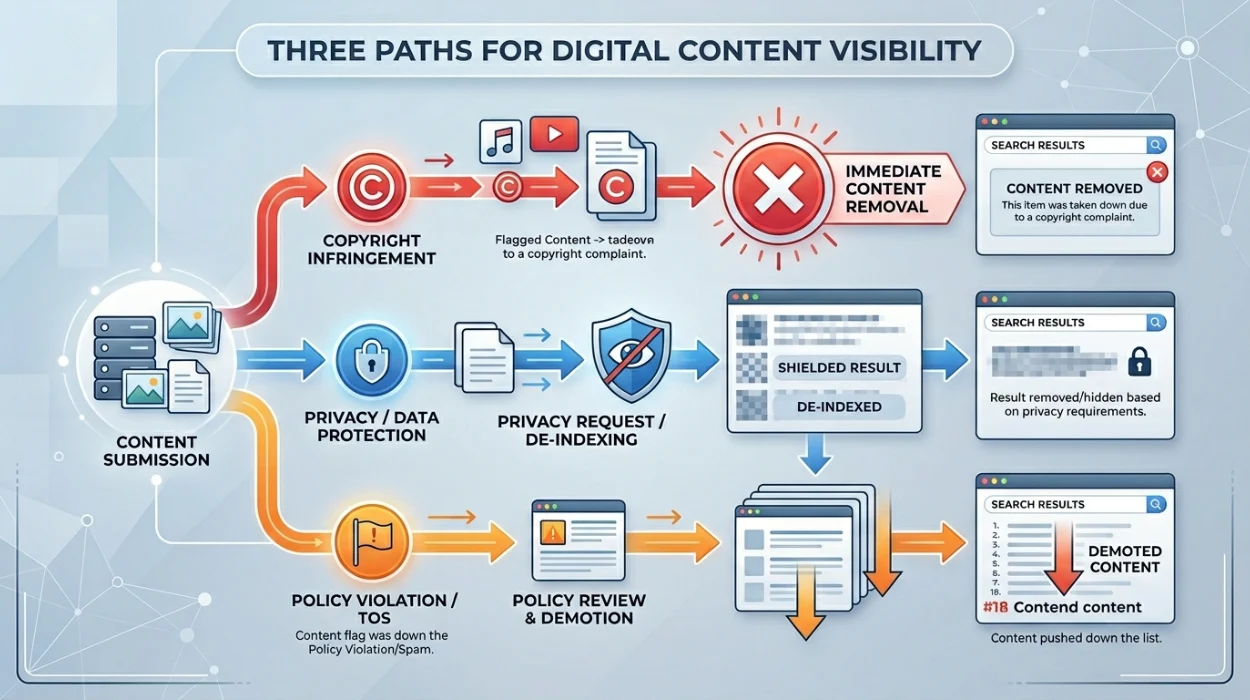
Copyright claims provide a legal mechanism for addressing unauthorised reposting of original social media content when the claimant owns or controls the relevant copyright. Reputation management is the process of monitoring, evaluating, and influencing how an individual, organisation, or entity is represented across digital environments. Online reputation refers to the combined perception created by indexed content, social signals, reviews, references, and other information associated with an entity across search ecosystems.
What Is Copyright Protection for Social Media Content?
Copyright protection is a legal framework that gives creators control over qualifying original works, including photographs, videos, graphics, written content, and other creative material published through social platforms. Social media publication does not automatically transfer copyright ownership to the platform or to users who view the content. The copyright relationship remains connected to the creator or rights holder, subject to the platform’s terms and applicable copyright law.
Reposted content becomes relevant to reputation management when duplicated material appears outside its original context or without the creator’s authorisation. Search engines evaluate publicly accessible pages as separate documents, even when those pages contain substantially similar material. Duplicate or unauthorised copies therefore create additional locations through which the same information enters the digital footprint of an individual or entity.
Copyright claims establish a formal basis for requesting removal of infringing material from a platform or website. The claim identifies the protected work, establishes the claimant’s relationship to that work, and identifies the allegedly infringing material. This process differs from ordinary content moderation because copyright enforcement is based on intellectual property rights rather than simply on whether content appears undesirable or reputationally harmful.
How Does Reposted Social Content Affect Online Reputation?
Reposted social content affects online reputation by increasing the number of digital locations associated with the same material, context, or identity. Online reputation is influenced by the information that search engines discover, index, associate, and rank around an entity. When unauthorised copies become indexed, they become additional reputation signals within the entity’s digital footprint.
Context is particularly important because reposted material does not always preserve the circumstances of its original publication. Captions, comments, surrounding text, usernames, timestamps, or accompanying claims can alter how a searcher interprets the material. Search engines process textual and contextual information around media, creating an information environment in which the same image or video receives different associations across different pages.
Reposted content also affects search visibility when duplicate versions occupy multiple URLs. Each indexed URL represents a separate document within the search ecosystem. Ranking systems evaluate relevance, authority, content quality, links, engagement signals, and other characteristics when determining which documents appear for a query.
Copyright enforcement therefore has a connection to reputation systems through content availability. Removing an unauthorised copy from its hosting environment reduces the source material available for continued indexing and discovery. The resulting change does not guarantee a specific SERP position, but it changes the set of documents that search systems can evaluate.
How Do Copyright Claims Remove Reposted Content?
Copyright claims remove reposted content through a formal notice and review process administered by the relevant platform or hosting provider. The rights holder identifies the protected work and provides information demonstrating ownership or authorisation to act on behalf of the owner. The notice also identifies the location of the allegedly infringing material, allowing the platform to evaluate the specific content.
A typical copyright claim contains information that allows the recipient to distinguish the original work from the allegedly unauthorised copy. The claimant provides identifying information, the location of the original work where relevant, and the URL or account containing the reposted material. Accuracy is important because platforms evaluate claims according to their applicable copyright procedures and legal requirements.
The platform then evaluates the notice against its copyright policy and applicable law. A valid claim can result in removal, restriction, or other enforcement action depending on the platform and circumstances. Some platforms also provide a counter-notification process for users who dispute the claim.
The mechanism therefore operates through rights enforcement rather than reputation scoring. A copyright claim does not ask a search engine to determine whether content is positive or negative. It establishes a legal basis for addressing unauthorised use of protected material at the location where that material is hosted.
Why Does Content Removal Matter for Search Visibility?
Content removal matters for search visibility because search engines rely on accessible and indexable documents when constructing search results. When a page containing unauthorised reposted content is removed, the page becomes unavailable as an active source for crawling and indexing. Search engines then process the changed availability of that document during subsequent crawling and indexing cycles.
Search visibility is the extent to which an entity, page, or piece of information appears within search results for relevant queries. It depends on the relationship between search intent, indexed content, authority, relevance, and ranking systems. Removing one page does not automatically remove every reference to the same information because copies, cached information, links, screenshots, and other references form separate digital assets.
The distinction between hosting removal and search-result removal is therefore essential. A platform can remove the original reposted content while search engines continue displaying an indexed URL temporarily. Search systems require time to recrawl the affected page, process its status, update their index, and adjust SERP evaluation.
This process demonstrates that reputation management operates across multiple information layers. The source layer contains the published material, the indexing layer determines whether search engines store and retrieve that material, and the ranking layer determines its position for specific queries. Copyright enforcement primarily addresses the source layer, while search visibility changes follow through subsequent indexing processes.
How Do Search Engines Interpret Trust and Authority Around Reposted Content?

Search engines interpret trust and authority through multiple signals rather than through a single reputation score. Authority refers to the perceived reliability and relevance of a source within a particular information context. Trust signals include factors associated with source quality, consistency, references, expertise, and the relationship between content and the entity represented.
A reposted social media item therefore does not automatically receive the same authority as its original source. Search systems analyse the page hosting the material, the surrounding text, links, entity relationships, and other available signals. The same creative work can consequently appear in different search contexts depending on the authority and relevance of each hosting page.
Entity perception is also influenced by repeated associations. An entity is a person, organisation, brand, or identifiable subject represented across connected information sources. When search systems repeatedly encounter an entity alongside particular terms, topics, media, or claims, those associations contribute to the broader information environment surrounding that entity.
Copyright removal addresses the underlying availability of unauthorised material rather than directly manipulating these ranking signals. This distinction prevents copyright enforcement from being treated as a conventional SEO ranking technique. Its relevance to reputation systems comes from controlling the continued publication of material that forms part of an entity’s searchable digital footprint.
How Do Reviews and Sentiment Relate to Reposted Social Content?
Reviews and sentiment relate to reposted content because both contribute contextual information about how an entity is represented online. Review signals consist of user-generated evaluations, ratings, written feedback, and related discussions associated with a business, product, person, or organisation. Sentiment interpretation involves analysing whether surrounding language expresses positive, negative, neutral, or mixed attitudes.
Reposted social content represents a different information type. Copyright ownership concerns the legal rights attached to creative material, whereas sentiment concerns the interpretation and tone surrounding an entity. A reposted image or video can therefore influence perception through accompanying commentary without the copyright issue itself representing a positive or negative sentiment signal.
Search ecosystems connect these information types through entity associations. A social post, review page, article, image, or discussion can contain references to the same entity. Search engines evaluate these documents according to their relevance and other ranking signals rather than combining them into one simple reputation score.
Copyright claims consequently address one component of the broader digital footprint. Reviews, editorial coverage, social discussions, and authoritative references remain separate information sources. Understanding these distinctions provides a more accurate model of how online reputation develops across search ecosystems.
How Does a Copyright Takedown Differ From Ordinary Content Moderation?
A copyright takedown is based on an intellectual property claim, while ordinary content moderation is generally based on platform rules governing acceptable content. Copyright enforcement focuses on the unauthorised use of protected material. Content moderation focuses on whether material complies with a platform’s community standards, safety rules, or other publishing policies.
This distinction affects how a removal request is evaluated. A copyright notice requires information relevant to ownership, authorisation, and infringement. A moderation report evaluates the content against the platform’s stated rules. The same reposted item can therefore involve different reporting mechanisms depending on the reason for requesting its removal.
The distinction also matters for reputation analysis. Content that is reputationally undesirable does not automatically constitute copyright infringement. Copyright protection relates to ownership and protected expression, not simply to whether information harms an entity’s image.
Using the correct mechanism preserves the integrity of the removal process. A copyright claim has a defined legal and procedural purpose, while reputation management encompasses a wider analysis of content, search visibility, entity perception, and digital trust.
Dive Deeper With Our Expert Guides:
Why Responding Publicly Can Sometimes Worsen a Social Media Backlash
Why Executives Need a Protected Personal Social Media Presence
How Can Copyright Claims Influence an Entity’s Digital Footprint?
Copyright claims influence an entity’s digital footprint by addressing unauthorised copies of creative material within the network of pages and accounts associated with that material. A digital footprint is the collection of publicly accessible information, references, profiles, publications, media, and interactions connected to an entity across online environments.
When unauthorised reposts remain available, each accessible location represents an additional point of publication. Those locations can generate links, comments, shares, references, and indexing activity. Removing an infringing copy reduces the availability of that particular source and limits its continued participation in the information ecosystem.
The effect remains specific to the removed content. Copyright enforcement does not erase independent references, legitimate commentary, or separately created material. It also does not directly alter reviews, editorial coverage, or other reputation signals that exist independently from the copyrighted work.
This limitation demonstrates why reputation management requires an ecosystem-level perspective. Search perception emerges from the interaction of multiple information sources rather than from a single webpage or social media post. Copyright claims form one mechanism within that wider information environment.
What Is the Relationship Between Copyright Enforcement and Search Reputation?
Copyright enforcement and search reputation are connected through the availability and indexing of online information. Search reputation refers to how an entity is represented and interpreted through search results, indexed pages, media, references, and associated topics. Copyright enforcement affects this environment when unauthorised material is removed from a source that search engines can access.
The relationship is indirect rather than algorithmically deterministic. A successful copyright claim removes or restricts the identified material according to the platform’s process. Search engines then process the changed source availability through crawling and indexing systems.
The resulting search environment depends on the remaining information ecosystem. If other pages contain the same material or related references, those sources continue contributing to search visibility. If the removed content represented a significant indexed source, its disappearance changes the collection of documents available for SERP evaluation.
Understanding this relationship separates legal enforcement from search optimisation. Copyright claims provide a rights-based mechanism for addressing unauthorised publication, while search reputation describes the broader perception created by indexed information. Their interaction occurs through the information lifecycle connecting publication, indexing, retrieval, and ranking.
What Are the Key Principles for Understanding Copyright-Based Content Removal?
Copyright-based content removal is best understood through the relationship between ownership, publication, indexing, and search perception. The following principles define that relationship:
- Identify ownership — Establish the protected work and the claimant’s legal relationship to it before evaluating a reposted copy.
- Locate infringement — Identify the specific account, webpage, post, image, or video containing the allegedly unauthorised material.
- Use the appropriate mechanism — Submit the claim through the relevant copyright process rather than treating copyright enforcement as general reputation reporting.
- Separate source removal from indexing — Distinguish removal from a platform from subsequent changes to search-engine indexing and SERP visibility.
- Evaluate the wider footprint — Analyse remaining copies, references, reviews, discussions, and authoritative sources because removal of one item does not remove the entire information ecosystem.
These principles demonstrate why copyright claims have a defined role within digital reputation systems. They address the legal status of specific creative material while search engines continue evaluating the wider collection of indexed information.
How Do Copyright Claims Support Digital Reputation Management?
Copyright claims provide a structured mechanism for addressing unauthorised reposting of protected social media content. Their effect on reputation systems occurs through the removal of specific source material, followed by changes in content accessibility, crawling, indexing, and search visibility. Reputation management is broader than copyright enforcement because it evaluates the complete information environment surrounding an entity.
Online reputation refers to the perception created through indexed content, reviews, references, media, social discussions, authority signals, and entity associations. Copyright enforcement contributes to this ecosystem by addressing one category of information at its source. Understanding the distinction between legal content removal, content indexing, and SERP evaluation provides a clearer framework for analysing how digital footprints develop and change.
How does a copyright claim remove reposted social media content?
A copyright claim identifies protected content and the allegedly unauthorised repost, allowing the platform to review the complaint under its copyright procedures. If the claim is valid, the platform can remove or restrict the reported content.
Can copyright claims remove copied images and videos from social media?
Yes, copyright claims can address unauthorised copies of original photographs, videos, graphics, and other qualifying creative works. The claimant needs to establish the relevant copyright ownership or authority to act.
Does removing reposted content improve online reputation?
Removing unauthorised content can reduce the availability of unwanted material within an entity’s digital footprint. However, it does not automatically remove other copies, reviews, references, or indexed pages that contribute to online reputation.
How long does a copyright takedown take on social media?
The timeframe depends on the platform’s copyright review process and the circumstances of the claim. After removal, search engines also require time to recrawl the affected page and update their index.
How is a copyright takedown different from social media content removal?
A copyright takedown is based on intellectual property rights concerning protected creative work, while general content removal can rely on platform policies or other reporting mechanisms. The appropriate process depends on why the content violates the applicable rules or rights.