A copyright takedown provides a formal route for requesting removal of reposted social content that uses protected creative work without authorisation. The process involves identifying the copyrighted material, documenting the unauthorised use, and submitting a compliant notice through the relevant platform or hosting provider.
Reputation management strategies differ based on whether unwanted content requires removal, suppression, or contextual improvement. Online reputation control methods are evaluated through their effect on search visibility, reputation signals, entity credibility, and the composition of search engine results pages (SERPs). Copyright takedowns represent a reactive removal approach, while content creation represents a proactive method for influencing the information environment surrounding an entity.
What Is the Most Effective Approach to Reposted Social Content?
Copyright removal is the most direct approach when the reposted material constitutes an identifiable copyright infringement. Content enhancement operates differently by publishing or strengthening legitimate information that contributes to the entity’s wider digital footprint. Removal addresses the source of the disputed material, whereas enhancement adds competing or contextual information to the search ecosystem.
A copyright takedown operates through a rights-based reporting mechanism. The rights holder identifies the protected work and specifies where an unauthorised copy appears. The platform then evaluates the notice according to its applicable copyright procedures and determines whether enforcement action is appropriate.
Content creation operates through an organic reputation-building mechanism. New articles, profiles, authoritative references, and other legitimate resources introduce additional information that search engines can crawl, index, and evaluate. This approach focuses on content enhancement rather than eliminating an existing source.
The effectiveness of each method therefore depends on the nature of the reputation issue. Removal directly targets an identified piece of unauthorised content, while enhancement addresses the broader information environment. Combining the two concepts in analysis requires distinguishing between content suppression and content enhancement rather than treating them as interchangeable strategies.
How Do Copyright Takedowns Compare With Content Creation?
Copyright takedowns provide direct source-level intervention, while content creation provides indirect search-level influence. A takedown attempts to reduce the availability of a specific unauthorised publication. Content creation increases the volume and relevance of legitimate information associated with an entity.
The principal strength of removal is specificity. A valid notice identifies a particular work and particular location, allowing the platform to assess the reported material. Its limitation is scope because removing one repost does not automatically address copies hosted elsewhere or independent references to the same subject.
Content creation has broader scalability because a single publishing strategy can generate multiple legitimate information assets. These assets can occupy different areas of the digital footprint and contribute to entity understanding. Its limitation is that publishing additional content does not directly remove an existing infringing copy.
Search ranking influence also differs between the approaches. Removal changes the availability of a source, while content creation changes the pool of information available for crawling, indexing, and ranking. Consequently, a takedown has a direct effect on the identified source, whereas content enhancement has a longer-term relationship with SERP composition.
When Is a Copyright Takedown More Appropriate Than Content Suppression?
A copyright takedown is more appropriate when the primary problem is an unauthorised reproduction of protected creative material. Content suppression refers to reducing the prominence of unwanted information through changes in the wider search environment rather than removing the source itself. These approaches address different mechanisms and therefore require separate evaluation.
Copyright enforcement begins with ownership or authorised control of the relevant work. The claimant then identifies the allegedly infringing copy and provides the information required by the platform’s reporting process. This creates a defined legal and procedural basis for the removal request.
Content suppression works differently because the original publication remains available. The strategy focuses on the relative visibility of competing pages, authoritative resources, and relevant content. Search ranking systems then evaluate these documents according to relevance, authority, quality, links, and other signals.
The distinction creates different risk profiles. A copyright notice based on inaccurate ownership information creates legal and procedural risks, while aggressive suppression strategies create risks associated with low-quality, manipulative, or irrelevant content. A sound evaluation therefore considers the legitimacy of the underlying material before selecting a response.
How Do Organic and Reactive Reputation Strategies Differ?
Organic reputation strategies build the information environment over time, while reactive strategies respond to an identified reputation event or content problem. Organic methods include publishing authoritative information, maintaining accurate profiles, and developing consistent entity references. Reactive methods include reporting infringing material, addressing inaccurate information, and responding to specific negative or unauthorised publications.
Organic activity has a long-term orientation because search engines require time to discover, index, and evaluate new information. Its effectiveness depends on the relevance, quality, authority, and consistency of the material being introduced. The objective is not simply to increase content volume but to strengthen the overall information structure around an entity.
Reactive removal has a shorter operational cycle because it begins with a specific identified problem. A copyright claim targets the source containing the unauthorised material rather than attempting to influence unrelated ranking signals. This makes reactive removal more precise when the underlying issue satisfies the relevant copyright criteria.
The two approaches therefore differ in scalability and sustainability. Organic methods can establish a continuing information framework, while reactive methods remain dependent on identifying and addressing individual incidents. A sustainable reputation strategy evaluates both the immediate source-level issue and the longer-term search environment.
How Do You Prepare a Copyright Takedown Request?
A copyright takedown request begins with establishing the protected work and documenting the location of the unauthorised copy. The claimant then provides the information required by the relevant platform or hosting provider. Accuracy and completeness are important because the recipient needs sufficient information to evaluate the copyright claim.
- Identify the protected work — Specify the original photograph, video, graphic, written work, or other qualifying creative material and establish the relevant ownership or authority.
- Locate the repost — Record the URL, account, post, or page containing the unauthorised copy so the platform can identify the precise material under review.
- Document the relationship — Explain the claimant’s relationship to the protected work and provide the information required to demonstrate ownership or authorised representation.
- Submit the notice — Use the platform’s designated copyright reporting mechanism and provide the required declarations and contact information.
- Monitor the outcome — Track the platform’s response and distinguish between removal of the source and subsequent changes to search-engine indexing.
This process is different from submitting a general complaint about content that appears undesirable. Copyright enforcement depends on the existence of relevant intellectual property rights rather than on the reputational impact of the publication alone.
What Information Does a Copyright Takedown Usually Require?
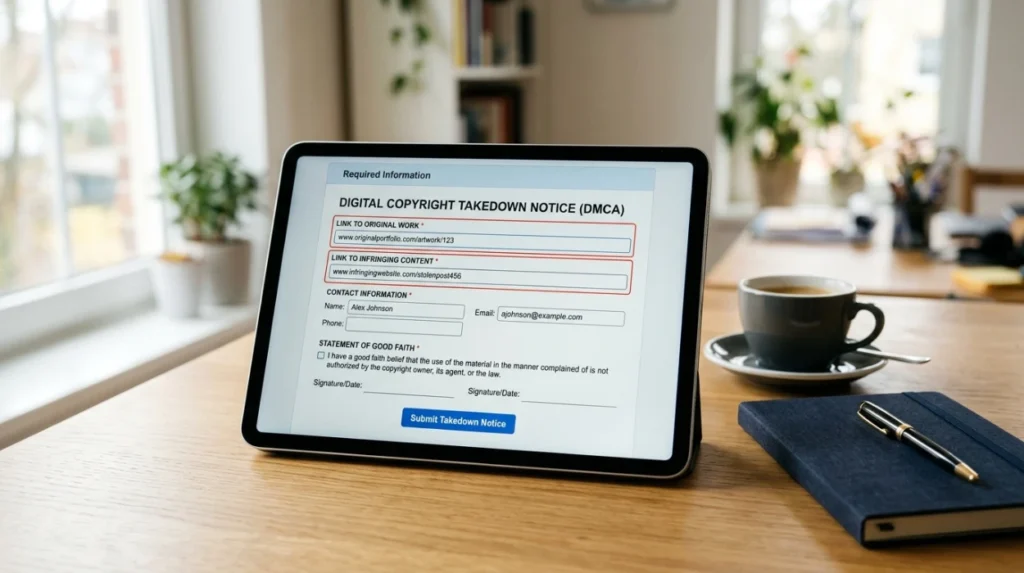
A copyright takedown usually requires information that identifies both the original protected work and the allegedly infringing material. The precise requirements differ between platforms and jurisdictions, so the applicable reporting procedure determines the information that needs to be submitted.
The original work establishes the subject of the copyright claim. The claimant identifies the creative work and provides sufficient information for the platform to understand what material is protected. The allegedly infringing location then establishes where the unauthorised reproduction appears.
A valid notice also requires claimant information and declarations specified by the relevant process. These requirements help the platform distinguish legitimate rights claims from unsupported complaints. The reporting framework therefore functions as a verification mechanism rather than a general reputation-management form.
From a risk perspective, accuracy is central to the process. An unsupported claim does not become valid because the content creates an undesirable search result. Copyright enforcement remains dependent on the underlying rights and the specific circumstances of the reported use.
How Does a Copyright Takedown Affect Search Visibility?
A copyright takedown affects search visibility indirectly by changing the availability of the reported source. When a platform removes an infringing post or page, the content is no longer available from that particular location. Search engines subsequently process the change through their normal crawling and indexing systems.
Search visibility is determined by the set of documents available for retrieval and ranking against a query. Removing one source therefore changes the information pool but does not automatically determine which remaining pages appear in the SERP. Other copies, references, discussions, or related content can continue contributing reputation signals.
The distinction between source removal and search-result removal is particularly important. A platform can remove content while a search engine temporarily retains an indexed reference to the affected URL. Recrawling and index updates determine when the search ecosystem reflects the changed source status.
The effect is therefore measurable at different stages. Source availability can change immediately after platform enforcement, while search visibility changes follow the indexing lifecycle. Evaluating both stages prevents copyright takedowns from being incorrectly treated as direct search-ranking interventions.
Does Removing Reposted Content Improve Entity Credibility?
Removing unauthorised reposted content can improve the consistency of an entity’s digital footprint when the material creates misleading or unwanted associations. Entity credibility refers to the degree to which information surrounding an identifiable entity presents a coherent and trustworthy representation. Copyright removal contributes to this environment by addressing an unauthorised source.
The effect remains dependent on the broader information ecosystem. Search engines evaluate multiple sources rather than assigning credibility based on one removed page. Reviews, authoritative references, editorial coverage, social profiles, and other indexed resources continue to influence entity perception.
Sentiment distribution also remains separate from copyright status. A copyright infringement does not automatically represent negative sentiment, and removing an infringing post does not remove independent negative or positive discussions. Reputation analysis therefore requires separate evaluation of legal status, content context, sentiment, and search visibility.
The strongest analytical distinction is between content ownership and content perception. Copyright determines rights over qualifying creative expression, while reputation systems evaluate the information and associations surrounding an entity. These systems interact through publication and indexing but operate according to different principles.
Dive Deeper With Our Expert Guides:
How to Decide When to Respond to Negative Social Media Attention
How to Audit an Executive’s Social Media for Reputation Risk
Is Copyright Removal Better for Short-Term or Long-Term Reputation Management?
Copyright removal is primarily a short-term, source-specific intervention, while organic content development has greater relevance to long-term reputation management. A takedown addresses a defined publication problem and therefore provides a focused response to a particular incident. Long-term reputation control requires continued management of the broader digital footprint.
The short-term advantage of removal is precision. A specific infringing URL can be identified and submitted through an established reporting mechanism. This limits the scope of the intervention and avoids unnecessarily modifying unrelated reputation signals.
The long-term limitation is recurrence. New reposts can appear on different accounts, websites, or platforms, creating additional sources that require separate evaluation. Removal therefore does not eliminate the underlying possibility of future unauthorised publication.
Long-term content enhancement operates on a different timescale. Consistent publication of accurate, authoritative information creates a wider information structure that search engines can evaluate over time. This makes organic strategies more sustainable for broader reputation objectives, while copyright removal remains more suitable for specific rights-based content issues.
How Does Social Media Content Removal Compare With Search Reputation Control?
Social media content removal focuses on the source of the material, while search reputation control focuses on how information appears and is interpreted within search results. The former addresses publication availability, whereas the latter evaluates SERP composition, search intent, entity associations, and reputation signals.
Social media removal is therefore more precise when an identifiable post violates copyright or another applicable platform rule. Search reputation control is broader because it considers the entire set of indexed resources associated with an entity. The two approaches differ in scope, measurement, and operational mechanism.
For users evaluating the process of Copyright Takedown for Reposted Content, the distinction between source removal and search visibility is particularly important. A successful takedown addresses the reported content, while search engines independently determine how remaining indexed information appears in response to queries.
This distinction also reduces unrealistic expectations about ranking outcomes. Copyright enforcement is not a mechanism for directly assigning search positions or changing search algorithms. Its search-related impact occurs because the information ecosystem changes after the underlying source becomes unavailable.
What Factors Should Be Evaluated Before Choosing a Removal Strategy?
The appropriate strategy depends on the legal status of the content, the source involved, the desired outcome, and the wider search environment. Evaluation requires separating the immediate content problem from broader reputation objectives. A copyright takedown is suitable for a rights-based issue, while content enhancement addresses information gaps or search-result composition.
- Verify the rights — Confirm ownership or authorised control before using a copyright enforcement mechanism.
- Assess the source — Determine whether the unwanted material exists on a social platform, independent website, search index, or multiple locations.
- Measure search visibility — Analyse the affected URL, query relationships, ranking position, and surrounding SERP composition.
- Evaluate reputation signals — Review entity associations, sentiment distribution, authority signals, and related indexed references.
- Compare sustainability — Determine whether the issue requires a single removal action or continuing management of the wider digital footprint.
This framework separates legal enforcement from broader reputation strategy. It also establishes measurable criteria for comparing effectiveness, scalability, risk exposure, and sustainability.
Which Reputation Strategy Fits Reposted Social Content?
Copyright takedowns and reputation enhancement serve different purposes within digital reputation management. A copyright takedown provides a focused mechanism for addressing unauthorised use of protected material, while content creation and search reputation strategies influence the broader information environment.
The key distinction is between content removal and content enhancement. Removal changes the availability of a specific source, whereas enhancement introduces additional legitimate information for search engines to discover, index, and evaluate. Reactive methods offer greater precision for defined content issues, while organic approaches provide greater relevance to long-term reputation development.
Evaluating these methods through search visibility, entity credibility, reputation signals, SERP composition, risk exposure, scalability, and sustainability creates a more accurate framework for reputation management. Copyright enforcement therefore functions as one specific component of a wider digital reputation system rather than as a standalone search-ranking technique.
How do I file a copyright takedown for reposted social content?
Identify the original copyrighted work, document the unauthorised repost, and submit a copyright notice through the relevant platform’s reporting process. The platform then reviews the claim under its copyright procedures.
Can I remove reposted social media content using copyright law?
Copyright law provides a removal mechanism when the reposted material uses protected creative work without appropriate authorisation. The claimant needs a valid copyright interest or authority to act for the rights holder.
What information is needed for a copyright takedown request?
A copyright takedown generally requires details identifying the protected work, the allegedly infringing content, and the claimant’s relevant ownership or authorisation. Platforms also require specific declarations and contact information under their reporting procedures.
Does a copyright takedown remove reposted content from Google search results?
A copyright takedown primarily addresses the content at its hosting source, not the search index itself. Search engines then need to recrawl and update their index before changes in search visibility appear.
Is copyright removal different from social media content removal?
Copyright removal is based on intellectual property rights concerning protected creative work, while social media content removal can also rely on platform policies or other reporting mechanisms. The appropriate method depends on the reason the content requires removal.