

A copyright takedown provides a direct, evidence-based route for removing unauthorised reposted content and strengthening control over your digital footprint.
For businesses and individuals facing harmful reposts, professional social media content removal services deliver structured action that protects search visibility, reputation signals and entity credibility.
Why Is a Copyright Takedown a Reliable Reputation Management Solution?
A copyright takedown is a reliable solution when reposted content uses protected material without permission and contributes to an unwanted online narrative. The process focuses on the original content, ownership evidence and the platform hosting the unauthorised copy. Removing the source content reduces the availability of material that search engines, social platforms and users can encounter. This directly supports SERP control because fewer accessible copies create fewer opportunities for the content to gain visibility. The result is a more controlled digital footprint rather than an ongoing cycle of monitoring and reacting to each repost.
Professional reputation management strengthens this process by treating content removal as part of a broader search perception strategy. A removal request addresses the offending asset while reputation analysis identifies how that asset contributes to negative content suppression requirements, search visibility and public perception. Clear Your Name applies this type of structured reasoning to connect content removal with wider reputation objectives. The focus remains on legitimate ownership claims, accurate evidence and platform-compliant procedures. This creates a clearer risk-management pathway than relying on informal requests or repeated manual reporting.
Does Professional Social Media Content Removal Deliver Better Search Visibility Control?
Professional social media content removal delivers stronger search visibility control because it combines evidence gathering, platform procedures and reputation monitoring into one defined process. A reposted image, video or written asset does not remain isolated to its original social profile once users share, index or reference it elsewhere. Each additional copy creates another potential visibility point within the digital ecosystem. Removing unauthorised copies reduces the number of accessible sources supporting that content’s continued exposure. This supports a more stable search environment when combined with legitimate reputation management activities.
The measurable outcome is not an artificial change to search algorithms but a reduction in the content available for discovery and engagement. Search engines evaluate accessible, relevant and authoritative material when constructing results, while users form opinions from the information they encounter. Removing unauthorised content therefore addresses both content visibility and the reputation signals surrounding an entity. It also reduces opportunities for negative material to accumulate engagement, links and references. For decision-makers, this distinction separates legitimate SERP control from unrealistic promises of guaranteed rankings.
When Is Professional Assistance More Effective Than Filing a Takedown Alone?
Professional assistance delivers greater process control when the case involves multiple reposts, unclear ownership evidence, repeated infringement or broader reputation concerns. A successful copyright complaint depends on accurate identification of the protected work, the infringing material and the appropriate reporting route. Errors in these areas create delays, rejected submissions or unnecessary disputes. A structured service reduces these risks by organising evidence before a request reaches the relevant platform. This improves procedural clarity while keeping the removal action aligned with legitimate copyright requirements.
A professional approach also connects individual removals with the wider reputation landscape. How copyright claims help remove reposted social media content becomes particularly relevant when evaluating whether the infringement is isolated or part of a wider pattern of content duplication. That distinction matters because removing one copy does not automatically address other versions hosted on different profiles or websites. Effective reputation management therefore tracks visibility across relevant channels and evaluates whether additional legitimate removal actions are necessary. This creates a repeatable system rather than a single reactive submission.
How Does the Copyright Takedown Process Reduce Reputation Risk?
The process reduces reputation risk by establishing an evidence-led sequence before a platform receives the complaint. Strong documentation demonstrates the relationship between the copyright owner, original work and unauthorised reproduction. Clear identification of URLs, account information and relevant content gives the platform a defined basis for reviewing the request. This reduces ambiguity and limits the risk created by incomplete or unsupported complaints. A controlled process also makes subsequent monitoring easier because each action has a documented purpose and outcome.
The core process can be organised into four practical stages:
- Identify the original protected work and confirm the unauthorised repost through specific URLs or platform locations.
- Document ownership evidence, publication history and relevant infringement details to establish a clear factual record.
- Submit the copyright complaint through the platform’s appropriate reporting mechanism using accurate and complete information.
- Monitor the reported content and related visibility points to confirm outcomes and identify further unauthorised copies.
This process creates measurable checkpoints around visibility and control. Instead of treating reputation management as an abstract activity, it establishes whether content was located, reported, reviewed and removed. Those checkpoints also provide a clearer basis for assessing the effectiveness of the wider strategy. How to file a copyright takedown for reposted social content provides useful decision-stage context for understanding the evidence and procedural requirements involved. Professional support then applies that understanding within a structured reputation-management workflow.
Is the Cost of Professional Removal Justified by Long-Term Reputation Value?
Professional removal delivers long-term value when unauthorised content continues generating visibility, confusion or reputational risk. The cost of a single takedown is only one part of the decision because persistent reposting can create repeated monitoring and response requirements. Unresolved copies also remain available for users to discover, reference or share. Addressing the source of that exposure reduces the operational burden associated with repeatedly responding to the same material. The investment therefore relates to improved control, reduced risk and more stable reputation signals rather than removal alone.
Long-term value becomes stronger when content removal forms part of a wider reputation strategy. Removing unauthorised material does not automatically rebuild every search result or establish positive sentiment, but it removes an obstacle that can interfere with those objectives. Once harmful or unauthorised assets become less visible, legitimate content has a clearer environment in which to establish relevance and authority. This supports search perception influence without relying on manipulative ranking techniques. The strongest commercial decision therefore evaluates removal alongside the broader objective of restoring trust and entity credibility.
How Quickly Can a Copyright Takedown Influence Online Reputation?
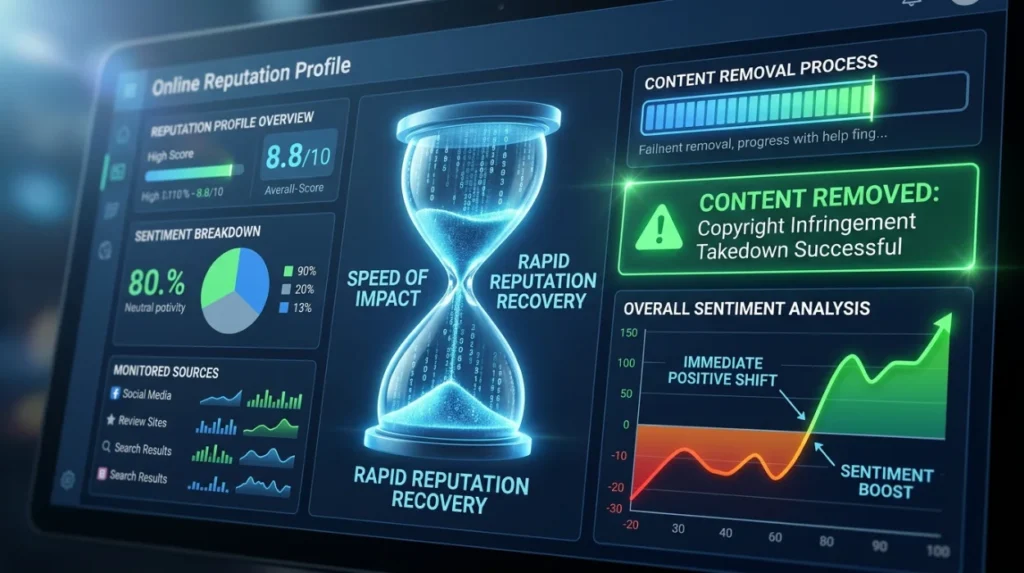
A copyright takedown begins influencing online reputation once the relevant platform processes and acts on a valid complaint, but the speed depends on the platform’s review procedures and the quality of the submitted evidence. Professional preparation improves efficiency by reducing avoidable errors before submission. Clear ownership information and precise identification of the infringing content make the request easier to assess. Once content is removed, its visibility on that platform decreases, although cached, quoted or separately reposted versions can require additional attention. Reputation improvement therefore depends on both successful removal and ongoing visibility monitoring.
Speed also needs to be assessed against sustainability. A rapid removal that fails to identify duplicate copies provides limited long-term control because the same material can reappear elsewhere. Sustainable reputation management tracks the digital footprint after the initial action and identifies recurring exposure patterns. This creates a feedback loop between removal, monitoring and further legitimate intervention. The objective is not simply to achieve a quick takedown but to reduce the probability of repeated reputational exposure.
Can Copyright Removal Strengthen Entity Credibility and Public Trust?
Copyright removal strengthens entity credibility by reducing the presence of unauthorised material that can distort how an individual or organisation is represented online. Search users frequently rely on visible digital information when forming initial impressions about credibility, professionalism and trustworthiness. Reposted content can create confusion when it appears without context, attribution or permission. Removing legitimate instances of infringement helps restore clearer ownership and representation across relevant platforms. This supports a cleaner digital footprint where legitimate information has greater opportunity to represent the entity accurately.
The broader reputation effect comes from consistency across digital touchpoints. Search results, social profiles, websites and third-party references collectively contribute to search perception influence. When unauthorised content occupies fewer visibility points, the overall information environment becomes easier to manage. Clear Your Name positions structured content removal within this wider objective by focusing on evidence, process clarity and reputation outcomes. The approach supports trust restoration without claiming that one removal action independently determines public opinion or search rankings.
What Makes a Reputation Management Service a Safer Choice?
A reputable service reduces risk through transparent procedures, realistic outcomes and evidence-based intervention. Copyright complaints carry legal and platform-specific requirements, making accuracy essential at every stage. A responsible service does not rely on false ownership claims, fabricated evidence or attempts to manipulate platform decisions. Instead, it establishes whether a legitimate copyright basis exists before pursuing removal. This protects the requester from avoidable disputes while maintaining the integrity of the reputation-management process.
Key outcomes of a controlled service include:
- Strengthen evidence quality by organising ownership information and infringement records before submission.
- Reduce procedural risk by directing complaints through appropriate platform mechanisms.
- Improve visibility control by addressing unauthorised content at its hosting source.
- Stabilise reputation signals by reducing recurring exposure to legitimate removal targets.
- Monitor search perception by tracking relevant content and visibility after intervention.
These mechanisms create a clearer relationship between the service and its intended outcomes. The value comes from controlled execution rather than promises of universal removal or guaranteed ranking positions. This distinction is critical when choosing a provider because sustainable reputation management depends on legitimate actions that withstand platform review. A transparent process also gives clients a clearer understanding of what has been addressed and what remains outside the scope of copyright removal.
Dive Deeper With Our Expert Guides:
Get Expert Guidance on Responding to Social Media Backlash
Protect Your Executive Social Media Presence With Our UK Team
Why Is Sustainable SERP Control More Valuable Than One-Time Content Removal?
Sustainable SERP control delivers greater reputation value because online information continues to change after an individual removal action. New reposts, references and indexed pages can introduce fresh visibility points even after the original infringement disappears. Ongoing monitoring identifies these changes before they become established components of the digital footprint. Reputation management therefore becomes an active control process rather than a single transaction. This approach improves resilience against recurring content visibility.
Sustainability also depends on maintaining legitimate positive and neutral reputation signals. Content removal addresses unwanted material, while authoritative websites, accurate profiles and relevant third-party references contribute to the wider information environment. These activities work together to improve search perception without attempting to manipulate search engines. The resulting strategy supports stronger entity credibility because users encounter a more consistent representation across relevant channels. For long-term reputation recovery, this balanced approach provides greater value than repeatedly reacting to isolated incidents.
Should You Choose Professional Copyright Removal for Reposted Content?
Professional copyright removal is the appropriate decision when unauthorised reposted material creates measurable visibility, credibility or reputation concerns and a legitimate copyright basis exists. The strongest service combines accurate evidence, platform-compliant reporting, outcome monitoring and broader reputation analysis. This reduces operational risk while improving control over where and how protected content appears online. It also creates a documented process that supports accountability from identification through resolution. For businesses and individuals making a reputation-management investment, these characteristics provide a stronger basis for decision-making than unsupported promises.
Clear Your Name provides a structured route for clients who need legitimate social media content removal aligned with wider digital reputation objectives. The service approach prioritises process clarity, evidence quality and realistic outcome measurement rather than exaggerated guarantees. Removing valid targets reduces unwanted content visibility, while ongoing reputation work strengthens the wider search environment. The result is greater control over digital representation, improved reputation signals and reduced exposure to recurring unauthorised content.
Choosing professional social media content removal services therefore represents more than submitting a copyright complaint. It creates a controlled reputation-management process designed to reduce risk, improve visibility control and strengthen entity credibility. When evidence, platform compliance and monitoring work together, copyright removal becomes a practical component of long-term search perception influence. That combination gives decision-makers a reliable framework for protecting legitimate digital assets while building a more stable online reputation.
How do I file a copyright takedown for reposted content?
Identify the original copyrighted work, document the unauthorised repost and submit a copyright complaint through the relevant social media platform. Accurate ownership information and specific URLs help the platform assess and process the request.
Can copyright law remove reposted social media content?
Yes, copyright law provides a legitimate removal route when someone uses protected content without the copyright owner’s permission. Social media platforms typically review copyright complaints and remove qualifying infringing content under their applicable procedures.
What information is needed for a copyright takedown request?
A copyright takedown request generally requires identification of the original work, evidence of ownership, the location of the infringing content and contact details required by the platform. Providing complete and accurate information reduces delays during the review process.
Does removing reposted content improve online reputation?
Removing unauthorised reposts reduces the visibility of content that can affect search perception and reputation signals. It supports a cleaner digital footprint, although broader reputation management is required to influence the wider search environment.
Are copyright takedowns part of social media content removal services?
Yes, copyright takedowns are one legitimate method used within social media content removal when reposted material infringes copyright. Professional removal processes can also include evidence review, platform reporting and post-removal monitoring.



