
Exposed personal information increases identity theft risk by giving unauthorised individuals data that can support impersonation, account compromise, fraud, or targeted social engineering.
Reputation management is the process of understanding and controlling how information associated with a person or entity appears across digital environments, including search engines and public websites.
Online reputation refers to the collection of information, references, profiles, reviews, records, and other digital signals associated with an identifiable person or entity. Personal information forms part of this digital footprint when names, addresses, telephone numbers, email addresses, employment details, usernames, or other identifying data become publicly accessible. The exposure of such information creates both privacy and reputation considerations because search engines can index publicly available pages. Understanding how exposed information moves through digital systems explains why privacy protection extends beyond individual websites.
What Personal Information Creates Identity Theft Risk?
Personal information creates identity theft risk when exposed data provides enough context to identify, impersonate, authenticate, or target an individual. Identity information is not limited to financial details because combinations of ordinary personal attributes can establish a detailed profile. Names, addresses, telephone numbers, email addresses, usernames, dates of birth, and employment information can become useful when combined with other publicly accessible data. The risk increases when separate information sources create a more complete identity profile. This process demonstrates why individual pieces of information can become more significant when aggregated.
Data aggregation is the process of combining information from multiple sources to construct a more detailed profile. Search engines facilitate discovery by organising publicly accessible pages around names, entities, locations, organisations, and related queries. A single page containing an address provides one data point, while multiple pages containing matching names, contact details, professional information, and associated profiles create stronger identity associations. These associations contribute to the broader digital footprint. Identity exposure therefore depends on both the sensitivity of individual information and the relationships between separate data sources.
Privacy exposure also creates reputation implications. Information appearing prominently for a person’s name can influence how users perceive that individual before they interact directly with them. Search visibility determines how easily the information can be discovered. Content indexing determines whether search engines store and potentially surface the page. Together, these mechanisms connect personal privacy with online reputation and entity perception.
How Does Exposed Personal Information Become Searchable?
Exposed personal information becomes searchable when publicly accessible content is discovered, crawled, processed, and indexed by a search engine. Content indexing refers to the process through which search engines store information from accessible webpages for potential retrieval in response to queries. A page containing personal details therefore becomes part of a larger searchable information environment once it is indexed. Search engines then evaluate the page in relation to relevant queries. This does not mean every indexed page appears prominently, because ranking depends on additional signals.
Search visibility refers to how prominently and frequently a piece of content appears for relevant searches. Personal information can become more visible when the associated page has strong relevance, authority, accessibility, or links from other websites. A search for a person’s name can therefore reveal information that exists across websites without requiring the user to know the original page location. This increases the practical importance of monitoring indexed information. Visibility rather than mere existence determines how easily exposed data can be discovered.
Search engines also organise information around entities. An entity is a distinguishable person, organisation, place, or concept that search systems associate with related information. When multiple pages consistently reference the same individual, search systems can establish relationships between the information contained on those pages. This contributes to entity perception and search context. Accurate entity associations therefore matter when evaluating the exposure of personal information.
How Does a Digital Footprint Increase Privacy Exposure?
A digital footprint is the collection of information and activity associated with an individual across digital environments. It includes public profiles, professional pages, social accounts, directories, publications, forum references, images, reviews, and other online records. Each source can contribute information that becomes easier to discover when connected to the same identity. The cumulative nature of a digital footprint makes isolated privacy assessments incomplete. Effective analysis therefore examines relationships between information sources rather than treating each page independently.
Public data becomes more significant when it contains consistent identifiers. A name combined with an employer, location, professional role, telephone number, or social profile creates stronger identity connections than a name alone. Search engines can associate these references through textual relevance and other signals. This increases the contextual depth available to someone researching the individual. The digital footprint consequently becomes a source of both reputation signals and privacy exposure.
The persistence of digital information also affects risk. A webpage can remain accessible long after its original publication purpose has disappeared. Search engines can continue discovering and indexing content while third-party websites reproduce or reference information elsewhere. Removing information from one source therefore does not necessarily eliminate every associated reference. Understanding this persistence is essential when evaluating personal information exposure.
How Do Search Engines Interpret Personal Information and Trust Signals?
Search engines interpret personal information through relevance, authority, content quality, context, and relationships between information sources. Trust signals are indicators that help establish the reliability, authority, or credibility of information within a search ecosystem. These signals are not equivalent to a verification of every factual claim contained on a page. Instead, search systems use multiple signals to determine how content relates to queries. The resulting ranking influences which information users encounter first.
Authority is particularly relevant when exposed personal information appears on established websites or platforms. A page hosted on an authoritative domain can receive stronger search visibility than an isolated low-authority page. This does not automatically make the personal information accurate or appropriate for publication. It demonstrates the difference between search ranking influence and factual legitimacy. Search systems and users therefore evaluate information through different but overlapping mechanisms.
Entity credibility also depends on consistency. If multiple reputable sources contain matching information about a person, search systems can establish stronger associations between those references. Contradictory information creates a different signal environment that requires additional evaluation. Reputation management analysis therefore examines not only whether personal information exists but also how it is represented across the digital footprint. This provides a more complete view of search perception.
Can Personal Information Affect Search Results About an Individual?
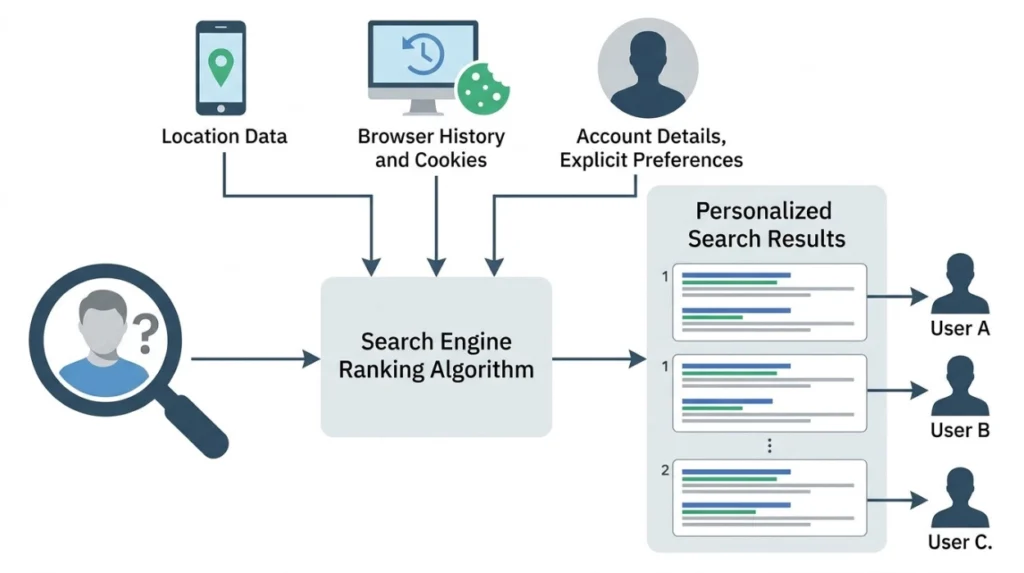
Personal information can affect search results when it becomes relevant to queries associated with an individual’s identity. Search results are constructed around query relevance, content authority, indexing status, and other ranking signals. A public address, contact number, professional record, or directory entry can therefore become visible when users search for the associated name. The practical impact depends on the prominence and context of the information. Highly visible information has greater potential to influence both privacy exposure and public perception.
SERP evaluation provides a method for assessing this exposure. SERP refers to the search engine results page displayed after a user submits a query. Evaluating the SERP involves examining which pages appear, what information they contain, how prominent they are, and what types of reputation signals they communicate. Personal information appearing within prominent results creates a different exposure level from information buried several pages deeper. Monitoring therefore requires attention to both indexing and ranking.
Search results also shape perception through information order. Users often encounter highly visible results before exploring less prominent sources. This creates an association between search visibility and initial entity perception. Accurate professional information can provide useful context, while unnecessary personal information can create privacy exposure. The composition of search results therefore matters alongside the existence of individual webpages.
How Does Data Aggregation Increase Identity Theft Risk?
Data aggregation increases identity theft risk by allowing separate pieces of information to create a more complete profile. A single public detail often provides limited context, but combinations of identifying information can increase the usefulness of the overall dataset. Public directories, social profiles, professional pages, archived documents, and other sources can each contribute separate attributes. Search engines make these sources easier to discover by connecting them to relevant queries. The combined digital footprint can therefore provide information that no individual page contains on its own.
Identity theft risk is influenced by information relationships rather than only information volume. A name connected to an address establishes one relationship, while that same name connected to an address, employer, telephone number, social profile, and other identifiers creates a deeper identity structure. This structure can support impersonation attempts and targeted social engineering. The analysis therefore focuses on how exposed information can be combined. Reducing unnecessary exposure limits the number of available data relationships.
Data aggregation also affects reputation signals. When information from multiple sources is repeatedly associated with the same person, search systems can create stronger entity connections. This makes inaccurate or outdated information more persistent within search ecosystems. Privacy and reputation management therefore overlap when public data becomes both discoverable and strongly associated with an entity. Monitoring these relationships provides a clearer picture of digital exposure.
Which Types of Online Information Require the Most Privacy Attention?
Information requiring heightened privacy attention includes data that directly identifies an individual or creates strong connections between separate identity attributes. The importance of a data point depends on its sensitivity, accessibility, accuracy, persistence, and relationship with other information. A public telephone number, residential address, personal email address, or identifying document reference can carry different levels of exposure depending on context. Professional information also requires assessment when it connects directly to personal identifiers. The objective is to understand the overall risk created by the information environment.
A structured assessment can prioritise information according to its function:
- Identify direct identifiers such as full names, personal telephone numbers, residential addresses, and personal email addresses.
- Assess authentication-related information such as dates of birth, usernames, account identifiers, or security-related details.
- Map associated information such as employment records, professional profiles, social accounts, and public directories.
- Evaluate search visibility by examining which pages appear for name-based and identity-related queries.
- Monitor duplication by checking whether exposed information has been reproduced across additional websites or platforms.
This framework separates simple online presence from meaningful privacy exposure. It also identifies which information contributes most strongly to an individual’s searchable identity. The result is a more precise understanding of digital footprint risk. Privacy assessment therefore benefits from analysing both individual data points and their relationships.
Does Removing Exposed Information Affect Online Reputation?
Removing unnecessary exposed information can affect online reputation by changing the information available for users and search engines to discover. A reduction in publicly accessible personal data can limit unwanted associations within the digital footprint. It can also alter the composition of information presented for relevant searches when indexed pages disappear or become inaccessible. However, removing one source does not automatically remove every reference to the same information. Search visibility therefore requires evaluation after any privacy-related change.
Content removal operates differently from content enhancement. Removal reduces the availability of a specific information asset, while enhancement introduces or strengthens legitimate information that provides better context around an entity. In privacy situations, removal focuses on unnecessary personal exposure rather than suppressing legitimate public information. The distinction protects informational accuracy while reducing unnecessary data visibility. This creates a more balanced approach to digital footprint management.
Search engines also require time to reflect changes in accessible content. A page that becomes unavailable does not instantly disappear from every search system. Cached information, duplicate pages, references, or separate indexed copies can continue to exist. Monitoring search visibility after a removal action therefore provides evidence of whether exposure has actually declined. This demonstrates why privacy management extends beyond the initial removal request.
Dive Deeper With Our Expert Guides:
Why Your Old Addresses Still Appear in Online People-Search Results
How Land Registry Records Can Reveal Your Home Address Online
How Does Personal Information Exposure Affect Entity Perception?
Personal information exposure affects entity perception by changing the information users encounter when researching an individual online. Entity perception refers to the understanding users and search systems develop from the available information associated with a person or organisation. Unnecessary personal details can dominate searches that users expected to contain professional or relevant information. This changes the context surrounding the entity. Search visibility therefore influences both privacy and reputation.
Accurate information contributes to stronger credibility when it provides relevant and consistent context. Professional profiles, authoritative publications, verified organisational pages, and reliable references can establish useful reputation signals. In contrast, outdated directories, incorrect personal information, or irrelevant records can create ambiguity. Search perception depends on the complete information environment rather than one isolated webpage. Maintaining accurate context therefore supports stronger entity credibility.
Privacy exposure also creates an information imbalance when personal details become more prominent than relevant professional information. This imbalance can affect what users notice first. SERP evaluation helps identify whether personal information occupies disproportionate visibility within identity-related searches. The analysis then distinguishes between information that is useful, necessary, outdated, inaccurate, or unnecessarily exposed. This creates a more precise basis for understanding online reputation.
What Steps Reduce Identity Theft Risk After a Personal Data Leak?
Reducing identity theft risk after a personal data leak requires identifying exposed information, monitoring its distribution, strengthening account security, and assessing ongoing search visibility. Privacy protection begins with understanding exactly what information has become accessible. The next stage involves determining whether the information appears on additional websites or has been indexed by search engines. Monitoring identifies continued exposure and new copies. These actions complement technical security measures by addressing the public information environment.
For readers evaluating the next stage of privacy protection, steps to reduce identity theft risk after a personal data leak provide a useful framework for connecting data exposure analysis with ongoing risk management.
Digital footprint monitoring remains important after the initial leak has been addressed. Information can migrate through reposts, directories, archives, social profiles, and other websites. Search engines can also continue displaying references until their indexes reflect changes in source availability. Continuous monitoring therefore identifies whether exposure is declining or persisting. This creates a measurable approach to privacy risk management.
Privacy risk also needs to be separated from reputation risk. A data leak can expose personal information without creating negative sentiment, while inaccurate or unwanted information can affect reputation without creating direct identity theft risk. The two risks overlap when exposed data becomes highly visible and strongly associated with the individual. Analysing both dimensions produces a more complete understanding of the digital footprint. This distinction prevents reputation signals from being treated as a substitute for privacy protection.
How Can People Evaluate Their Exposure Across Search Ecosystems?
People can evaluate exposure by analysing name-based searches, public directories, social profiles, professional pages, archived information, and other indexed references. Search visibility provides an initial indication of how easily personal information can be discovered. Content indexing provides insight into whether webpages have entered search databases. Entity relationships reveal how separate pieces of information connect around the same identity. Together, these factors establish a practical digital exposure assessment.
The evaluation also needs to consider accuracy and persistence. An outdated address that appears on one low-visibility page represents a different risk from the same address appearing across multiple highly visible websites. Repeated information creates stronger associations and increases discoverability. Duplicate content also increases the possibility that information remains accessible after one source is changed. Measuring these factors helps establish priorities for privacy management.
Search ecosystem analysis should remain evidence-based. Search engines determine rankings independently, and public websites control the information they publish. A person therefore cannot assume that one action will immediately change every result. Monitoring provides the evidence needed to understand how exposure changes over time. This makes digital footprint evaluation a continuous analytical process rather than a one-time search.
Why Does Exposed Personal Information Create Long-Term Digital Risk?
Exposed personal information creates long-term digital risk because individual data points can become connected across websites, directories, social platforms, and search engines. Data aggregation strengthens these relationships, while content indexing makes publicly accessible information easier to discover. Search visibility then determines how prominently the information appears for identity-related queries. These mechanisms connect privacy exposure with reputation signals and entity perception.
Identity theft risk is therefore influenced by both the sensitivity of information and the structure of the surrounding digital footprint. Names, addresses, contact details, professional information, usernames, and other identifiers become more significant when they appear together across multiple sources. Search engines can reinforce these associations through indexing and ranking systems. Evaluating the complete information environment provides a clearer picture than examining individual webpages.
Understanding this relationship also clarifies the role of reputation management. Reputation is not simply positive or negative sentiment; it is the broader information environment through which users and search systems understand an entity. Privacy exposure forms one component of that environment. Monitoring search visibility, content indexing, entity associations, and information accuracy therefore provides a structured way to understand digital risk without confusing privacy protection with manipulation of search results.
How does exposed personal information increase the risk of identity theft?
Exposed personal information such as names, addresses, phone numbers, email addresses, and dates of birth can help criminals build detailed identity profiles. When information from multiple sources is combined, it can increase the risk of impersonation, fraud, and targeted social engineering.
What personal information puts you at risk of identity theft?
Sensitive identifiers such as full names, residential addresses, personal email addresses, phone numbers, dates of birth, usernames, and account details can increase identity theft risk. The risk becomes greater when these details are publicly accessible across multiple websites.
Can personal information found on Google increase identity theft risk?
Public information appearing in Google search results can increase exposure by making personal details easier to discover. Search visibility becomes more significant when multiple pages connect the same identifying information to an individual.
How can you remove exposed personal information from the internet?
Start by identifying websites displaying unnecessary personal information and request removal through the relevant website or platform. Ongoing search monitoring also helps identify duplicate pages, reposted information, and new sources that continue exposing the data.
What should you do after a personal data leak?
After a personal data leak, identify exactly what information was exposed, secure affected accounts, monitor for suspicious activity, and check search results for public copies of the data. Tracking the digital footprint helps identify continued exposure and supports longer-term identity theft risk reduction.