
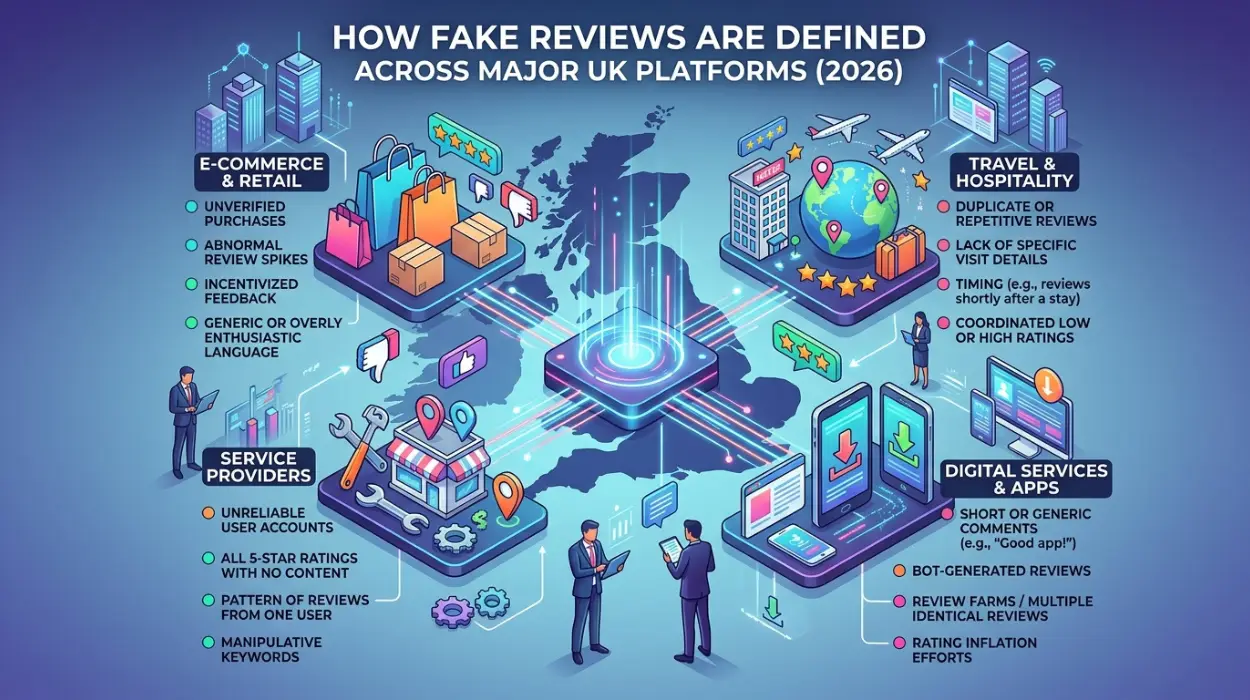
Fake reviews UK are defined as reviews that misrepresent genuine customer experiences through fabricated, manipulated, incentivised, or misleading content. Across major UK platforms in 2026, review integrity depends on automated detection systems, moderation policies, and trust evaluation frameworks that identify inauthentic reputation signals.
Reputation management is the process of understanding how information influences public perception across search ecosystems. Online reputation refers to the collection of indexed content, reputation signals, and search results that shape entity perception within search engine results pages (SERPs). Fake reviews contribute directly to digital footprints because search engines and review platforms evaluate review authenticity when assessing trust, credibility, and search visibility. Algorithms increasingly interpret review quality alongside content indexing, authority signals, and sentiment distribution to determine how businesses and individuals are represented online.
What Are Fake Reviews Across Major UK Platforms?
Fake reviews are reviews that do not accurately represent authentic customer experiences. Within search ecosystems, fake reviews refer to manipulated reputation signals that distort public perception by presenting false or misleading evaluations of products, services, or organisations.
Major UK review platforms define fake reviews according to authenticity rather than opinion. Reviews generated without genuine customer interaction, exchanged for incentives without disclosure, copied from other sources, or produced through coordinated manipulation are generally classified as inauthentic. This distinction allows review systems to evaluate credibility independently of whether the sentiment is positive or negative.
Fake reviews influence search visibility because review platforms integrate trust indicators into their ranking algorithms. As authenticity decreases, reputation signals become less reliable, affecting entity perception across search results.
How Do Review Platforms Detect Fake Reviews?
Review platforms detect fake reviews by analysing behavioural signals, content characteristics, account history, and interaction patterns.
Algorithms evaluate review authenticity using multiple verification layers rather than relying solely on review text. Machine learning systems compare language patterns, submission timing, reviewer behaviour, geographic consistency, device information, and account activity to identify manipulation. These mechanisms allow automated moderation systems to distinguish authentic customer experiences from coordinated review campaigns.
Detection systems also assess relationships between reviewers and reviewed entities. Repeated behavioural similarities strengthen evidence of inauthentic activity and influence platform moderation decisions. These evaluations improve trust signals while maintaining higher-quality review ecosystems.
Why Do Fake Reviews Influence Online Reputation?
Fake reviews influence online reputation because review content contributes directly to entity perception and search credibility.
Reputation signals include review volume, review authenticity, reviewer authority, sentiment distribution, and content freshness. Search engines and review platforms evaluate these indicators collectively when interpreting trustworthiness. Genuine reviews reinforce entity credibility, whereas manipulated reviews distort search perception by introducing inaccurate reputation data.
Digital footprints expand whenever reviews become publicly accessible and searchable. As fake reviews accumulate, they alter the information available for SERP evaluation, influencing both user interpretation and algorithmic assessment.
How Do Search Engines Interpret Review Signals?

Search engines interpret review signals as indicators of credibility, authority, and user satisfaction.
Review signals refer to measurable attributes associated with review content, including authenticity, consistency, sentiment, recency, and reviewer trust. These indicators complement traditional ranking factors such as backlinks, structured data, and content quality. Together they contribute to broader entity evaluation within search ecosystems.
Algorithms do not evaluate review quantity alone. They assess whether review patterns align with expected user behaviour and whether review content demonstrates authentic engagement. Consistent authenticity strengthens search visibility because trustworthy signals improve confidence in indexed information.
What Role Does Sentiment Distribution Play in Reputation?
Sentiment distribution refers to the balance of positive, neutral, and negative reviews associated with an entity.
Search ecosystems evaluate sentiment as one component of overall reputation rather than an isolated ranking factor. Natural review profiles contain a balanced distribution of experiences, whereas manipulated profiles often display abnormal patterns that automated systems identify during moderation.
Balanced sentiment contributes to stronger trust signals because it reflects authentic customer interaction. Artificially concentrated positive or negative reviews reduce credibility and influence how algorithms interpret reputation quality.
How Does Content Indexing Affect Fake Review Visibility?
Content indexing determines how review content becomes searchable across review platforms and search engines.
Once reviews are published on publicly accessible platforms, indexing systems discover, categorise, and associate them with relevant entities. Indexed reviews contribute to search visibility by forming part of an entity’s digital footprint and supporting contextual relationships within search results.
Platform moderation can remove reviews before or after indexing depending on detection outcomes. When reviews are removed, search engines gradually update indexed information during future crawling cycles, altering reputation signals over time.
How Do Trust Signals Support Review Credibility?
Trust signals are measurable indicators that demonstrate the authenticity and reliability of review content.
These signals include verified purchases, reviewer history, account consistency, engagement quality, publication transparency, and moderation outcomes. Review platforms analyse these characteristics to distinguish authentic customer feedback from manipulated reputation activity.
Trust signals improve entity credibility because they provide evidence supporting the legitimacy of publicly available reviews. Strong verification frameworks reduce misinformation while strengthening confidence in indexed review content.
Why Are Fake Reviews Important Within Reputation Management?
Fake reviews influence reputation management because they modify digital footprints, search perception, and public credibility across interconnected search ecosystems.
Reputation management analyses how indexed information contributes to search visibility through reputation signals rather than isolated content items. Review authenticity forms part of this evaluation because algorithms interpret review behaviour alongside authority, trust, and content relevance.
Understanding What a Fake Reviews Removal Service Does Across Multiple Platforms at Once provides additional insight into how coordinated review management influences search visibility, reputation signals, and digital trust across multiple review ecosystems.
Fake reviews are defined through authenticity rather than opinion, making behavioural analysis, trust signals, and platform moderation central to their identification. Review platforms and search engines continuously evaluate review credibility using algorithms that interpret content quality, reviewer behaviour, and sentiment distribution.
As fake reviews become part of searchable digital footprints, they influence entity perception, search visibility, and online credibility. Understanding review authenticity, indexing behaviour, trust signals, and platform evaluation systems provides a stronger conceptual foundation for analysing reputation management within modern search ecosystems.
What is considered a fake review on major UK platforms?
A fake review is feedback that does not reflect a genuine customer experience and is created to manipulate reputation or consumer perception. Major UK platforms evaluate review authenticity using behavioural signals, moderation systems, and verification processes.
How do UK review platforms detect fake reviews?
Review platforms analyse reviewer behaviour, account history, content patterns, submission timing, and verification signals to identify suspicious activity. These automated systems help maintain reliable reputation signals and improve search credibility.
Do fake reviews affect search visibility?
Yes. Fake reviews influence search visibility by affecting reputation signals, entity credibility, and trust indicators that search engines and review platforms evaluate. Authentic review profiles contribute to stronger search perception over time.
Can fake reviews be removed from multiple platforms?
Yes. Fake reviews that breach platform policies can be reported for assessment and removal through the relevant moderation procedures. Clear Your Name explains how Fake Reviews Removal Services address review issues across multiple online platforms.
Why are fake reviews important for online reputation management?
Fake reviews become part of an entity’s digital footprint and influence how users and search engines interpret credibility. Clear Your Name highlights how Fake Reviews Removal Services support more accurate reputation signals by addressing inauthentic review content.