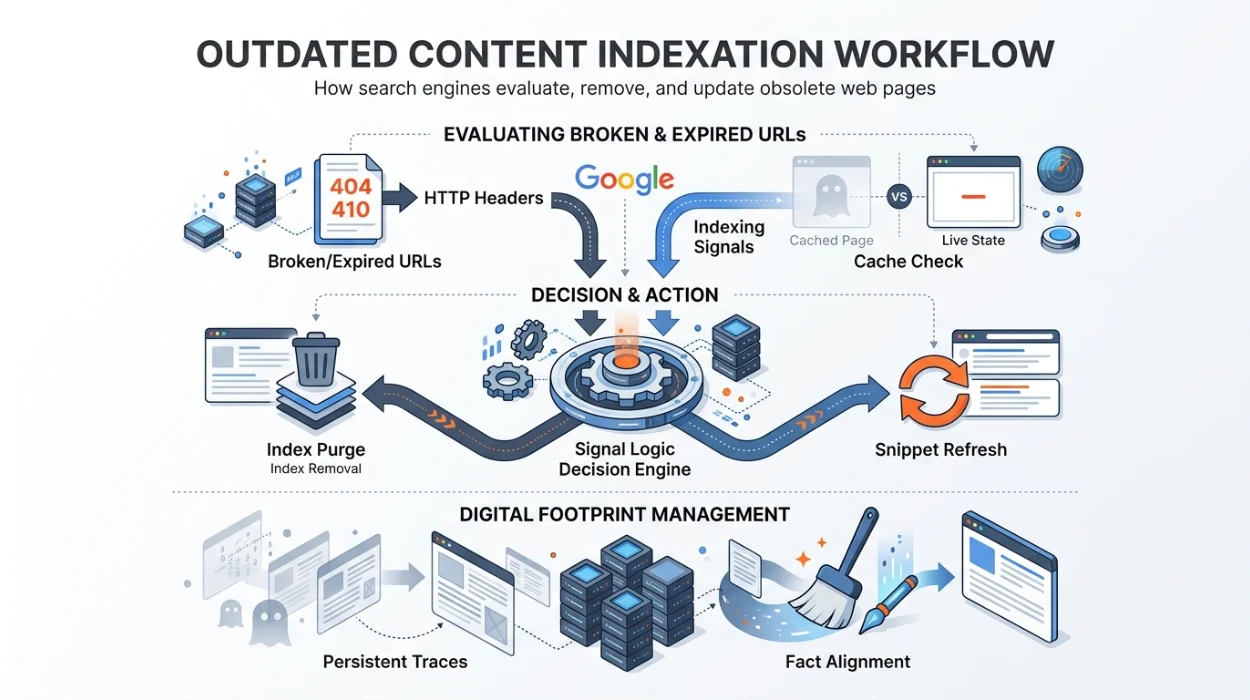
Google’s Outdated Content Tool processes expired and broken URLs by evaluating HTTP response headers, cached page states, and indexing signals to determine whether web resources require index removal or snippet updates. Online reputation control methods are evaluated through their ability to eliminate persistent digital traces, align search perception with current factual realities, and manage outdated indexation footprints across search engine result pages.
How Does Google’s Outdated Content Tool Identify Expired and Broken Web Resources?
Google’s Outdated Content Tool identifies expired and broken web resources through algorithmic verification of server status codes and snippet text variance. When a user submits an indexation removal request, the automated pipeline initiates a fresh crawl request to the specified URL to evaluate the HTTP response header. If the server returns a 404 (Not Found) or 410 (Gone) status code, the search engine verifies that the page no longer exists on the host domain. The system then schedules the URL for removal from the primary index, which strips the page record, cached snapshot, and associated ranking signals from search results. When the server returns a 200 (OK) status code but the page content no longer contains specific text, the tool operates under snippet update mode. In this scenario, the user provides a string of text present in the cached search snippet that no longer appears on the live web page. The processing system compares the live HTML document against the cached index record, verifies the absence of the specified terms, and purges the outdated snippet and cached copy while maintaining the indexed URL entry.
How Do Automated Content Removal Tools Compare to Manual Removal Request Submissions?
Automated content removal tools compare to manual removal request submissions across speed, scalability, and error-handling precision. Automated removal frameworks utilise direct Application Programming Interface (API) integrations or programmatic request pipelines to process large volumes of dead URLs, outdated snippets, and HTTP status verification checks simultaneously. This programmatic processing reduces turnaround times for enterprise-level web properties containing thousands of expired pages, obsolete directory listings, or legacy URL structures. Manual submissions require human operators to manually submit individual URLs, identify specific obsolete text strings, and monitor processing statuses through Search Console or public tool interfaces. Manual submission protocols provide superior contextual evaluation for complex removal cases where URL parameters, soft 404 errors, or dynamic content rendering cause automated processing workflows to fail. Programmatic methods optimize scale and speed for straightforward HTTP status code removals, whereas manual methods offer precise diagnostic oversight for edge cases involving partial content updates, canonical redirects, and soft server responses.

What Are the Technical Differences Between Content Removal and Content Suppression Strategies?
Content removal operates by permanently eliminating obsolete or defamatory web pages from search engine indexes through technical removal protocols or source-level deletion. This method relies on triggering explicit HTTP 404/410 status codes, executing robots.txt disallow directives, or securing legal takedowns that force domain owners to remove content. Once processed by search crawlers, the targeted page completely disappears from search engine result pages, eliminating its visibility footprint and search ranking influence. Content suppression operates by creating, optimizing, and promoting positive or neutral digital assets to push negative or outdated search results off the primary viewable pages. Suppression strategy utilizes search engine optimization mechanisms—such as authority building, entity alignment, and topical coverage—to elevate controlled web properties above target URLs without altering the underlying indexed content. Removal provides an absolute reduction in exposure by deleting the root source, whereas suppression manages sentiment distribution by altering the ranking order within search engine results pages.
How Do Server Response Codes Impact Search Perception and Entity Credibility Signals?
Server response codes impact search perception and entity credibility signals by directly controlling how search engine crawlers index, render, and display historical URL records. Standard 200 (OK) status codes communicate active content availability, instructing crawlers to maintain indexation, update cached text snapshots, and apply accumulated backlink equity to the target domain. If a 200 code persists on a page displaying empty templates, generic error text, or obsolete information, search engines interpret the page as a soft 404, which creates indexing ambiguity and preserves outdated snippets on search results pages. Explicit 404 (Not Found) and 410 (Gone) status codes inform crawlers that the resource is permanently unavailable, forcing search algorithms to drop the URL from search indices and remove cached previews during subsequent re-crawl cycles. Unprocessed server errors or lingering redirects allow outdated personal data, obsolete corporate disclosures, or misleading brand associations to remain accessible via search engine indices, damaging search perception and diluting entity credibility across digital trust ecosystems.
How Do You Evaluate the Sustainability and Scalability of Digital Footprint Cleanup Methods?
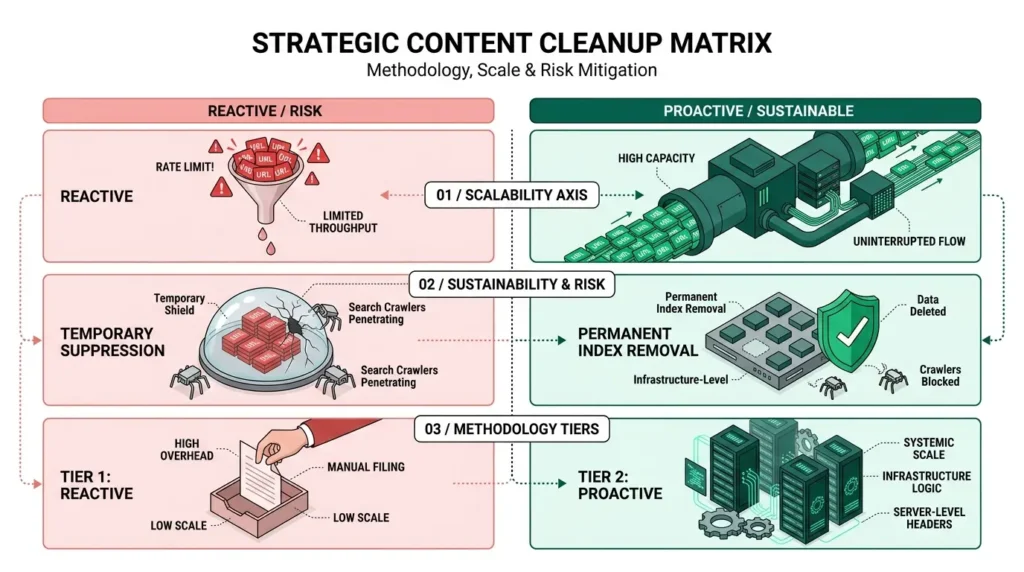
Digital footprint cleanup methods are evaluated through their operational scalability, technical sustainability, and long-term risk exposure across evolving search engine architectures. Scalability evaluates the capacity of a removal framework to audit, process, and clear hundreds or thousands of obsolete URL endpoints without triggering rate limits or algorithmic search penalties. Sustainability measures whether a technical intervention permanently eliminates search visibility or merely creates temporary suppression that can be reversed by search engine re-crawling, domain re-registration, or core algorithm updates. Reactive methodologies—such as filing individual submission forms—offer low scalability and high operational overhead, making them suitable only for isolated reputation incidents or small web footprints. Proactive technical methodologies—such as automated log analysis, server-level header configuration, and enterprise dead links removal services—provide systemic scalability and permanent index removal by resolving content expiration directly at the infrastructure level. Evaluating these options requires balancing immediate administrative overhead against the long-term cost of maintaining suppressed search results across dynamic search engine landscapes.
How Do Search Engine Algorithms Interpret Outdated Snippets Versus Deleted Pages?
Search engine algorithms interpret outdated snippets as cached textual representations of live pages, whereas deleted pages represent fully decommissioned resources requiring complete index purge. When a web page remains live but undergoes text modifications, search crawlers retain the old document snapshot in secondary index storage until the next scheduled re-crawl event occurs. During this interim period, the search engine displays outdated snippet text in response to relevant user queries, creating a mismatch between search result previews and actual target page content. The Outdated Content Tool overrides standard re-crawl frequencies by validating text discrepancies between live HTML documents and cached index files, forcing an immediate snippet refresh without dropping the core page ranking. When a page returns 404 or 410 status codes, the algorithm interprets the entity state change as absolute resource termination, initiating a systematic purge of index pointers, cached snapshots, and ranking equity calculations.
What Strategic Frameworks Determine the Best Approach for Reputation Signal Restoration?
Strategic frameworks for reputation signal restoration determine the optimal operational pathway by categorizing reputation threats based on domain control, legal validity, and technical index status. The evaluation process requires assessing the targeted digital asset through three sequential diagnostic criteria:
- Audit server response headers to confirm whether the target URL returns active status codes, broken resource errors, or soft 404 responses.
- Determine domain ownership control to evaluate whether direct server modifications, robots.txt directives, or canonical tags can be executed internally.
- Assess legal, privacy, or policy grounds (such as GDPR right-to-be-forgotten provisions or copyright violations) when third-party webmasters refuse direct content removal requests.
When webmasters decommission content without updating server header responses, submitting requests via search engine update tools provides rapid snippet clearing and URL de-indexation. When third-party websites retain damaging content and refuse removal requests, technical removal protocols become ineffective, requiring organizations to pivot to suppression methodologies. Suppression frameworks rely on multi-channel content generation, entity authority building, and algorithmic displacement to ensure authoritative, controlled brand signals occupy top search results page real estate.Technical reputation management relies on understanding the functional distinctions between indexation removal, cached snippet clearing, and algorithmic content suppression. Google’s Outdated Content Tool serves as a specialized mechanism for accelerating index updates when underlying web pages display 404/410 status codes or show significant text variance from cached snapshots. While direct URL removal eliminates obsolete search signals at the source, organic suppression frameworks provide alternative mitigation when third-party webmasters maintain active page hostings. Selecting an optimal reputation control strategy requires rigorous analysis of domain authority, technical server responses, regulatory frameworks, and long-term maintenance requirements to ensure sustained entity credibility across search ecosystems.
How long does Google’s Outdated Content Tool take to process a removal request?
Google’s Outdated Content Tool typically processes URL index updates and snippet removals within a few hours to several days, depending on crawl frequency and server responsiveness. The automated system verifies whether the target web page returns an explicit HTTP 404/410 status code or displays text discrepancies against the cached index record. For complex web footprints, professional removal workflows through Clear Your Name help ensure HTTP headers and server status codes trigger rapid de-indexation across search engines.
What is the difference between removing a URL and updating a cached snippet?
URL removal completely deletes a web page, its cached snapshot, and its ranking signals from search engine results when the server returns a 404 or 410 error status code. In contrast, updating a cached snippet removes obsolete text or personal details while keeping the live web page indexed if the main URL remains active with an HTTP 200 code. Understanding these technical distinctions allows site owners and reputation managers to apply the correct de-indexation or snippet-clearing protocols.
Why does an outdated or deleted search result still show on Google?
An outdated search result remains visible on Google when search engine crawlers have not yet re-visited the target server to index the updated HTML or process the missing page status code. Additionally, if a decommissioned web page fails to return an explicit 404 or 410 server response, algorithms treat the page as active and retain its cached snapshot in search results. Utilizing technical link cleanup strategies ensures server status headers properly communicate resource termination to accelerate index removal.