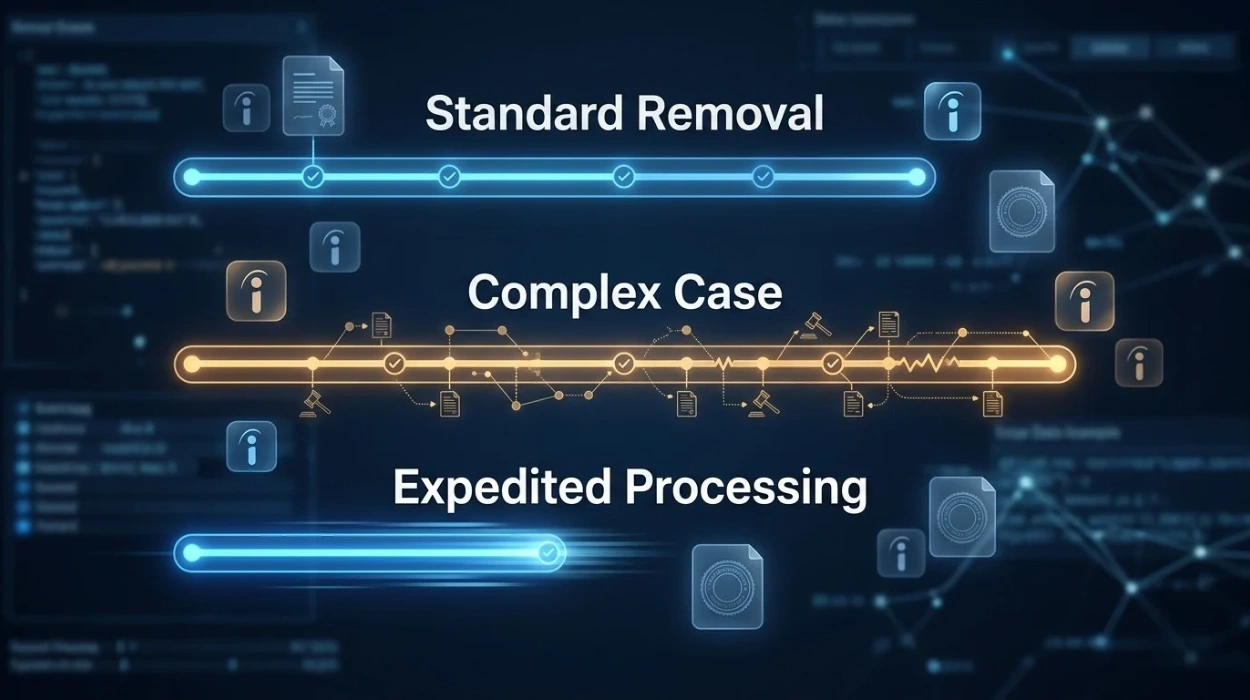
Indeed removal timelines differ according to the type of content reported, the evidence available and the complexity of the policy issue. Straightforward guideline violations are evaluated differently from disputed employment claims, identity concerns or reviews requiring additional verification.
Reputation management strategies differ based on the source, nature and persistence of damaging content. Online reputation control methods are evaluated through removal feasibility, search visibility, reputation signals, entity credibility and the sustainability of the resulting SERP composition.
How Do Indeed Removal Timelines Differ by Case Type?
Indeed removal timelines vary because each case presents a different moderation question and evidence requirement. A review containing identifiable policy violations has a different assessment pathway from content that simply expresses a negative opinion about an employer. Removal is a reactive reputation management method that operates by challenging the original content at its source rather than changing its position through search optimisation. The effectiveness of this approach therefore depends on whether a legitimate removal mechanism exists. Where the platform accepts the reported violation, removing the source can eliminate its direct contribution to the employer’s online reputation.
Straightforward cases generally involve a clearly identifiable issue that can be matched against a platform rule. Examples include content containing prohibited material, personal information or other elements covered by specific moderation requirements. The evaluation process focuses on whether the reported material satisfies the relevant removal criteria rather than whether the employer considers the review unfair. This distinction limits unnecessary removal requests and creates a clearer evidence-to-policy relationship. The resulting impact on search visibility is also direct because the original content no longer contributes its previous reputation signals.
Complex cases operate differently because the disputed issue is not always visible from the review alone. A complaint involving employment circumstances, alleged misconduct or disagreement over workplace events can require a stronger factual assessment. The limitation is that negative sentiment does not itself establish a policy violation, so removal feasibility depends on the specific circumstances and applicable rules. This makes timeline comparisons dependent on case classification rather than on a fixed number of processing days.
Which Indeed Cases Tend to Require More Detailed Evaluation?
Cases involving disputed factual claims require more detailed evaluation because the distinction between criticism and prohibited content can be difficult to establish from the wording alone. A negative review is not automatically removable simply because an employer disputes its accuracy. The assessment instead examines the content against the applicable moderation framework and the evidence supporting the report. Evidence operates by establishing a factual connection between the reported content and the policy issue being raised. This creates a more structured basis for evaluating removal than relying on sentiment alone.
Identity-related cases represent another category where verification can affect the assessment process. A review connected to a person who cannot be associated with the relevant employment relationship presents a different evidential question from a review written by a verified employee. The central issue becomes whether available information establishes the claimed connection or identifies a legitimate reason for reporting the content. This distinction affects both risk exposure and removal feasibility. An unsupported assertion about reviewer identity provides less analytical value than documented evidence demonstrating a specific inconsistency.
Policy-sensitive cases also require classification before an appropriate response is selected. Content can contain multiple elements, with one section potentially falling within a policy restriction while another section represents ordinary workplace criticism. Evaluating the complete content prevents the removal strategy from treating every negative statement as equivalent. It also separates legitimate criticism from content that potentially breaches platform rules. This classification improves consistency when comparing expected timelines across different case types.
How Does Removal Compare With Content Creation for Reputation Control?
Removal targets the original reputation signal, while content creation changes the surrounding information environment. Removal operates by seeking the deletion or restriction of source material, whereas content creation operates by increasing the availability and relevance of alternative authoritative information. These mechanisms produce different effects on SERP composition because one reduces an existing result and the other strengthens competing results. The distinction becomes important when damaging content cannot be removed through a valid platform mechanism. In that situation, content enhancement can address search perception without requiring the original page to disappear.
Content creation is an organic reputation management approach because it develops authoritative assets before or alongside reputation problems. Examples include professional biographies, organisational pages, expert publications and accurately maintained profiles. These assets create additional reputation signals that search systems can evaluate when determining which information is relevant to an entity. The limitation is that creating content does not guarantee displacement of a specific negative result. Search ranking influence depends on relevance, authority, technical quality, competition and the relationship between the content and the searched entity.
Removal has a stronger direct effect when the reported material qualifies for deletion. Its main advantage is source-level intervention because the damaging asset itself is addressed rather than surrounded by additional content. Its limitation is dependency on platform rules and evidence because a removal request cannot legitimately convert ordinary criticism into prohibited content. This makes removal highly case-dependent, while content enhancement provides a broader long-term mechanism for improving the information environment.
How Do Organic and Reactive Reputation Strategies Compare?
Organic reputation strategies build reputation signals continuously, while reactive strategies respond to specific reputation threats after they appear. Organic activity operates through the development and maintenance of credible information associated with an entity over time. Reactive activity operates by identifying an existing problem and selecting an intervention based on its source and characteristics. The two approaches therefore differ in timing, scalability and risk exposure. A balanced evaluation considers whether the objective involves preventing reputation gaps, addressing an active issue or improving both conditions.
Organic strategies provide greater continuity because authoritative content can remain useful after an individual reputation incident has been resolved. Their sustainability comes from maintaining a coherent digital footprint rather than relying on repeated interventions. The limitation is that organic development does not directly remove inaccurate or policy-violating content. Its effect on sentiment distribution is indirect because positive or neutral information increases the relative presence of alternative signals rather than deleting negative ones.
Reactive strategies provide a more immediate mechanism for addressing specific content. Removal requests, correction processes and platform reporting represent reactive interventions because each responds to an identified problem. Their scalability depends on the number of sources, platforms and separate issues requiring assessment. Reactive work also carries higher procedural risk when evidence is weak because repeated unsupported reporting can fail to establish a legitimate removal basis. The most appropriate evaluation therefore depends on whether the reputation problem is isolated or part of a wider digital footprint issue.
How Does Short-Term Removal Differ From Long-Term Reputation Management?
Short-term removal focuses on resolving an identifiable source problem, while long-term reputation management focuses on maintaining a stable and credible search environment. Removing one damaging review can change the available reputation signals associated with an entity, but it does not automatically establish stronger positive or neutral signals elsewhere. Long-term management operates by maintaining accurate information across relevant digital properties and monitoring changes in search perception. This creates a distinction between immediate intervention and sustained reputation resilience. The two approaches address different stages of the reputation lifecycle.
Short-term interventions are easier to measure when the objective is source removal. Metrics can include whether the reported content remains accessible, whether the relevant review is still indexed and whether its visibility changes after platform action. These measurements establish whether the intervention achieved its immediate objective. They do not, however, measure broader entity credibility or overall sentiment distribution. A reputation system therefore requires wider evaluation when the problem extends beyond one piece of content.
Long-term strategies measure broader changes in SERP composition and reputation signals. Relevant indicators include the proportion of authoritative results, the consistency of entity information and the visibility of trusted sources for important branded searches. Content enhancement operates by increasing the quantity and quality of relevant information surrounding an entity, while monitoring identifies emerging negative signals before they become dominant. This approach has stronger sustainability characteristics but requires continuous management rather than a single intervention.
How Should Employers Evaluate the Effectiveness of Different Indeed Removal Approaches?

Employers can evaluate Indeed removal approaches by comparing evidence quality, policy relevance, timeline sensitivity and the expected effect on search perception. A useful evaluation separates whether content qualifies for removal from whether removal is strategically important for the broader digital footprint. This distinction prevents employers from treating every negative review as an identical reputation problem. It also clarifies whether content removal, content enhancement or monitoring represents the relevant mechanism. Effectiveness is therefore measured against the actual reputation objective rather than against removal alone.
- Classify the content by identifying whether the issue concerns a policy violation, disputed employment claim, reviewer identity or ordinary criticism.
- Document the evidence by connecting each factual point to a specific element of the reported content.
- Compare removal with enhancement by determining whether the source itself has a legitimate removal pathway.
- Measure SERP effects by tracking the visibility and composition of results associated with the employer or entity.
- Monitor sentiment distribution by evaluating whether negative, neutral and authoritative information changes over time.
This framework also helps distinguish effectiveness from speed. A rapid outcome is not necessarily a sustainable reputation improvement if the broader SERP environment remains unchanged. Conversely, a longer evaluation process can reflect the complexity of evidence rather than ineffective reputation management. Measuring both source-level outcomes and search-level effects provides a more complete assessment.
Dive Deeper With Our Expert Guides:
What Proof Shows an Indeed Reviewer Was Never a Real Employee
How to Handle a Retaliatory Indeed Review After Dismissal
How Does SERP Composition Affect the Value of Indeed Removal?
SERP composition determines how strongly an Indeed review contributes to search perception relative to other available information. Search engines organise results according to relevance and other ranking systems rather than assigning a simple reputation score to an employer. Reputation signals emerge from the information available about an entity and the relationships between that entity, its pages and relevant search queries. Removing one result can therefore change the available information set without determining every subsequent ranking position. The effect depends on what other results remain visible for the same searches.
Content suppression and content enhancement address this environment differently. Content suppression reduces the relative prominence of damaging information through stronger surrounding search results, while content enhancement develops authoritative material that contributes additional credibility signals. Neither mechanism is identical to source removal because the original content can remain accessible even when its search visibility changes. This distinction is important when evaluating the long-term consequences of an Indeed review.
The relationship between removal and SERP control is therefore complementary rather than interchangeable. Where legitimate removal is available, it addresses the source directly. Where removal is unavailable, search perception can be analysed through the composition, authority and relevance of surrounding results. A complete reputation assessment considers both the source-level status of the review and the wider search environment in which users encounter it.
How Can Employers Establish a Clear Timeline for Their Specific Case?
A clear Indeed review removal timeline requires case classification before an estimated process can be meaningfully discussed. The relevant variables include the review type, suspected policy issue, available evidence, reporting route and complexity of verification. A generic timeline cannot accurately represent every case because these variables change the assessment requirements. Employers therefore gain a more useful estimate by mapping their circumstances against the characteristics of comparable case types. This approach separates evidence-based timeline analysis from unsupported fixed-duration claims.
The same principle applies when evaluating Indeed review removal timeline expectations. The timeline is not simply a measure of how quickly a request is submitted or acknowledged; it reflects the sequence of reporting, assessment, evidence review and platform action. Cases with clearly identifiable policy issues have a different procedural profile from cases requiring factual interpretation. Understanding that distinction helps employers assess realistic expectations without assuming that every report follows an identical pathway.
Indeed removal timelines differ because case complexity, evidence quality, policy relevance and verification requirements influence how content is evaluated. Direct removal targets the source, content enhancement strengthens the surrounding information environment, and monitoring provides ongoing visibility into emerging reputation risks. Organic strategies offer continuity through sustained reputation signals, while reactive strategies address identifiable issues after they appear.
The strategic distinction is therefore between source-level intervention and search-environment management. Removal can directly eliminate a qualifying reputation signal, while content suppression and enhancement influence its relative visibility through SERP composition. Employers evaluating these approaches need to consider effectiveness, scalability, risk exposure and sustainability rather than focusing solely on processing speed. A case-specific assessment provides a more accurate framework for understanding timelines and selecting the relevant reputation management mechanism.
How long does an Indeed review removal request take?
Indeed review removal timelines vary according to the case type, evidence available and the platform’s review process. Cases involving clear policy violations can follow a different timeline from disputes requiring additional evidence.
How long does it take to remove a fake Indeed review?
Fake or non-genuine Indeed reviews may take different amounts of time to address depending on the evidence supporting the claim. Clear evidence that a reviewer is not connected to the organisation can help establish the basis for an Indeed review removal request.
Does an NDA-breaching Indeed review take longer to remove?
An Indeed review involving confidential or restricted information can require additional evidence to establish the relevant policy or contractual issue. The Indeed removal timeline therefore depends on how clearly the breach can be documented and assessed.
How long does Indeed take to remove a retaliatory employee review?
A retaliatory review may require evidence showing the connection between the employment dispute and the review. The removal timeline depends on the strength of the supporting evidence and how the case is assessed under Indeed’s review policies.
What affects the timeline for Indeed review removal cases?
Key factors include the type of review, evidence of a policy violation, reviewer authenticity and the complexity of the dispute. Clear Your Name can help organise the relevant information for an Indeed review removal case, but the final processing time depends on the platform’s review process.