

False news articles appear about you online because search ecosystems prioritise content indexing, linking, and authority signals over individual‑driven accuracy checks. These systems do not inherently distinguish factual accuracy from narrative appeal, so misleading coverage can rank and persist as long as it meets technical‑relevance criteria.
Reputation management is the structured coordination of how information about an entity is created, indexed, and weighted in digital ecosystems. Online reputation refers to the collective perception formed when users encounter search results, news articles, and other indexed references about that person or business.
How does search indexing allow false news articles to appear?
Search indexing allows false news articles to appear by treating content as just another URL to catalogue rather than as a vetted truth claim. Within this framework, the presence of false information is not filtered out at ingestion; it is assessed later through ranking and linking dynamics.
Search indexing works by:
- Crawling and storing copies of web pages that reference entities, including news articles, blog posts, and social‑media excerpts.
- Extracting text, metadata, and links from these pages to build a searchable index of reputation‑related references.
- Enabling search engines to serve these references to users without an initial editorial gatekeeping step.
Because indexing is neutral and breadth‑focused, false news can enter the ecosystem as long as it is technically accessible, regardless of its factual integrity. This means that misinformation becomes part of the raw material used in SERP evaluation and entity perception.
How do ranking dynamics allow false articles to stay visible?
Ranking dynamics allow false news articles to stay visible by weighting signals such as links, citations, and engagement rather than truth‑judgements. Within SERP evaluation, popularity‑proxy metrics often outweigh content‑quality checks, which keeps inaccurate or misleading references prominent on How to remove false news articles.
Key ranking factors that sustain visibility include:
- Backlinks and citations: When other sites reference a false article, search engines interpret those links as evidence of authority and relevance.
- User engagement: High click‑through rates, dwell time, and social‑sharing around a controversial or emotionally charged piece signal that users find it compelling.
- Recency patterns: Fresh or updated content sometimes receives a temporary ranking bump, which can extend the lifespan of false narratives.
These dynamics mean that a false news article can remain highly visible even if accurate corrections exist elsewhere at lower ranking priority.
How do reputation signals distinguish between true and false information?
Reputation signals do not directly distinguish between true and false information; they derive credibility from patterns of consistency, authority, and trust‑related signals across many sources. Within search‑reputation systems, “truth” is inferred from coherence and evidence‑weighting rather than from a single‑point verification.
This mechanism operates when:
- Multiple authoritative sources converge on a consistent description of an event, person, or business, which search engines interpret as higher‑credibility information.
- Entities with stable, verifiable profiles and consistent disclosures accumulate stronger reputation signals than those with fragmented or contradictory narratives.
- Fact‑checking, corrections, and reputation‑management‑driven content gradually shift sentiment distribution and SERP evaluation toward more accurate signals.
False information typically lacks this depth of supporting evidence, but it can temporarily dominate if it is widely shared, linked, or framed compellingly.
How does entity perception change when false news ranks highly?
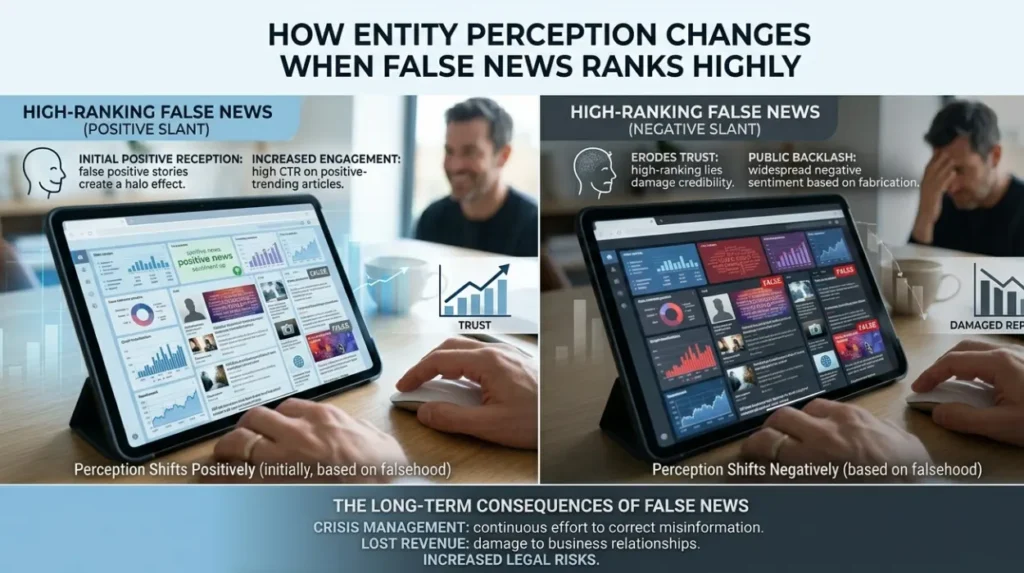
Entity perception changes when false news ranks highly because search engines and users treat top‑position content as the primary reference point for interpreting credibility and risk. Within this framework, visibility functions as a proxy for authority, regardless of content‑quality.
High‑ranking false news affects perception by:
- Defining the first‑impression narrative for search users, who often accept top‑position results as the most accurate or important information.
- Distorting sentiment distribution so that negative or misleading references skew how risk, reliability, and character are inferred.
- Reinforcing misperceptions over time, especially when accurate corrections remain buried in lower‑position results.
Within digital‑trust systems, this means that a single falsely framed article can undermine entity credibility even if it is isolated or contradicted by higher‑quality sources.
How does the digital footprint embed false news into online reputation?
The digital footprint embeds false news into online reputation by integrating it into the broader index of references associated with an entity. Within SERP evaluation, the presence of these references helps shape how reputation signals are weighted and how users interpret search results.
This embedding occurs when:
- Multiple URLs referencing an entity news articles, profiles, and social posts are indexed and linked together, forming a graph of reputation‑related content.
- False news appears in this graph and is reinforced through citations, links, or review mentions, increasing its ranking influence.
- Search engines treat this cluster as evidence of what is “known” about the entity, even if parts of it are inaccurate.
Over time, the digital footprint hardens certain reputational attributes, including those based on false coverage, unless balanced or corrected content systematically competes for ranking priority.
How does authority and trust architecture amplify false narratives?
Authority and trust architecture amplify false narratives when search engines interpret high‑domain‑authority sites, formal‑citation patterns, and consistent linking as evidence of credibility, regardless of content‑factuality. Within modern search ecosystems, where most users cannot audit source‑credibility manually, this architecture often rewards reach over accuracy.
This amplification operates through:
- Domain‑authority signals: Coverage published on high‑traffic, established media domains receives an automatic ranking benefit, even if the reporting is flawed or one‑sided.
- Editorial‑gatekeeping gaps: Some outlets prioritise clicks or controversy over rigorous fact‑checking, which allows misleading narratives to pass through editorial filters.
- Cascading citations: When other reputable outlets reference or quote the original false article, search engines treat those citations as validation instead of as risk indicators.
These mechanisms mean that reputation signals based on false news are not only visible but can appear deeply entrenched in the SERP structure.
How does content visibility affect the perceived accuracy of false news?
Content visibility affects the perceived accuracy of false news because search users typically accept top‑position results as accurate, especially when they are embedded in mainstream sites or SERP‑rich features. Within this environment, ranking priority substitutes for explicit verification.
This perception effect operates when:
- Users do not scroll beyond the first page, so they rarely encounter more balanced or corrective content that may exist further down.
- Negative or sensationalist coverage, even when misleading, appears in multiple SERP positions, which search engines interpret as a strong signal of relevance.
- Search engines reinforce this pattern by surfacing sitelinks, featured snippets, and knowledge‑adjacent boxes that highlight the most prominent references.
In this way, false news becomes difficult to dislodge from perception because it is treated as normal, authoritative information rather than as an outlier.
How can users and entities respond to false news within this ecosystem?
Users and entities can respond to false news within this ecosystem only through structured, evidence‑based counter‑measures that reshape SERP composition, reputation signals, and sentiment distribution. There is no single‑point removal or automatic correction; the response must mirror the mechanisms that allowed the article to appear and rank.
Effective responses include:
- Creating or optimising authoritative, factually accurate content that answers the same search intents as the false article, using on‑page, technical‑SEO, and citation‑building tactics to improve its ranking influence.
- Applying correction or takedown requests where content clearly breaches legal or policy‑based standards, which may reduce its visibility or indexing.
- Monitoring reputation signals and SERP evaluation over time to ensure that corrective content gains and maintains prominence relative to harmful coverage.
By aligning counter‑measures with how search engines interpret trust, authority, and relevance, individuals and organisations can systematically reduce the impact of false news rather than relying on isolated, one‑off corrections.
A structured discipline
False news articles appear about you online because search ecosystems prioritise indexing breadth, linking patterns, and authority signals over individual‑driven truth‑checks. Reputation management is a structured discipline that aligns how information is created, indexed, and weighted, while online reputation refers to the collective perception formed when users encounter those indexed references.
False news becomes impactful when it ranks highly, is embedded in the digital footprint, and is reinforced by authority and trust architecture. Within this framework, the most reliable way to mitigate harm is to systematically reshape SERP composition, sentiment distribution, and reputation signals using evidence‑based, platform‑aware tactics rather than expecting automatic removal or correction.
FAQs:
Why do false news articles appear about me online in search results?
False news articles appear about you online because search engines index and rank content based on authority, links, and engagement rather than automatically verifying factual accuracy. These articles gain visibility when they are published on established domains, widely linked, or heavily shared, even if they are misleading or inaccurate.
How does a false news article impact my online reputation and credibility?
A false news article can damage your online reputation by dominating first‑impression search results, skewing sentiment distribution, and reinforcing negative perceptions of credibility and trustworthiness. Even if the article is outdated or incorrect, its high ranking in SERPs leads many users to treat it as authoritative evidence.
Can search engines remove or de‑index false news articles about individuals?
Search engines can de‑index false news articles only when content clearly breaches legal or policy‑based standards such as defamation, privacy, or data‑protection rules, and when supported by documented evidence. They do not automatically remove content just because it is factually inaccurate or damaging to personal reputation.
How does reputation management help if false news articles appear about me?
Reputation management helps by reshaping SERP composition so that accurate, authoritative content ranks above or alongside the false article, reducing its prominence in search visibility. It also strengthens sentiment distribution and trust signals around your name, counterbalancing the impact of inaccurate news narratives.
How long can a false news article affect my reputation online?
A false news article can affect your reputation online for as long as it remains visible in top‑position SERP clusters, especially if it is frequently cited or linked by high‑authority domains. The impact diminishes when accurate, evidence‑based content is systematically promoted and consistently outperforms the false article in ranking and visibility.