

Online defamation removal in the UK works through platform policies, publisher review processes, legal frameworks, and search visibility controls that determine whether harmful content remains accessible or is removed from public view.
Reputation management strategies differ based on content ownership, publishing authority, indexing status, and platform governance structures. Online reputation control methods are evaluated through their impact on search visibility, entity credibility, reputation signals, and long-term SERP composition.
How Do Publisher Removal Processes Compare With Platform-Based Removal Systems?
Publisher removal processes operate through editorial review and content governance, while platform-based removal systems operate through policy enforcement and community standards. The distinction influences how reputation management strategies are evaluated across digital environments.
Publisher-controlled content is content that exists on news websites, blogs, industry publications, and independent media properties. Removal requests are assessed through editorial procedures that examine factual accuracy, legal considerations, public interest factors, and evidential support. Publishers retain direct control over publication decisions because they own and manage the content infrastructure.
Platform-based content operates differently because social networks, forums, review websites, and user-generated content environments rely on policy enforcement frameworks. Content evaluation focuses on platform rules, moderation standards, harassment policies, privacy provisions, and defamation-related complaints. The platform acts as an intermediary between content creators and public audiences.
From a search visibility perspective, publisher content often carries stronger authority signals because established publications possess recognised topical authority and entity trust. Platform content generates influence through scale, engagement signals, and user participation. The evaluation framework therefore differs according to the source of publication and the mechanisms controlling content retention.
How Does Publisher Authority Influence Removal Outcomes?
Publisher authority refers to the trust and credibility signals associated with a publication’s content ecosystem. Authority influences search ranking potential because search engines evaluate source reliability when determining visibility.
High-authority publications often implement structured review mechanisms because editorial integrity functions as a trust signal. Content assessments frequently involve evidence verification, factual analysis, and legal review. These processes create a more formal evaluation environment than standard platform moderation systems.
The limitation of publisher review processes is that authority does not automatically lead to content removal. Editorial teams assess public interest, factual support, and publication standards before modifying indexed content. Consequently, removal outcomes depend on evidential analysis rather than reputation concerns alone.
How Does Legal Removal Compare With Content Suppression Strategies?
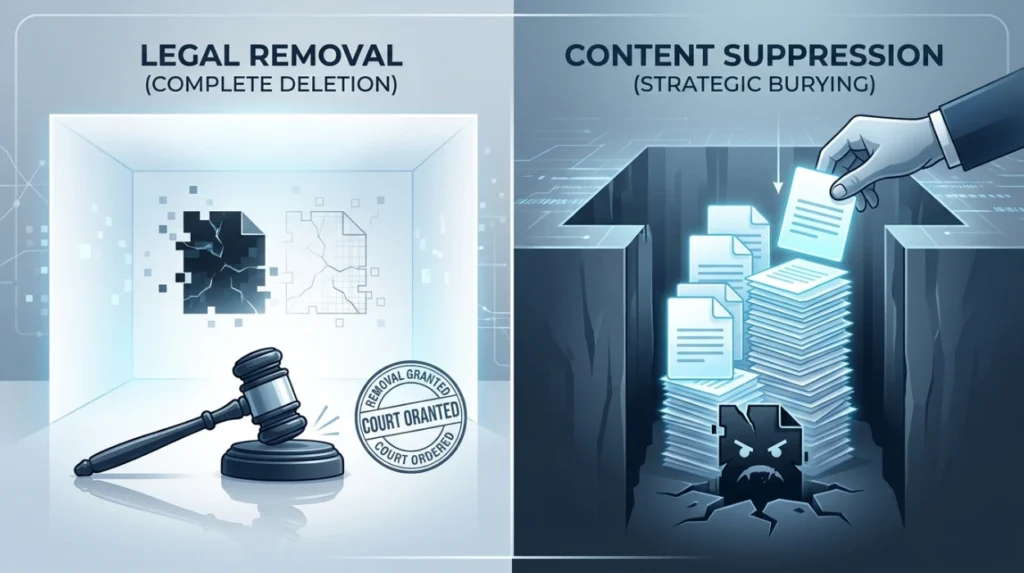
Legal removal and content suppression represent two distinct reputation management approaches. Legal removal focuses on eliminating content, while content suppression focuses on altering search visibility distribution.
Legal removal is a reactive strategy that operates through legal rights, publisher negotiations, court orders, privacy frameworks, or policy-based enforcement mechanisms. The objective is content elimination or substantial visibility reduction through direct intervention. Success is measured by removal, correction, or de-indexing outcomes.
Content suppression operates by increasing the prominence of alternative content assets within search ecosystems. The mechanism relies on content enhancement, entity optimisation, digital asset development, and search ranking influence. Rather than removing negative material, suppression seeks to alter SERP composition by increasing the visibility of neutral or authoritative content.
The comparative difference lies in control mechanisms. Legal removal directly targets harmful content, while suppression indirectly changes perception through ranking distribution. Legal removal offers immediate visibility impact when successful, whereas suppression depends on sustained content performance and indexing dynamics.
Which Approach Creates Greater Search Ranking Influence?
Search ranking influence is evaluated through visibility distribution rather than legal classification. Legal removal achieves influence by eliminating ranking eligibility. Content suppression achieves influence by increasing competition within search results.
Suppression strategies create broader scalability because content assets can target multiple search queries, branded terms, and entity-related searches simultaneously. Legal removal remains focused on individual content items or publication instances. The comparative effectiveness therefore depends on reputation objectives, content volume, and search ecosystem complexity.
How Do Reactive and Proactive Reputation Management Approaches Differ?
Reactive reputation management addresses existing visibility challenges, while proactive reputation management focuses on controlling future reputation signals. Both approaches influence entity credibility through different operational mechanisms.
Reactive strategies begin after negative content gains visibility. These methods evaluate harmful publications, sentiment distribution issues, misleading information, and reputational exposure. Activities include content review, publisher engagement, policy assessment, and visibility management.
Proactive strategies operate before reputational issues emerge. The approach focuses on building authoritative content assets, strengthening entity associations, improving information accuracy, and expanding positive reputation signals. Search engines interpret these assets as credibility indicators because they contribute to topical authority and entity understanding.
The comparison reveals differences in sustainability. Reactive methods address immediate exposure risks, while proactive methods contribute to long-term search ecosystem stability. Search engines continuously evaluate available information, making proactive reputation development an important component of visibility management.
How Do Search Engines Evaluate Reputation Signals During Defamation Disputes?
Search engines evaluate reputation signals through relevance, authority, credibility, and user value indicators rather than legal conclusions. This distinction explains why content visibility and legal classification operate independently.
Reputation signals are measurable indicators that help search systems understand entity associations. These signals include citations, mentions, publication authority, user engagement, review sentiment, and topical relevance. Search algorithms use these inputs to determine ranking eligibility and visibility distribution.
Defamation disputes introduce additional complexity because legal status does not automatically alter search engine interpretation. Search systems analyse indexed content according to ranking frameworks rather than judicial evaluation. Consequently, content remains visible until removal, de-indexing, policy intervention, or ranking displacement occurs.
Entity credibility emerges through cumulative signal evaluation. Search engines compare available information sources, analyse consistency patterns, and assess content relationships across the web. This process demonstrates why reputation management requires understanding both legal and search ecosystem mechanisms.
What Reputation Signals Influence Entity Credibility?
Entity credibility is influenced by the following measurable factors:
- Analyse source authority through publication trust indicators and citation quality.
- Evaluate content consistency through repeated entity associations across indexed assets.
- Measure sentiment distribution through positive, neutral, and negative content visibility.
- Assess engagement patterns through user interaction and information relevance signals.
These mechanisms collectively shape how search systems interpret reputational information.
How Does Removal Across Search Engines Differ From Removal Across Publishers?
Search engine removal and publisher removal operate through separate governance structures. A publisher controls content publication, while a search engine controls content discoverability.
Publisher removal eliminates or modifies information at the source. Search engine removal affects indexing, retrieval, or visibility without necessarily altering the original publication. This distinction creates different outcomes for reputation management evaluation.
Source removal generally produces a broader visibility impact because the content no longer exists in its published form. Search engine removal limits discoverability but does not eliminate publication existence. Users accessing the original URL directly may still encounter the information.
The effectiveness comparison depends on visibility objectives. Publisher removal addresses publication presence. Search engine removal addresses search accessibility. Understanding the distinction improves evaluation of reputation control methods across digital ecosystems.
Dive Deeper With Our Expert Guides:
What a Suppression Campaign for Negative Google Content in the UK Involves
What Methods Are Most Effective for Removing Negative UK Search Results
How Do Different Platforms Influence Sentiment Distribution?
Sentiment distribution refers to the balance of positive, neutral, and negative information associated with an entity across searchable environments. Different platforms influence sentiment distribution through unique content structures and ranking mechanisms.
News publishers influence sentiment through editorial narratives and authoritative reporting. Review platforms influence sentiment through aggregate ratings and user feedback. Social platforms influence sentiment through engagement-driven visibility and community interactions. Forums influence sentiment through discussion-based content creation.
Search engines aggregate information from all of these sources when constructing entity understanding. As a result, platform diversity affects how reputation signals are distributed throughout the search ecosystem. A single negative publication may carry strong authority signals, while numerous user-generated mentions may influence sentiment volume.
The evaluation of platform influence therefore requires analysis of authority, indexing frequency, engagement levels, and ranking potential. Sentiment distribution is not determined solely by content volume but by visibility-weighted exposure.
What Are the Strategic Limitations of Online Defamation Removal Approaches?
Online defamation removal approaches contain operational limitations that influence effectiveness and scalability. These limitations arise from platform governance, legal thresholds, content replication, and search ecosystem complexity.
Removal strategies depend on successful assessment by publishers, platforms, courts, or policy administrators. Approval standards differ between systems, creating inconsistent outcomes. Content replication introduces additional complexity because information may appear across multiple domains and publication environments.
Content suppression strategies face different limitations. Visibility improvements require ongoing optimisation, content production, and authority development. Ranking influence develops over time rather than through immediate intervention. Consequently, suppression effectiveness depends on sustained ecosystem participation.
The comparative analysis demonstrates that reputation management approaches function within interconnected digital systems. Content ownership, search visibility, authority signals, and platform governance collectively determine strategic outcomes.
Online defamation removal in the UK operates through a combination of publisher governance, platform moderation systems, legal frameworks, and search visibility controls. Each mechanism influences reputation signals through different operational processes and evaluation standards.
The comparison between removal strategies, suppression methods, proactive reputation development, and reactive interventions highlights significant differences in scalability, sustainability, and search ranking influence. Publisher authority, platform governance, indexing behaviour, and sentiment distribution all contribute to how reputational information is interpreted within search ecosystems.
Understanding these differences provides a clearer framework for evaluating reputation management approaches. Search visibility, entity credibility, and content governance remain central factors in determining how digital reputation evolves across platforms and publishers.
How does online defamation removal work across different platforms in the UK?
Online defamation removal in the UK works through platform policies, publisher review procedures, and legal frameworks. Each platform evaluates reported content according to its own moderation standards, content policies, and reputational risk criteria.
Can defamatory content be removed from search engine results?
Search engines can reduce or remove visibility in specific circumstances, but this process differs from removing content at the source. Publisher removal eliminates the original content, while search result removal affects discoverability and search visibility.
What is the difference between publisher removal and platform moderation?
Publisher removal involves editorial review of content published on websites, news outlets, or blogs. Platform moderation focuses on user-generated content and applies community guidelines, reporting systems, and policy enforcement mechanisms.
How does online defamation affect search visibility and reputation?
Defamatory content can influence search visibility by becoming indexed and appearing in search engine results pages. This visibility contributes to reputation signals, entity credibility, and public perception within digital search ecosystems.
Why is understanding online defamation removal important for reputation management?
Understanding online defamation removal helps explain how negative content is assessed, challenged, and managed across digital platforms. Clear Your Name highlights the relationship between content governance, search visibility, and online reputation management within the UK information ecosystem.