

Reputation management is the study and practice of how information about a person or organisation is created, organised and interpreted across digital systems. Online reputation refers to the sum of publicly accessible signals, content and indexes that define an entity’s perceived credibility within search ecosystems.
UK defamation law defines actionable false statements as those that damage an individual’s or entity’s reputation by lowering them in the estimation of right-thinking members of society. The law covers published statements that are presented as facts, not opinions, when those statements are false, identifiable to the claimant, and cause or are likely to cause serious harm to reputation. In the online context, a single posting, a replicated review, or a persistent article that repeats the statement qualifies as publication.
How does UK defamation law define publication for online content?
UK defamation law defines publication as the communication of a defamatory statement to at least one person other than the claimant. Online publication refers to any accessible posting, upload, or indexed page that presents the statement to a third-party audience.
Publication is the act of making a statement available to a third party; online publication refers to that act when performed via websites, social platforms, review sites, or other internet-accessible channels.
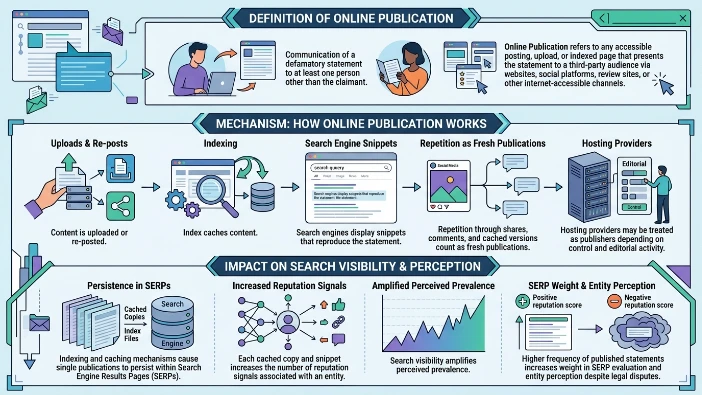
Publication occurs when content is uploaded or re-posted, when an index caches content, or when search engines display snippets that reproduce the statement. Repetition through shares, comments, and cached versions counts as fresh publications for legal purposes. Hosting providers may be treated as publishers depending on control and editorial activity.
Indexing and caching mechanisms cause single publications to persist within SERPs; each cached copy and snippet increases the number of reputation signals associated with an entity. Search visibility amplifies perceived prevalence; higher frequency of published statements increases weight in SERP evaluation and entity perception despite legal disputes.
Which types of online statements qualify as defamatory under UK law?
Statements that present verifiable false facts that lower a person’s or entity’s reputation in the estimation of right-thinking members of society qualify as defamatory. Allegations of criminality, dishonesty, professional incompetence and serious moral failings typically meet the threshold if false and damaging.
Courts assess the literal and contextual meaning, audience reception, and likely effect on reputation. Statements framed as verifiable claims (dates, actions, statuses) are treated as factual; hyperbole or clearly subjective commentary is evaluated for ordinary meaning. Aggregated repetition across platforms strengthens perceived truth for readers and algorithms.
Content labelled as factual by users or platforms generates stronger reputation signals than content labelled as opinion; search engines and readers treat repeated factual assertions as higher-weight signals, elevating such content in SERPs and worsening entity perception absent correction or countervailing authority signals.
How do defences like truth, honest opinion and public interest operate online?
Truth is a defence when the defendant proves the substance of the statement; honest opinion applies when a statement is recognisably opinion based on true facts; public interest allows responsible publication where information is demonstrably in the public’s interest.
Courts test evidential support for factual claims and examine whether platforms or authors presented information responsibly. Online evidence includes timestamps, source links, archived pages, and moderation records. Platforms’ content labels (opinion tags, fact-check notices) form part of the contextual evidence used to evaluate the defence.
When a defendant successfully invokes a defence, the legal status alters authority signals: verified corrections, judicial findings, or fact-check markers can reduce the weight of the original content in SERP evaluation and shift entity perception by promoting authoritative pages over disputed content.
How do search engines interpret trust and credibility for defamatory or disputed content?
Search engines evaluate trust and credibility through algorithmic signals that combine content quality, authority, provenance and user behaviour. Algorithms operationalise credibility as a composite of evidence-based signals rather than legal determinations.
Ranking systems analyse source authority (domain history, backlinks), content signals (original reporting, citations), user signals (click-through rates, dwell time), and trust indicators (HTTPS, structured data). Fact-check labels and authoritative rebuttals serve as counter-signals. Algorithms weigh recency and repetition; repeated false claims without authoritative contradiction retain higher visibility.
Search visibility for disputed content declines where dominant authority signals favour corrective pages, official statements, or court judgments. Absence of authoritative countercontent plus high engagement sustains visibility and entrenches negative entity perception within SERP evaluation.
How does the presence of reviews and sentiment-bearing content affect legal evaluation and search reputation?
Reviews and sentiment-bearing posts create evaluative signals that blend opinion with factual claims; their legal and algorithmic treatment differs based on how they are framed and substantiated.
Defamation analysis separates pure opinion from statements implying unreported facts. If a review asserts verifiable false facts, it becomes actionable. From a search-system perspective, aggregated sentiment and review quantity create reputation signals used in ranking and snippet features, influencing SERP perception and click behaviour.
High volume of negative reviews increases negative reputation signals and elevates adverse content in SERPs; fact-based rebuttals and authoritative responses can generate countervailing signals that reduce the prominence of harmful reviews in indexing and entity perception.
How does content indexing and caching interact with legal remedies and reputational control?
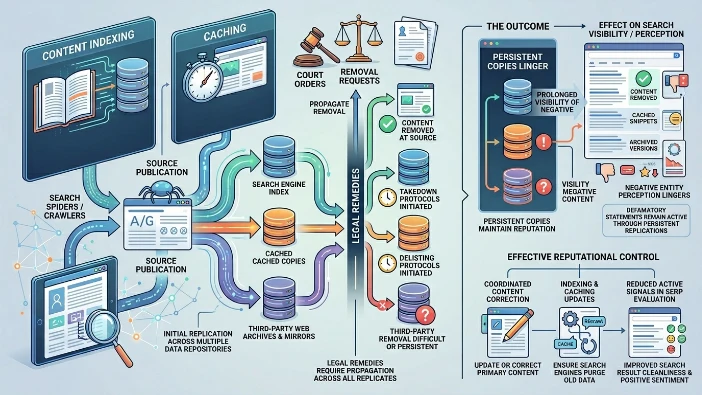
Indexing and caching replicate content across search infrastructures; those replications affect the reach and persistence of defamatory statements and the efficacy of legal remedies.
Cached snapshots and third-party archives create multiple replicates of a single publication. Legal remedies (removal requests, court orders) require propagation to search indexes, caches and archives. Search engines and archives implement takedown or delisting protocols, while cached copies and third-party mirrors may persist beyond initial removal.
Persistent caches and mirrored content maintain reputation signals despite primary removals, prolonging visibility and negative entity perception. Effective reputational control requires coordinated content correction and indexing updates to reduce active signals in SERP evaluation.
Dive Deeper With Our Expert Guides:
How Instagram Posts Can Damage Your Reputation Even Without Tagging You Directly
What Constitutes Harmful Facebook Content Under UK Platform and Legal Standards
How do authority and trust signals shape entity perception in SERPs?
Authority signals are quantifiable indicators (backlinks, domain age, editorial reputation) that algorithms use to infer prominence; trust signals are indicators (secure protocols, verifiable authorship, citation quality) that infer credibility.
Algorithms aggregate diverse authority and trust signals to compute a relevance and credibility score for ranking. High-quality, authoritative pages outrank unverified content; structured data and provenance metadata increase the chance that authoritative pages appear as rich snippets or knowledge panels, directly influencing entity perception.
Strengthen your online reputation with professional Facebook Content Removal Services that improve authority and trust signals across search ecosystems. Verified removals, credible content strategies, and authoritative digital assets help reshape entity perception and reduce the visibility of harmful or misleading SERP results.
What role does an entity’s digital footprint play in legal and algorithmic reputation formation?
An entity’s digital footprint forms the substrate upon which legal findings and algorithmic inferences operate; the composition and structure of that footprint determine the resilience of reputation signals. Digital footprint is the aggregate of all online references, profiles, content, links and indexed records that refer to an entity within search ecosystems.
Search engines map the footprint through entity recognition, knowledge graph associations and clustering of topical content. Legal records, authoritative profiles and corrective publications alter the footprint’s components and relationships. The density, recency and authority of items within the footprint affect both court evidence and algorithmic weighting.
A fragmented or sparse footprint amplifies the relative effect of isolated defamatory items; a diversified, authoritative footprint dilutes individual negative signals and supports improved SERP evaluation and entity perception.
For more information explore:
How UK Defamation Law Gives You the Right to Request Removal of False Content
UK defamation law covers false factual statements published online that damage reputation by lowering the subject in the estimation of right-thinking members of society. Legal definitions of publication, falsity and harm intersect with search ecosystems where indexing, caching, authority signals and user engagement shape how statements rank and how entities are perceived. Understanding the mechanisms—how publication replicates through caches, how algorithms weigh authority and trust, and how reviews and sentiment function as reputation signals—allows informed analysis of how legal remedies translate into changes in search visibility and entity perception. Effective mitigation depends on altering the mix of reputation signals within the digital footprint so that authoritative, verified content outweighs disputed assertions.
What types of online content does UK defamation law cover?
UK defamation law covers published online statements presented as factual claims that injure reputation, including articles, reviews, blog posts and social media posts. Clear Your Name explains that verifiable false assertions (allegations of criminality, dishonesty or professional incompetence) are actionable and can form the basis for legal remedies.
How does publication on social platforms affect a defamation claim?
Publication on social platforms counts when a third party can access the statement; reposts, shares and cached snippets create additional publications. Clear Your Name notes that each accessible copy amplifies reputation signals and strengthens evidential indexing for legal proceedings.
Can negative reviews be defamatory under UK law?
Negative reviews that state verifiable false facts rather than honest opinion qualify as defamatory; purely subjective opinions are less likely to succeed. Clear Your Name advises that review content asserting false events or actions becomes actionable and influences search visibility as reputational signals.
How do search indexing and caching influence the removal of defamatory content?
Indexing and caching replicate content across search ecosystems, so takedown or court orders require propagation to search indexes, caches and archives to reduce visibility. Clear Your Name highlights that persistent caches and third‑party mirrors can maintain negative SERP signals even after primary removals.