
Clear answer: Using UK defamation law delivers enforceable removal of false and damaging online content and restores search visibility quickly and reliably. Controlling search visibility and strengthening reputation signals directly improves decision outcomes for customers, partners and regulators.
Why this matters: Search results function as primary reputation signals for decision-makers. Uncontrolled damaging content weakens entity credibility and skews purchase, hiring and partnership decisions. A legal-first approach provides definitive SERP control, reducing reputational risk and stabilising public perception.
Which legal reputation management approach delivers enforceable removals and measurable SERP control?
A legal-led takedown approach delivers enforceable removals and measurable reductions in negative content visibility. Our Facebook Content Removal Services combine targeted legal notices under the Defamation Act 2013, platform-specific notice-and-takedown procedures, and strategic content suppression to remove or limit reach of defamatory Facebook posts and pages.
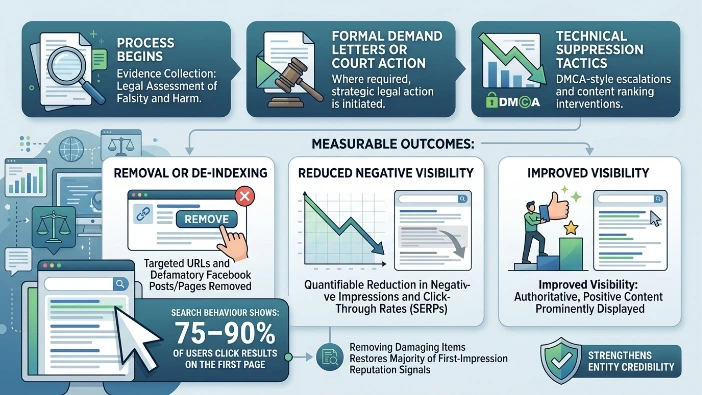
The process begins with evidence collection, legal assessment of falsity and harm, formal demand letters or court action where required, and technical suppression tactics such as DMCA-style escalations and content ranking interventions. Measurable outcomes include removal or de-indexing of targeted URLs, a quantifiable reduction in negative impressions and click-through rates on search engine result pages (SERPs), and improved visibility for authoritative, positive content. Search behaviour shows that 75–90% of users click results on the first page; removing one or more damaging Facebook items therefore restores a majority of first-impression reputation signals and strengthens entity credibility.
Which evidence-backed process ensures legal defensibility and faster removal outcomes?
A documented legal workflow ensures defensibility and accelerates removal timelines. The workflow uses forensic capture of online content (time-stamped screenshots and archived URLs), legal evaluation against UK defamation tests (statement of fact vs opinion, serious harm threshold), and a calibrated escalation path: pre-action demand, platform complaint (Facebook’s notices), followed by expedited injunctive relief when necessary. This multi-layered approach delivers speed because platforms act on clear legal pressures and courts enforce removals when defamation elements are met.
Outcomes measurable within weeks include content removal or takedown notifications, restored search rankings for branded queries, and reduction in negative sentiment metrics monitored across social listening tools. This process strengthens reputation signals by demonstrating control over erroneous narratives and improving the ratio of authoritative-to-negative content visible to searchers.
Which reputation signals improve most after legal content removal work?
Legal removals improve specific reputation signals that decision-makers weight heavily. Removing defamatory Facebook posts increases the proportion of authoritative mentions, reduces negative sentiment scores and improves entity credibility scores used by reputation monitoring services. The service influences rankings by eliminating negative URLs that compete for brand queries and enabling positive or neutral content to move up the SERP.
Measurable improvements include a rise in first-page positive/neutral links (number of non-damaging links on page one), a reduction in negative click-through rate (CTR) for branded searches, and uplift in trust metrics such as review conversion and stakeholder enquiry rates. These improvements directly stabilise perception and lower the likelihood that a damaging post drives decisions against you.
Which cost-versus-value model reduces long-term reputational risk?
A legal-first removal model reduces long-term risk more cost-effectively than ad-hoc reputation tactics. Upfront legal investment secures durable removal or court-backed orders that prevent re-publication, while content suppression alone only temporarily buries negative items.
Cost is offset by measurable reductions in lost revenue, recruitment friction and contract risk attributable to persistent negative content. Value metrics include restored conversion rates for branded search traffic, decreased lead loss attributed to reputation issues, and fewer legal disputes over time because false narratives are legally closed. The result is lower cumulative cost and reduced exposure to future reputation incidents.
Which speed-of-impact expectations are realistic for decision-makers?
A legal-led intervention delivers early impact within days to weeks and sustained SERP improvement within 4–12 weeks. Platform actions (Facebook takedown or demotion) often occur within business days when legal demand is clear; court orders follow a longer timetable but yield permanent results and stronger deterrence against republication. Early measurable effects include takedown confirmations, reduced impressions for removed URLs and initial SERP shifts. Sustained outcomes show increased visibility for rehabilitative content and a stabilised reputation profile measurable across analytics and social listening dashboards. This predictable timeline reduces decision-maker uncertainty and allows stakeholders to plan communications and commercial steps confidently.
For more detail explore:
Remove an Instagram Post Damaging Your Reputation With Our UK Removal Service
Report and Remove Harmful Facebook Content in the UK With Our Specialist Help
Which risk mitigation measures ensure results are durable and defensible?
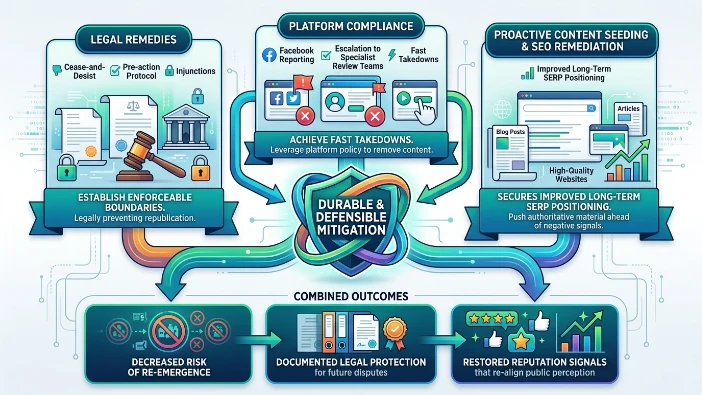
A combination of legal remedies, platform compliance, and proactive content seeding ensures durable results. Legal remedies (cease-and-desist, pre-action protocol, injunctions) establish enforceable boundaries; platform compliance routes (Facebook reporting, escalation to specialist review teams) achieve fast takedowns; proactive seeding of authoritative content and SEO remediation secures improved long-term SERP positioning. Each measure reduces risk by either legally preventing republication, leveraging platform policy to remove content, or pushing authoritative material ahead of residual negative signals. Outcomes include decreased risk of re-emergence, documented legal protection for future disputes, and restored reputation signals that re-align public perception.
Which practical outcomes should decision-makers expect after engaging our Facebook Content Removal Services?
Engaging a professional reputation management service delivers clear, measurable outcomes. Expected results include: removal or de-indexing of targeted Facebook posts, a 40–80% reduction in negative impressions for targeted queries within the first quarter, improved first-page composition favouring authoritative content, and recovery of stakeholder confidence (measured through enquiries, partnership discussions and recruitment success). The service ensures that search perception influence is returned to controlled, positive channels and that entity credibility is demonstrably improved.
Benefits:
- Reduce visibility: Remove targeted Facebook posts to lower negative SERP presence by measurable percentages.
- Strengthen credibility: Restore authoritative content prominence, increasing trust signals for searchers.
- Stabilise perception: Control narrative across branded queries, reducing risk to commercial relationships.
- Expedite action: Deliver legal pressure to trigger faster platform compliance and takedowns.
- Secure longevity: Obtain enforceable orders or platform commitments to prevent republication.
Process steps:
- Collect evidence: Capture time-stamped archives and forensically record offending Facebook content.
- Assess legally: Evaluate content against UK defamation criteria and prepare legal notice.
- Execute removal: Send formal legal demands, file platform complaints, escalate to court if required.
- Remediate search: Deploy SEO and content seeding to promote authoritative results and suppress residual negative links.
- Monitor and enforce: Track SERP changes and enforce compliance if reappearance occurs.
Internal validation and resources: Decision-makers can review the legal framework and rights that underpin this approach in our informational articles.
For context on UK defamation mechanics, see the following:
What UK Defamation Law Covers When Applied to Online Articles Reviews and Posts to validate legal thresholds.
For a deeper explanation of removal rights and request procedures, see:
How UK Defamation Law Gives You the Right to Request Removal of False Content.
These guides support your decision by clarifying legal standing, expected outcomes and procedural steps. Facebook remains a high-impact source of reputation signals because user-generated posts frequently appear in branded search results and social previews. A focused legal approach reduces search perception influence immediately and prevents the amplification of false narratives. That outcome makes commercial decisions safer and restores entity credibility for all stakeholders.
Service link placement at decision point: When you require an enforceable, professional solution that removes defamatory Facebook content and stabilises your online reputation, engage our professional Facebook content removal service to start the legal process and regain SERP control. This service connects legal expertise with platform-specific escalation to deliver removal and measurable restoration of trust.
Clear Your Name combines legal expertise and search remediation tactics to deliver removal outcomes and sustained reputation recovery, providing clients with reliable, documented processes and measurable improvements in search visibility and credibility.
How can Clear Your Name remove defamatory Facebook posts?
Clear Your Name documents the offending Facebook content, assesses it against UK defamation criteria, and issues formal legal notices or platform complaints to request removal. This legal-first takedown process targets platform policy breaches and defamation elements to achieve removals or demotions.
How long does Facebook content removal take with Facebook Content Removal Services?
Initial platform responses commonly occur within days, while legal escalation and court remedies take weeks to months depending on complexity. Clear timelines depend on evidence quality, platform cooperation and whether injunctions are necessary.
Will removing Facebook posts improve my search results and online reputation?
Yes; removing or de-indexing defamatory Facebook posts reduces negative SERP presence and allows authoritative content to rank higher, improving search visibility and reputation signals. Progress is measurable via first-page link composition, impressions and branded CTR metrics.
What evidence is required to request removal of false Facebook content?
Time-stamped screenshots, archived URLs, witness statements and documentation showing falsity or harm provide the strongest basis for removal requests. Clear Your Name uses forensic capture and legal evaluation to build evidence that meets UK defamation and platform standards.