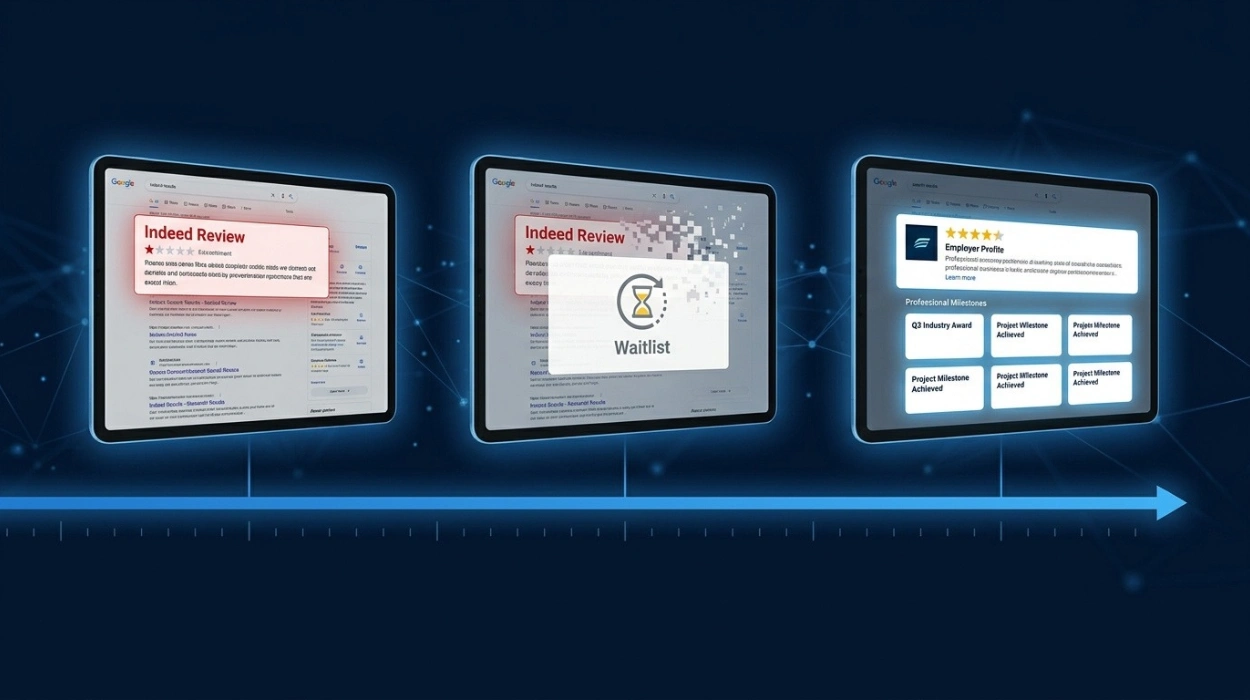
An Indeed review removal can change an employer’s visible rating, review volume and overall sentiment distribution, but it does not guarantee an immediate improvement in reputation. Realistic results depend on the review’s influence, the remaining feedback, the resulting rating structure and the employer’s wider search visibility.
Reputation management strategies differ based on whether the objective is removing problematic information, reducing its visibility or strengthening alternative reputation signals. Online reputation control methods are evaluated through their effect on SERP composition, entity credibility, sentiment distribution, search visibility and the sustainability of resulting changes.
How does Indeed review removal compare with reputation enhancement?
Indeed review removal provides direct source-level control, while reputation enhancement works by strengthening credible information that competes within the wider search ecosystem. Removal addresses a specific review when it qualifies for action under the platform’s policies, whereas enhancement focuses on developing positive or neutral reputation signals around the employer entity. The distinction matters because removing one review does not automatically create stronger positive evidence elsewhere. A review removal changes the composition of the Indeed profile, but content enhancement changes the broader information environment surrounding the employer. These approaches therefore operate through different mechanisms and produce different types of reputation outcomes.
What does review removal change?
Review removal is a source-control mechanism that eliminates qualifying content from the platform where the review exists. Its immediate effect relates to review volume, rating calculations and sentiment distribution within the employer profile. The effect on the overall online reputation depends on how prominent the removed review was within the profile and whether related content appears on other websites. A single removed review has a different impact from removing a review that represents a substantial proportion of the available feedback. The resulting change therefore requires evaluation at both profile and search-ecosystem level.
How does reputation enhancement differ?
Reputation enhancement operates by increasing the presence and relevance of credible information that contributes to entity credibility. This can include accurate employer information, authoritative company profiles, useful corporate content and legitimate employee feedback. Unlike removal, enhancement does not eliminate the original source of negative sentiment. Instead, it changes the relative distribution of information available to users and search systems. Its effectiveness therefore depends on content quality, source authority, relevance and the ability of that information to remain visible over time.
Is removing an Indeed review more effective than adding positive reviews?
Review removal has a more direct short-term effect when a qualifying review materially affects the employer’s Indeed profile. Adding positive reviews operates through cumulative sentiment distribution and therefore depends on the number, quality and authenticity of subsequent reviews. Removal changes an existing input, while new reviews introduce additional inputs into the rating environment. Neither mechanism guarantees a specific rating because the final result depends on the remaining review set and platform calculation processes. The appropriate evaluation therefore compares immediate profile change with longer-term sentiment development.
When does removal have stronger impact?
Removal has stronger measurable impact when the targeted review carries significant weight within a relatively small review profile. For example, eliminating one strongly negative review from a profile with limited feedback produces a more noticeable change than removing one negative review from a profile containing hundreds of reviews. The mechanism is mathematical as well as reputational because the removed rating no longer contributes to the profile’s aggregate sentiment. The visibility of the removed content also changes if the review no longer appears on the originating page. The result remains limited when identical allegations or negative sentiment exist across independent platforms.
When does positive review generation have stronger impact?
Positive review generation has stronger cumulative influence when an employer has an established review base and continues receiving authentic feedback. Each legitimate review contributes another reputation signal and can gradually alter the distribution between positive, neutral and negative sentiment. This process is slower because it does not remove existing criticism from the profile. Its sustainability depends on genuine participation rather than concentrated short-term activity. Search perception can therefore improve through a broader evidence base, although the change is less immediate than source-level removal.
How do organic and reactive reputation approaches differ after review removal?
Reactive reputation management addresses an identified reputation problem, while organic management builds a stronger information environment before or alongside individual reputation incidents. A reactive approach commonly begins with identifying a damaging review, assessing its policy status and determining whether removal is available. An organic approach focuses on maintaining accurate profiles, credible content and legitimate reputation signals over time. Reactive work can produce faster source-level changes, while organic activity provides broader resilience against isolated negative events. The two approaches therefore differ primarily in timing, scope and risk exposure.
What is a reactive reputation strategy?
A reactive strategy is a response mechanism activated after negative information becomes visible. It operates by identifying the source, assessing its influence and selecting an appropriate intervention such as removal, correction, response or suppression. This approach is efficient when the problem is clearly defined and the available intervention directly addresses the source. Its limitation is that action begins after the reputation signal has already entered the public information environment. Replicated content, search indexing and secondary discussions can therefore remain relevant after the original review has been addressed.
What is an organic reputation strategy?
An organic strategy is a continuous reputation-building process based on credible information and legitimate reputation signals. It operates by maintaining a balanced digital footprint across relevant platforms rather than responding only when negative content appears. This creates a broader entity context that helps users evaluate an employer through multiple information sources. Its principal strength is sustainability because reputation signals develop through ongoing activity rather than a single intervention. Its limitation is that it does not directly remove a problematic review or correct an inaccurate source.
What short-term results are realistic after an Indeed review removal?
Short-term results are generally visible at the profile level before they become visible across broader search results. A removed review can alter the review count, average rating or visible sentiment distribution, depending on the profile structure. The change is measurable through direct comparison of the employer profile before and after removal. Search ranking influence is less predictable because search engines evaluate numerous signals beyond an individual Indeed rating. Consequently, an improved Indeed profile does not automatically produce an equivalent improvement across branded search results.
Which metrics reveal immediate impact?
Immediate evaluation focuses on measurable changes directly associated with the removed review. Relevant indicators include the remaining review count, visible average rating, rating distribution and the continued presence or absence of the targeted content. These metrics establish whether source-level intervention produced the intended profile change. They do not independently establish broader reputation recovery because search results contain information from independent sources. A proper evaluation therefore separates platform-level outcomes from search-level outcomes.
What long-term results are realistic after an Indeed review removal?
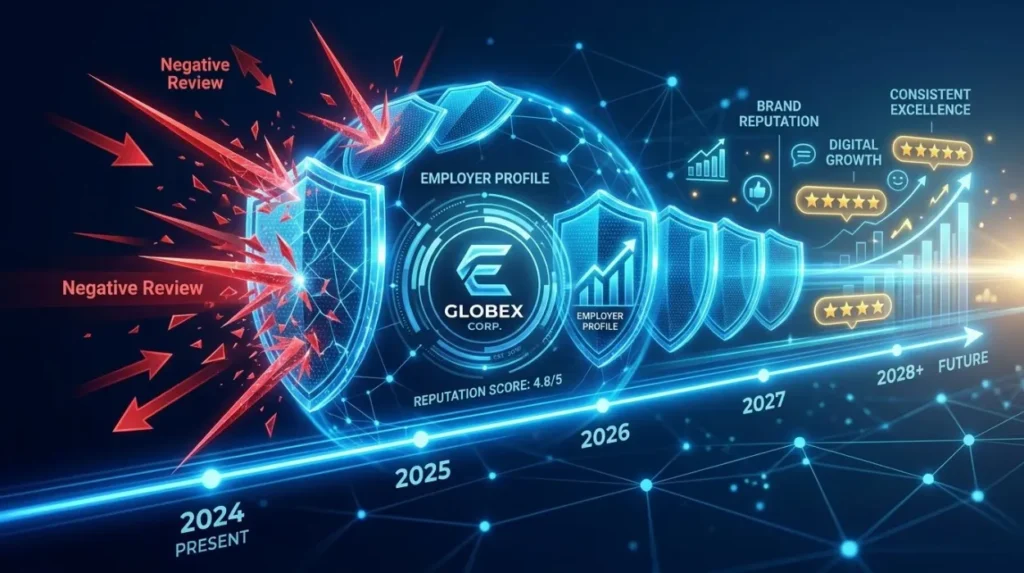
Long-term reputation outcomes depend on whether the employer develops a stronger and more balanced information environment after the removal. Source-level intervention can resolve one reputation signal, but sustainable search perception requires continued monitoring of review platforms, employer profiles, social channels, forums and other indexed sources. Search engines continuously reassess available information, so the SERP composition can change independently of an Indeed profile. Long-term success is therefore measured through stability rather than a single rating improvement. A durable outcome combines source accuracy, balanced sentiment and consistent entity credibility across relevant information sources.
Why does monitoring remain important?
Monitoring is important because reputation information can be copied, referenced or redistributed outside the original platform. A removed Indeed review can therefore represent only one part of a wider reputation issue if similar claims appear elsewhere. Monitoring identifies changes in branded queries, review profiles and search-result composition over time. It also distinguishes genuine improvement from temporary fluctuations in visibility. This makes monitoring a measurement mechanism rather than a standalone reputation tactic.
How does content suppression compare with content enhancement after removal?
Content suppression reduces the visibility of unwanted information, whereas content enhancement increases the strength and relevance of favourable or neutral information. Suppression operates primarily through search-result positioning and SERP composition, while enhancement works through the creation or strengthening of credible information assets. Neither approach is equivalent to removing the original source. Suppression can reduce exposure without changing the underlying content, while enhancement can strengthen alternative reputation signals without eliminating criticism. Their effectiveness therefore depends on the specific search environment and the authority of competing pages.
When is suppression relevant?
Suppression becomes relevant when negative content remains accessible but occupies disproportionate visibility for important branded searches. The mechanism involves strengthening competing pages so that unwanted results receive less prominent placement within relevant queries. Its effectiveness depends on the authority, relevance and indexing behaviour of the pages competing for those search positions. Suppression does not erase the underlying source and therefore carries a different risk profile from direct removal. A result can also regain visibility if competing content loses relevance or authority.
When is enhancement relevant?
Enhancement becomes relevant when the search environment lacks sufficient authoritative information representing the employer accurately. Strong corporate pages, authoritative profiles and legitimate reputation content can provide search engines with additional entity context. This approach supports entity credibility by expanding the information available for interpreting the organisation. Its impact is cumulative rather than immediate because new content requires indexing and must establish relevance. Enhancement therefore functions as a long-term search perception strategy rather than a direct substitute for source removal.
How should employers measure the effectiveness of an Indeed review removal?
Effectiveness is best measured through a combination of platform metrics, search visibility and sentiment analysis rather than the Indeed rating alone. A structured assessment compares the profile before and after removal, then examines how the change affects branded search results and wider reputation signals. This separates direct intervention outcomes from unrelated fluctuations in search ranking influence. It also prevents an improved platform rating from being treated as evidence of complete reputation recovery. Measurement therefore needs to cover both the originating platform and the wider search ecosystem.
Which evaluation framework provides the clearest comparison?
A practical evaluation framework can be structured around four measurable areas:
- Measure the change in review volume, average rating and sentiment distribution after removal.
- Compare branded SERPs before and after the intervention to identify changes in negative and neutral result visibility.
- Analyse the authority and relevance of pages contributing to the employer’s search perception.
- Monitor recurring changes to reviews, search results and entity references to assess sustainability.
This framework distinguishes immediate source-level results from broader reputation effects. It also creates a consistent basis for comparing removal, suppression and enhancement strategies without treating one metric as a complete representation of reputation.
Dive Deeper With Our Expert Guides:
What Improves Your Indeed Star Rating After a Removal
How to Build a Crisis Response Plan for Indeed Reviews
Can an Indeed rating improve without removing every negative review?
An employer’s rating can improve without eliminating every negative review because reputation evaluation depends on the overall distribution and credibility of available feedback. A balanced profile containing positive, neutral and negative experiences can provide a more representative reputation signal than a profile dominated by one sentiment category. Search users also evaluate review patterns rather than relying exclusively on the numerical rating. Removing qualifying content therefore represents only one possible intervention within a broader reputation management framework. The long-term objective is an accurate and credible information environment rather than the complete absence of criticism.
What results should employers avoid expecting after review removal?
Employers should not treat review removal as an automatic mechanism for restoring every aspect of online reputation. A removed review does not guarantee a particular rating, a permanent SERP improvement or the disappearance of related criticism from independent platforms. Search engines evaluate content using multiple signals, while review platforms apply their own rating and moderation mechanisms. Reputation recovery therefore has different outcomes at source, platform and search levels. Treating these levels as identical creates unrealistic expectations and weakens performance measurement.
The distinction becomes especially important when evaluating recover their Indeed rating as part of a wider reputation strategy. Rating recovery represents one measurable outcome, while broader search perception involves review sentiment, branded queries, content authority and SERP composition. A stronger rating can contribute to improved trust signals, but it does not independently establish complete entity credibility. Evaluation therefore requires a separation between platform-specific recovery and broader digital reputation control.
What is the most sustainable approach after an Indeed review removal?
The most sustainable approach combines accurate source control with ongoing reputation monitoring and legitimate information enhancement. Removal provides direct control where a review qualifies for intervention, while enhancement develops stronger alternative reputation signals across the wider search ecosystem. Monitoring then measures whether the improvement remains stable as new reviews and indexed content appear. This combined model reduces dependence on a single tactic and provides a clearer assessment of risk exposure. Sustainability ultimately depends on maintaining credible information rather than relying on one-time changes.
Indeed review removal and reputation enhancement operate through different mechanisms and therefore produce different outcomes. Removal provides direct control over qualifying source content, while positive review generation changes sentiment distribution through additional authentic feedback. Suppression affects SERP composition, whereas enhancement strengthens the alternative information available to search engines and users.
Short-term evaluation focuses on measurable changes to the Indeed profile, while long-term evaluation examines search visibility, entity credibility, sentiment distribution and the stability of reputation signals. Organic approaches provide continuity, while reactive approaches address defined reputation events. The strongest strategic assessment separates platform-level outcomes from broader search perception and measures effectiveness through evidence rather than assuming that one rating change represents complete reputation recovery.
What results are realistic after an Indeed review removal?
An Indeed review removal can reduce the visibility of unwanted feedback when the review breaches the platform’s policies. The realistic outcome depends on whether Indeed accepts the removal request and how prominently the review appears in search results.
How long does an Indeed review removal take?
The timeframe depends on Indeed’s review process, the reason for the removal request, and whether additional evidence is required. Reviews that clearly violate platform guidelines can be easier to challenge than content that does not meet removal criteria.
Does removing an Indeed review improve online reputation?
Removing a problematic Indeed review can improve the overall search perception of a business or recruitment organisation by reducing negative content. However, reputation improvement also depends on other reviews, search results, employer profiles and third-party content.
Can all negative Indeed reviews be removed?
No, a negative Indeed review is not automatically eligible for removal simply because it is unfavourable. An Indeed review removal request generally requires a valid policy-based reason, such as prohibited content, personal information, or other guideline violations.
What happens after an Indeed review is successfully removed?
Once a review is removed, the page may no longer display that specific feedback, although search engines can take time to reflect the change. Monitoring subsequent search results helps identify cached pages, duplicated content or other reputation issues that remain visible.