An Indeed star rating improves after a removal when the remaining review dataset contains a stronger distribution of positive ratings relative to negative ratings. The effect depends on which review is removed, the number of reviews remaining and how the resulting sentiment distribution affects the aggregate score.
Reputation management strategies differ based on whether the objective involves removing qualifying content, improving the remaining information environment or strengthening positive reputation signals over time. Online reputation control methods are evaluated through their effect on content visibility, review composition, entity credibility and the sustainability of resulting search signals.
What actually improves an Indeed star rating after a review removal?
The remaining distribution of review ratings determines whether an Indeed star rating improves after a removal. Removing a low-rated review has a different mathematical effect from removing a high-rated review because the aggregate calculation changes according to the ratings that remain. The number of reviews also determines the proportional influence of the removed rating. A small review dataset experiences a more noticeable numerical change than a large dataset. The rating therefore reflects the composition of the remaining review population rather than the removal action alone.
Review removal and rating improvement represent separate reputation mechanisms. Removal changes the composition of available content, while rating improvement depends on the numerical relationship between the remaining ratings. This distinction prevents removal from being treated as an automatic reputation improvement mechanism. A removed review can alter the score without changing the underlying sentiment of the remaining reviews. Evaluation therefore requires examining the post-removal dataset rather than measuring the removal event in isolation.
Is review removal more effective than adding positive reviews?
Review removal and positive review acquisition operate through different mechanisms and produce different reputation effects. Removal reduces the influence of an existing rating by taking qualifying content out of the available dataset, while additional positive reviews increase the proportion of favourable ratings. The first approach changes the denominator and rating distribution, whereas the second introduces new reputation signals. Their effectiveness therefore depends on the structure of the existing review profile. Neither mechanism represents a universal solution because each interacts differently with review volume and sentiment distribution.
Positive review acquisition also creates a longer-term content signal because each legitimate review adds new qualitative and numerical information. Removal produces a more immediate change when an eligible negative rating has a significant proportional effect on the aggregate score. However, adding positive reviews requires continued participation from reviewers and does not directly address content that violates platform requirements. Comparing the approaches therefore involves assessing eligibility, mathematical influence, sustainability and the legitimacy of the resulting reputation signals.
How does content removal compare with content enhancement?
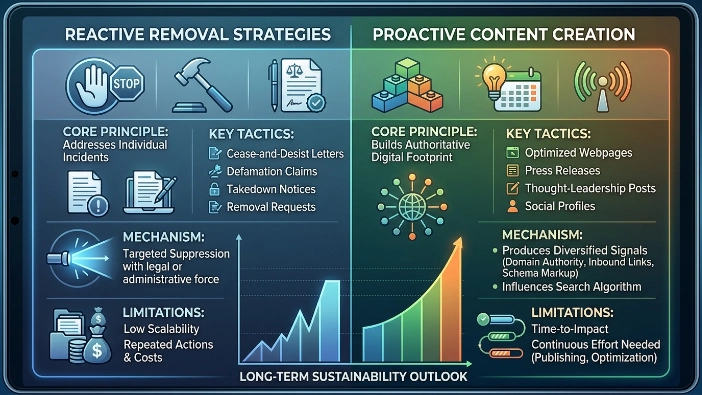
Content removal operates by reducing the amount of negative or unsuitable information associated with an organisation, while content enhancement operates by increasing the quality and relevance of favourable information. Removal is a reactive strategy because it responds to an existing reputation problem. Enhancement is an organic strategy because it builds additional information that contributes to the wider digital footprint. These mechanisms affect reputation at different points in the information lifecycle. Comparing them requires separating source-level intervention from the creation of new reputation signals.
Content enhancement has a broader effect on the information environment because it can influence how users encounter an organisation across search results and review ecosystems. Removal has a narrower mechanism because its immediate impact concerns a specific piece of content or review. A removal therefore has greater precision when the target content qualifies for platform action. Enhancement provides greater scope for developing a balanced information environment over time. The appropriate evaluation depends on whether the primary issue is problematic content, weak positive representation or an imbalance between the two.
Does removing a negative Indeed review improve search visibility?
Removing a negative Indeed review can alter the information available on the platform, but its effect on search visibility depends on how the affected page is indexed and ranked. Search engines evaluate pages through relevance, authority, content quality and relationships between entities and information. A change to one review does not automatically produce an equivalent change across search engine results pages. The search-ranking influence of the altered content depends on the role that page plays within the broader SERP composition. Removal therefore represents a source-level change rather than a guaranteed ranking outcome.
Search visibility also differs from platform-level rating improvement. An improved Indeed score changes the numerical reputation signal visible to users, while search visibility concerns whether and where the associated content appears in search results. These mechanisms can interact without producing identical outcomes. A rating can improve while the review page remains visible, or a page can become less prominent without producing a substantial numerical rating change. Evaluation therefore requires separate measurement of platform reputation and search presence.
How does positive review content affect employer reputation?

Positive review content strengthens employer reputation by adding favourable sentiment and contextual information to the organisation’s digital footprint. A positive review contributes a numerical rating while also describing specific experiences, workplace attributes or organisational characteristics. These textual elements create semantic associations around the employer entity. When positive themes occur consistently, they provide a clearer representation of the organisation within the review ecosystem. This makes positive review content a reputation signal rather than simply an additional numerical value.
The effectiveness of positive content depends on authenticity, relevance and distribution. A balanced collection of legitimate reviews creates a more informative reputation profile than a dataset dominated by repetitive or context-free statements. Search engines and users interpret information through its surrounding context, so review quality influences the credibility of the overall signal. Positive content therefore contributes to entity credibility through both sentiment and information depth. Its value extends beyond the immediate effect on the star rating.
Is organic reputation improvement more sustainable than reactive removal?
Organic reputation improvement is generally more sustainable as a long-term strategy because it builds an ongoing information base rather than relying exclusively on individual interventions. It operates through legitimate review generation, accurate business information and continued development of positive reputation signals. Reactive removal addresses specific content and therefore has a narrower operational scope. Its sustainability depends on whether new problematic content continues to appear. The two approaches consequently address different stages of reputation management.
Organic improvement also creates cumulative effects within the digital footprint. New reviews add content, reinforce entity associations and provide additional evidence about an organisation’s reputation. Reactive removal produces a targeted change without necessarily strengthening the remaining information environment. This distinction matters when evaluating long-term reputation stability. A sustainable strategy therefore considers both immediate risk reduction and the continued development of credible information.
How does review volume affect the impact of a removal?
Review volume directly affects the mathematical influence of removing an individual rating. In a small review dataset, one removed rating represents a comparatively large proportion of the total available ratings. In a larger dataset, the same removal represents a smaller proportional change. This means the numerical impact of removal cannot be evaluated without considering the existing review count. Rating movement is therefore dependent on both the rating being removed and the size of the remaining dataset.
Review volume also affects how users interpret the resulting score. A rating supported by a substantial collection of reviews provides more context than an identical score based on a small number of ratings. The removal of one review therefore changes both the numerical calculation and the composition of the available evidence. However, the interpretive effect remains connected to the broader review history. Effective evaluation measures the rating change alongside review volume and sentiment distribution.
Which approach creates stronger reputation signals: removal or enhancement?
Removal creates a targeted reputation signal by reducing the presence of a specific piece of information, while enhancement creates additional signals through new positive content. Removal therefore provides precision, whereas enhancement provides accumulation. The former is closely tied to platform eligibility and content-level intervention, while the latter depends on legitimate content creation and sustained participation. Their relative effectiveness depends on the reputation problem being evaluated. A content-level problem requires a different mechanism from a weak or incomplete reputation profile.
The distinction also affects risk exposure. Removal based on valid platform grounds has a defined evidential basis, while enhancement depends on the authenticity and relevance of newly generated content. Attempts to manipulate review systems introduce credibility and compliance risks because reputation signals lose value when their origin lacks legitimacy. Sustainable reputation analysis therefore prioritises defensible evidence and genuine information. The strongest approach is determined by mechanism, not by the apparent speed of numerical change.
How do short-term and long-term reputation strategies differ?
Short-term strategies focus on changing an immediate reputation signal, while long-term strategies focus on improving the underlying information environment. Review removal represents a short-term intervention when qualifying content directly affects the available rating dataset. Content enhancement and legitimate review development operate over a longer period because they add information incrementally. The time horizon therefore changes how effectiveness is measured. Short-term evaluation focuses on immediate rating and visibility changes, while long-term evaluation examines sustainability and reputation consistency.
Short-term results also have different limitations from long-term reputation development. A rating can change quickly after a qualifying removal without altering the wider sentiment surrounding the employer. Conversely, sustained positive content can gradually reshape the information environment without producing an immediate numerical shift. This distinction is important when evaluating reputation outcomes against business objectives. Measurement therefore requires defined timeframes, reputation signals and search visibility indicators.
Dive Deeper With Our Expert Guides:
How to Build a Crisis Response Plan for Indeed Reviews
How Recruitment Agencies Should Handle Negative Indeed Reviews
How do search engines evaluate reputation signals after a review changes?
Search engines evaluate reputation-related content within the broader context of indexed information rather than treating a single rating as an independent ranking command. When review content changes, the indexed representation of the entity can also change, depending on crawling, processing and ranking. The resulting SERP composition reflects the relationship between the altered page and other available sources. Search ranking influence therefore depends on the overall information ecosystem. A change in one review does not establish a guaranteed position within search results.
Authority and relevance also influence how reputation information is surfaced. A highly relevant review page can remain visible because it continues to satisfy the search intent associated with an employer query. Removing one review changes the page’s content but does not necessarily remove the page itself from search results. Content suppression and content enhancement therefore operate at different levels of the search system. Understanding these distinctions prevents platform-level changes from being mistaken for direct search-ranking interventions.
How should the effectiveness of an Indeed reputation strategy be evaluated?
An Indeed reputation strategy is evaluated through measurable changes in review composition, rating distribution, search visibility and entity credibility. The first measurement concerns the numerical effect of any review change. The second examines whether the remaining content creates a coherent and credible sentiment distribution. The third evaluates how associated pages appear within relevant search results. The final assessment considers whether the outcome remains stable over time.
A structured evaluation can be organised through four analytical measures:
- Measure the rating distribution before and after an intervention to identify the mathematical effect on the aggregate score.
- Analyse remaining review sentiment to determine whether recurring themes continue to influence employer perception.
- Compare SERP composition to identify changes in the visibility of review pages and related reputation content.
- Assess sustainability by monitoring whether the resulting reputation signals remain consistent as new content enters the ecosystem.
This framework separates numerical improvement from broader reputation improvement. A higher star rating represents one measurable outcome, but it does not independently establish stronger entity credibility. Search visibility, sentiment distribution and content context provide additional evidence. Strategic evaluation therefore requires a combined assessment rather than a single performance metric.
What factors determine whether removal or enhancement is more effective?
The effectiveness of removal or enhancement depends on the type of reputation problem, the review dataset, the content’s eligibility for intervention and the wider search environment. Removal has greater precision when a specific review qualifies for action under platform rules. Enhancement has broader scope when the principal weakness involves limited positive information or an imbalanced sentiment distribution. The two approaches also differ in scalability because targeted removals depend on identifiable content, while enhancement depends on continued legitimate content generation. Risk exposure therefore forms part of the strategic comparison.
The long-term objective also influences the evaluation. If the issue concerns a specific piece of unsuitable content, removal directly addresses the source of the problem. If the issue concerns a consistently weak reputation profile, enhancement addresses the broader information environment. Neither mechanism automatically replaces the other because they operate through different reputation systems. A balanced assessment therefore considers immediate impact, search-ranking influence, credibility, scalability and sustainability together.
What improves an Indeed star rating after removal over the long term?
Long-term improvement depends on the quality and distribution of the reviews that remain after a removal. A removed negative rating can improve the aggregate score, but continued reputation development depends on legitimate positive experiences being represented within the review dataset. The resulting sentiment distribution therefore matters more than the removal event in isolation. A stronger review profile develops through credible information rather than numerical manipulation. This creates a distinction between temporary rating movement and sustainable reputation improvement.
The wider digital footprint also influences long-term perception. Positive review content, accurate organisational information and relevant authoritative sources contribute to a more complete entity representation. Search engines process these signals within the broader indexed information environment. Consequently, long-term reputation improvement involves both platform-level review signals and wider search visibility. Improve Your Indeed Star Rating With Our Removal Service represents the transactional framing of removal, while the underlying reputation analysis remains focused on how content changes affect the information ecosystem.
Improving an Indeed star rating after a removal depends on the composition of the remaining review dataset rather than the removal event alone. Removal provides a targeted mechanism for changing available review information, while content enhancement builds additional positive reputation signals. Organic approaches offer cumulative information development, whereas reactive approaches address defined content-level issues. Search visibility introduces another layer because platform rating changes do not automatically produce equivalent changes in SERP composition.
Effective reputation evaluation therefore considers rating distribution, review volume, sentiment, content eligibility, search visibility, entity credibility, risk exposure and sustainability together. The distinction between content suppression and content enhancement is central to selecting an appropriate analytical framework. A numerical rating provides one measurable reputation signal, but long-term online reputation depends on the broader information environment surrounding the entity.
What improves your Indeed star rating after a review removal?
Removing a policy-violating review can improve the overall rating by changing the number of reviews included in the calculation. The final star rating depends on the remaining reviews, their individual ratings, and Indeed’s rating methodology.
Does removing a negative Indeed review increase your star rating?
It can increase the average star rating when the removed review has a rating below the existing average. The effect depends on the review’s star value and the total number of remaining Indeed reviews.
How long does it take for an Indeed star rating to update after review removal?
The rating may take time to reflect a removed review because platform systems need to process the change. The visible update depends on Indeed’s review and rating system rather than the removal request alone.
Can new positive Indeed reviews improve a company’s star rating?
New genuine positive reviews can raise an Indeed star rating when their ratings are higher than the existing average. Consistent employee feedback provides a stronger basis for improving the overall review profile than isolated rating changes.
How can businesses improve their Indeed rating after removing a review?
Businesses can focus on encouraging genuine employee feedback, addressing recurring workplace concerns and maintaining an accurate review profile. Clear Your Name can be considered when a review removal issue involves content that violates applicable platform policies.