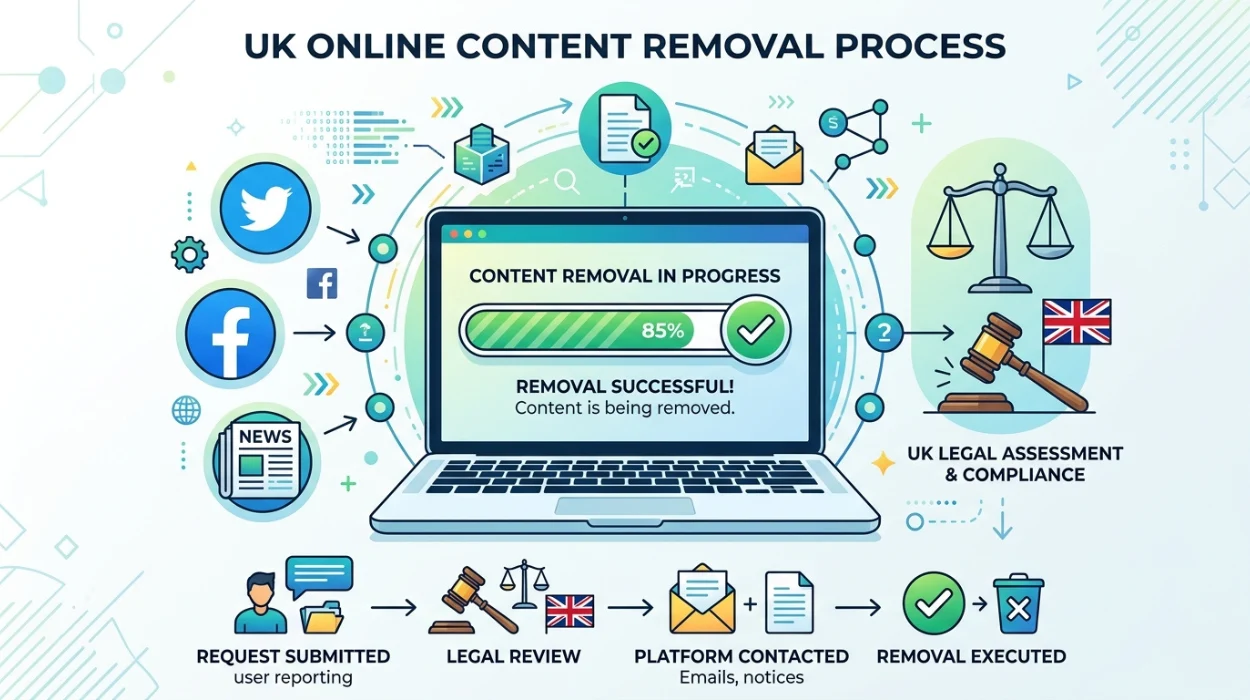
Online defamation removal in the UK operates through a combination of legal, platform-based, and search-focused reputation management approaches. The effectiveness of each method depends on content type, publication source, indexing status, and the strength of available reputation signals.
Reputation management strategies differ based on how information is published, distributed, indexed, and interpreted within search ecosystems. Online reputation control methods are evaluated through their influence on search visibility, entity credibility, sentiment distribution, and long-term SERP composition.
How Does Online Defamation Removal Differ Between Social Media and Articles?
Online defamation removal differs because social media platforms and article-based publications operate under distinct content governance and indexing systems.
Social media content is typically governed by platform policies that regulate harassment, misinformation, impersonation, and harmful content. Removal mechanisms operate through reporting systems, moderation reviews, and policy enforcement frameworks. Search engines may index public social content, but visibility often depends on platform authority, engagement metrics, and accessibility settings. As a result, platform-level moderation frequently acts as the primary control mechanism.
Article-based content operates within publisher-controlled environments. News sites, blogs, industry publications, and independent websites maintain editorial ownership over published material. Removal processes often involve direct publisher review, correction requests, legal evaluation, or editorial reconsideration. Because articles frequently maintain stronger indexing stability, their influence on search ranking visibility often remains longer than social media content. This distinction creates different removal pathways and different reputation management considerations.
Which Online Defamation Removal Methods Are Most Commonly Used?
Online defamation removal methods are evaluated according to content ownership, legal standing, and platform governance structures.
Three approaches dominate the evaluation framework:
- Submit platform complaints by triggering moderation systems that review content against community guidelines and policy standards.
- Request publisher review by presenting evidence relating to accuracy, factual errors, or reputational concerns.
- Initiate legal assessment by evaluating whether content satisfies UK defamation thresholds and legal removal requirements.
Each approach operates differently within search ecosystems. Platform complaints focus on policy enforcement. Publisher reviews focus on editorial decision-making. Legal assessment focuses on reputational harm and legal compliance. The suitability of each method depends on content structure, publication environment, and evidence quality.
How Do Platform Reporting Systems Compare With Publisher Removal Requests?
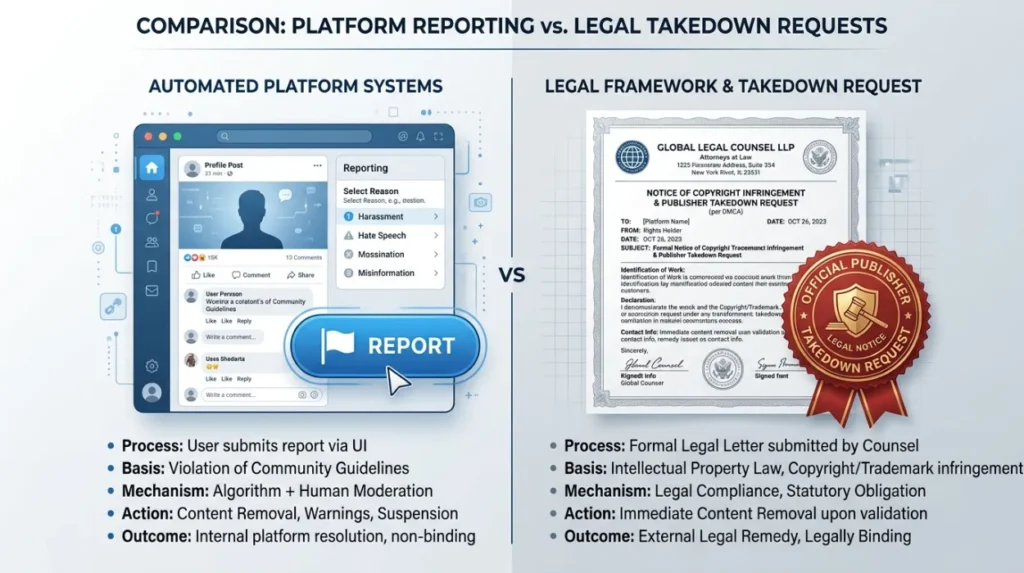
Platform reporting systems prioritise policy compliance, while publisher removal requests prioritise editorial evaluation.
Social media reporting frameworks evaluate whether content violates internal platform rules. Moderation systems assess reported material against documented policies. The outcome depends on rule interpretation rather than broader reputation concerns. This process creates relatively rapid review cycles but limits evaluation to platform-specific standards.
Publisher removal requests operate through editorial processes. Editors assess factual accuracy, publication standards, source credibility, and content legitimacy. The process often involves deeper content evaluation because publishers maintain direct responsibility for published information. Editorial reviews generally require more detailed analysis than platform moderation reviews. Consequently, publisher-controlled content often involves a more complex removal pathway.
From a search visibility perspective, publisher decisions frequently exert greater influence because article content often maintains stronger indexing persistence and search ranking influence.
How Does Legal Defamation Assessment Compare With Platform-Based Removal?
Legal defamation assessment evaluates reputational harm under UK law, whereas platform-based removal evaluates compliance with platform policies.
Defamation analysis examines publication, identification, factual accuracy, and serious harm thresholds. The process focuses on whether content damages reputation through false information. Legal frameworks operate independently from platform rules and editorial policies. This creates a distinct evaluation pathway based on legal standards rather than community guidelines.
Platform-based removal evaluates whether content violates platform-specific behavioural or content requirements. Content can remain lawful while violating platform rules. Conversely, content can raise legal concerns while remaining visible during platform review processes. This distinction explains why legal and platform-based approaches frequently operate simultaneously rather than competitively.
Search engines do not independently determine legal liability. They interpret indexed information through ranking systems, relevance calculations, and authority evaluation mechanisms. Therefore, legal outcomes influence reputation ecosystems indirectly through content availability and visibility.
What Role Does Search Engine Indexing Play in Defamation Visibility?
Search engine indexing determines whether content becomes discoverable through search queries and entity searches.
Content indexing refers to the process through which search engines discover, analyse, categorise, and store information. Indexed content enters searchable databases and becomes eligible for ranking. Visibility depends on relevance signals, authority indicators, and query alignment rather than publication date alone.
Defamatory content gains greater reputation impact when indexing connects negative information with an identifiable entity. Search engines establish semantic relationships between names, organisations, topics, and published documents. Repeated associations influence entity credibility and search perception. Consequently, indexed content often creates broader reputational implications than content confined to isolated platforms.
The relationship between indexing and reputation explains why removal discussions frequently focus on visibility as well as publication status.
How Does Content Removal Compare With Content Suppression Strategies?
Content removal eliminates information availability, while content suppression influences visibility through search result composition.
Content removal operates by reducing or eliminating access to the original source. Successful removal often removes indexing eligibility and reduces future discoverability. This approach directly addresses content existence rather than visibility competition.
Content suppression operates through search ranking influence. New authoritative content, entity-focused information, and positive reputation signals compete against negative content within SERPs. The objective involves adjusting visibility distribution rather than eliminating publication. Search engines reassess relevance and authority relationships as new information enters the ecosystem.
How Do Search Engines Interpret Content Suppression vs Content Enhancement?
Content suppression focuses on reducing negative visibility through ranking competition, whereas content enhancement focuses on strengthening authoritative information assets.
Search engines evaluate content through quality indicators, topical relevance, authority signals, and semantic relationships. Enhanced content expands entity understanding and contributes additional credibility signals. Suppression relies on competitive ranking dynamics, while enhancement focuses on improving information quality and entity representation. Both approaches influence sentiment distribution differently.
Which Approach Creates the Fastest Reputation Impact?
The speed of reputation impact depends on platform responsiveness, indexing status, and content authority.
Platform moderation often produces the fastest outcomes because review systems operate within centralised governance structures. When policy violations are confirmed, content accessibility changes immediately. This creates direct effects on visibility within the platform environment.
Editorial reviews generally require longer evaluation periods because publishers analyse factual accuracy and publication legitimacy. Legal processes frequently involve the most extensive timelines due to procedural requirements and evidentiary standards. However, legal outcomes often generate broader authority because they rely on established legal frameworks rather than discretionary moderation systems.
Speed alone does not determine effectiveness. Sustainable reputation outcomes depend on visibility reduction, indexing changes, and long-term sentiment distribution across search ecosystems.
How Do Different Removal Methods Affect Search Visibility?
Removal methods affect search visibility through different mechanisms that alter content accessibility and ranking eligibility.
Platform removals reduce discoverability within platform environments. Public posts removed from accessible locations often lose indexing opportunities and visibility pathways. The impact depends on whether content has already been archived, replicated, or referenced elsewhere.
Publisher removals directly affect source availability. Search engines reassess indexed content when source pages change, disappear, or become inaccessible. This often leads to indexing adjustments and reduced search visibility over time. Because publishers frequently maintain strong domain authority, these changes can significantly influence SERP composition.
Legal outcomes affect visibility indirectly through content status changes. When content availability changes, search engines update indexed information according to crawling and indexing processes. Consequently, visibility outcomes emerge from technical search mechanisms rather than legal interpretation itself.
Dive Deeper With Our Expert Guides:
How Online Defamation Removal in the UK Works Across Platforms and Publishers
What a Suppression Campaign for Negative Google Content in the UK Involves
How Is Effectiveness Measured Across Online Defamation Removal Strategies?
Effectiveness is measured through visibility reduction, sentiment distribution improvement, and entity credibility stabilisation.
Evaluation frameworks typically analyse:
- Measure search visibility by assessing ranking positions and discoverability levels across branded and entity-based searches.
- Analyse sentiment distribution by comparing positive, neutral, and negative content representation within search results.
- Evaluate entity credibility by examining authority signals associated with indexed information sources.
- Track indexing changes by monitoring whether disputed content remains accessible through search ecosystems.
These measurements provide objective indicators of reputation outcomes. Visibility changes reveal search ranking influence. Sentiment analysis reveals perception shifts. Entity evaluation reveals how search systems interpret credibility relationships over time.
What Strategic Factors Influence Method Selection?
Method selection depends on content ownership, publication authority, indexing status, and reputational risk exposure.
Ownership determines who controls content accessibility. Platform-owned content follows moderation frameworks. Publisher-owned content follows editorial frameworks. Search visibility determines the extent of reputational exposure created by indexed information. Authority levels influence the strength of ranking signals associated with disputed content.
Risk exposure analysis evaluates potential long-term effects on entity perception and search credibility. Sustainable reputation management frameworks compare immediate outcomes against long-term visibility considerations. This comparison explains why different removal methods often operate together within broader reputation management strategies.
Within comparative evaluation models, discussions surrounding Remove Online Defamation in the UK With Legal and Content Removal Combined frequently focus on how legal assessment and publication control mechanisms interact across search ecosystems.
Online defamation removal in the UK involves multiple approaches that operate across different information environments. Platform reporting systems, publisher reviews, legal assessment frameworks, content removal processes, and content suppression strategies each influence reputation signals through distinct mechanisms.
The effectiveness of any approach depends on content ownership, search visibility, indexing status, and authority signals. Comparing these methods reveals important differences in speed, scalability, sustainability, and risk exposure. Understanding these distinctions provides a clearer framework for evaluating how online reputation control functions across social media platforms, articles, and search ecosystems.
How does online defamation removal work across social media and articles?
Online defamation removal works through platform reporting systems, publisher review processes, and legal assessment procedures. The method used depends on where the content is published and how it affects online reputation and search visibility.
Can defamatory social media posts be removed in the UK?
Social media posts may be removed if they violate platform policies or meet legal defamation criteria. Removal decisions are typically based on content rules, factual accuracy, and reputational harm assessments.
What is the difference between removing a defamatory article and a social media post?
Defamatory articles are usually reviewed by publishers or website owners, while social media posts are evaluated through platform moderation systems. Each approach follows different content governance and review mechanisms.
How does online defamation affect search engine results?
Defamatory content can influence search visibility when it is indexed and ranked by search engines. Negative content may affect reputation signals, entity credibility, and public perception within search results.
Why is online defamation removal important for ORM Services?
Online defamation removal helps reduce the visibility of false or harmful content that affects reputation signals. Clear Your Name recognises that ORM Services evaluate content indexing, sentiment distribution, and search perception to understand reputation impact.