Personal information reaches dark-web marketplaces when data is stolen, exposed, aggregated, or traded through illicit networks after a security breach or unauthorised disclosure. Reputation management is the process of understanding and managing the information associated with an individual or entity across digital environments, including search engines and publicly accessible databases.
Online reputation refers to the information and reputation signals that shape how an entity is perceived across the internet. Personal information exposed through illicit data markets forms part of a broader digital footprint, even when that information does not immediately appear in search results. Understanding how this information moves through digital ecosystems explains why privacy exposure and online reputation are interconnected.
How Does Personal Information Reach the Dark Web?
Personal information reaches the dark web primarily through data breaches, credential theft, malware infections, database exposures, and unauthorised access to online accounts. A compromised database can contain names, email addresses, telephone numbers, usernames, passwords, financial information, or other identifiers. Once extracted, the information can be copied, aggregated, and redistributed without the knowledge of the affected individuals. Dark-web marketplaces and private forums then provide environments where stolen datasets are advertised, exchanged, or sold.
The dark web refers to internet services that are not normally accessible through standard search engines and require specialised software or configurations for access. This distinction separates the dark web from the broader deep web, which includes ordinary pages that search engines do not index, such as private accounts and subscription databases. Data appearing in a dark-web environment therefore does not automatically become visible through Google or Bing. However, information from the same breach can appear elsewhere through indexed webpages, breach discussions, reposts, or public references.
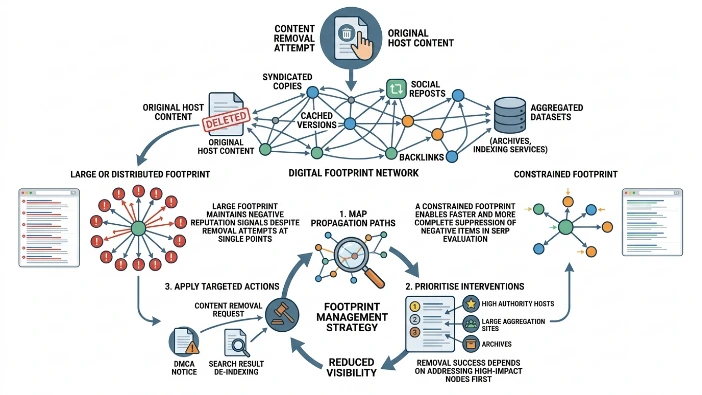
The movement of personal information also creates a chain of digital copies. One compromised dataset can be duplicated across different sources, increasing its persistence after the original breach is addressed. This makes data exposure a distribution problem rather than a single-location event. Understanding that distribution is important when evaluating the overall digital footprint associated with an individual or entity.
Why Is Stolen Personal Information Valuable on Dark-Web Markets?
Stolen personal information has value because individual data points can be combined to create more complete identity profiles. An email address alone represents one identifier, while an email address combined with a name, password, location, account details, or other records creates a more extensive dataset. Illicit markets therefore treat personal information as a transferable digital asset. The value of the information depends on factors such as freshness, accuracy, completeness, uniqueness, and potential misuse.
Credentials are particularly significant because compromised passwords and authentication information can connect previously separate accounts. Reused credentials increase the relationship between different parts of a person’s digital footprint. Other personal identifiers can also strengthen these connections by linking names, usernames, email addresses, and publicly available information. The resulting data structure provides a more detailed representation of the affected entity.
From a reputation perspective, this information creates an indirect risk. Search engines do not treat dark-web listings as conventional reputation signals in the same way they evaluate indexed webpages, reviews, or authoritative publications. However, exposed information can migrate into public discussions, websites, breach databases, or search-indexed documents. The privacy exposure can therefore eventually influence the visible information environment surrounding an entity.
How Do Data Breaches Turn Personal Information Into Searchable Content?
A data breach becomes relevant to search visibility when information or references to the breach appear on websites that search engines can crawl and index. Search engines evaluate publicly accessible webpages according to relevance, authority, content relationships, and other ranking signals. A dark-web listing itself does not need to rank in a SERP for the underlying breach to become part of an entity’s online information environment. Public reporting, security research, database references, and discussion pages can create indexed associations with the affected person or organisation.
Content indexing is the process through which search engines discover, process, and store information from webpages for potential inclusion in search results. Information contained within private or inaccessible systems does not automatically enter a search engine’s index. However, references to the same data can appear on indexed pages. This creates a distinction between data exposure and search exposure.
The distinction is important for reputation analysis. A person’s information can exist within an illicit data environment without appearing in branded searches. Conversely, a breach can generate significant search visibility when authoritative websites publish reports connected to the affected entity. SERP evaluation therefore focuses on what users can discover through search, while privacy analysis examines the broader existence and circulation of the underlying information.
How Does the Dark Web Differ From the Deep Web and Surface Web?
The surface web consists of internet content that conventional search engines can discover and index, while the deep web includes content that is not normally indexed because it sits behind authentication, technical restrictions, or private systems. The dark web represents a smaller portion of the deep web that uses specialised networks and access mechanisms. These categories describe accessibility and discoverability rather than the nature or legality of every piece of information hosted there.
This distinction matters when analysing personal information exposure. A private customer database represents deep-web information because it is inaccessible to ordinary search crawlers, while a publicly indexed webpage discussing a breach belongs to the surface web. A stolen dataset traded through a hidden service belongs to the dark web. The same underlying personal information can therefore exist simultaneously across different layers of the internet.
The layers also produce different reputation signals. Search engines primarily evaluate information available within their crawlable ecosystem, while dark-web monitoring focuses on sources outside conventional search visibility. Combining the two perspectives creates a more complete understanding of digital exposure. It separates what is technically exposed from what is publicly discoverable through search.
How Does Leaked Personal Information Affect an Online Reputation?

Leaked personal information affects online reputation when exposed data becomes connected with identifiable entities across publicly visible digital sources. Reputation signals are information patterns that influence how search systems and users understand an entity. A breach report containing an organisation’s name, for example, creates a different signal from a private dataset that never becomes publicly indexed. Context determines how strongly the information influences entity perception.
Search engines analyse relationships between entities, topics, documents, and queries when constructing search results. A page that associates an entity with a security incident can therefore become relevant for searches involving that entity. Authority also affects visibility because information from established publications or trusted security sources can receive stronger search ranking influence than an obscure page.
Sentiment interpretation adds another dimension. A factual security report can carry a neutral informational context, while commentary surrounding the same incident can introduce negative sentiment. Reviews, articles, forum discussions, and social references can collectively influence the sentiment distribution surrounding an entity. Reputation analysis therefore examines both the existence of information and the context in which search users encounter it.
How Do Search Engines Interpret Trust and Credibility After a Data Exposure?
Search engines evaluate trust and credibility through signals associated with webpages, entities, authorship, relevance, authority, and the broader information environment. They do not simply assign an entity a universal reputation score based on a single data breach. Instead, individual documents and their relationships with queries contribute to the search results presented to users. This makes context and source quality central to SERP evaluation.
A reputable security publication discussing a confirmed breach carries a different informational context from an anonymous webpage making an unsupported claim. Search systems analyse the content and its relationship to user queries rather than treating every mention as equally authoritative. The surrounding information therefore affects how a breach-related page contributes to search visibility.
Entity perception develops through accumulated information. Accurate profiles, authoritative publications, verified information, reviews, and other relevant sources contribute different reputation signals. A breach-related reference becomes one component within that wider ecosystem. Understanding this relationship prevents the mistaken assumption that data exposure automatically produces a uniform search penalty for an individual or organisation.
Can Personal Information From a Data Breach Appear in Google Search Results?
Personal information associated with a breach can appear in Google search results when it is published on an indexed webpage or other crawlable source. The original stolen dataset does not need to be directly indexed for related information to become searchable. News reports, security research, public breach databases, forum posts, and copied content can create indexed references. Search visibility therefore depends on where the information is published and how search engines evaluate that source.
Indexing also changes over time. A webpage can become indexed after publication and later disappear from search results following removal, deindexing, content changes, or other search-system processes. Conversely, a previously obscure reference can gain visibility when its source becomes more authoritative or relevant to a search query. Monitoring therefore requires attention to both content availability and ranking dynamics.
The search impact of leaked information also depends on query intent. A person’s name combined with terms such as “data breach” produces a different SERP from a general name search. Search engines evaluate query relevance against indexed content, meaning that the same breach reference can have different visibility across different searches. This makes query-level analysis important when assessing online reputation.
How Does Personal Information Become Part of a Digital Footprint?
A digital footprint is the collection of information and traces associated with an individual or entity across digital environments. It includes information deliberately published by the entity as well as information generated by third parties, platforms, databases, publications, and online interactions. Breach-related information can become part of this footprint when it creates an identifiable connection to the entity.
The footprint expands through duplication and association. A leaked email address can appear in a security report, forum discussion, database reference, or public document, creating multiple information nodes. Each node has its own visibility, authority, and indexing characteristics. The combined network therefore provides a more complete representation of how information about an entity circulates online.
Digital footprint analysis distinguishes controlled information from externally generated information. Official profiles and websites are usually managed directly by the entity, while third-party references operate independently. This distinction becomes important when assessing reputation signals because the entity has different levels of control over each information source. The result is a layered information environment rather than a single online profile.
Dive Deeper With Our Expert Guides:
How Exposed Personal Information Increases Your Risk of Identity Theft
Why Your Old Addresses Still Appear in Online People-Search Results
What Types of Personal Information Are Commonly Exposed?
Personal information exposed through breaches varies according to the systems involved and the type of database compromised. Common categories include contact details, account credentials, usernames, authentication information, and other identifying records. Financial or identity-related information can also appear when systems containing those records are compromised. The significance of each category depends on its sensitivity, accuracy, and ability to connect with other information.
Different data types create different forms of exposure. A public email address already appearing online represents a different risk from a newly exposed authentication credential. A username can connect accounts across platforms, while a full identity record creates a broader association between separate data points. Evaluating exposure therefore requires examining the relationships between the fields rather than counting individual pieces of information.
This distinction also affects reputation analysis. Some exposed information has limited relevance to search perception because it remains outside public search systems. Other information becomes significant when it creates indexed associations between an entity and a security incident. Privacy exposure and reputation exposure therefore overlap but remain analytically distinct.
How Can Early Detection Change the Impact of Leaked Personal Information?
Early detection improves information control by identifying exposure before leaked data develops a wider publicly visible footprint. Dark-web monitoring examines relevant hidden sources for identifiers, breach references, credentials, or datasets connected with an individual or organisation. The purpose is detection rather than direct manipulation of search results. Early awareness provides information about what has been exposed, where it appears, and whether the data is still circulating.
Monitoring also creates a timeline of exposure. Analysts can distinguish newly detected incidents from older records that continue circulating. This helps determine whether an exposure represents a new event, an existing breach, or a duplicated dataset. The distinction is important because repeated appearances do not necessarily represent separate breaches.
The relationship between detection and reputation management becomes stronger when exposed information reaches public search environments. Dark web monitoring for leaked personal information provides a framework for understanding how early detection connects privacy exposure with wider digital footprint analysis. Monitoring hidden sources and analysing public search visibility address different layers of the same information ecosystem.
How Do Privacy Exposure and Search Reputation Intersect?
Privacy exposure and search reputation intersect when personal information moves from restricted or hidden environments into publicly accessible sources. A dark-web listing represents an exposure event, while an indexed webpage referencing the same information creates a search visibility event. These events require different forms of analysis because they operate through different technical systems.
The intersection becomes more important when exposed information is attached to an identifiable entity. Search engines can connect names, organisations, domains, usernames, and topics through relationships within indexed content. This process contributes to entity perception because users encounter those associations during search. The underlying information therefore has both privacy implications and potential reputation implications.
Effective analysis separates the two objectives. Privacy analysis asks where personal information exists and how it circulates, while reputation analysis asks how information affects public visibility, credibility, and perception. Treating them as identical creates inaccurate conclusions. Treating them as completely unrelated also ignores how information moves between hidden and public digital environments.
How Should Online Credibility Be Evaluated After Personal Information Exposure?
Online credibility is evaluated through the quality, authority, accuracy, consistency, and context of information associated with an entity. A data exposure represents one event within that broader information environment. Its significance depends on the content published about the incident, the authority of the sources, the search queries involved, and the wider set of reputation signals surrounding the entity.
Evaluation therefore requires examining the SERP rather than focusing solely on the original breach. Search results reveal which information users encounter, which sources receive prominent positions, and how the entity is represented across different queries. This provides a practical measurement of search perception. It also distinguishes private exposure from public visibility.
A balanced assessment considers authoritative information alongside breach-related references. Accurate corporate profiles, official information, trusted publications, and relevant third-party sources provide contextual signals that help users interpret an entity. This does not erase a security incident, but it demonstrates why search reputation is formed through a broader information ecosystem. Entity credibility is consequently a cumulative concept rather than the result of one isolated document.
Personal information reaches the dark web through data breaches, unauthorised access, credential theft, database exposure, and illicit data trading. The dark web itself is distinct from the searchable surface web, but information connected with dark-web incidents can migrate into public webpages, reports, databases, forums, and other indexed sources. This movement creates a connection between privacy exposure, digital footprint development, and search visibility.
Reputation management is therefore relevant to understanding how exposed information affects entity perception after it enters public search ecosystems. Search engines evaluate indexed content through relevance, authority, context, and relationships between entities and queries. Reputation signals develop from this wider information environment rather than from one isolated incident.
The key distinction is between data exposure and search exposure. Data can exist in hidden environments without becoming publicly searchable, while references to the same incident can become prominent through authoritative indexed sources. Understanding this distinction provides a clearer framework for evaluating online credibility, SERP composition, content indexing, and the wider digital footprint associated with personal information.
How does personal information end up for sale on the dark web?
Personal information typically reaches dark-web marketplaces through data breaches, credential theft, malware, database exposure, or unauthorised access. Stolen records can then be copied, aggregated, and traded through hidden online networks.
What personal information is commonly sold on the dark web?
Commonly exposed information includes email addresses, usernames, passwords, contact details, authentication data, and other identifying records. The significance of exposed data depends on its sensitivity, accuracy, and how it connects with other personal information.
Can information sold on the dark web appear in Google search results?
The original dark-web listing is not normally indexed by conventional search engines, but related breach reports, databases, forum posts, and public references can appear in search results. This can create searchable reputation signals associated with an individual or organisation.
How does leaked personal information affect online reputation?
Leaked information can affect online reputation when breach-related references become publicly visible and associated with an identifiable person or organisation. Search visibility, source authority, context, and sentiment influence how these references contribute to entity perception.
Can dark web monitoring detect leaked personal information early?
Yes, dark web monitoring can identify exposed identifiers, credentials, breach references, and datasets across relevant hidden sources. Early detection helps establish what information has been exposed and supports assessment of related privacy and digital footprint risks.