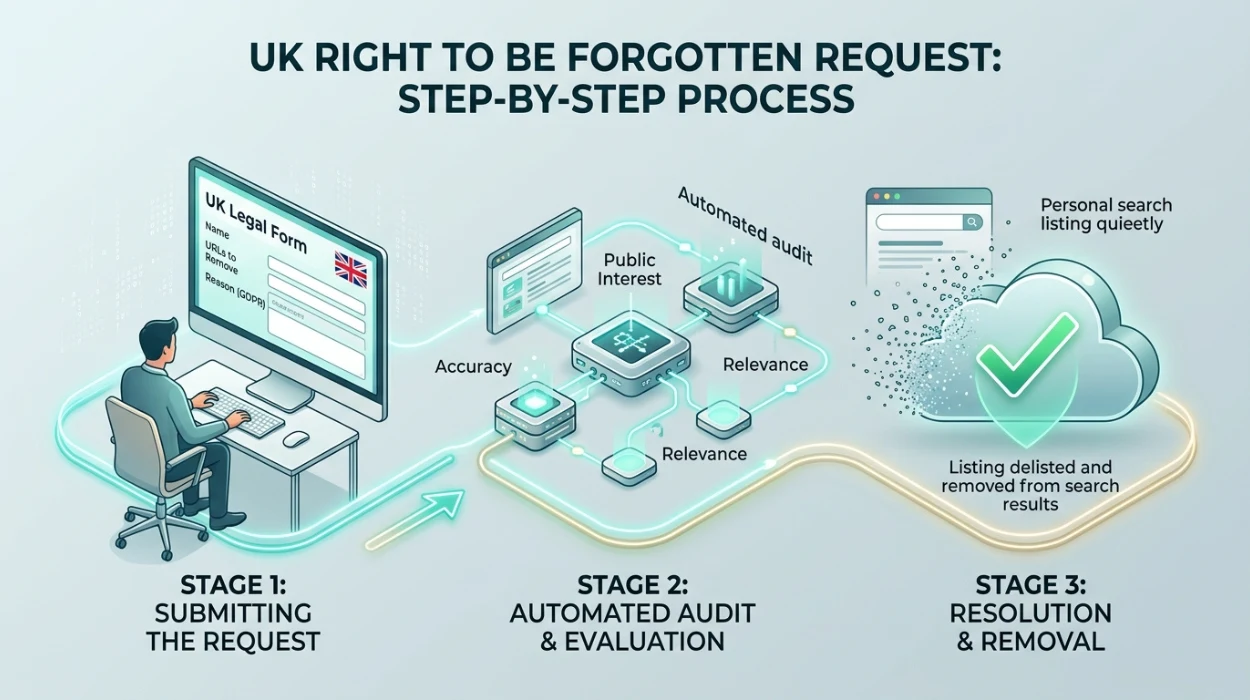
The Right to Be Forgotten request process operates through a structured legal and search evaluation framework rather than an automatic removal system. Reputation management strategies differ based on the type of information involved, the applicable legal criteria, and how search engines evaluate reputation signals within search ecosystems.
Online reputation control methods are evaluated through search ranking influence, entity credibility, content indexing, and legal compliance. Understanding the practical stages of the Right to Be Forgotten process requires analysing how search engines balance privacy rights, public interest, and search visibility when assessing individual requests.
How does the Right to Be Forgotten request process compare with other reputation management approaches?
The Right to Be Forgotten request process is a legal mechanism for requesting the removal of eligible personal information from search engine results. Unlike broader reputation management approaches, it focuses on search visibility through legal assessment rather than changing overall online sentiment or creating additional content. The process operates by evaluating whether indexed information continues to satisfy the legal conditions established under UK GDPR and the Data Protection Act 2018.
Content removal strategies differ from content enhancement because each influences SERP composition through different mechanisms. Removal requests reduce the discoverability of qualifying information, whereas content enhancement introduces additional authoritative material that influences search ranking distribution over time. Both approaches affect reputation signals, although they operate through separate technical and legal processes.
Organic reputation management develops through continuous publication, authority building, and trust signal improvement. Reactive approaches respond to existing visibility issues by addressing already indexed content. Organic methods generally strengthen long-term entity credibility, while reactive methods address immediate visibility concerns relating to specific information.
These distinctions demonstrate that the Right to Be Forgotten forms one component within a wider reputation management framework. Its effectiveness depends on legal eligibility rather than search optimisation techniques alone.
Why are some Right to Be Forgotten requests accepted while others are refused?
Acceptance depends upon how search engines evaluate competing legal and public interest considerations. A request succeeds when continued indexing no longer satisfies the balance between individual privacy rights and legitimate public access to information. Refusal occurs where search visibility continues serving an important public purpose or where legal requirements for removal remain unmet.
Search engines analyse multiple reputation signals before making decisions. Information accuracy, publication authority, relevance, age, ongoing public significance, and the individual’s role all contribute to SERP evaluation. These factors collectively determine whether reducing search visibility aligns with applicable legal obligations.
Entity credibility also influences evaluation indirectly because authoritative publications frequently carry stronger informational value within search ecosystems. Search engines recognise the reliability of established publishers while simultaneously assessing whether continued indexing remains proportionate under privacy legislation.
The evaluation therefore extends beyond a simple legal checklist. Search visibility results from the interaction between algorithmic indexing systems, legal review procedures, and broader public interest considerations.
How do evaluation criteria compare?
The principal evaluation criteria operate together rather than independently.
- Assess relevance by determining whether the indexed information remains current and proportionate.
- Compare privacy interests against legitimate public interest before balancing competing rights.
- Evaluate publication authority to understand the informational significance of the source.
- Measure ongoing search ranking influence across name-based search queries.
Each criterion contributes to the overall assessment instead of determining the outcome independently.
How do search engines interpret reputation signals during the request process?
Reputation signals are indicators that assist search engines in evaluating the credibility, relevance, and accessibility of indexed information. The Right to Be Forgotten request process interacts with these signals because removal decisions affect which webpages remain visible within search engine results pages.
Search engines interpret authority relationships, structured information, content quality, publication history, and user search intent when organising SERPs. Reputation signals therefore extend beyond the content itself and include the broader context surrounding publication. A highly authoritative news article carries different evaluative significance from an anonymous webpage because authority contributes directly to entity credibility.
Search ranking influence also changes over time as content ages, user behaviour develops, and new information enters search ecosystems. Older material does not automatically lose visibility because search engines continue evaluating authority alongside relevance. Consequently, historic personal information frequently remains prominent where strong authority relationships continue supporting its ranking position.
This explains why legal review forms an important element of the Right to Be Forgotten process. Algorithmic relevance alone cannot determine whether privacy rights justify reduced search visibility.
Which practical stages define the Right to Be Forgotten request process?
The request process follows a structured sequence that combines legal review with search engine evaluation. Each stage contributes different information before a final determination regarding search visibility occurs.
How does each stage operate?
- Identify the specific URLs associated with name-based search visibility and determine which indexed results are relevant.
- Evaluate whether the information satisfies UK GDPR eligibility criteria relating to privacy, relevance, proportionality, and public interest.
- Submit the request together with supporting evidence explaining why continued indexing no longer remains justified.
- Review the submission through legal assessment alongside search engine evaluation processes.
- Determine whether eligible URLs receive reduced visibility within applicable search results while maintaining compliance with legal obligations.
Each stage demonstrates that the process operates through structured evaluation rather than immediate removal. Search engines continue balancing legal requirements against public information interests throughout the assessment.
How do content suppression and content enhancement differ when evaluating long-term effectiveness?

Content suppression and content enhancement represent two distinct reputation management strategies that influence search ecosystems through different mechanisms. Content suppression focuses on reducing the visibility of specific indexed information where legal, technical, or policy-based grounds exist. Content enhancement strengthens the overall search landscape by increasing the presence of authoritative and relevant material.
Their long-term effectiveness differs because each addresses separate aspects of search ranking influence. Suppression directly changes SERP composition where eligible information becomes less discoverable. Enhancement gradually redistributes reputation signals by expanding authoritative digital assets that search engines recognise during ongoing evaluation.
From an analytical perspective, suppression produces targeted visibility changes, whereas enhancement contributes broader improvements in entity credibility. Neither method replaces the other because both respond to different search ecosystem conditions. Understanding these operational differences provides a clearer basis for evaluating appropriate reputation management strategies.
How do short-term and long-term outcomes compare within the Right to Be Forgotten process?
Short-term and long-term outcomes differ because they operate through separate mechanisms within search ecosystems. The Right to Be Forgotten process produces short-term effects by changing the visibility of eligible search results once a request has been approved. Long-term reputation stability depends on how search engines continue evaluating authority, relevance, content freshness, and evolving reputation signals after the initial decision.
Short-term changes primarily affect discoverability during name-based searches. Eligible URLs become less visible within applicable search engine results, altering the composition of the SERP without changing the underlying publication. This adjustment influences immediate entity perception because users encounter a different set of indexed results during their first search.
Long-term impact develops through continuous algorithmic evaluation. Search engines reassess indexed information as authority relationships evolve, new content appears, and search behaviour changes. Reputation signals therefore remain dynamic rather than fixed, meaning overall search visibility reflects ongoing evaluation rather than a single legal outcome.
Comparing these outcomes demonstrates that the Right to Be Forgotten addresses one element of digital reputation rather than the complete reputation ecosystem. Search ranking influence continues developing as search engines interpret updated information alongside historical records.
How scalable and sustainable is the Right to Be Forgotten process compared with other approaches?
Scalability refers to the ability of a reputation management method to address increasing volumes of indexed information across multiple search results. Sustainability refers to whether the method continues supporting balanced search visibility over time without relying on constant intervention. The Right to Be Forgotten process provides targeted legal evaluation for individual URLs rather than broad reputation management across an entire digital footprint.
Compared with content enhancement, the process offers limited scalability because each request normally requires separate assessment against legal criteria. Content enhancement influences wider sections of a digital footprint through continuous publication and authority development, allowing search ecosystems to evaluate additional reputation signals across multiple indexed assets.
From a sustainability perspective, both approaches operate differently. The Right to Be Forgotten maintains reduced visibility only where legal conditions continue supporting the original decision. Content enhancement develops sustainable authority through ongoing publication, structured information, and consistent reputation signals recognised by search engines over time.
This comparison illustrates that legal removal mechanisms and organic reputation development fulfil different functions. Their effectiveness depends upon the specific reputation objectives being evaluated rather than a universal measure of success.
How do scalability factors compare?
Scalability differs according to operational scope and evaluation requirements.
- Evaluate individual URLs through legal assessment within the Right to Be Forgotten process.
- Expand digital authority by publishing credible information across multiple trusted platforms.
- Strengthen reputation signals through consistent entity references and structured content.
- Maintain search visibility through continuous indexing and authority development.
Each method operates within distinct technical and legal boundaries, producing different scalability characteristics.
Dive Deeper With Our Expert Guides:
What GDPR Rights You Have When Removing Personal Information From Google UK
What Google’s Privacy Tools Allow When Requesting Phone Number Removal
What risk factors influence the effectiveness of Right to Be Forgotten requests?
Risk exposure forms part of every reputation management evaluation because search visibility depends upon legal, technical, and informational variables operating simultaneously. The Right to Be Forgotten process reduces certain visibility risks for eligible information, although it does not remove every reputation-related challenge within search ecosystems.
One significant factor involves public interest evaluation. Information serving an ongoing public purpose frequently remains indexed despite privacy requests because search engines balance competing legal rights before reaching a decision. Authority relationships also influence evaluation, particularly where established publishers provide information considered relevant to public understanding.
Technical limitations represent another consideration. Search engines evaluate only indexed search visibility, meaning original publisher websites continue existing unless separate legal or editorial action affects publication. Reputation signals therefore continue developing through remaining indexed sources and newly published information.
Comparing these risks demonstrates that the Right to Be Forgotten operates within defined legal boundaries rather than offering universal removal. Understanding these limitations improves interpretation of how search visibility evolves after legal assessment.
Which analytical considerations help evaluate the most appropriate reputation management approach?
Analytical evaluation compares methods according to legal eligibility, search ranking influence, sustainability, scalability, and overall impact on entity credibility. No single approach addresses every reputation challenge because different search ecosystem conditions require different operational mechanisms. Evaluating these characteristics provides a structured basis for understanding how each strategy functions.
The Right to Be Forgotten operates by reducing eligible search visibility through legal review. Content suppression evaluates whether existing information satisfies removal requirements under applicable law or platform policies. Content enhancement strengthens reputation signals through authoritative publishing and improved entity associations. Organic reputation management develops credibility gradually, whereas reactive approaches address already indexed material requiring immediate evaluation.
Search engines interpret these activities collectively rather than independently. Reputation signals emerge from authority relationships, content indexing, search intent, structured data, and user behaviour. Consequently, the composition of a SERP reflects the interaction of multiple evaluation systems instead of one isolated ranking factor.
Understanding these comparative mechanisms enables more accurate assessment of reputation management strategies. Evaluation therefore focuses on operational effectiveness, legal suitability, sustainability, and long-term search ecosystem behaviour rather than assuming a single universal solution.
The Right to Be Forgotten request process represents a structured legal mechanism for evaluating whether eligible personal information continues to justify search visibility within UK search ecosystems. Its operation differs from broader reputation management methods because it changes discoverability through legal assessment rather than altering the original source material or relying upon content publication.
Comparative analysis demonstrates that removal requests, content suppression, content enhancement, and organic reputation development each operate through distinct mechanisms. Their effectiveness varies according to legal eligibility, search ranking influence, scalability, sustainability, and the balance between privacy rights and public interest.
Search engines continue interpreting reputation signals through authority relationships, entity credibility, sentiment distribution, and content indexing. Understanding these interacting systems provides a clearer framework for evaluating how the Right to Be Forgotten functions alongside wider reputation management strategies within the United Kingdom.
How does the Right to Be Forgotten request process work in the UK?
The Right to Be Forgotten request process involves submitting a request to a search engine to assess whether eligible personal information qualifies for reduced search visibility under UK GDPR. The decision is based on privacy rights, public interest, relevance, and the continued necessity of indexing the content.
What information can be removed through a Right to Be Forgotten request?
Eligible personal information that is inaccurate, outdated, excessive, or no longer relevant may qualify for reduced visibility in search results. The original webpage usually remains online unless the publisher independently removes the content.
Why are some Right to Be Forgotten requests rejected?
Search engines reject requests when the information serves an ongoing public interest or remains relevant for transparency, public safety, or legal reporting. They balance individual privacy rights with the public’s right to access information before making a decision.
What is the difference between the Right to Be Forgotten and Personal Information Removal Services?
The Right to Be Forgotten is a legal process that requests the removal of eligible search results, while Personal Information Removal Services evaluate different legal and technical routes for reducing online visibility. Clear Your Name can help assess the most appropriate approach based on the nature of the indexed content and UK data protection requirements.
Does the Right to Be Forgotten completely remove content from Google?
No. A successful Right to Be Forgotten request generally removes eligible search results associated with a person’s name, not the original webpage itself. If the source website continues to publish the content, it may still be accessible through direct links or other search queries.