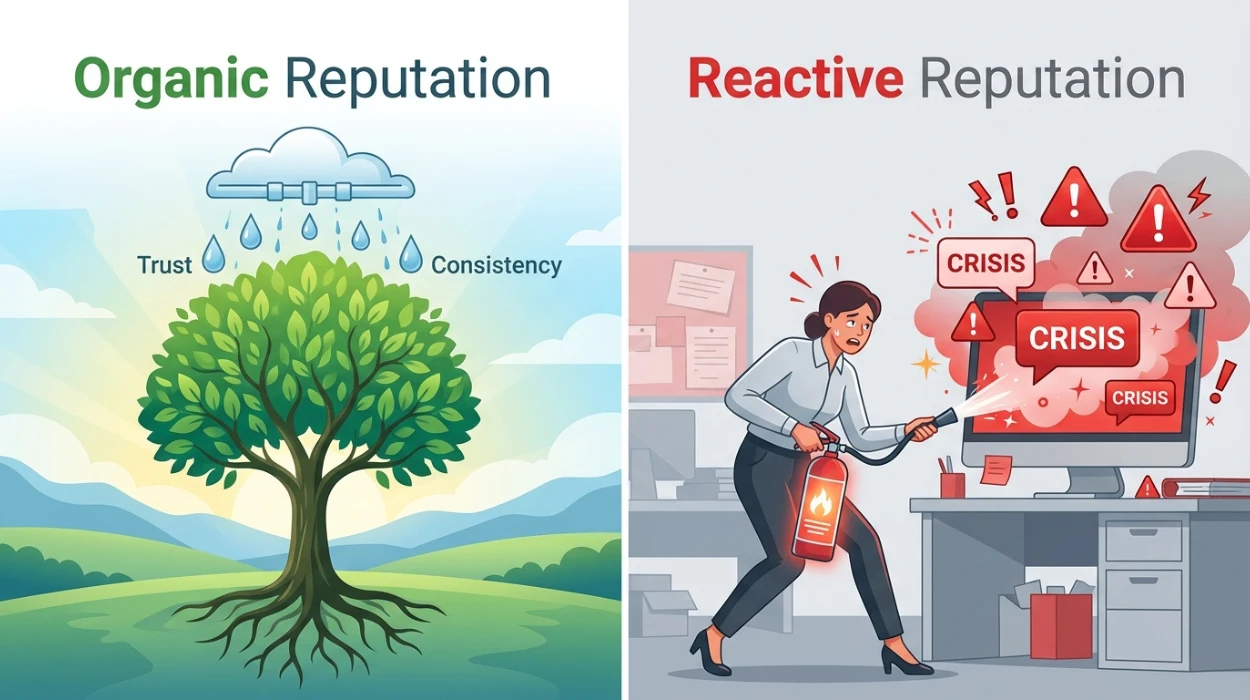
An Indeed refusal to remove a review means the initial moderation route has not resulted in removal under the platform’s applicable rules. An effective appeal analysis therefore focuses on identifying the relevant policy basis, presenting evidence that addresses that basis, and separating content-removal issues from broader reputation management.
Reputation management strategies differ based on whether the objective is content removal, search-result influence, or broader entity credibility. Online reputation control methods are evaluated through policy eligibility, search visibility, reputation signals, risk exposure, scalability, and long-term sustainability.
What is the most effective approach after an Indeed review removal refusal?
The most effective approach is to reassess the review against the specific content rules rather than simply repeating the original removal request. Indeed states that reviews can be reported when they breach its guidelines, including restrictions covering unlawful, fraudulent, discriminatory, threatening, abusive, libellous or defamatory statements, irrelevant material, personal information, and attempts to present company claims as established facts.
A policy-based reassessment is different from an objection based on negative sentiment. Content removal is a compliance mechanism, meaning the relevant question concerns whether the content falls within a prohibited category. Disagreement with the review’s tone, conclusions, or criticism does not by itself establish a policy violation.
The distinction also affects reputation risk. A weak appeal that focuses on disagreement creates little new information for moderation, whereas a structured submission that identifies a precise guideline issue provides a clearer basis for reassessment. The approach therefore depends on evidence quality rather than the intensity of the objection.
How does a policy-based appeal compare with a general complaint?
A policy-based appeal provides a stronger analytical structure than a general complaint because it connects the disputed content to a defined moderation rule. Indeed’s published guidance explains that content violating its guidelines can be removed, while compliant negative experiences remain within the permitted review framework.
A general complaint normally centres on disagreement with the review itself. This approach treats reputational harm as the primary argument, while a policy-based approach treats the platform’s content standards as the primary evaluation framework. The latter creates a clearer relationship between the evidence submitted and the moderation decision being challenged.
This distinction is important for search reputation because content removal and reputation repair operate at different levels. Removal addresses the source document, while reputation management examines the wider SERP composition and entity representation. An appeal therefore has a narrow content objective, whereas broader reputation analysis evaluates the information environment surrounding the content.
What evidence makes an Indeed review appeal more relevant?
Relevant evidence directly demonstrates why the review conflicts with an applicable content rule. Examples include evidence that identifies personal information, defamatory content, discriminatory language, irrelevant material, or claims presented as factual assertions rather than personal workplace experience. Indeed states that reviews are expected to represent the reviewer’s own opinions and experiences and identifies categories of content that are not permitted.
Evidence quality is more important than evidence volume. A long submission containing unrelated complaints creates weak semantic alignment with the moderation criterion, while a concise explanation connected to a specific passage creates a clearer evidential relationship. The evaluation framework therefore prioritises relevance, traceability, and policy alignment.
The evidence also needs to distinguish factual disagreement from policy non-compliance. A business disputing the truth of a negative statement does not automatically demonstrate that the statement violates the review rules. This distinction reduces the risk of treating reputation concerns as equivalent to moderation eligibility.
Is appealing removal more effective than suppressing negative search results?
Appealing removal and content suppression address different layers of reputation management. An appeal attempts to change the availability of the original review, while suppression or content enhancement focuses on changing the composition and visibility of information appearing in search results.
Content suppression operates by increasing the relative visibility of other relevant pages so that negative material occupies less prominent SERP positions. Content enhancement operates by developing useful, authoritative information that strengthens the broader digital footprint. Neither method changes the moderation status of the original review.
The comparative advantage depends on the underlying problem. When content clearly breaches a platform rule, removal provides a direct route to changing the source document. When the content remains within platform guidelines, broader search strategies address visibility and entity perception without relying on removal.
How does organic reputation management compare with reactive review appeals?
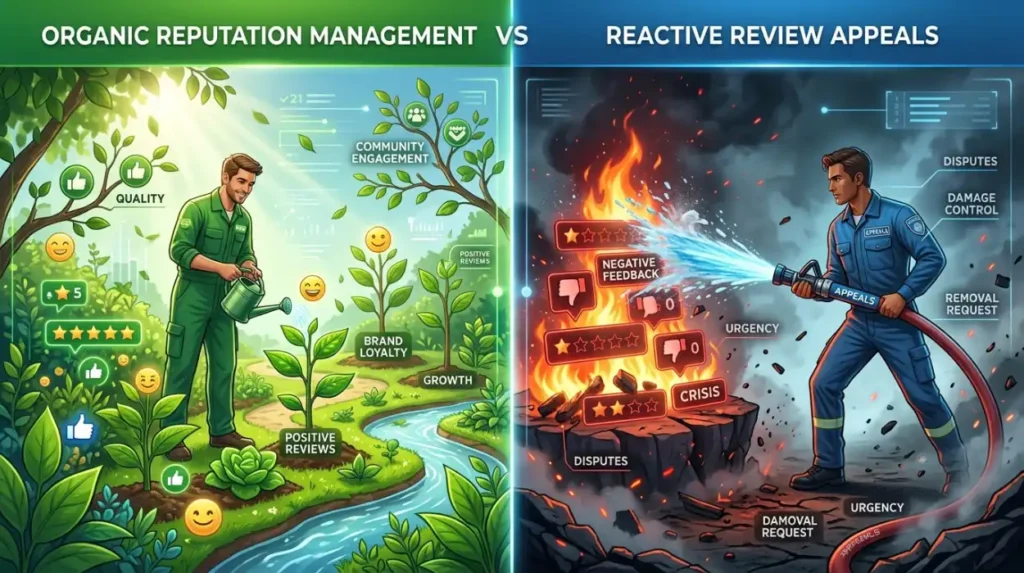
Reactive review appeals address an identified reputation event, whereas organic reputation management develops the wider information environment over time. A reactive approach begins with a specific review, moderation decision, or search-result problem. An organic approach builds relevant content, authoritative references, and consistent entity information without depending on a single disputed document.
Reactive methods have a narrower scope and a more immediate objective. Their effectiveness depends on whether the triggering content meets a defined removal or moderation criterion. Organic methods have a broader scope but require sustained content development and consistent information architecture.
The distinction becomes important when evaluating search ranking influence. A successful appeal can remove one reputation signal from a platform, but it does not automatically replace that signal with stronger information in search results. Organic reputation management directly addresses SERP composition by expanding the range of relevant information available to search systems and users.
When is content removal preferable to content enhancement?
Content removal is more directly aligned with a problem when the underlying material violates an applicable platform policy. Indeed states that content breaching its guidelines can be removed, while compliant reviews remain available.
Content enhancement becomes more relevant when removal is unavailable or when the reputation issue extends beyond one review. This approach develops additional information that contributes to the entity’s digital footprint, such as authoritative organisational pages, relevant professional content, and consistent entity references.
The two approaches also differ in sustainability. Removal depends on continued policy eligibility and the platform’s moderation framework. Enhancement creates a broader information environment that does not depend entirely on one platform decision, although its search impact remains dependent on indexing, relevance, authority, and ranking systems.
How does short-term removal differ from long-term reputation repair?
Short-term removal focuses on changing the status of one piece of content. If the content qualifies for removal, the direct effect concerns the availability of that specific review. This creates a defined outcome but does not automatically alter the entire search ecosystem associated with the entity.
Long-term reputation repair evaluates the complete distribution of reputation signals. It considers which pages rank for branded queries, how sentiment is distributed across visible sources, whether authoritative information is available, and how consistently the entity is represented across digital properties.
The strategic difference is therefore between source-level correction and ecosystem-level improvement. Source-level correction addresses a particular document, while ecosystem-level improvement addresses the balance of information available to searchers. A sustainable reputation framework evaluates both rather than assuming that one removed review resolves every search perception issue.
Dive Deeper With Our Expert Guides:
How to Escalate Beyond Indeed’s Flagging Tool When It Fails
What an Enterprise Indeed Review Management Strategy Should Include
How does a refused review affect SERP composition?
A refused review can remain part of the available information environment, but its presence does not automatically determine its position in search results. SERP composition reflects the interaction between query relevance, content quality, authority, indexing, user intent, and other search signals.
The review becomes more significant when its page is highly visible for queries connected with the entity. Branded searches, employer-related queries, and reputation-focused searches can expose different sections of the digital footprint. The same review therefore has different practical significance depending on the queries for which its associated page appears.
Search reputation analysis measures this relationship rather than assuming that publication equals high visibility. A published review can have limited search influence if it has weak visibility, while a highly visible page can become a stronger reputation signal because it occupies a prominent position in the SERP.
How should reputation signals be measured after an appeal?
Reputation signals are best measured through changes in content status, indexing, ranking position, sentiment distribution, and entity context. These metrics distinguish whether an appeal changed the original content from whether the wider search environment changed independently.
A useful evaluation framework is:
- Check the content status by determining whether the disputed review remains published or has been removed following moderation.
- Measure search visibility by monitoring whether the review page appears for relevant branded and reputation-related queries.
- Evaluate sentiment distribution by analysing whether negative, neutral, and positive sources dominate visible search results.
- Assess entity credibility by reviewing whether authoritative and relevant sources provide consistent information about the organisation.
- Compare SERP composition by examining which pages occupy prominent positions before and after the reputation-management activity.
This framework separates platform outcomes from search outcomes. It also prevents a successful removal decision from being incorrectly treated as proof that the complete digital reputation has been repaired.
What are the limitations of appealing an Indeed review refusal?
The principal limitation is that an appeal remains dependent on the platform’s content standards. A negative review that complies with those standards does not become removable simply because it has a reputational impact. Indeed explicitly states that it does not guarantee the accuracy of user-generated Company Page content or endorse it.
A second limitation concerns scope. Removing one review does not automatically remove references to the same information elsewhere on the internet. Search engines also process other pages, profiles, discussions, documents, and references connected with the entity.
A third limitation concerns search ranking influence. Even when a review disappears from its original platform, search results do not necessarily change immediately or completely. Search engines independently process indexed content, meaning the wider digital footprint continues to influence entity perception and SERP composition.
How does an appeal compare with broader reputation management strategies?
An appeal is a reactive, source-specific strategy, while broader reputation management evaluates the entire information ecosystem. The appeal targets the moderation status of one review, whereas content enhancement targets the visibility and credibility of other information associated with the entity.
The appeal has a clear decision point because the relevant question is whether the content qualifies for removal under the applicable rules. Broader reputation management has a wider measurement framework involving search visibility, authority, sentiment distribution, entity consistency, and content indexing. This makes direct comparison possible but prevents the two strategies from being treated as substitutes.
The strongest analytical model therefore treats removal and enhancement as complementary layers rather than competing solutions. Removal addresses content eligibility, while enhancement addresses search perception. When removal is unavailable, the second layer becomes more important because reputation signals continue to operate within the broader search ecosystem.
What is the most sustainable approach to an Indeed review refusal?
The most sustainable approach is to evaluate the refusal at both the content-policy level and the search-ecosystem level. The first evaluation establishes whether the review contains a specific policy issue that supports further moderation consideration. The second evaluates how the review contributes to search visibility, entity credibility, sentiment distribution, and the wider digital footprint.
This two-layer model reduces strategic overdependence on removal. A policy-based appeal remains relevant when identifiable grounds exist, while broader content enhancement addresses the surrounding information environment when the review remains compliant. The distinction also clarifies risk because each method has a different dependency: removal depends on moderation eligibility, while enhancement depends on search visibility and content performance.
Long-term sustainability therefore comes from measuring the relationship between content status and search perception. A removed review represents a change at the source level, while a balanced SERP represents a change at the search-perception level. Reputation management becomes more robust when both outcomes are analysed separately.
Which approach works best after a refused review removal?
A policy-based appeal is the most direct approach when a review contains identifiable material that conflicts with applicable content guidelines. Content enhancement provides a broader strategy when the review remains compliant, because it addresses SERP composition, search visibility, and the distribution of reputation signals rather than relying exclusively on removal.
The key difference is between content suppression vs content enhancement. Removal attempts to reduce the availability of a specific reputation signal, while enhancement develops additional authoritative information that changes the wider information environment. Organic strategies generally address long-term entity credibility, whereas reactive appeals address a specific moderation event.
A complete evaluation therefore considers effectiveness, scalability, risk exposure, and sustainability together. The outcome of an appeal represents only one layer of reputation management; the wider digital footprint, indexing environment, sentiment distribution, and SERP composition determine how the entity continues to be represented in search.
For the next stage of this consideration process, the relevant commercial-intent topic is Appeal a Refused Indeed Review Removal With Our UK Support.
How can I appeal an Indeed refusal to remove a review?
You can appeal an Indeed refusal by reviewing the reason given, gathering evidence that the review violates Indeed’s content guidelines, and submitting a clear reconsideration request. A structured appeal should focus on specific policy issues rather than simply disputing the reviewer’s opinion.
What should I include in an Indeed review removal appeal?
Include the review URL, relevant screenshots, the reason you believe the content violates Indeed’s policies, and any supporting evidence. Clear Your Name can help organise the information so the request addresses the specific grounds for removal.
Can Indeed remove a review after rejecting a previous removal request?
Yes, a rejected request does not necessarily prevent further review if you can provide relevant evidence or identify a policy violation that was overlooked. A stronger appeal should address the original refusal and explain why the review meets Indeed’s removal criteria.
What happens if Indeed refuses to remove a review again?
If Indeed maintains its refusal, you can reassess whether the review breaches its policies and consider other reputation management options. These may include responding appropriately, monitoring search visibility, and addressing misleading or harmful information through relevant channels.
Can Clear Your Name help with an Indeed review removal appeal?
Clear Your Name can help assess the circumstances surrounding an Indeed review and structure an appeal based on relevant content and platform policies. The outcome ultimately depends on Indeed’s review process and whether the submitted evidence supports removal.