
An enterprise Indeed review management strategy needs structured monitoring, response governance, sentiment analysis, escalation controls and location-level consistency. Reputation management strategies differ based on whether an organisation prioritises reactive review handling, proactive reputation development, content enhancement or removal-focused intervention.
Online reputation control methods are evaluated through their influence on reputation signals, entity credibility, search visibility, risk exposure and long-term sustainability. For enterprise employers, the complexity increases because reviews can originate from different locations, departments, employee groups and operational contexts, creating a distributed reputation environment that requires consistent analysis rather than isolated responses.
What should an enterprise Indeed review management strategy prioritise?
A centralised governance model provides the strongest foundation because enterprise review activity spans multiple locations and operational teams. Indeed reviews contain reputation signals relating to workplace culture, management, compensation, career development and employee experience, making structured classification essential. A central process defines how reviews are monitored, categorised, escalated and answered across the organisation. Local teams can contribute contextual information while central governance maintains consistency in tone, accuracy and risk controls. This approach also creates comparable data across locations, allowing sentiment distribution to be evaluated rather than treating each review as an independent event.
An enterprise strategy also needs clear distinctions between review monitoring and reputation intervention. Monitoring identifies changes in review volume, ratings, recurring themes and sentiment, while intervention determines how the organisation responds to those changes. The distinction matters because a high volume of reviews does not automatically indicate a reputation problem, while a smaller number of highly critical reviews can create significant perception risks when they rank prominently. Measuring review activity alongside content visibility provides a more complete representation of the employer reputation environment.
How does content enhancement compare with review removal strategies?
Content enhancement focuses on increasing the visibility and relevance of accurate, useful information, whereas removal strategies focus on addressing specific content that qualifies for removal under applicable platform rules or legal frameworks. Content enhancement operates by developing authoritative information that strengthens the broader information ecosystem surrounding an employer. Removal operates through platform processes, policy enforcement or legally recognised mechanisms rather than through ordinary search optimisation. The two approaches therefore influence reputation conditions through different mechanisms and cannot be treated as interchangeable.
Content enhancement has greater relevance when negative reviews remain legitimate and compliant with platform rules but exist within an imbalanced information environment. Publishing accurate corporate information, employer resources and credible third-party material can strengthen the wider entity profile, although it does not directly erase negative reviews. Removal strategies have a narrower application because eligibility depends on the nature of the content and the rules governing its publication. Consequently, content suppression versus content enhancement represents a strategic distinction: suppression addresses visibility or eligibility conditions, while enhancement develops stronger competing reputation signals.
Is an organic or reactive Indeed review management approach more effective?
An organic approach creates reputation signals continuously through legitimate business activity, employee engagement, accurate information and consistent review practices. A reactive approach responds after reviews, complaints or reputation issues become visible. Organic management provides greater sustainability because reputation signals accumulate through ongoing activity rather than depending exclusively on responses to negative events. Reactive management provides speed and issue-specific control but remains dependent on the appearance of a problem before intervention begins.
The strongest enterprise model combines continuous monitoring with structured reactive controls. Monitoring establishes a baseline for review volume, rating distribution and sentiment, while reactive processes define how significant changes are assessed. This combination allows an organisation to distinguish isolated criticism from recurring location-level patterns. It also prevents the response process from becoming the entire reputation strategy, which limits an organisation’s ability to influence its broader digital footprint and entity credibility.
How do short-term and long-term reputation strategies differ?
Short-term reputation management concentrates on immediate visibility and response conditions, while long-term management focuses on sustained reputation signals and stable perception. A rapid response can address inaccurate claims, clarify misunderstandings or demonstrate that a workplace concern has been recognised. Its direct influence remains limited because a response does not necessarily change the existence, ranking or prominence of the original review. Long-term strategy instead evaluates how review sentiment, authoritative content, employer information and search visibility interact over an extended period.
Search ranking influence also changes over time because search systems evaluate relevance, authority, content quality and user behaviour rather than relying on a single reputation metric. A short-term response can improve the information available to a reader evaluating a review, while a sustained content strategy can strengthen the wider entity context. Long-term measurement therefore requires more than counting responses. It evaluates whether sentiment distribution, search visibility and reputation signals are becoming more balanced across relevant queries and locations.
How should enterprise employers measure the effectiveness of review management?

Effectiveness is measured through defined reputation indicators rather than response volume alone. Useful measurements include review rating trends, sentiment distribution, review velocity, recurring themes, response coverage, location-level variation and the visibility of relevant employer content. These indicators reveal whether a strategy is addressing an underlying reputation pattern or simply increasing administrative activity. Measurement also enables comparisons between locations, allowing enterprise teams to identify whether reputation risks are concentrated in particular operational areas.
A structured evaluation framework can separate operational performance from search perception outcomes:
- Measure review velocity by tracking changes in review volume across defined periods and locations.
- Compare sentiment distribution by categorising recurring positive, neutral and negative themes across employer profiles.
- Analyse search visibility by monitoring the prominence of Indeed pages and competing reputation-related content for relevant queries.
- Evaluate response coverage by recording how consistently appropriate reviews receive accurate and policy-compliant responses.
- Identify recurring themes by linking review topics to departments, locations or operational categories where reliable information exists.
These measurements provide a more accurate assessment of enterprise reputation performance because they connect activity with observable outcomes. A high response rate, for example, does not demonstrate successful reputation control if negative sentiment continues to increase or damaging narratives remain highly visible. Conversely, a stable review environment with persistent criticism in one location indicates a different strategic issue from an organisation-wide decline in sentiment. Measurement therefore needs both aggregate and location-level analysis.
How should enterprises manage reviews across multiple locations?
Location-level segmentation provides greater analytical precision than treating every Indeed review as part of a single corporate reputation. Each location can generate a distinct sentiment distribution because management practices, workplace conditions and employee experiences differ. Central governance establishes common standards, while local analysis identifies the operational causes behind recurring review themes. This structure prevents an enterprise response from becoming so generic that it fails to address location-specific concerns.
Scalability depends on standardised processes rather than identical responses. A central framework can define classification categories, escalation thresholds, response principles and reporting formats without requiring every location to use the same wording. This distinction is important because excessive standardisation can make responses appear disconnected from the review being addressed. Effective enterprise management therefore combines procedural consistency with contextual accuracy.
How do response strategies affect trust signals and entity credibility?
Response quality influences how readers interpret the relationship between negative feedback and the organisation’s stated identity. A factual, relevant response can add context to a review and demonstrate that the employer acknowledges the subject being discussed. A defensive, repetitive or irrelevant response can introduce additional negative signals because readers evaluate the organisation’s behaviour as well as the original criticism. Response strategy therefore operates as part of the broader trust environment rather than functioning solely as customer-service communication.
Entity credibility is strengthened when information across an employer’s digital ecosystem remains accurate, consistent and verifiable. Indeed reviews form one part of that ecosystem, alongside corporate websites, professional profiles, news coverage, employer information and other third-party sources. Search systems interpret these sources through different signals, meaning a single review rarely determines the entire search perception of an organisation. The strategic objective is therefore to maintain an accurate and balanced information environment rather than attempting to eliminate all negative sentiment.
Dive Deeper With Our Expert Guides:
What Small UK Businesses Should Know About Indeed Review Removal
How to Ethically Encourage Employees to Leave Indeed Reviews
When does review removal become relevant within an enterprise strategy?
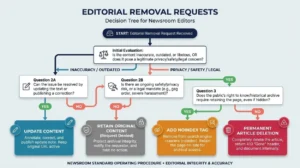
Review removal becomes relevant when specific content appears to violate the applicable platform’s policies or falls within a recognised legal or regulatory basis for removal. It is not equivalent to removing legitimate criticism simply because that criticism is negative. This distinction is central to risk management because inappropriate removal attempts can create additional scrutiny or undermine the credibility of the organisation’s reputation strategy. Removal therefore operates as a targeted mechanism rather than a universal solution for negative reviews.
An enterprise strategy needs an assessment process before pursuing removal. The review can be evaluated for policy relevance, factual context, potential legal considerations and evidence supporting any applicable violation. Content that does not meet a recognised removal criterion remains part of the reputation environment and requires alternative management methods. This creates a practical distinction between removal, response and content enhancement, with each mechanism addressing a different reputation condition.
What makes an enterprise Indeed review management plan scalable?
Scalability depends on governance, automation where appropriate, defined escalation procedures and consistent measurement. Enterprise review management becomes difficult when every location monitors reviews independently without shared classifications or reporting standards. A scalable model creates central visibility while preserving the ability to investigate local issues. It also establishes clear ownership so that monitoring, analysis, response approval and escalation do not become duplicated across departments.
A scalable Enterprise Indeed Review Management Plan therefore needs to connect monitoring with decision-making rather than treating review tracking as a standalone task. The plan can define thresholds for escalation, categories for sentiment analysis, standards for factual responses and reporting intervals for corporate leadership. These mechanisms allow review activity to be compared consistently across locations while maintaining sufficient context for local interpretation. Scalability ultimately comes from repeatable processes that maintain analytical quality as the number of locations and reviews increases.
How should enterprises balance reputation risk with sustainability?
Sustainable reputation management balances immediate intervention with long-term development of credible reputation signals. An organisation that relies exclusively on reactive responses remains exposed to recurring issues because each new review creates another isolated response requirement. An organisation that focuses exclusively on content enhancement can overlook urgent inaccuracies, policy violations or emerging negative sentiment. A balanced strategy therefore allocates different mechanisms according to the underlying reputation condition.
Risk exposure also depends on consistency and evidence. Responses need factual accuracy, removal decisions require identifiable grounds, and reputation claims need support from reliable information. Search visibility analysis provides an additional layer because the impact of a review depends partly on whether users encounter it during relevant searches. The most sustainable approach evaluates the complete information environment rather than treating Indeed reviews as an isolated reputation asset.
Which enterprise Indeed review management approach is most sustainable?
An effective enterprise Indeed review management strategy combines central governance, location-level analysis, proactive reputation development and controlled reactive intervention. Content enhancement and review removal serve different functions, while organic and reactive methods address different stages of reputation development. Short-term responses provide immediate context, whereas long-term strategies strengthen the wider reputation ecosystem and support more stable search perception.
The strategic evaluation therefore depends on effectiveness, scalability, risk exposure and sustainability rather than review response volume alone. Enterprises need to measure sentiment distribution, search visibility, reputation signals and entity credibility alongside operational indicators. This framework creates a clearer distinction between legitimate criticism, policy-relevant content, inaccurate information and broader perception issues. A structured approach ultimately provides a more reliable basis for managing enterprise-level Indeed reviews across locations without treating every reputation problem as the same type of search or content challenge.
What should an enterprise Indeed review management strategy include?
An enterprise Indeed review management strategy should include review monitoring, sentiment analysis, response management, issue escalation, and reputation reporting. It also needs consistent processes for identifying recurring employee concerns and maintaining an accurate employer reputation.
How can enterprises manage negative reviews on Indeed?
Enterprises can manage negative Indeed reviews by monitoring feedback, responding professionally where appropriate, addressing legitimate concerns internally, and identifying recurring themes. Review management focuses on improving the underlying employee experience while maintaining a balanced and credible online presence.
Why is Indeed review management important for large organisations?
Indeed reviews influence how prospective employees evaluate an organisation before applying or accepting an offer. Effective review management helps enterprises understand public employee sentiment, identify reputation risks, and maintain a more accurate representation of workplace culture.
Can enterprise review management improve an employer’s online reputation?
Yes, structured review management can improve an employer’s online reputation by increasing responsiveness, addressing recurring concerns, and encouraging authentic employee feedback. The goal is to create a balanced review profile supported by credible information rather than attempting to remove legitimate criticism.
What metrics should enterprises track for Indeed review management?
Key metrics include review volume, average rating, sentiment trends, response rates, response times, recurring topics, and changes in employee feedback over time. Tracking these indicators helps organisations measure reputation trends and identify areas requiring operational attention.