Reputation management is the process of understanding how review-related information is collected, interpreted, and evaluated across search ecosystems. Online reputation refers to the collection of review signals, authority indicators, indexed content, and entity relationships that influence how companies are perceived within search engine results pages (SERPs).
Company reviews contribute significant reputation signals because they represent publicly accessible information that search engines use to understand trust, credibility, and user experience. Reviews influence entity perception alongside business profiles, authoritative content, citations, and structured data. Understanding how review ecosystems operate explains how search visibility develops through the interaction of content indexing, sentiment interpretation, authority evaluation, and digital credibility.
What Are Professional Review Management Services for Companies?
Professional review management services for companies refer to the structured discipline of analysing how customer reviews, ratings, and feedback influence online reputation within search ecosystems. The concept focuses on understanding the relationship between review content, search visibility, and entity credibility rather than individual review responses.
Reviews exist across multiple digital platforms, including search engines, industry directories, social platforms, and independent review websites. Search algorithms evaluate these sources collectively because each contributes additional reputation signals that influence entity perception. A company’s searchable reputation therefore reflects the combined interpretation of indexed reviews rather than isolated feedback.
Review management also extends beyond collecting positive ratings. Search ecosystems evaluate review freshness, consistency, reviewer credibility, platform authority, and contextual relevance. These interconnected factors help algorithms understand whether review information provides reliable evidence of customer experience.
The discipline therefore defines how review ecosystems interact with broader reputation systems. Reviews contribute contextual information that complements structured business data, website authority, citations, and recognised entity relationships throughout digital search environments.
Why Do Reviews Influence Search Visibility?
Reviews influence search visibility because they provide search engines with measurable reputation signals that help evaluate trust, credibility, and user satisfaction. Search systems interpret reviews alongside authority signals to improve the relevance and accuracy of search results.
Review content contributes semantic information describing products, services, industries, and customer experiences. Search algorithms analyse this language to identify recurring themes, topical relevance, and contextual relationships between businesses and user expectations. This semantic evaluation strengthens entity understanding beyond basic business information.
Review quantity also contributes contextual value when combined with review quality and authenticity. Search engines compare review frequency, consistency, and freshness rather than relying solely on overall ratings. Balanced evaluation improves search accuracy because algorithms interpret ongoing customer feedback instead of isolated historical information.
Search visibility therefore develops through continuous analysis of review-related reputation signals. Indexed reviews provide additional context that helps search engines organise businesses according to authority, credibility, and relevance within competitive search environments.
How does review freshness affect search evaluation?
Review freshness refers to the recency of publicly available customer feedback across recognised review platforms. Search algorithms evaluate fresh reviews because current information improves contextual relevance and helps maintain accurate entity perception within evolving search ecosystems.
How Is Company Reputation Formed Through Review Signals?
Company reputation is formed through the interaction of review signals, authority indicators, structured information, and indexed digital content across search ecosystems. Search engines interpret these interconnected elements to establish entity credibility and determine search visibility.
Every published review contributes additional information regarding customer experiences, service quality, and business consistency. Search algorithms compare this information across authoritative review platforms before integrating it into broader reputation evaluation. Entity perception therefore develops through repeated semantic analysis rather than individual reviews.
Review sentiment also influences reputation formation. Search systems examine linguistic patterns, contextual meaning, reviewer credibility, and publication quality to understand how reviews contribute to overall digital perception. This evaluation extends beyond simple positive or negative classifications because algorithms interpret semantic relationships within broader content ecosystems.
Business reputation therefore reflects cumulative digital evidence. Reviews operate alongside corporate websites, media references, industry citations, structured data, and authoritative publications to create a comprehensive representation of organisational credibility.
How Do Search Engines Interpret Review Sentiment?
Search engines interpret review sentiment by analysing language patterns, semantic context, reviewer credibility, and topical relationships across indexed review content. Sentiment interpretation helps algorithms understand how customer feedback contributes to reputation signals without relying exclusively on numerical ratings.
Natural language processing enables search systems to identify contextual meaning within written reviews. Rather than focusing on isolated words, algorithms evaluate complete semantic structures to determine whether content represents constructive feedback, factual information, or broader customer experiences. This process improves the quality of sentiment analysis throughout search ecosystems.
Review platforms also contribute authority signals that strengthen sentiment interpretation. Feedback published on recognised platforms receives greater contextual value because trusted environments maintain stronger verification processes and higher content reliability. Search engines therefore compare both review content and source authority when evaluating credibility.
Sentiment interpretation contributes to search visibility because it enhances entity understanding. Consistent contextual signals enable search algorithms to organise businesses more accurately according to user expectations, topical relevance, and digital trust.
What Role Does Content Indexing Play in Review Management?
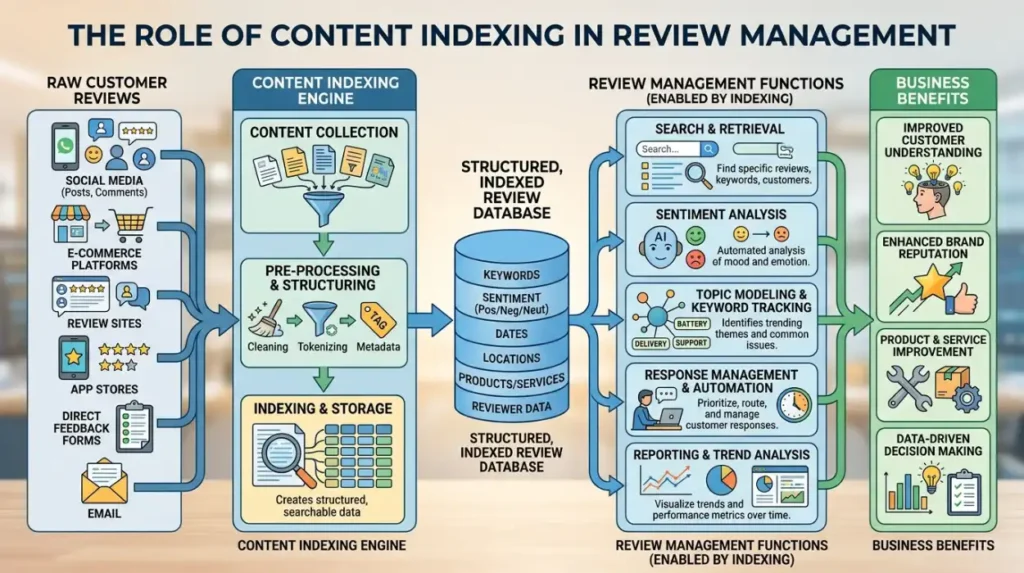
Content indexing refers to the process through which search engines discover, classify, and store review-related information for retrieval within search results. Reviews become part of searchable ecosystems only after successful indexing enables search algorithms to evaluate their relevance and authority.
Search crawlers identify publicly accessible reviews, business listings, structured information, and associated metadata before incorporating them into searchable indexes. Algorithms then compare indexed review content with broader entity information to improve semantic understanding. This relationship strengthens the connection between review platforms and overall business reputation.
Indexed reviews continue influencing search evaluation after publication because search systems regularly revisit existing content during crawling cycles. Updated reviews, revised ratings, edited responses, and additional customer feedback provide new contextual information that contributes to ongoing reputation assessment. Search visibility therefore evolves continuously as indexed review ecosystems expand.
Content indexing also supports consistency across multiple platforms. Search engines compare review information with business details, location data, and recognised entity attributes to reduce ambiguity and strengthen digital credibility. Accurate indexing therefore plays a central role in maintaining reliable reputation signals throughout modern search environments.
How Do Authority Signals Strengthen Review Credibility?
Authority signals define the reliability and trustworthiness of review-related information within search ecosystems. Search engines evaluate these signals to determine whether customer feedback contributes meaningful context to entity perception and search visibility. Review credibility therefore depends on both the quality of the review and the authority of the platform hosting it.
Authoritative review platforms maintain recognised publishing standards, consistent moderation practices, and structured business information. Search algorithms compare these characteristics when determining how much contextual value a review provides during SERP evaluation. Strong authority signals improve confidence in the accuracy and relevance of indexed review content.
Reviewer consistency also contributes to authority evaluation. Search systems analyse behavioural patterns, account authenticity, review history, and semantic consistency to distinguish reliable contributions from low-quality or manipulated content. These evaluations strengthen overall trust within digital review ecosystems.
Authority signals therefore operate as an additional layer of reputation analysis. They help search engines organise review information according to credibility, enabling more accurate entity perception across competitive search environments.
How do trusted review platforms influence search perception?
Trusted review platforms provide structured, verifiable, and consistently moderated information that strengthens reputation signals. Search engines evaluate these platforms as reliable sources because their review ecosystems improve semantic understanding and reduce uncertainty surrounding entity credibility.
Dive Deeper With Our Expert Guides:
Remove Harmful Customer Reviews from Google Maps
Expert Fake Review Removal Services for Brands
Why Is Entity Perception Important in Review Management?
Entity perception refers to the process through which search engines identify, classify, and connect a company with its reviews, business information, industry relationships, and authoritative digital references. It enables algorithms to understand the organisation as a recognised entity rather than as isolated webpages or individual reviews.
Reviews contribute directly to entity perception because they reinforce semantic relationships between customer experiences, products, services, and organisational identity. Search systems compare review language with business profiles, structured data, citations, and official websites to strengthen contextual understanding.
Consistent entity information improves search accuracy by reducing ambiguity between organisations with similar names or overlapping industries. Search engines use these semantic relationships to organise search results more effectively and present relevant information for branded and industry-specific queries.
Entity perception therefore extends beyond reputation alone. It influences knowledge graph development, enhanced SERP features, and the broader interpretation of digital credibility across search ecosystems.
How Do Review Signals Affect Digital Trust?
Digital trust refers to the confidence search engines and users establish through the evaluation of reliable, consistent, and authoritative online information. Review signals contribute to digital trust by providing publicly available evidence that supports broader reputation analysis.
Search algorithms compare review sentiment, platform authority, reviewer authenticity, structured business information, and content relevance to determine how review ecosystems contribute to overall credibility. These interconnected signals improve the accuracy of search evaluation because they provide additional context regarding business reputation.
Digital trust also depends upon consistency. Reviews that align with recognised business information, authoritative citations, and verified entity data strengthen semantic confidence within search ecosystems. Consistent information enables search engines to interpret businesses with greater certainty during ranking evaluation.
The relationship between review signals and digital trust demonstrates that online credibility develops through multiple interconnected sources rather than isolated customer opinions. Search visibility therefore reflects cumulative reputation evidence gathered across recognised digital platforms.
How Does SERP Evaluation Influence Company Reputation?
SERP evaluation refers to the process through which search engines determine the visibility, ranking, and presentation of review-related information within search results. It combines authority signals, review content, indexing behaviour, and semantic relevance to organise information according to user intent.
Review information appears in multiple SERP features, including local listings, business profiles, review snippets, knowledge panels, and organic search results. Each feature contributes additional context that influences user perception before any webpage is selected. Search visibility therefore depends on the combined presentation of these reputation signals.
Algorithms continuously compare new review information with historical reputation data to maintain accurate search results. Fresh reviews, updated ratings, revised business information, and authoritative references all contribute to evolving SERP composition. This ongoing evaluation enables search ecosystems to reflect current reputation signals while preserving long-term entity understanding.
The interaction between review signals and SERP evaluation demonstrates how search engines organise credibility across multiple digital sources. Company reputation therefore develops through the continuous interpretation of structured information, indexed content, and authoritative review ecosystems.
Throughout the analysis of review signals, authority evaluation, entity perception, and search visibility, the concepts associated with Review & Rating Removal provide additional understanding of how review-related information contributes to broader reputation management within search ecosystems.
Professional review management for companies represents the systematic analysis of how reviews, ratings, authority signals, and indexed information influence online reputation across search ecosystems. Search engines evaluate review sentiment, platform credibility, entity relationships, content indexing, and SERP composition to establish digital trust and search visibility. These interconnected mechanisms explain how company reputation develops through cumulative reputation signals rather than isolated customer feedback. Understanding these concepts provides a comprehensive framework for analysing review ecosystems and their influence on long-term online credibility.
What are professional review management services for companies?
Professional review management services for companies focus on monitoring, analysing, and managing online reviews that influence business reputation. They help organisations understand how review signals affect search visibility, entity credibility, and customer trust across digital platforms.
How do online reviews affect a company’s search rankings?
Online reviews contribute reputation signals that search engines use alongside authority, relevance, and content quality when evaluating search results. Consistent, authentic, and recent reviews can improve entity perception and strengthen visibility in search engine results pages (SERPs).
Why is review management important for online reputation?
Review management helps businesses maintain accurate and balanced reputation signals across review platforms and search engines. It supports digital trust by ensuring customer feedback contributes positively to overall entity credibility and search perception.
How do search engines evaluate review credibility?
Search engines evaluate review credibility by analysing reviewer authenticity, platform authority, review freshness, sentiment, and content relevance. These factors help determine how review information influences online reputation and SERP evaluation.
What is the difference between review management and review & rating removal?
Review management focuses on monitoring, responding to, and analysing customer feedback to strengthen online reputation over time. Review & Rating Removal specifically addresses the removal of reviews or ratings that qualify under platform policies or legal requirements, helping improve overall reputation signals where applicable.