
Removing an Indeed review containing false pay or benefit claims requires a structured reputation management process focused on content intervention, evidence and search visibility control.
A professional approach strengthens reputation signals, protects entity credibility and reduces the influence of inaccurate claims on candidates evaluating an organisation.
Can Indeed review removal services effectively address false pay or benefit claims?
Yes, professional Indeed review removal services provide a structured route for addressing reviews that contain demonstrably inaccurate or policy-relevant claims. The process begins by identifying the specific statements that create reputational risk rather than treating the entire review as a negative opinion. Evidence is then assessed against the platform’s review standards and the factual context surrounding the disputed claims. This distinction is essential because a negative opinion is different from a factual allegation that can be challenged through evidence. A precise intervention improves the quality of the removal request and reduces the risk of relying on arguments that do not address the platform’s review criteria. The result is a clearer and more defensible approach to reputation protection.
False statements about salary, benefits or employment conditions can influence candidate perception because compensation is a high-value decision factor. A review claiming that an organisation failed to provide promised benefits or misrepresented pay creates a specific reputation signal that candidates can interpret as evidence of wider employment problems. Search users frequently assess multiple signals before deciding whether to apply, accept an offer or investigate an employer further. This makes inaccurate review content more than a single negative statement; it becomes part of the digital information environment surrounding the organisation. Professional intervention therefore focuses on reducing the visibility and credibility of inaccurate information while strengthening trustworthy information elsewhere in the search ecosystem. That combination provides stronger long-term control than simply reacting to individual comments.
How does a professional review removal process reduce reputational risk?
A professional process reduces reputational risk by separating evidence collection, policy assessment, platform intervention and search monitoring into defined stages. The first stage establishes exactly what the review claims and identifies which statements are factual, misleading or unsupported. The next stage connects those statements with relevant evidence, such as employment records, published benefit information or documented company policies where appropriate. The intervention then focuses on the strongest legitimate basis for requesting platform action rather than relying on general disagreement with the reviewer. Monitoring follows the submission to identify changes in review visibility and search presentation. This process clarity creates an auditable approach that reduces unnecessary escalation and improves consistency.
A structured process also prevents an organisation from making a common mistake: attempting to challenge every negative statement as if it were removable content. Reputation management works more effectively when intervention targets content with a clear basis for action while allowing legitimate criticism to remain distinct. This protects entity credibility because search users are more likely to trust an organisation that responds through evidence rather than attempting to eliminate every unfavourable opinion. It also creates a stronger foundation for negative content suppression when problematic material continues to appear in search results. Understanding false pay or benefit claims on Indeed helps decision-makers distinguish factual disputes from legitimate employee feedback and select an appropriate response. The resulting strategy improves precision while reducing reputational and operational risk.
What evidence strengthens an Indeed review removal request?
Strong evidence strengthens an Indeed review removal request because it connects the disputed statement with verifiable information. A reputation management provider evaluates the claim at statement level, identifies the factual issue and organises supporting material around the specific allegation. This creates a clearer case than submitting a broad complaint that simply describes the review as unfair. Evidence also helps establish whether the allegation conflicts with publicly documented employment terms or other reliable records. The objective is not to manufacture a favourable narrative but to present a credible basis for platform-level review. That evidence-led approach improves process reliability and supports defensible decision-making.
Useful preparation focuses on four practical actions:
- Identify each disputed pay or benefit statement and separate factual allegations from subjective opinions.
- Document the relevant employment terms, policies or records that demonstrate the factual position.
- Match each disputed claim with supporting evidence so the platform can assess the issue efficiently.
- Monitor the review and search results after intervention to measure changes in content visibility and reputation signals.
This evidence structure also supports wider search perception influence. When a problematic review receives attention from search engines or appears prominently for branded employment searches, the issue extends beyond the original Indeed page. Search visibility determines how easily candidates encounter the allegation, while the surrounding results determine whether that allegation becomes the dominant narrative. A professional strategy therefore evaluates both the source content and the wider SERP environment. This produces a more complete understanding of reputational exposure and establishes measurable priorities for intervention.
Does removing a false Indeed review improve search perception?
Yes, removing an inaccurate review can improve search perception when that review contributes materially to the negative information appearing for relevant searches. Search engines organise and rank content according to numerous relevance, authority and quality signals, so removing a single page does not guarantee an immediate ranking change across every search query. However, eliminating an inaccurate source reduces one piece of negative content from the information environment surrounding the organisation. This creates greater opportunity for authoritative pages, accurate company information and credible reputation signals to receive attention. The practical objective is therefore not simply deletion but improved SERP control across searches that influence candidate decision-making. A sustained strategy measures visibility, ranking position and the composition of results rather than relying on removal alone. Organisations can also challenge an Indeed review with false pay claims when the content contains inaccurate factual allegations that warrant platform-level intervention.
Negative content suppression becomes particularly important when a review remains visible despite intervention attempts. Suppression focuses on reducing the prominence of problematic information through legitimate search ecosystem strategies while strengthening relevant and authoritative content. This approach works alongside source-level intervention because search perception depends on the complete results page rather than one URL in isolation. Strong entity credibility, consistent business information and useful authoritative content provide additional signals that shape how an organisation is perceived online. A reputation management service therefore connects removal activity with broader search visibility management. This creates a more sustainable route towards controlled narrative development.
Is professional support worth the cost of removing an inaccurate Indeed review?
Yes, professional support provides long-term value when an inaccurate review creates meaningful exposure for recruitment, employer credibility or candidate decision-making. The cost of intervention needs to be assessed against the continuing impact of a highly visible false claim rather than against the price of submitting a single complaint. A prominent allegation about pay or benefits can affect candidate confidence, encourage additional scrutiny and influence how other reputation signals are interpreted. Professional support reduces the internal time required to investigate platform rules, organise evidence and manage follow-up activity. It also introduces a repeatable process that organisations can use when future reputation risks emerge. The value therefore comes from risk reduction, process clarity and sustained reputation control.
A professional reputation management strategy delivers value through measurable outcomes:
- Reduce the visibility of inaccurate review content that creates identifiable reputational exposure.
- Strengthen search results with authoritative information that supports entity credibility.
- Improve SERP control by monitoring how negative and positive reputation signals interact.
- Stabilise search perception through consistent content and reputation monitoring.
- Protect candidate confidence by reducing reliance on unsupported or inaccurate claims.
This approach also improves resource allocation. Instead of repeatedly responding to individual comments without a defined strategy, organisations gain a structured framework for identifying priority risks and selecting the correct intervention. The process distinguishes removal, suppression and content enhancement according to the source and visibility of the reputation problem. That precision prevents unnecessary activity and focuses investment on the search results and reputation signals that directly affect decision-making. For organisations where employer perception influences recruitment, the long-term value of controlled search visibility extends beyond a single review. It becomes part of wider digital trust management.
How quickly can an Indeed review removal strategy produce an impact?
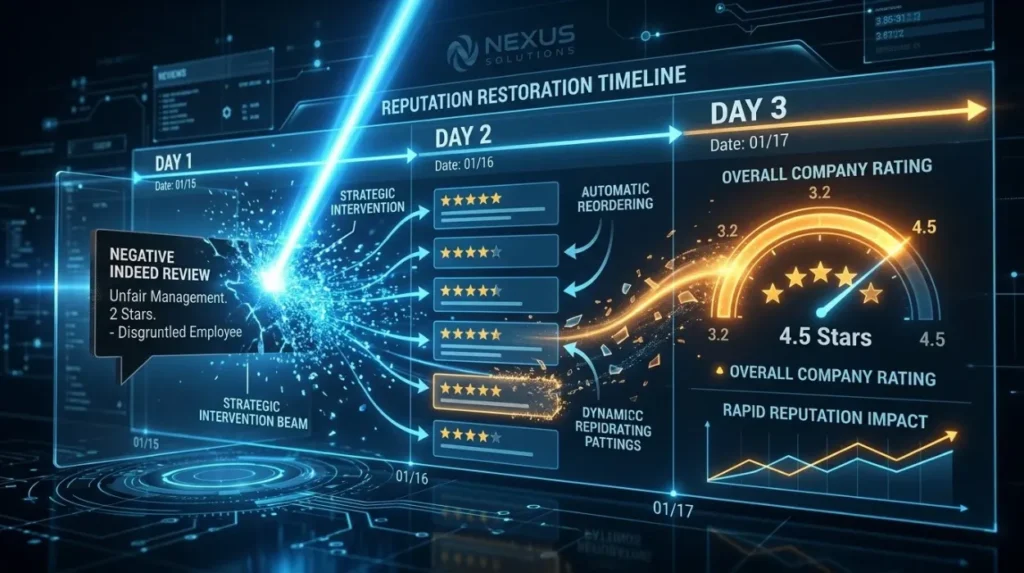
The impact begins with the quality and precision of the intervention, while the timing of platform decisions and search changes remains dependent on external systems. A professional process creates immediate operational control by identifying the disputed content, preparing evidence and submitting a focused intervention. Once action is taken, monitoring establishes whether the review remains visible, changes position or disappears from the relevant search environment. This allows decision-makers to distinguish platform-level results from broader search visibility changes. Measuring each stage prevents unrealistic expectations and provides a clearer understanding of progress. Speed therefore comes from disciplined execution rather than unsupported promises about guaranteed removal times.
Search impact also develops across multiple layers. Source-level removal addresses the original review, while SERP control addresses how candidates encounter reputation information through branded and employment-related searches. Content enhancement strengthens authoritative signals that remain relevant after the immediate review issue has been addressed. This layered approach improves sustainability because reputation protection does not depend entirely on one successful removal request. It creates a broader information environment in which accurate and useful content has a stronger role in shaping public perception. The result is greater control over how the organisation is represented online.
Dive Deeper With Our Expert Guides:
See How We Help UK Employers Recover Their Indeed Rating
Improve Your Indeed Star Rating With Our Removal Service
Why is Clear Your Name a reliable solution for Indeed review reputation risks?
Clear Your Name provides a structured reputation management approach centred on evidence, search visibility and controlled reputation intervention. The service focuses on the relationship between source-level content and the wider search ecosystem rather than treating an Indeed review as an isolated problem. This creates a clearer decision framework for organisations dealing with inaccurate pay or benefit allegations. Evidence-led assessment establishes the appropriate intervention, while search monitoring measures how the issue affects wider perception. The process prioritises legitimate reputation protection rather than exaggerated promises or artificial manipulation. That combination supports reliability and transparent decision-making.
For organisations ready to address a damaging review, Indeed Review Removal Services provide a focused route from evidence assessment to platform intervention and search monitoring. The strongest solution combines source-level action with wider SERP control so that removing or challenging one piece of content does not become the entire reputation strategy. Clear Your Name applies this principle by connecting intervention with reputation signals, entity credibility and longer-term search perception influence. This creates a practical framework for reducing exposure while strengthening the information candidates encounter. The objective remains measurable: reduce inaccurate content visibility, improve search results and stabilise digital trust.
What should organisations do after challenging a false Indeed review?
Organisations need to continue monitoring search visibility and reputation signals after submitting a review challenge. Removing or challenging the original content addresses the immediate source, but sustainable reputation management requires attention to the wider information environment. Branded searches, employer-related queries and review-related results provide useful indicators of whether negative content continues to influence public perception. Monitoring also identifies new content that introduces similar claims or creates additional reputation risk. This turns reputation management from a one-time response into an ongoing control process.
A sustainable post-intervention process focuses on clear actions:
- Monitor branded and employer-related searches to identify changes in negative content visibility.
- Track review-related results to measure whether problematic information continues influencing perception.
- Strengthen authoritative content that supports accurate entity information and employer credibility.
- Review emerging reputation signals to identify new risks before they become highly visible.
- Maintain evidence and intervention records to support consistent future reputation decisions.
The strongest reputation strategy combines immediate intervention with long-term search perception management. A false pay or benefit allegation deserves a precise response based on evidence, platform relevance and measurable search exposure. Professional support improves reliability by making each stage of the process transparent and outcome-focused. Clear Your Name positions reputation management as a controlled digital trust process, connecting review intervention with SERP control and sustainable reputation signals. For organisations seeking a credible route to reduce inaccurate Indeed review exposure, this structured approach provides clear actions, measurable objectives and stronger control over how the organisation is perceived online.
Can an Indeed review containing false pay claims be removed?
An Indeed review containing false pay or benefit claims can be challenged when the content breaches relevant platform rules or contains demonstrably inaccurate information. Evidence-based Indeed Review Removal Services focus on identifying the disputed claims and presenting supporting evidence for review.
How do I challenge a false pay claim on Indeed?
Start by identifying the specific salary or benefit statement that is inaccurate and collect reliable evidence showing the correct information. A structured review challenge then presents the evidence clearly and focuses on the relevant review standards.
What evidence is needed to remove a false Indeed review?
Useful evidence includes documented employment terms, published benefit information, company policies and records that directly contradict the disputed claim. The evidence should clearly connect to the specific statement being challenged rather than simply showing that the review is negative.
Does removing a false Indeed review improve online reputation?
Removing inaccurate review content can reduce negative information visibility and improve the overall search environment surrounding an organisation. It also supports stronger reputation signals and SERP control when combined with authoritative, accurate content.
How can Clear Your Name help with Indeed review removal?
Clear Your Name uses an evidence-led approach to identify disputed claims, support review intervention and monitor wider search visibility. Indeed Review Removal Services focus on reducing inaccurate content exposure while strengthening reputation signals and search perception.