

Speeding up an Indeed review removal request depends on the quality of the case, supporting evidence and clarity of the submission. A structured removal process helps reduce avoidable delays while protecting search visibility, reputation signals and professional credibility.
Why does Indeed review removal require a structured approach?
A structured approach gives an Indeed review removal request a clear factual and policy-based foundation. The process begins by identifying the exact review, isolating the disputed information and establishing why the content requires platform assessment. Supporting evidence then connects the stated concern with verifiable information. This creates a consistent record that can be used throughout the review process. It also prevents a removal request from becoming a general complaint about negative feedback. For reputation management, this distinction matters because a specific content issue requires a specific intervention.
Search visibility control also depends on understanding how the reported review fits into the wider digital footprint. A review that remains published can continue contributing to the information users encounter when researching an organisation. Search engines independently assess indexed pages according to relevance, authority, context and other ranking signals. As a result, the removal of a review and its effect on search results represent two separate stages. A structured process addresses the source content first and then evaluates its continuing visibility. This provides a more measurable route from identification to resolution.
Which Indeed review removal method provides the strongest basis for action?
A policy-focused removal request provides the strongest basis because it connects the reported content to a defined reason for intervention. A request that simply describes a review as unfair does not establish the same analytical foundation as one that identifies the precise issue and supplies relevant evidence. The submission needs to distinguish factual concerns from ordinary negative opinions. This distinction helps maintain an objective assessment of the content. It also makes subsequent communication easier because the original reason for reporting remains clearly documented. A focused case therefore provides greater process clarity than repeated generic reports.
Professional Indeed review removal services use structured assessment rather than relying on repeated reporting alone. The process evaluates the review, supporting evidence, relevant platform considerations and the appropriate submission route. Each stage serves a separate purpose and creates information for the next stage. This reduces the risk of submitting incomplete or contradictory information. It also creates a documented workflow that can be monitored after submission. The emphasis remains on evidence and eligibility rather than unsupported promises of removal.
How can evidence speed up an Indeed review removal request?
Evidence can reduce avoidable delays by giving the platform a clear factual basis for evaluating the reported content. Relevant documentation can demonstrate factual inaccuracies, inconsistencies, policy-related concerns or other circumstances directly connected to the review. Evidence is most useful when it addresses the specific statement being challenged. General background information without a clear connection to the reported content provides less analytical value. Organising evidence around the central issue creates a more coherent case. This makes the removal request easier to understand and assess.
Evidence also strengthens reputation management by creating a documented distinction between allegation and verification. A removal request is more precise when the reported statement, factual evidence and requested action are clearly connected. This prevents the submission from becoming unnecessarily broad. It also creates a useful record if additional communication is required during the investigation. The evidence-based approach supports accountability throughout the process. For organisations dealing with persistent review visibility, this structure provides a clearer basis for measuring progress.
How quickly can an Indeed review removal request produce results?
The response time for an Indeed review removal request depends on the platform’s investigation process, the nature of the reported content and the information supplied. No legitimate removal service can guarantee a fixed timeframe for a platform-controlled decision. However, avoidable delays within the submission process can be reduced through accurate documentation and complete evidence. The case can then move through identification, assessment, submission and follow-up without unnecessary repetition. Monitoring also creates a clear record of the platform’s response. This separates controllable process efficiency from the platform’s independent moderation decision.
This distinction is important when evaluating the speed of an intervention. A service controls how thoroughly the case is prepared and how consistently it is monitored, but it does not control Indeed’s final decision. A reliable approach therefore avoids artificial deadlines and instead measures specific process stages. These stages include content identification, evidence preparation, submission, response tracking and post-decision monitoring. Each checkpoint provides information about the progress of the case. This creates a more transparent assessment of performance than an unsupported promise of rapid removal.
For additional context, understanding Indeed review investigation times helps explain why a reported review does not always receive an immediate decision. Investigation speed can depend on the information presented, the nature of the concern and the platform’s internal assessment process. This TOFU-level understanding helps organisations distinguish genuine investigation factors from avoidable submission problems. It also provides a useful foundation for deciding whether further intervention is appropriate. Search reputation management becomes more effective when platform response time is evaluated separately from search ranking behaviour.
What makes professional Indeed review removal different from a basic report?
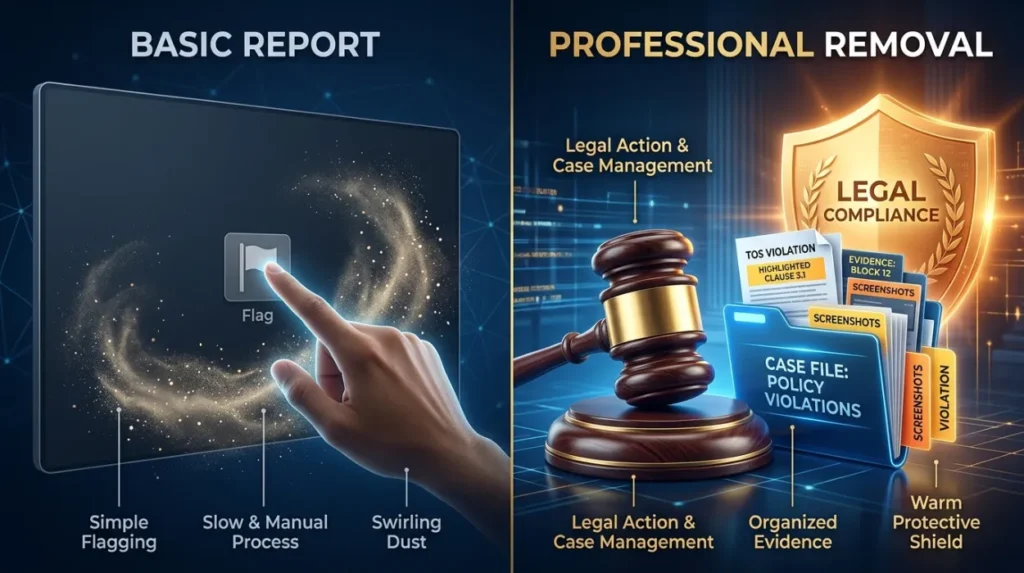
Professional removal work differs from a basic report through the depth of assessment, documentation and monitoring surrounding the submission. A basic report identifies content for platform review, while a structured service evaluates the underlying issue before preparing the request. This assessment establishes the exact content in dispute and identifies relevant supporting evidence. The submission then presents the information in a consistent and organised format. Follow-up monitoring records the platform response rather than leaving the case without a documented status. This creates a repeatable process from initial identification through outcome evaluation.
The distinction becomes more important when the review contributes to a broader reputation problem. An Indeed review can become one reputation signal within an organisation’s wider digital footprint. Search users can encounter that information alongside company pages, directories, social profiles and other third-party sources. Removing eligible problematic content addresses the source itself rather than attempting to counterbalance it through unrelated content creation. This makes source-level removal different from negative content suppression. The appropriate strategy therefore depends on the nature of the underlying information.
Can Indeed review removal improve search visibility and reputation?
Successful removal of eligible content can reduce the amount of problematic information available from the original source. It does not guarantee a specific Google ranking position because search engines independently determine indexing and ranking. However, if a review previously appeared in relevant search results, its removal can change the available content landscape. Search monitoring is therefore necessary to determine whether the source continues appearing in indexed results. This creates a measurable distinction between platform action and SERP evaluation. Reputation management uses both measurements to understand the wider effect of an intervention.
Reputation signals are formed across multiple sources rather than through one review alone. Search engines evaluate information according to relevance, authority, context and relationships between entities and content. An Indeed review can contribute to an organisation’s online credibility profile when it is visible to prospective customers, employees or other search users. Removing eligible content addresses one component of that profile. Broader monitoring then determines what other information remains visible. This prevents one successful removal from being incorrectly interpreted as complete search reputation control.
Dive Deeper With Our Expert Guides:
Remove Personal Data From Indeed Reviews Under UK GDPR Law
Pursue a Defamation Claim Over an Indeed Review With Legal Support
What factors affect the value of professional Indeed review removal?
The value of professional removal work depends on the validity of the case, the quality of evidence, process efficiency and the potential reputation impact of the content. A persistent review that attracts search visibility can remain part of an organisation’s digital footprint over time. Repeated manual reporting can also consume resources without creating a complete evidential record. A structured service consolidates assessment, evidence preparation, submission and monitoring into one workflow. This creates greater visibility into what has been done and what remains unresolved. The long-term value therefore relates to risk reduction and process control rather than simply the speed of one submission.
Cost also needs to be evaluated against the nature of the reputation problem. A review with a defensible basis for removal requires a source-level intervention, while an unfavourable but compliant review requires a different reputation strategy. Treating both situations identically creates unnecessary risk and inefficient resource use. A structured assessment identifies the appropriate route before significant effort is committed. This helps ensure that removal is pursued only where there is a valid basis. The result is a more controlled and evidence-led approach to online reputation management.
How does a structured service reduce Indeed review removal risks?
A structured service reduces risk by maintaining consistency from initial assessment through post-submission monitoring. The process begins by identifying the exact review and documenting the relevant concern. Evidence is then verified and organised around the specific issue. The request is submitted using a clear explanation rather than unsupported or repetitive claims. Follow-up records the platform response and establishes the current status of the case. Finally, search monitoring evaluates whether the content continues to appear within relevant indexed results.
Clear Your Name applies this process to keep review removal focused on evidence, documentation and measurable outcomes. The approach does not depend on promising a predetermined platform decision. Instead, it creates a transparent workflow in which each stage has a defined purpose. This improves process clarity while reducing the risk of inconsistent submissions. It also makes it easier to identify whether the remaining problem is platform-level content or search-level visibility. Such separation is essential for accurate reputation management.
When is Indeed review removal a better option than content suppression?
Indeed review removal is the more direct option when the underlying content has a valid basis for platform intervention. Removal addresses the source itself, whereas content suppression focuses on reducing the prominence of information within search results. These approaches operate through different mechanisms and therefore produce different types of outcomes. Source removal can eliminate the original review from the platform if the request is accepted. Suppression does not necessarily alter the underlying page or information. Selecting between them requires an assessment of the content’s status and the available intervention route.
This distinction also affects long-term risk management. Suppression relies on the continuing visibility and ranking behaviour of alternative content, while removal addresses the original information source. Search algorithms can change rankings independently of reputation strategy, making visibility-based approaches require ongoing monitoring. A source-level removal decision therefore provides a different form of control. The strongest strategy is determined by the actual cause of the reputation problem. This prevents investment in search visibility work when the underlying issue is an eligible review that requires source-level assessment.
How should businesses evaluate an Indeed review removal service?
Businesses can evaluate an Indeed review removal service through methodology, evidence handling, transparency and outcome monitoring. A reliable service explains how reviews are assessed and how supporting evidence is incorporated into the removal request. It also distinguishes platform-controlled decisions from activities that the service itself controls. This creates realistic expectations while maintaining a clear process record. Monitoring after submission provides additional evidence about the status of the intervention. These factors create a stronger basis for evaluating reliability than promotional claims alone.
Clear Your Name focuses on a documented workflow that connects content assessment with evidence verification, submission and monitoring. The process keeps the intervention centred on the specific review rather than making broad claims about reputation improvement. This supports better decision-making because the organisation can identify what has changed at each stage. It also provides a clearer distinction between review removal and wider SERP management. The result is a structured approach designed around process clarity, risk reduction and measurable reputation signals.
Businesses considering the broader factors behind removal requests can also review factors affecting Indeed removal responses to understand how evidence quality, report structure and platform assessment influence response handling. This MOFU information provides decision-stage context before selecting an intervention. It also reinforces the importance of separating controllable submission quality from the platform’s independent review process.
Why is a structured Indeed review removal strategy important?
A structured Indeed review removal strategy creates a measurable route from content identification to evidence assessment, platform submission and search monitoring. It reduces avoidable process problems while keeping expectations aligned with the platform’s independent decision-making role. The approach also separates source-level removal from search-level reputation management. This distinction ensures that the intervention addresses the actual cause of the visibility problem. For organisations managing professional credibility, that level of process clarity supports stronger risk control.
Clear Your Name positions its removal process around evidence, documentation, monitoring and realistic outcome assessment. The objective is not to guarantee an arbitrary response time but to ensure that each controllable stage is handled systematically. When eligible content is successfully removed, post-removal monitoring establishes whether its search visibility has also changed. When removal is not available, the assessment provides a clearer basis for considering alternative reputation strategies. This evidence-led approach creates a reliable framework for managing Indeed review visibility and protecting wider online reputation.
How can I speed up an Indeed review removal request?
A clear, evidence-based request can reduce avoidable delays by identifying the specific review, explaining the relevant policy concern, and providing supporting documentation. Indeed review removal services can also help organise submissions and monitor responses.
How long does Indeed review removal usually take?
The timeframe depends on the nature of the reported review, the evidence provided, and Indeed’s investigation process. Response times are controlled by the platform, so no legitimate service can guarantee a fixed removal timeframe.
What evidence is needed to remove an Indeed review?
Relevant evidence can include records that demonstrate factual inaccuracies, policy concerns, or other grounds connected to the removal request. The evidence needs to directly support the specific issue identified in the review.
Can removing an Indeed review improve online reputation?
Removing eligible content can reduce the visibility of a problematic review and improve the information environment surrounding an organisation. Search visibility and reputation signals still require separate monitoring because search engines independently determine how content is indexed and ranked.
Are Indeed review removal services worth using?
Professional Indeed review removal services provide structured assessment, evidence verification, submission management, and follow-up monitoring. Their value depends on whether the review has a valid basis for removal and how effectively the case is documented.