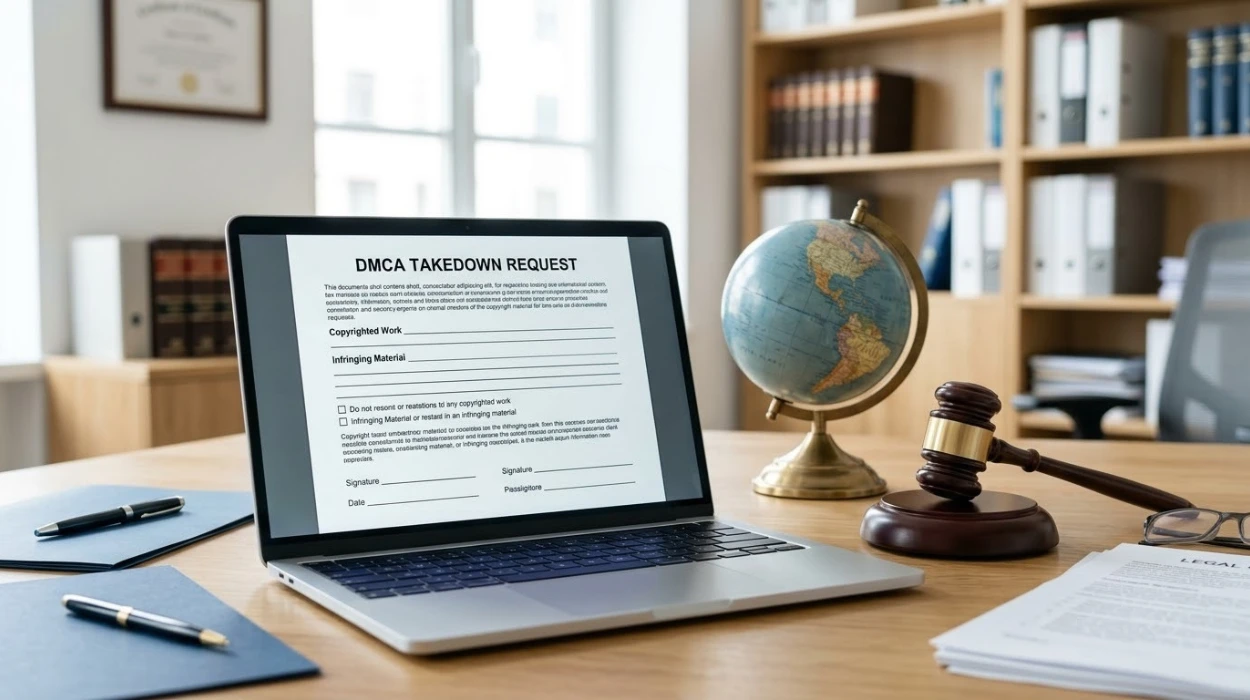
An international DMCA takedown request is a copyright complaint submitted to a digital platform or service provider to address material alleged to infringe copyright, often involving content hosted across national borders. Reputation management strategies differ based on the legal status of the content, the location of the material, the platform’s procedures and the effect of the content on search visibility and public perception.
Online reputation control methods are evaluated through their ability to address harmful content, preserve legitimate information and improve the accuracy of a company’s digital footprint. Filing a takedown request is one approach to content removal, while search engine de-indexing, platform reporting and content enhancement operate through different mechanisms. Understanding these differences is essential because a copyright complaint does not automatically establish infringement, guarantee removal or eliminate every search result associated with a disputed page. An effective evaluation therefore examines jurisdiction, evidence, platform requirements, procedural risks and the expected impact on corporate reputation.
What Is the Difference Between a DMCA Takedown and an International Copyright Complaint?
A DMCA takedown request is a copyright notice made under the United States Digital Millennium Copyright Act, particularly its notice-and-takedown framework in Section 512. An international copyright complaint is a broader term for a request or legal process concerning alleged copyright infringement involving parties, platforms or material connected to different countries. The distinction matters because the DMCA is United States legislation, whereas international copyright disputes can involve different national laws, treaties and enforcement procedures. A complaint concerning a website hosted abroad does not automatically become an international DMCA procedure simply because the website is accessible worldwide. The appropriate route depends on the relevant legal rights, the recipient’s role and the circumstances of the alleged infringement.
The DMCA process operates through a defined notice procedure for qualifying online service providers. A sufficiently detailed notice identifies the copyrighted work, the allegedly infringing material, the claimant’s contact details and the required statements of good faith and accuracy. Under the relevant statutory framework, a qualifying service provider can remove or disable access to the identified material to benefit from the applicable safe-harbour provisions. The person submitting the notice must have a valid basis to act on behalf of the copyright owner. A notice that lacks the required information or targets material that is not infringing creates procedural and legal risks.
International copyright complaints follow a more varied process because copyright protection and enforcement are governed by applicable national laws alongside international agreements. A platform can operate a global reporting system while applying different rules to content hosted, accessed or challenged in different jurisdictions. The Berne Convention establishes important principles for international copyright protection, but it does not create a single worldwide takedown procedure. Consequently, the presence of an overseas host does not remove the need to identify the relevant rights and legal framework. The distinction between a DMCA notice and a broader international complaint determines which evidence, recipient and procedure are appropriate.
Which Content Removal Method Is Most Effective for Protecting Online Reputation?
The most effective content removal method is the one that matches the actual legal or policy basis for the disputed material. Copyright takedowns address unauthorised use of protected creative work, trademark complaints address qualifying misuse of protected brand identifiers, and platform policy reports address violations of the platform’s own rules. Search engine de-indexing concerns the visibility of a URL in a search provider’s results rather than necessarily removing the underlying content. These methods target different problems, so their outcomes are not directly interchangeable. Selecting a method based on the verified cause of the reputational issue reduces procedural errors and unnecessary escalation.
Copyright removal is relevant when a website reproduces protected material, such as original photographs, text, illustrations or video, without the necessary authorisation. The claimant identifies the copyrighted work and the specific material alleged to infringe it, allowing the recipient to assess the notice under its applicable process. Its principal strength is the ability to address identifiable uses of protected work rather than relying solely on a general claim that the content damages reputation. Its limitation is scope: a valid copyright complaint does not automatically justify removing factual criticism, independently created material or every page mentioning the copyright owner. A complaint also requires sufficient evidence of ownership or authority to act.
Trademark reporting addresses a different type of misuse, including certain unauthorised uses of names, logos or other protected identifiers that create legally relevant confusion. It is more appropriate than a copyright notice when the central issue concerns brand identity rather than copying a protected creative work. However, not every reference to a company name or logo constitutes infringement, and legal outcomes depend on the rights involved, the context and the applicable law. Platform impersonation policies provide another route when a fake account or website misrepresents its affiliation with a business. Comparing these options requires matching the reported conduct to the specific legal right or platform rule being invoked.
How Do You File an International DMCA Takedown Request Step by Step?

Filing an international DMCA takedown request involves identifying the protected work, locating the allegedly infringing material, establishing the basis for the complaint and submitting a sufficiently complete notice to the appropriate recipient. The process is most reliable when each step is supported by evidence rather than assumptions about ownership, intent or jurisdiction. Although platforms often provide dedicated copyright reporting forms, their requirements and handling procedures differ. A request involving a foreign website can also require separate consideration of the hosting provider, domain registrar, search engine or other intermediary. Each recipient controls a different part of the digital environment, so a report to one party does not automatically resolve the issue everywhere.
What evidence is required before submitting a copyright notice?
The first step is to establish ownership of, or authority to represent the owner of, the copyrighted material. Relevant evidence includes original files, publication records, creation dates, licence documents and agreements identifying the rights holder. The claimant then records the exact URLs containing the allegedly infringing material and preserves dated screenshots or other reliable records of what appears on those pages. Evidence should distinguish the original work from the material being challenged and explain the alleged unauthorised use. This preparation supports an accurate notice and reduces the risk of reporting content that is licensed, independently created or otherwise lawfully available.
How do you identify the correct platform or service provider?
The next step is to identify the organisation that can act on the specific material or service involved. A website’s hosting provider may control stored files, while a search engine controls whether a URL appears in its own results and a social platform controls content published on its service. Domain registrars manage domain registration rather than necessarily hosting the content itself. The appropriate recipient can be identified through official copyright reporting pages, published abuse procedures and reliable service-provider information. Sending a complaint to the wrong intermediary can delay review because that recipient lacks authority to perform the requested action.
How do you prepare and submit the notice?
The claimant prepares the notice using the recipient’s official process and supplies the information required by the relevant procedure. For a DMCA notice, the statutory requirements include identifying the copyrighted work, identifying the material to be removed or disabled with sufficient information, providing contact details, making the required good-faith and accuracy statements, and including a physical or electronic signature. The notice is then submitted through the designated reporting channel, with a copy and supporting records retained for reference. The claimant must avoid inaccurate assertions, because misrepresentations in a takedown notice can create legal consequences. Submission begins the recipient’s review process; it does not establish that the claim is valid or guarantee removal.
How do you evaluate the outcome after submission?
The final step is to check the reported URL and the recipient’s response against the specific action requested. A host can remove material from a website, while a search engine can remove a result from particular search listings without deleting the original page. The claimant records whether access has been disabled, whether the page remains indexed and whether duplicate URLs contain the same material. Where a notice is rejected, the reason should be assessed before choosing another procedure or submitting a corrected complaint. This approach distinguishes successful source removal from reduced search visibility and prevents one outcome from being incorrectly treated as complete resolution.
Is Content Removal More Effective Than Search Engine De-Indexing?
Content removal and search engine de-indexing differ in the location where the intervention occurs. Content removal addresses the material at its source, such as a website, hosting platform or social network, while de-indexing removes or restricts a URL’s appearance in a particular search engine’s results. Source removal offers a more direct response when the content is genuinely infringing and the responsible provider accepts a valid request. De-indexing can reduce discoverability when the relevant search provider has a valid legal or policy basis to act, even if the source remains accessible. Neither method automatically removes copies distributed through unrelated websites or other search services.
The effect on SERP composition also differs between the two methods. Removing a source page can eventually affect the availability of that content to search engines, although indexed results can persist temporarily until the search engine processes the change. De-indexing directly affects the reporting search engine’s results for the relevant URL or queries, subject to the scope of its decision. The original content can remain accessible through direct links, other search engines or third-party copies. As a result, an assessment of search visibility must distinguish changes in ranking and indexing from the actual removal of content.
The suitability of each method depends on the source of the reputational risk. Source removal is relevant when the material itself violates copyright or another enforceable rule, whereas de-indexing is relevant when a search provider accepts a valid request under its own policies or applicable legal obligations. A page that contains lawful criticism does not become removable simply because it ranks prominently for a branded query. Likewise, de-indexing is not a substitute for proving ownership of a copyrighted work. Evaluating both approaches against the actual issue produces a more accurate assessment of effectiveness and procedural risk.
Dive Deeper With Our Expert Guides:
DMCA Safe Harbor Exemption: When Can Hosts Refuse Copyright Takedowns?
How to Challenge Competitors Misusing Your Brand Trademark in Search Ads
How Does Content Suppression Compare With Content Enhancement?
Content suppression is an approach that seeks to reduce the visibility or availability of specific harmful or misleading material through legitimate removal, de-indexing or other applicable mechanisms. Content enhancement instead improves the quality, completeness and discoverability of accurate information associated with an organisation. Suppression addresses a particular source or result, whereas enhancement strengthens the broader information environment surrounding the corporate entity. The two approaches operate through different mechanisms and are not equivalent substitutes. Their relative value depends on whether the main problem is unlawful content, inaccurate information, limited visibility of authoritative sources or a combination of these conditions.
Suppression can produce a direct change when a valid complaint leads to the removal of infringing material or the exclusion of a URL from search results. Its limitation is that the result often applies only to the reported material and the recipient’s own service. Duplicate copies, reposts and independent references can continue to appear elsewhere. Enhancement operates over a longer period by publishing useful, verifiable information through official websites, corporate announcements, expert commentary and other relevant resources. However, publishing additional content does not guarantee that negative material will lose rankings or that search engines will prioritise the newly published pages.
The distinction between short-term and long-term impact is important when evaluating reputation signals. A successful takedown can address a specific source quickly after the relevant review, although processing times and outcomes vary by provider. Content enhancement depends on publication quality, relevance, indexing and competitive search conditions, making its effect less immediate and less predictable. Suppression alone does not establish a comprehensive or credible digital footprint, while enhancement alone does not resolve a substantiated copyright infringement. A balanced assessment measures the direct result of the intervention alongside changes in search visibility, entity credibility and the wider composition of branded search results.
How Do Organic and Reactive Reputation Strategies Differ?
Reactive reputation strategies respond to an identified incident, such as a fake website, an unauthorised copy of protected material or a misleading account impersonating a company. They operate through evidence collection, incident classification, reporting and follow-up with the relevant platform or intermediary. Their principal advantage is a defined connection between the observed problem and the action taken. Their limitation is that they begin after the harmful material has appeared, leaving an interval during which users can encounter and share it. The effectiveness of a reactive response depends on the validity of the complaint, the recipient’s authority and the speed and scope of the resulting action.
Organic reputation strategies build a stronger information environment before a specific incident occurs. They include maintaining accurate corporate information, publishing original material, ensuring consistency across official channels and monitoring branded search results. These activities support the discoverability of legitimate sources and help users distinguish official communications from unauthorised representations. However, organic visibility does not guarantee protection against impersonation, and a credible official website does not automatically outrank every misleading page. Preventive activity therefore reduces information gaps without replacing the need for incident-specific action.
The two approaches are complementary but serve different purposes. Reactive reporting addresses a defined instance of suspected infringement or policy violation, while organic activity supports longer-term discoverability and identity consistency. Scalability also differs: monitoring systems can identify recurring patterns across domains and platforms, but each complaint still requires accurate classification and evidence. Organic content programmes can serve multiple branded queries, although their performance depends on competition, relevance and search ranking systems. Evaluation is strongest when the immediate result of an intervention is measured separately from sustained improvements in the company’s digital footprint.
What Legal and Reputational Risks Affect International Takedown Requests?
International takedown requests carry legal and procedural risks when the claimant misidentifies the rights involved, targets lawful material or submits inaccurate information. Copyright ownership does not automatically extend to every use of a work, and licences, exceptions and limitations affect whether a particular use infringes copyright. Fair dealing under UK law and fair use under US law are distinct legal concepts, and their application depends on the relevant jurisdiction and circumstances. A request based on an unsupported assumption of ownership can be challenged and can undermine the credibility of subsequent complaints. Accurate identification of the work, the claimant’s authority and the allegedly infringing use is therefore central to responsible reporting.
Counter-notice procedures create an additional consideration under the US DMCA framework. In qualifying circumstances, a person whose material has been removed can submit a counter-notification disputing the claim, and the service provider follows the statutory process for handling that response. Restoration can occur where the applicable requirements are satisfied and the claimant does not take the specified legal action within the relevant period. This means that an initial removal is not always the final outcome. A realistic evaluation accounts for disputes, procedural deadlines and the possibility that the material returns.
Reputational risks also arise when an organisation treats every negative reference as an infringement. Lawful criticism, independent reporting and factual commentary can contribute to public understanding even when they present an unfavourable view of a company. Submitting an unsuitable takedown request can attract additional scrutiny and weaken perceptions of transparency or fairness. Copyright and trademark procedures are designed to address specific rights, not to provide a general mechanism for suppressing criticism. Separating legitimate intellectual property claims from broader reputation concerns protects both procedural accuracy and corporate credibility.
How Can the Effectiveness of an International Takedown Strategy Be Measured?
The effectiveness of an international takedown strategy is measured by comparing the requested action with the observable outcome across the relevant source, platform and search environment. Removal status establishes whether the identified material has become unavailable at the reported location, while indexing status indicates whether a search engine continues to display the corresponding URL. Search visibility measurements show whether the page appears for relevant branded queries, but changes in ranking alone do not establish that the underlying problem has been resolved. A complete evaluation records the scope of each action and identifies what remains accessible. This prevents a local or temporary result from being reported as a universal removal.
Operational indicators measure the efficiency and repeatability of the process. These include the proportion of notices accepted, the frequency of requests requiring correction, the time taken to receive a decision and the recurrence of the same material on new URLs. Each indicator requires context because providers use different procedures and response times, while complex cases involve different evidential requirements. A high acceptance rate does not independently prove that every notice was legally justified, and a rapid decision does not guarantee that copies elsewhere have disappeared. Combining procedural measures with verified outcomes produces a more informative assessment of effectiveness and risk.
Reputational indicators examine whether the wider digital information environment has changed. Analysts compare the composition of branded SERPs, the visibility of official corporate pages, the persistence of unauthorised references and the accuracy of publicly available company information. Sentiment distribution across reviews and public discussion provides additional context, although sentiment changes do not independently prove that a takedown caused the change. Long-term evaluation also considers whether the same identity misuse recurs and whether accurate information remains accessible. These measures distinguish immediate content intervention from sustainable improvements in online reputation.
Which Approach Best Balances Removal, Search Visibility and Long-Term Credibility?
The most appropriate approach is determined by the nature of the content, the rights available, the platform involved and the intended outcome. Copyright notices address qualifying unauthorised use of protected creative works, trademark complaints address qualifying misuse of protected marks, and platform reports address violations of specific service rules. Search de-indexing affects discoverability within the relevant search engine, while content enhancement improves the supply of accurate and useful information. Each method has a different scope, evidential threshold and potential effect on public perception. For cases involving Brand Hijackers and Fake Websites, evaluating the applicable intellectual property rights and platform policies helps identify the appropriate route for addressing unauthorised brand use. No single procedure resolves every form of brand misuse or every reputational concern.
A sound evaluation begins by classifying the incident and preserving evidence, then identifying the recipient with authority to act on the material. The next consideration is whether the requested outcome concerns source removal, search visibility, correction of inaccurate information or a combination of these goals. The claimant then assesses procedural requirements, possible counterclaims and the likelihood of duplicate material remaining available. After submission, the result is measured against the original objective rather than an assumed expectation of complete removal. This sequence connects legal and platform mechanisms with observable changes in the digital footprint.
In conclusion, international DMCA takedown requests form one part of a wider set of approaches to copyright enforcement and online reputation control. Their value depends on the existence of a valid copyright claim, the accuracy of the evidence and the authority of the recipient to act. Source removal, search de-indexing, reactive reporting and organic content enhancement address different parts of the problem, with distinct limitations in scope, timing and sustainability. Effective comparison separates legal validity from search performance and immediate removal from long-term reputational outcomes. This distinction provides a more reliable basis for evaluating content removal decisions and their influence on corporate credibility.
What is an international DMCA takedown request?
An international DMCA takedown request is a copyright complaint submitted to a digital platform or service provider concerning material alleged to infringe copyright across national borders. The DMCA is a US law, so international cases also require consideration of the relevant jurisdiction, platform procedures and applicable copyright rules.
How do I file an international DMCA takedown request?
Identify the copyrighted work, collect evidence of ownership, record the URLs containing the allegedly infringing material and submit a complete notice through the relevant platform’s official reporting process. Include the required statements and contact details, and retain a copy of the submission for follow-up.
What evidence is required for a DMCA takedown notice?
A DMCA takedown notice requires identification of the copyrighted work, the specific material being challenged, the claimant’s contact details and the statutory declarations of good faith and accuracy. Original files, publication records and dated screenshots also help establish ownership and document the alleged infringement.
Can a DMCA takedown request remove content from a foreign website?
A DMCA notice can lead to content removal when the relevant service provider accepts and acts on a valid complaint, including in cases involving overseas websites. However, the outcome depends on the provider’s role, applicable legal requirements and the circumstances of the claim; removal from one platform does not automatically eliminate copies elsewhere.
How can DMCA takedown requests protect a company’s online reputation?
Valid DMCA takedown requests can help address unauthorised copies of copyrighted material, such as corporate photographs, original text or promotional videos, that contribute to reputational risks. Clear Your Name’s copyright and trademark services relate to content removal concerns, but copyright notices do not automatically remove fake websites, trademark misuse or lawful criticism.