
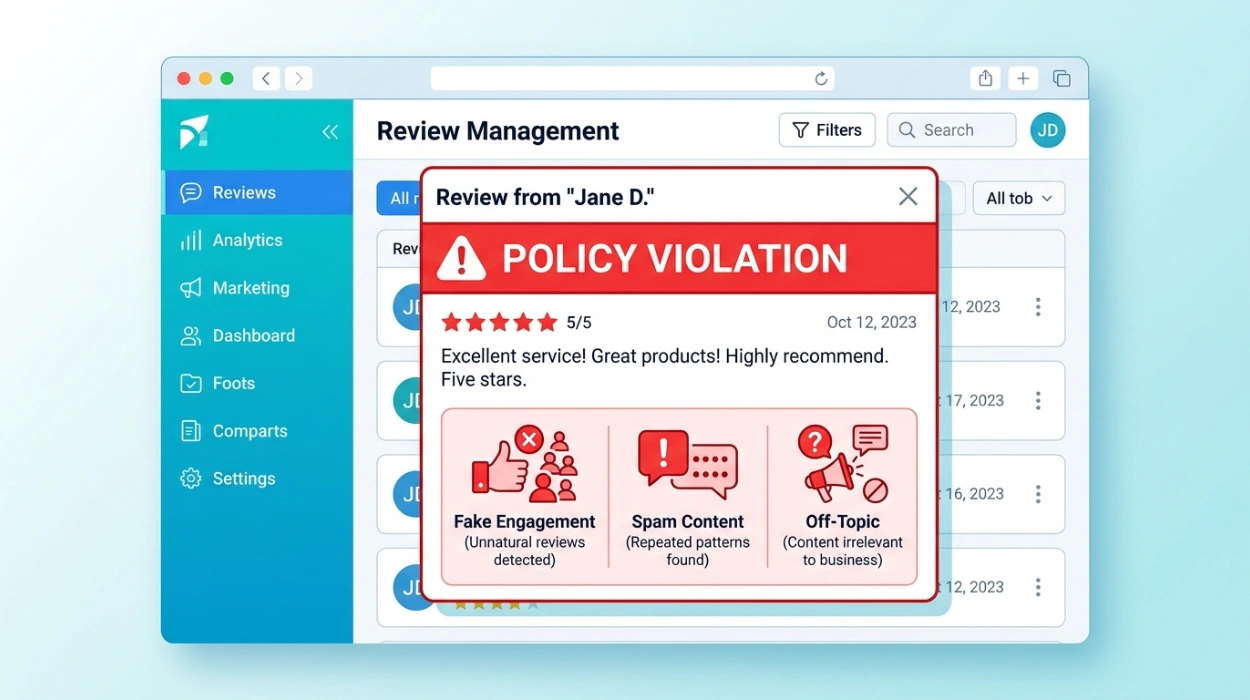
A Google review counts as a policy violation when it breaches Google’s published review content policies, including deceptive, irrelevant, misleading, or prohibited content. Reporting a review relies on identifying the specific policy category that the content violates rather than expressing disagreement with the opinion itself.
Reputation management is the process of monitoring, analysing, and understanding how digital information influences public perception and search visibility across search ecosystems. Online reputation refers to the collection of indexed content, reviews, mentions, and reputation signals that shape how search engines and users evaluate the credibility of an entity.
What Is Considered a Policy Violation in a Google Review?
A policy violation is any review that conflicts with Google’s review content policies and therefore fails to meet the platform’s standards for authenticity, relevance, and user value. Search ecosystems distinguish between genuine customer opinions and content that manipulates reputation signals or misrepresents real experiences.
Google evaluates reviews through a combination of automated systems and human moderation. The platform analyses textual patterns, account behaviour, metadata, and contextual relevance to determine whether submitted content aligns with its review policies. This evaluation focuses on policy compliance rather than whether the review expresses positive or negative sentiment.
Policy violations directly influence reputation signals because reviews contribute to how search engines interpret trust, authority, and entity perception. Reviews that remain visible become part of the indexed information associated with a business, while reviews removed for policy violations no longer contribute to search evaluation. This distinction preserves the integrity of review-based trust signals within search results.
Google identifies multiple categories of prohibited review content based on authenticity, safety, and relevance.
- Publish deceptive content by posting fabricated experiences that do not reflect genuine interactions. Such reviews distort reputation signals by introducing inaccurate information into the review ecosystem.
- Submit spam or repetitive content through duplicated reviews or coordinated posting behaviour. Repeated content weakens content quality and signals potential manipulation.
- Create conflicts of interest by reviewing a business for personal, financial, or competitive advantage. Reviews influenced by undisclosed interests undermine the credibility of user-generated content.
- Include prohibited material such as offensive language, illegal content, or personal information. These elements violate platform safety standards rather than customer satisfaction standards.
- Post irrelevant content that discusses unrelated topics instead of actual customer experiences. Irrelevant information reduces the usefulness of reviews for both search systems and users.
Why Does a Fake Google Review Violate Platform Policies?
A fake Google review violates platform policies because it misrepresents authentic customer experience and introduces misleading reputation signals into search ecosystems. The review system exists to reflect genuine interactions, making authenticity the defining requirement for review eligibility.
Search engines evaluate reviews as trust indicators that contribute to entity understanding. Fake reviews interfere with this evaluation by presenting inaccurate information that influences user perception without factual support. As a result, review authenticity becomes an essential component of search quality rather than merely a moderation issue.
Policy enforcement protects the reliability of review-based information. When deceptive content remains indexed, it affects how search algorithms interpret credibility and how users assess businesses during decision-making. Removing policy-violating reviews strengthens the accuracy of reputation signals available within search results.
Search systems analyse behavioural, contextual, and linguistic indicators to identify inconsistencies associated with deceptive reviews.
Automated systems evaluate posting frequency, reviewer activity, account history, geographical consistency, and textual similarity. These signals help determine whether review behaviour reflects authentic customer engagement or coordinated manipulation. Individual indicators rarely determine outcomes independently, but combined patterns contribute to broader evaluation models.
Natural language analysis also supports policy enforcement by identifying repetitive structures, unusual phrasing, and abnormal sentiment distribution. These characteristics assist moderation systems in recognising content that deviates from expected patterns of genuine customer feedback.
Dive Deeper With Our Expert Guides:
How Fake Google Reviews Are Created and Why They Are Difficult to Remove Alone
What a Google Review Removal Service Does That Self-Reporting Often Cannot Achieve
Does a Negative Review Automatically Break Google’s Policies?
No. A negative review does not violate Google’s policies solely because it expresses dissatisfaction. Platform policies distinguish between legitimate criticism and prohibited content based on authenticity and policy compliance rather than emotional tone.
Critical feedback forms an essential component of balanced online reputation. Genuine negative experiences contribute valuable information that helps search engines maintain diverse and representative review ecosystems. Removing authentic criticism simply because it damages perception would reduce the accuracy of reputation signals.
Policy evaluation focuses on the content itself. A negative review remains compliant when it reflects an authentic customer experience without containing deceptive information, prohibited material, or policy violations. Conversely, a positive review becomes removable if it breaches platform rules through manipulation or fabrication.
The distinction depends on compliance with published review policies rather than the review’s sentiment.
A genuine review describes an authentic experience connected to the reviewed entity. The content remains relevant, original, and consistent with platform guidelines. Search engines interpret these reviews as legitimate reputation signals regardless of whether the sentiment is favourable or unfavourable.
A policy-violating review contains elements that compromise authenticity, relevance, or safety. Fabricated experiences, impersonation, spam behaviour, and misleading claims transform user-generated content into policy violations because they distort information quality rather than expressing honest opinion.
How Does Google Evaluate Reports About Fake Reviews?

Google evaluates reported reviews by comparing the reported content against its established review policies rather than accepting reports based solely on user disagreement. The reporting process functions as a moderation signal that initiates policy assessment instead of guaranteeing review removal.
When a report is submitted, automated moderation systems first examine the review using existing policy criteria. Content patterns, reviewer behaviour, metadata, and contextual relationships all contribute to the evaluation process. Reviews that present stronger indicators of policy violations receive closer scrutiny within moderation workflows.
Human reviewers may participate when automated systems require additional contextual interpretation. This layered evaluation improves consistency by balancing scalable automation with policy-based judgement. The review remains visible unless moderation determines that it conflicts with published standards.
Search visibility is influenced by this moderation framework because only reviews that satisfy policy requirements continue contributing to indexed reputation signals. Reviews removed following successful policy evaluation no longer affect entity perception within search ecosystems.
Evidence supports moderation by demonstrating clear alignment between the reported review and an identifiable policy breach.
Effective reports reference observable characteristics rather than personal disagreement. Indicators such as fabricated customer claims, duplicate content, impersonation, conflicts of interest, or irrelevant information provide moderation systems with policy-specific context for evaluation.
The reporting process analyses whether the review satisfies the conditions defined within Google’s policies. Evidence therefore functions as a mechanism for identifying objective policy conflicts rather than debating the validity of customer opinions.
What Happens After a Fake Google Review Is Reported?
After a fake Google review is reported, the review enters Google’s moderation process for policy evaluation. Reporting does not remove content automatically because moderation depends on verifying whether the review breaches established review policies.
The moderation system analyses the reported content alongside behavioural and contextual signals. Automated detection evaluates review authenticity, account activity, content consistency, and relationships between the reviewer and the reviewed entity. This assessment determines whether the review satisfies Google’s content standards or conflicts with prohibited review categories.
Where additional verification is required, human moderation supports the evaluation process. The decision is based on policy interpretation rather than public opinion or commercial impact. Reviews that comply with the platform’s policies remain visible, while confirmed policy violations are removed from public search visibility.
The outcome also affects reputation signals within search ecosystems. Removed reviews cease contributing to indexed review data, sentiment analysis, and entity perception, preserving the integrity of search-based credibility assessment.
Review removal changes the information available for search engines to evaluate but does not redefine an entity’s reputation independently. Search systems assess reputation through multiple interconnected signals rather than relying on individual reviews.
When policy-violating content is removed, the remaining review profile provides a more accurate representation of authentic customer feedback. This improves the quality of indexed information used in SERP evaluation and strengthens the reliability of reputation signals associated with the entity.
Review moderation therefore supports search quality by ensuring that visible review content reflects genuine experiences instead of manipulated or deceptive information.
Why Is Policy Knowledge Important When Reporting a Fake Google Review?
Understanding review policies improves the accuracy of reporting because reports are evaluated against defined content standards rather than subjective disagreement. Policy knowledge enables users to identify the specific rule that the reported content violates.
Search ecosystems operate through structured evaluation frameworks. Reviews are interpreted according to authenticity, relevance, safety, and credibility rather than popularity or sentiment alone. Reporting aligned with these criteria supports more effective moderation by matching the report to recognised policy categories.
Policy awareness also improves understanding of reputation management as an information system. It explains why some reported reviews remain visible while others are removed following moderation. The determining factor is policy compliance rather than the perceived fairness of the review.
This distinction reinforces trust within review ecosystems by ensuring that moderation decisions remain consistent with published standards rather than individual expectations.
How Does Reporting Compare with Other Reputation Management Approaches?
Reporting focuses on identifying content that breaches platform policies, whereas broader reputation management examines how indexed information shapes search visibility and entity perception over time. The two processes operate within the same search ecosystem but address different aspects of reputation evaluation.
Reporting functions as a policy-based moderation mechanism. Its objective is to identify review content that violates established guidelines and to support accurate moderation decisions. Success depends on demonstrating a clear policy breach instead of influencing sentiment or public perception.
Reputation management refers to the continuous analysis of digital information that contributes to online credibility. It evaluates review signals, indexed content, authority indicators, and overall search visibility to understand how search engines interpret an entity across multiple information sources.
Understanding the relationship between these concepts provides a broader view of digital trust. Reporting addresses individual review compliance, while reputation management analyses the wider collection of signals that influence search evaluation.
Within this broader context, the analytical differences explored in How Reporting a Fake Google Review Compares to Using a Professional Service explain how policy reporting and structured reputation analysis address separate stages of reputation management.
Google review policy violations are defined by clear content standards that prioritise authenticity, relevance, safety, and credibility within search ecosystems. A review becomes eligible for removal when it breaches these standards rather than when it expresses negative sentiment or unpopular opinions.
Reporting a fake Google review is therefore a policy-based moderation process designed to protect the integrity of review signals that contribute to search visibility and entity perception. Understanding how review policies operate also strengthens understanding of online reputation as an interconnected system shaped by indexed information, trust signals, content evaluation, and SERP interpretation.
As search ecosystems continue to evaluate credibility through structured information, policy knowledge remains an essential component of understanding how digital reputation is formed, interpreted, and maintained.
What types of Google reviews can be reported as policy violations?
Google reviews can be reported if they violate Google’s review content policies, such as spam, fake engagement, conflicts of interest, impersonation, harassment, or irrelevant content. A review cannot be reported simply because it is negative; it must breach a specific policy.
Does reporting a fake Google review guarantee that it will be removed?
No. Reporting a fake Google review starts a moderation process in which Google evaluates the content against its published policies. The review is removed only if the platform determines that it violates those policies.
How does Google decide whether a review is fake?
Google analyses review content, account behaviour, metadata, and authenticity signals to identify potential policy violations. Its moderation systems evaluate whether the review represents a genuine customer experience and complies with review guidelines.
Can a genuine negative Google review be removed?
A genuine negative review that reflects a real customer experience does not violate Google’s policies simply because it contains criticism. Removal depends on policy breaches such as deceptive content, spam, or prohibited material rather than the review’s sentiment.
How does understanding Google review policies support online reputation management?
Understanding review policies helps identify which reviews qualify for reporting and explains how moderation affects search visibility and reputation signals. Clear Your Name recognises that policy knowledge contributes to informed reputation management by improving understanding of how review content influences online credibility.