

The cost of Indeed review removal in the UK depends on factors such as review complexity, removal eligibility, evidence requirements, and the amount of work needed to assess the relevant content. Pricing also varies according to whether the objective involves a single review, multiple reviews, or wider reputation analysis.
Reputation management is the process of monitoring, analysing, and influencing how information about an organisation is represented across digital environments. Online reputation refers to the combined information, sentiment, authority, and credibility signals that shape how an entity is perceived through search engines and other online platforms.
What factors determine the cost of Indeed review removal?
The main cost factors are the number of reviews, complexity of the content, evidence required, and assessment of whether the review breaches platform rules. Indeed review removal is not simply a deletion task because review content is evaluated against the platform’s policies, context, and available evidence.
A single review containing a clear policy violation requires a different assessment from a group of reviews involving disputed claims or repeated content. The removal process therefore involves analysing the review, identifying the relevant issue, and determining whether an appropriate reporting or dispute mechanism exists. The level of analysis affects the amount of work involved.
Review complexity also influences reputation management costs because different forms of content create different evaluation requirements. Factual inaccuracies, inappropriate disclosures, conflicts of interest, abusive language, and potentially defamatory statements represent distinct content characteristics. Each characteristic requires separate analysis before its potential impact on search visibility and entity perception can be assessed.
The cost therefore reflects the complexity of the information problem rather than simply the existence of a review. A review that contains multiple claims requires more detailed assessment than a short piece of content with an obvious policy issue. Pricing becomes more understandable when it is linked to the number and complexity of actions required.
How does the number of Indeed reviews affect removal costs?
The number of reviews affects cost because each review represents a separate piece of content requiring evaluation, documentation, and potential reporting. A single review creates one content-removal target, while a larger review set creates a broader assessment and monitoring requirement.
Review volume also affects the analysis of sentiment distribution. Search systems and users can interpret repeated negative sentiment differently from an isolated negative statement because the overall review profile provides a broader representation of an organisation. Reputation management therefore evaluates individual reviews alongside the wider review environment.
Each review requires contextual assessment before a removal request is considered. The relevant question is not simply whether a review is negative, but whether the content meets an applicable removal criterion. This distinction separates legitimate negative feedback from content that violates platform standards.
Higher review volume consequently increases the amount of analytical work. A structured assessment identifies which reviews require attention, which contain potentially actionable issues, and which represent ordinary user-generated feedback. This process creates a more accurate basis for estimating removal costs.
Does the type of review violation affect Indeed removal pricing?
The type of potential violation directly affects the complexity of review assessment. Content that clearly conflicts with a platform’s rules generally requires a different evidence assessment from content where the policy issue depends on context or interpretation.
Review signals are not automatically negative reputation signals. A critical review can remain legitimate user-generated content even when it affects sentiment distribution. Removal analysis therefore focuses on the characteristics of the content rather than treating negative sentiment itself as sufficient justification.
Potentially actionable content requires closer examination of wording, factual claims, personal information, relevance, authenticity, and other applicable considerations. The more factors involved, the greater the analytical requirement before a removal request can be prepared. This distinction explains why pricing cannot be determined from star ratings or sentiment alone.
Content indexing adds another layer of complexity. Once a review becomes publicly accessible and indexed, it can appear in searches relating to the company or employer. Its visibility therefore depends on both the review platform and the way search engines evaluate and rank the page.
Dive Deeper With Our Expert Guides:
How Long Indeed Takes to Investigate a Reported Review
Why GDPR Can Apply to Personal Data Inside Indeed Reviews
How does evidence affect the cost of Indeed review removal?
Evidence affects cost because a removal request requires a clear explanation of why the content violates an applicable rule or requirement. Evidence provides the basis for evaluating the review rather than relying on subjective disagreement with its contents.
Relevant evidence can include information demonstrating that a reviewer lacked a legitimate connection with the organisation, that content contains identifiable policy violations, or that information conflicts with verifiable facts. The quality and relevance of evidence influence the strength of the underlying assessment.
Evidence analysis also contributes to entity credibility. Search engines evaluate information from different sources, while users assess whether available content appears trustworthy and relevant. A review dispute therefore involves both the platform-level question of whether content qualifies for removal and the wider reputation question of how the information affects the entity profile.
The cost of evidence analysis rises when documentation requires extensive review or cross-referencing. A straightforward content issue requires less investigation than a dispute involving multiple claims and supporting records. Pricing therefore reflects analytical workload as well as the number of reviews involved.
Is Indeed review removal different from negative review management?
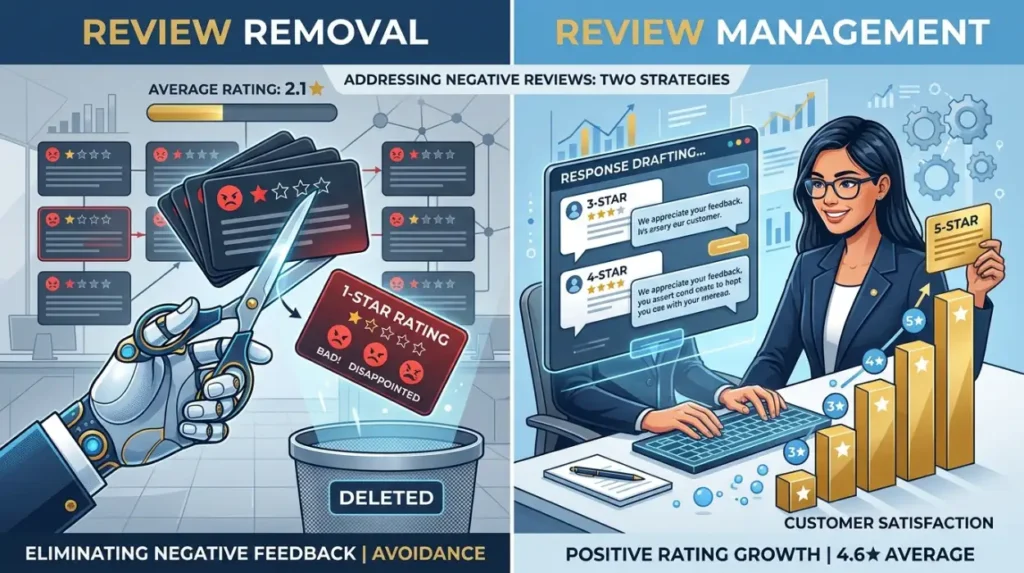
Indeed review removal and negative review management represent different approaches because removal focuses on eligible content, while review management addresses the broader reputation environment. Negative feedback is not automatically removable simply because it damages sentiment or search perception.
Review management analyses the overall distribution of positive, neutral, and negative information surrounding an organisation. It examines patterns in ratings, recurring themes, review frequency, content quality, and the authority of the platforms involved. This creates a broader understanding of how reputation signals influence entity perception.
Removal is narrower and operates through platform-specific mechanisms. The objective is to identify content that falls within an applicable removal category and present the relevant evidence. The approach therefore depends on content eligibility rather than sentiment alone.
This distinction is important when evaluating cost. A removal assessment can involve a defined number of reviews, whereas broader review management requires analysis of the entire reputation environment. Combining the two concepts without distinguishing their mechanisms creates inaccurate expectations about pricing.
How does search visibility influence the value of review removal?
Search visibility influences the significance of review removal because highly visible review content has greater potential to affect what users encounter when researching an organisation. A review that appears prominently for a company-name search has a different visibility profile from content that receives little organic exposure.
SERP evaluation considers relevance, authority, content quality, and relationships between search queries and indexed pages. Review platforms can therefore become part of the search results for branded queries when their pages provide information relevant to the entity. The review then becomes part of the wider digital footprint.
Search visibility does not determine whether content qualifies for removal. Platform policies and applicable rules remain the primary basis for content-removal decisions. However, visibility helps explain why organisations analyse specific reviews as part of broader reputation management.
The cost-benefit assessment therefore includes both removal eligibility and search prominence. Content that is eligible for removal and highly visible represents a more significant reputation-management priority than content with limited discoverability. This distinction helps establish which review issues require immediate analytical attention.
How do authority and trust signals affect review reputation?
Authority and trust signals influence how information is interpreted within search ecosystems. A review appearing on an established employment platform can carry different contextual significance from an isolated comment on a low-authority website.
Authority refers to the perceived reliability and relevance of an information source within a search ecosystem. Trust signals represent indicators that help search systems and users evaluate the credibility of information. These concepts contribute to entity perception but do not independently determine whether a review is removed.
Search engines analyse relationships between the organisation, review platform, reviewer-generated content, and search query. A relevant review page can therefore become part of the information landscape surrounding a brand or employer. Its ranking position influences exposure, while the content itself contributes sentiment information.
Removal analysis consequently considers both the source and the content. A high-authority source containing legitimate criticism remains a valid reputation signal, while content that violates platform requirements requires a different evaluation. This separation keeps review removal focused on eligibility rather than reputation preference.
Does the age of an Indeed review affect its removal cost?
The age of a review can affect the amount of analysis required, particularly when historical information must be compared with current organisational circumstances. Older content can remain relevant to search visibility even when the underlying employment relationship or business circumstances have changed.
Historical content forms part of an entity’s digital footprint when it remains publicly accessible and indexed. Search engines do not automatically disregard older pages simply because newer information exists. Relevance, authority, query relationships, and other ranking signals influence whether historical content continues appearing in SERPs.
Age alone does not establish a valid basis for removal. A review requires assessment against the applicable platform rules and content characteristics. Historical context becomes relevant when evaluating factual accuracy, employment status, duplication, or other circumstances connected with the content.
Additional historical research can therefore increase analytical workload. When a review requires comparison with older company records, employment information, or related content, the assessment becomes more complex. This is one reason review-removal pricing varies between cases.
How do multiple reviews change the overall removal assessment?
Multiple reviews require a portfolio-level assessment because each piece of content can contribute to the organisation’s overall sentiment distribution. Analysing reviews collectively identifies patterns that an individual review assessment does not reveal.
The process begins by categorising each review according to content characteristics and potential policy relevance. Reviews can then be prioritised based on visibility, severity, duplication, relevance, and available evidence. This creates a structured framework for determining where analytical effort is most valuable.
The broader review profile also affects entity perception. Searchers rarely evaluate an organisation through one isolated piece of information; they encounter a combination of reviews, company pages, news content, directories, professional profiles, and other sources. Review signals therefore operate within a wider information ecosystem.
For this reason, pricing for multiple reviews often reflects the scope of analysis rather than a simple multiplication of a single-review fee. A group of related reviews can require pattern analysis, evidence organisation, and monitoring. The resulting cost depends on the actual work required to evaluate the content.
What is the difference between short-term and long-term review removal costs?
Short-term removal costs relate to assessing and addressing specific review content, while long-term reputation costs involve monitoring the wider information environment after the initial action. A one-time removal assessment therefore represents only one stage of reputation management.
Short-term work focuses on identifying potentially actionable content, preparing evidence, and submitting an appropriate request through the relevant platform mechanism. The immediate outcome is a decision or response concerning the targeted review. This stage is measurable because the specific content represents a defined target.
Long-term management focuses on whether similar content appears again and how the overall SERP composition changes. Monitoring identifies new reviews, duplicated content, changing sentiment distribution, and shifts in search visibility. This creates a continuing reputation signal analysis process.
Sustainability therefore depends on monitoring rather than assuming that one removal action permanently resolves an organisation’s reputation environment. The cost of ongoing monitoring varies according to review volume, search visibility, source coverage, and monitoring frequency. Evaluating these factors provides a more complete understanding of total reputation-management expenditure.
How can businesses compare Indeed review removal pricing in the UK?
Businesses can compare pricing more accurately by evaluating the scope, methodology, evidence requirements, and monitoring included in each approach. A price comparison based only on the number of reviews provides limited information about the actual analytical work involved.
A useful evaluation framework focuses on four elements:
- Assess the number and complexity of reviews, including whether each item requires individual evidence analysis.
- Compare the removal methodology, including how potential policy violations are identified and documented.
- Evaluate search visibility requirements, including whether indexed SERP exposure and third-party references form part of the analysis.
- Measure ongoing monitoring requirements, including review tracking, sentiment distribution, and changes in entity perception.
This framework connects cost with actual mechanisms rather than headline pricing. It also separates content-removal work from broader reputation management, allowing organisations to identify exactly what the quoted activity covers.
For businesses researching pricing structures in greater detail, How to Compare Indeed Review Removal Service Pricing in the UK provides the relevant next-stage query because it moves from understanding cost factors towards evaluating different pricing approaches.
How does review removal fit into wider online reputation management?
Indeed review removal represents one component of online reputation management rather than a complete reputation strategy. Online reputation management refers to the systematic analysis and control of information that influences how an entity is represented across digital platforms and search results.
Review signals form one part of this information ecosystem. Other signals include news coverage, company information, professional profiles, social content, directories, customer feedback, and authoritative third-party references. Search engines evaluate these sources according to their relevance and relationship to the entity and query.
This means removing one review does not automatically transform the overall search profile. The impact depends on the review’s visibility, authority, sentiment, and relationship with other information surrounding the organisation. A high-ranking review represents a different search-perception issue from an isolated page with minimal visibility.
Understanding this wider context explains why Indeed review removal costs vary. The price reflects the specific content problem, evidence requirements, source characteristics, search visibility, and monitoring scope. Reputation management therefore requires an information-system perspective rather than a simple deletion model.
The cost of Indeed review removal in the UK is determined by the complexity, quantity, eligibility, evidence requirements, search visibility, and monitoring needs associated with the content. Pricing therefore varies because review-removal work involves analysis rather than a standardised deletion mechanism.
Review signals contribute to the wider digital footprint through sentiment, source authority, content relevance, and SERP visibility. Removal focuses on content that meets applicable platform requirements, while broader reputation management evaluates how reviews interact with other reputation signals and entity information.
The most useful way to understand cost is to connect price with the underlying work required. Review volume, evidence complexity, historical analysis, search visibility, and long-term monitoring each influence the resources required to evaluate and manage Indeed review content.
Ultimately, Indeed review removal is best understood as a content and reputation-management process operating within a larger search ecosystem. Evaluating the mechanism, evidence, visibility, and sustainability of the approach provides a more accurate basis for understanding cost and its relationship with online reputation.
How much does Indeed review removal cost in the UK?
The cost of Indeed review removal depends on the number of reviews, content complexity, evidence requirements, and the level of analysis required. Pricing also varies when search visibility monitoring or wider reputation management is included.
What factors affect the cost of Indeed review removal?
Key factors include the number of reviews, potential policy violations, evidence requirements, historical research, and the visibility of the content in search results. More complex cases require greater analysis and documentation.
Can negative Indeed reviews be removed from search results?
Negative reviews are not automatically removable simply because they affect a company’s reputation. Removal depends on whether the content meets applicable platform rules, while search visibility is influenced separately by indexing and ranking signals.
Is Indeed review removal different from reputation management?
Indeed review removal focuses on eligible review content, while reputation management evaluates the wider digital footprint, including reviews, search results, directories, news and other reputation signals. Review removal is therefore one component of broader online reputation management.
How can I compare Indeed review removal service pricing in the UK?
Compare pricing based on review volume, removal methodology, evidence assessment, search visibility monitoring, and ongoing reputation management requirements. Evaluating these factors provides a more accurate comparison than comparing headline prices alone.