Google removes a review in the UK only after evaluating the evidence Google needs to remove a review, ensuring the content breaches its published review policies rather than reflecting a business’s disagreement with the opinion. Reputation management strategies differ based on how effectively they combine policy evidence, technical evaluation, and reputation signals to influence search visibility and SERP composition.
Online reputation control methods are evaluated through the quality of evidence presented, the relevance of policy violations, and the consistency of reputation signals across search ecosystems. Review removal represents one approach within broader reputation management because search engines balance authentic user feedback with content policy enforcement. Google’s moderation systems compare submitted evidence against predefined review standards before determining whether a review remains indexed or is removed. Understanding the evidence requirements enables a clearer comparison of review management strategies, their effectiveness, and their limitations within modern search ecosystems.
What evidence does Google evaluate before removing a review?
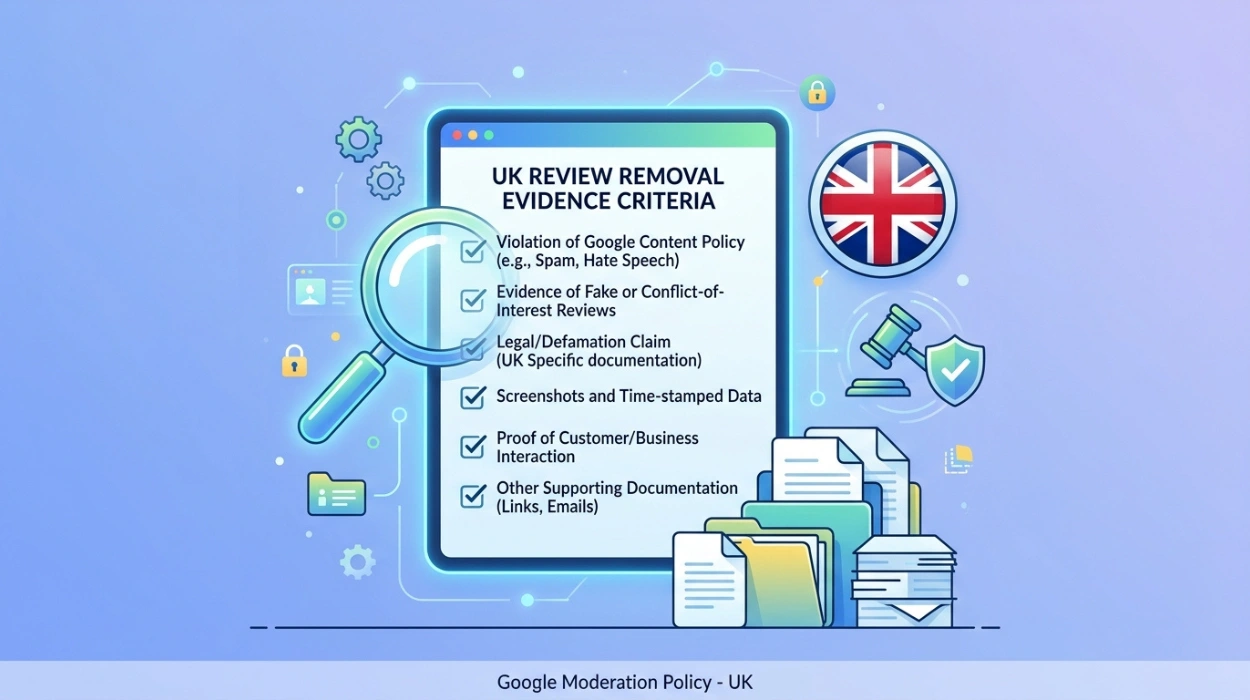
Google evaluates evidence that directly demonstrates a review violates its published content policies rather than evidence showing dissatisfaction with the review itself. Evidence refers to verifiable information that supports a specific policy breach within Google’s review moderation framework. Search engines require objective documentation because reputation signals depend upon authentic and reliable user-generated content.
Evidence commonly includes screenshots, timestamps, account activity, supporting documentation, publicly available inconsistencies, and references demonstrating conflicts with Google’s review policies. Google’s moderation systems compare this information with behavioural signals, review history, and contextual data before determining whether policy violations exist. This structured evaluation protects entity credibility while maintaining balanced search visibility.
The evidence-based approach differs from opinion-based requests because moderation decisions rely upon documented policy breaches rather than subjective disagreement. Google’s systems therefore prioritise factual verification over reputation preferences, strengthening digital trust across search ecosystems.
How does policy-based evidence compare with opinion-based requests?
Policy-based evidence differs from opinion-based requests because moderation decisions depend upon documented violations instead of personal disagreement. Policy-based evidence operates by demonstrating how review content conflicts with Google’s published standards. Opinion-based requests focus primarily on dissatisfaction without establishing measurable policy breaches.
Policy evidence provides clear evaluation criteria that Google’s moderation systems can verify objectively. Examples include evidence of impersonation, spam behaviour, conflicts of interest, prohibited content, or misleading information supported by documentation. These factors contribute directly to moderation analysis because they relate to Google’s enforcement framework rather than individual business outcomes.
Opinion-based requests provide limited moderation value because authentic reviews remain protected regardless of whether they contain favourable or unfavourable experiences. Search engines preserve genuine user feedback to maintain accurate reputation signals and balanced sentiment distribution. This comparison demonstrates that evidence aligned with moderation policies produces stronger evaluation outcomes than unsupported disagreement.
Which types of evidence provide stronger moderation support?
Different evidence types provide different levels of moderation support because Google’s review evaluation systems prioritise objective verification. Strong evidence establishes a direct relationship between review content and a specific policy violation, allowing moderators to compare documented facts against published standards.
Documentary evidence consists of records that demonstrate factual inconsistencies or policy breaches through verifiable documentation. Examples include transaction records, correspondence, screenshots, legal documents, or identity verification where relevant to the reported issue. This evidence operates by establishing factual accuracy that moderators can independently evaluate.
Behavioral evidence focuses on patterns associated with review activity rather than the review text alone. Moderation systems analyse repeated posting behaviour, coordinated activity, account history, duplicated content, and unusual engagement patterns that indicate potential manipulation. Google’s automated systems compare these signals against established moderation models before escalating reviews for further assessment.
The comparison demonstrates complementary strengths. Documentary evidence provides direct factual verification, while behavioural evidence strengthens contextual analysis by identifying suspicious activity across broader review ecosystems. Together they improve the accuracy of policy evaluation without altering authentic user feedback.
Contextual evidence refers to information that explains the relationship between the reviewer, the reviewed entity, and the surrounding circumstances. Google’s moderation systems evaluate context to determine whether the review aligns with authentic customer experiences or reflects prohibited activity. Context improves moderation accuracy because isolated content rarely provides complete evaluative information.
Search engines compare contextual evidence with account behaviour, review timing, geographical indicators, and interaction history to identify inconsistencies. This broader assessment strengthens entity credibility by ensuring moderation decisions reflect the complete evidence available rather than isolated statements. Context therefore complements documentary and behavioural evidence during Google’s evaluation process.
How do reactive and proactive reputation management approaches compare?

Reactive and proactive reputation management approaches differ according to when evidence is prepared and how reputation signals are managed. Reactive methods respond after problematic reviews appear, while proactive approaches strengthen review ecosystems before disputes arise. Both influence online reputation, although they operate through different mechanisms within search ecosystems.
Reactive reputation management analyses reported reviews, gathers supporting documentation, and evaluates policy compliance after reputation concerns become visible. This approach focuses on identifying policy breaches and presenting structured evidence for moderation review. Its effectiveness depends upon the quality of documented information and Google’s evaluation timeline.
Proactive reputation management develops consistent reputation signals through transparent business information, authentic customer engagement, accurate digital assets, and reliable review practices. Search engines interpret these signals as indicators of entity credibility, improving long-term search ranking influence and reducing future moderation complexity. The comparison demonstrates that proactive methods strengthen sustainability, whereas reactive approaches resolve existing review-related concerns.
Which reputation management method delivers the most sustainable review outcomes?
The most sustainable reputation management method combines evidence-based review evaluation with long-term reputation signal management. Sustainable reputation management is the continuous process of maintaining accurate digital information while ensuring that review-related concerns are assessed through documented policy standards. Search ecosystems evaluate long-term consistency more effectively than isolated moderation requests because entity credibility develops through accumulated reputation signals.
Evidence-based review management operates by aligning documentation, policy compliance, and search ecosystem analysis. This approach strengthens digital trust because moderation requests rely upon verifiable information instead of subjective opinion. Search engines compare policy evidence with behavioural signals, account history, and content authenticity before determining whether a review continues contributing value within SERPs.
Long-term sustainability also depends upon maintaining consistent review quality across digital platforms. Accurate business information, transparent customer interactions, and authentic review activity strengthen reputation signals over time. This comparison demonstrates that structured evidence management supports stable search visibility more effectively than repeated reactive interventions.
How does Google balance review authenticity with policy enforcement?
Google balances review authenticity with policy enforcement by evaluating whether user-generated content reflects genuine experiences while complying with published moderation standards. Authenticity is the verification that review content originates from legitimate user interactions, whereas policy enforcement determines whether that content breaches Google’s review rules. Both elements operate together to preserve reliable search ecosystems.
Moderation systems analyse review text, behavioural patterns, account credibility, submission history, and contextual evidence before applying enforcement decisions. Reviews expressing genuine customer experiences remain visible when they comply with content policies, regardless of whether they contain positive or negative sentiment. Reviews containing prohibited content, manipulation, impersonation, or misleading information undergo further evaluation against documented evidence.
This balanced approach protects both search quality and entity credibility. Search engines maintain trustworthy review ecosystems by removing policy-violating content while preserving authentic feedback that contributes meaningful reputation signals. The process therefore strengthens digital trust through objective policy application rather than subjective content preference.
Which factors determine the effectiveness of review evidence?
The effectiveness of review evidence is determined by relevance, accuracy, verifiability, and consistency with Google’s published moderation policies. Effective evidence establishes a measurable connection between reported content and a specific policy violation, enabling moderators to evaluate documented facts objectively. Search ecosystems interpret strong evidence as reliable support for moderation decisions because it reduces uncertainty during policy evaluation.
A structured evaluation framework includes:
- Collect documentary evidence that directly supports the reported policy violation through screenshots, records, or verified documentation.
- Demonstrate behavioural inconsistencies by identifying unusual review activity, repeated posting patterns, or coordinated engagement signals.
- Align supporting information with Google’s published review policies so moderation focuses on documented rule breaches rather than personal disagreement.
- Verify factual consistency across submitted materials to strengthen credibility during moderation assessment.
Each stage improves moderation quality because Google’s systems compare multiple forms of evidence before reaching a decision. Consistent documentation reduces ambiguity while strengthening search perception through accurate policy enforcement.
How do short-term and long-term review management approaches compare?
Short-term and long-term review management approaches differ according to their objectives, scalability, and influence on reputation signals. Short-term methods focus on resolving individual moderation issues through targeted evidence submission, whereas long-term approaches strengthen overall online credibility by maintaining accurate reputation signals across search ecosystems. Both contribute to reputation management, although they address different stages of the evaluation process.
Short-term review management produces immediate moderation requests supported by documented policy evidence. Its effectiveness depends upon Google’s assessment of submitted information and the relevance of the reported policy violation. This approach resolves specific review concerns but does not independently strengthen broader entity credibility.
Long-term review management operates by maintaining authentic customer engagement, accurate business information, consistent digital assets, and reliable review practices. Search engines evaluate these cumulative signals when interpreting entity credibility and search ranking influence. This comparison demonstrates that long-term strategies improve sustainability because they reinforce the quality of the wider reputation ecosystem instead of addressing isolated moderation cases.
Google evaluates review removal requests through documented evidence that demonstrates clear breaches of published content policies rather than personal disagreement with customer opinions. Policy-based evidence, documentary verification, behavioural analysis, and contextual information each contribute to moderation decisions because search engines prioritise authentic reputation signals when maintaining search quality. Understanding these evaluation mechanisms provides a clearer framework for comparing review management approaches within search ecosystems.
Comparing reactive and proactive reputation management methods also demonstrates that sustainable outcomes depend upon consistent reputation signals supported by verifiable evidence. Search visibility, entity credibility, sentiment distribution, and SERP composition all benefit from structured moderation processes that preserve authentic reviews while removing policy-violating content where justified. This analytical perspective explains why evidence quality remains central to Google’s review moderation framework.
A deeper examination of Get Your Google Review Removed Legally With UK Expert Assistance Today naturally extends this evaluation by focusing on the implementation stage after sufficient evidence has been established and assessed.
What evidence does Google need before it will remove a review in the UK?
Google requires evidence showing that a review breaches its published content policies, such as spam, fake engagement, impersonation, conflicts of interest, or prohibited content. Documentation that directly supports a policy violation carries greater weight than personal disagreement with a review.
Will Google remove a negative review if it is unfair?
Google does not remove reviews simply because they are negative or critical. A review is considered for removal only if the submitted evidence demonstrates that it violates Google’s review content policies.
What types of evidence strengthen a Google review removal request?
Strong evidence includes screenshots, transaction records, identity verification, communication records, timestamps, and documentation that proves a review breaches Google’s policies. Behavioural evidence, such as suspicious review patterns, can also support the evaluation process.
How long does Google take to review evidence for a review removal request?
The review timeframe varies because Google assesses each request according to its moderation process and the complexity of the evidence provided. Reviews remain visible until Google’s evaluation confirms that a policy violation has occurred.
Can Google Review Removal Services help identify policy violations?
Google Review Removal Services assess review content against Google’s published policies to determine whether sufficient evidence exists for a removal request. Clear Your Name supports this process