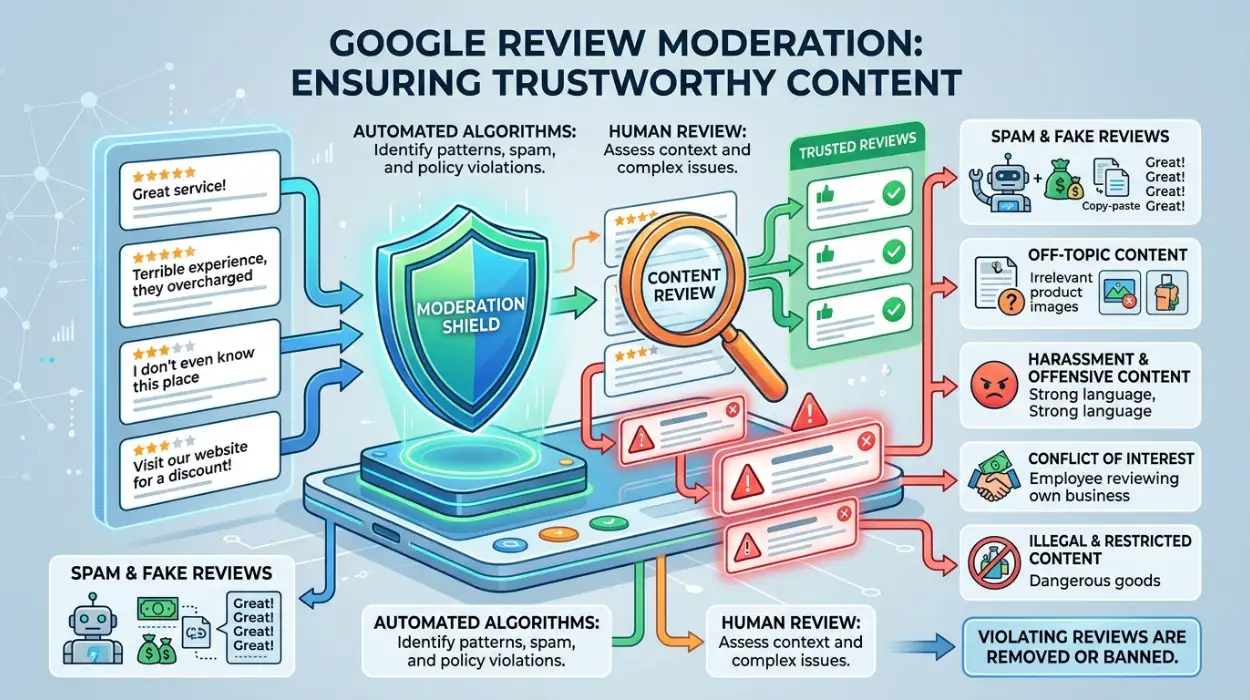
Google Reviews are moderated through automated systems and human evaluation that assess content against Google Reviews content policies before determining whether reviews remain visible or are removed. Reputation management is the process of understanding how user-generated content, reputation signals, and search engine evaluation influence online credibility and search visibility across digital ecosystems.
Online reputation refers to the collection of indexed information, reviews, ratings, and trust signals that search engines evaluate when presenting entities within search engine results pages (SERPs). Google Reviews contribute directly to entity perception because they provide publicly accessible user-generated content that algorithms analyse alongside business information, authority indicators, and content quality. Review moderation exists to protect the reliability of this ecosystem by filtering content that violates Google’s published policies while preserving authentic user experiences. Understanding how moderation works explains why some reviews remain visible while others are removed after policy evaluation. This process also demonstrates how review content influences digital trust, search perception, and long-term reputation signals.
How does Google moderate reviews within its search ecosystem?
Google moderates reviews through a combination of automated detection systems and manual policy evaluation that analyse whether submitted content complies with established review guidelines. Review moderation refers to the process of identifying, evaluating, and enforcing content standards designed to maintain trustworthy user-generated information. This system protects search quality by reducing the visibility of misleading, abusive, or policy-violating content before it affects search perception.
Google’s automated systems analyse review text, behavioural patterns, account activity, and submission characteristics to identify signals associated with policy violations. These systems compare newly submitted reviews against existing moderation models that detect spam, manipulated engagement, prohibited language, and suspicious activity. Reviews identified for additional assessment enter further evaluation before visibility decisions are finalised. This layered process strengthens search visibility by maintaining higher confidence in publicly displayed review information.
Manual moderation complements automated analysis where additional contextual assessment is required. Human reviewers evaluate reports against Google’s published content policies rather than subjective opinion. This structured review process ensures that moderation decisions remain consistent with defined policy standards while supporting reliable entity perception across search results.
What types of review content violate Google’s content policies?
Review content violates Google’s content policies when it conflicts with the platform’s standards for authenticity, legality, relevance, and user safety. Content policy violations refer to information that reduces the reliability of review ecosystems or interferes with accurate public evaluation. Google’s moderation systems analyse these violations because policy compliance directly affects online credibility and search trust.
Which forms of misleading content are prohibited?
Misleading content includes reviews that intentionally present false information, impersonate individuals, manipulate public perception, or misrepresent genuine customer experiences. Google evaluates authenticity by analysing behavioural signals alongside the textual content of each review. Artificial review patterns, coordinated posting behaviour, and deceptive engagement reduce confidence in review integrity because they distort genuine reputation signals.
Search engines depend upon authentic review information when evaluating entity perception. Misleading reviews weaken trust signals by introducing inaccurate information into publicly accessible review ecosystems. Google’s moderation process therefore prioritises identifying behaviour that interferes with accurate reputation assessment rather than evaluating business performance itself.
Why are spam reviews removed?
Spam reviews are removed because they interfere with the accuracy and usefulness of review systems. Spam refers to repetitive, promotional, irrelevant, or artificially generated content that provides little informational value for users. Google’s algorithms detect spam by analysing submission frequency, account behaviour, duplicated language, and abnormal interaction patterns.
Spam detection strengthens content indexing quality because review information contributes to Google’s broader understanding of entities and local search relevance. Removing spam improves search visibility by ensuring that reputation signals reflect authentic user experiences rather than manipulated activity. This moderation process supports higher confidence in the reliability of review-based information presented within SERPs.
How do review signals influence online reputation?

Review signals influence online reputation because search engines interpret user feedback as one component of broader entity evaluation. Review signals refer to measurable indicators generated through ratings, written reviews, reviewer activity, and engagement patterns. These signals contribute to Google’s understanding of credibility, trust, and relevance within search ecosystems.
Search visibility reflects accumulated evidence rather than isolated reviews. Google’s algorithms analyse review quality alongside business information, website authority, structured data, and topical relevance before determining how entities appear in search results. Review content therefore contributes to entity perception by providing publicly accessible indicators of user interaction rather than acting as independent ranking factors.
Sentiment interpretation also plays a role in reputation analysis. Search systems evaluate linguistic patterns, contextual relevance, and authenticity rather than relying exclusively on numerical ratings. This broader assessment enables search engines to understand how review ecosystems contribute to digital trust while reducing the influence of manipulated engagement.
Why does Google evaluate authenticity instead of opinion?
Google evaluates authenticity instead of opinion because review moderation focuses on policy compliance rather than determining whether positive or negative experiences are correct. Authenticity refers to whether content reflects genuine user experiences that comply with published review standards. Search ecosystems prioritise authentic information because reliable reputation signals improve the overall quality of indexed content.
Opinion remains protected when it originates from genuine experiences and complies with moderation policies. Google’s systems therefore distinguish between legitimate criticism and prohibited behaviour by analysing evidence of authenticity rather than emotional tone. This distinction supports balanced search visibility while preserving meaningful public information.
Authenticity evaluation also strengthens entity credibility by ensuring that reviews contribute reliable evidence within broader search ecosystems. Genuine user-generated content improves trust signals because search engines interpret authentic interactions as valuable informational resources. Policy enforcement therefore protects review integrity rather than controlling public opinion.
How does review moderation affect search visibility?
Review moderation affects search visibility by influencing the quality of reputation signals available for search engine evaluation. Moderated review ecosystems provide more reliable information, enabling search algorithms to interpret entity credibility with greater confidence. Content that complies with moderation standards contributes positively to overall information quality within Google’s search environment.
Search visibility depends upon consistent evaluation across multiple reputation indicators. Review content operates alongside website quality, structured data, backlinks, business information, and topical relevance to define how entities appear within SERPs. When moderation removes policy-violating reviews, Google’s systems improve the reliability of available reputation signals without altering legitimate public feedback.
This relationship demonstrates that moderation supports search quality through content integrity rather than direct ranking manipulation. Reliable review ecosystems contribute to stronger entity perception because search engines evaluate trustworthy information more effectively than inconsistent or manipulated content.
How do trust signals support Google’s review moderation systems?
Trust signals support Google’s review moderation systems by providing measurable indicators that help search algorithms evaluate the reliability of user-generated content. Trust signals refer to the collection of behavioural, technical, and contextual factors that define the credibility of reviews within search ecosystems. These signals include reviewer consistency, account history, engagement patterns, content relevance, and relationships between reviews and verified entities. Google’s moderation systems analyse these indicators collectively rather than relying on a single characteristic when determining whether review content complies with published policies.
Review moderation also contributes to entity perception because authentic reviews strengthen the overall quality of publicly available information. Search engines compare review signals with broader reputation indicators such as business information, website authority, structured data, and content indexing. This comparison improves Google’s ability to distinguish genuine user contributions from manipulated review activity. As a result, trust signals reinforce the integrity of search visibility while supporting accurate online credibility across digital ecosystems.
The relationship between trust signals and moderation demonstrates that Google’s review policies operate as part of a wider search quality framework. Every moderation decision contributes to maintaining reliable search results by ensuring that indexed review content reflects authentic experiences rather than artificial influence.
How does review moderation influence content indexing and SERP evaluation?
Review moderation influences content indexing and SERP evaluation because user-generated content forms part of Google’s broader understanding of entities and their online reputation. Content indexing refers to the process of collecting, analysing, and storing information before presenting it within search engine results pages. Moderated reviews contribute reliable information that search systems can evaluate alongside other indexed resources when interpreting entity credibility.
SERP evaluation analyses how indexed information satisfies search intent while maintaining content quality. Review content provides contextual evidence about entities, allowing search engines to strengthen confidence in the relevance and authenticity of displayed information. Reviews that violate Google’s content policies reduce information quality and therefore undergo moderation before contributing to search evaluation.
Google’s indexing systems also compare review content with related reputation signals to identify inconsistencies across digital information. This comparison improves semantic understanding because search engines interpret reviews as one component of an interconnected knowledge network rather than isolated text. Moderation therefore strengthens search quality by improving the reliability of indexed information available for SERP evaluation.
Why do some reviews remain visible after being reported?
Some reviews remain visible after being reported because reporting initiates policy evaluation rather than automatic removal. Google analyses every reported review against its published content policies before determining whether the content violates moderation standards. The reporting process therefore functions as a request for review instead of evidence that a policy breach has occurred.
Evaluation focuses on authenticity, relevance, prohibited content, and behavioural signals rather than disagreement with the review itself. Reviews that represent genuine experiences and comply with Google’s moderation policies continue appearing within search results regardless of whether they express positive or negative opinions. This distinction protects the integrity of public feedback while maintaining balanced review ecosystems.
Moderation also requires consistency across enforcement decisions. Google’s systems compare reported content with established policy definitions to ensure similar cases receive similar outcomes. This structured approach improves online credibility because moderation decisions remain based on documented standards instead of subjective interpretation.
How does Google’s review policy contribute to digital trust?
Google’s review policy contributes to digital trust by establishing consistent standards for authentic user-generated content within search ecosystems. Digital trust refers to the confidence users place in publicly available online information when making decisions based on search results. Review moderation strengthens this confidence by reducing misleading, abusive, or manipulated content that weakens reputation signals.
Policy enforcement supports entity credibility because authentic reviews provide reliable evidence of user interaction. Search engines interpret these interactions alongside authority signals, structured data, and content relevance to develop a broader understanding of online reputation. Moderation therefore improves search perception by protecting the quality of indexed information rather than influencing individual opinions.
Digital trust also depends upon transparent moderation principles. Google’s published policies define acceptable review behaviour, enabling consistent enforcement across diverse entities and industries. This policy-driven approach strengthens search ecosystems because reliable review information contributes to more accurate SERP evaluation and improved information quality.
Google moderates reviews through structured systems that combine automated analysis with manual policy evaluation to protect the quality and reliability of user-generated content. Review moderation strengthens search visibility by ensuring that indexed reputation signals reflect authentic experiences rather than misleading, manipulative, or policy-violating information. This process contributes to entity perception, online credibility, and digital trust across search ecosystems.
Understanding how moderation operates provides greater insight into the relationship between review content, content indexing, SERP evaluation, and reputation signals. Google’s algorithms analyse authenticity, behavioural patterns, trust indicators, and policy compliance before determining whether review content remains visible within search results. These interconnected systems demonstrate that online reputation develops through continuous evaluation of reliable information rather than isolated pieces of content.
A deeper understanding of What Evidence Google Needs Before It Will Remove a Review in the UK expands this analysis by examining the documentation and policy criteria that support Google’s review evaluation process.
How does Google moderate reviews before they appear in search results?
Google moderates reviews using automated detection systems and manual policy reviews to identify content that violates its review guidelines. The process evaluates authenticity, spam patterns, prohibited content, and user behaviour before review content influences search visibility and online reputation.
What types of Google Reviews violate Google’s content policies?
Reviews that contain spam, fake engagement, impersonation, misleading information, conflicts of interest, illegal content, or abusive language can violate Google’s content policies. These reviews are assessed against Google’s moderation standards before any action is taken.
Why are some reported Google Reviews not removed?
Reporting a review does not guarantee its removal because Google evaluates the content against its published review policies. Reviews that reflect genuine customer experiences and do not breach the guidelines generally remain visible, even if they receive complaints.
Do Google Reviews affect search visibility and online reputation?
Yes. Google Reviews contribute to reputation signals, entity credibility, and user trust, all of which influence search perception and local search visibility. Authentic reviews help search engines evaluate the reliability of business information.
Can Google Review Removal Services help with policy-violating reviews?
Google Review Removal Services focus on identifying reviews that potentially breach Google’s content policies and supporting the review removal process where appropriate. Clear Your Name provides structured guidance by assessing policy compliance and the available evidence before submitting removal requests.